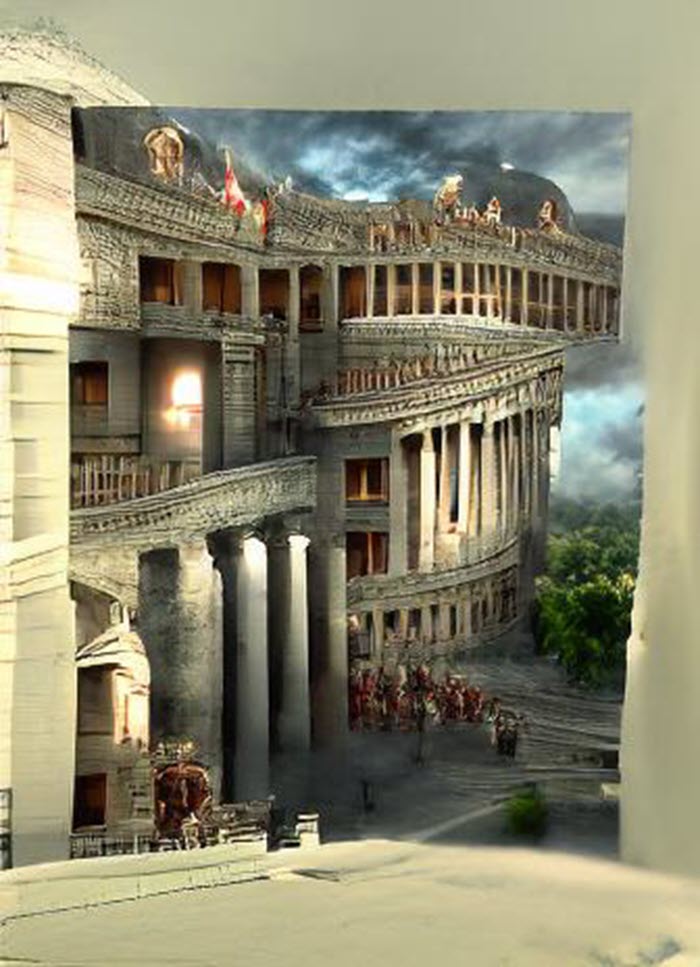
Wonders of the Roman Empire
Wonders of the Roman Empire
[Sidenote: Early inhabitants of Italy.]
The great capital of the ancient world had a very humble beginning, and that is involved in myth and mystery. Even the Latin stock, inhabiting the country from the Tiber to the Volscian mountains, which furnished the first inhabitants of the city, cannot be clearly traced, since we have no traditions of the first migration of the human race into Italy. It is supposed by Mommsen that the peoples which inhabited Latium belong to the Indo-Germanic family. Among these were probably the independent cantons of the Ramnians, Tities, and Luceres, which united to form a single commonwealth, and occupied the hills which arose about fourteen miles from the mouth of the Tiber. Around these hills was a rural population which tilled the fields. From these settlements a fortified fort arose on the Palatine Hill, fitted to be a place of trade from its situation on the Tiber, and also a fortress to protect the urban villages. Though unhealthy in its site, it was admirably adapted for these purposes, and thus early became an important place.
[Sidenote: Foundation of Rome.]
[Sidenote: Settlement under Romulus.]
[Sidenote: Extent of the city at the death of Romulus.]
The legends attribute a different foundation of the "Eternal City." But these also assign the Palatine as the nucleus of ancient Rome. It was on this hill that Romulus and Remus grew up to manhood, and it was this hill which Romulus selected as the site of the city he was so desirous to build. But modern critics suppose that he did not occupy the whole hill, but only the western part of it. Varro, whose authority is generally received, assigns the year 753 before Christ as the date for the foundation of the city. The first memorable incident in the history of this little city of robbers was the care of Romulus to increase its population by opening an asylum for fugitive slaves on the Capitoline Hill. But this supplied only males who had no wives. And when the proposal of the founder to solicit intermarriage with the neighboring nations was rejected, he resorted to stratagem and force. He invites the Sabines and the people of other Latin towns to witness games. A crowd of men and women are assembled, and while all are intent on the games, the unmarried women are seized by the Roman youth. Then ensues, of course, a war with the Sabines, the result of which is that the Sabines are united with the Romans and settle on the Quirinal. The Saturnian Hill is left in possession of the Sabines, while Romulus assumes the Sabine name of Quirinus, from which we infer that the Sabines had the best of the conflict. Callius, who, it is said, assisted Romulus, receives as a compensation the hill known as the Caelian. At the death of Romulus, who reigned thirty-seven years, Rome comprised the Palatine, the Quirinal, the Caelian, and the Capitoline hills. [Footnote: M. Ampere, Hist. Rom., tom. i. ch. xii.] The Sabines thus occupy two of the seven hills, and furnish not only people for the infant city, but laws, customs, and manners, especially religious observances.
[Sidenote: The public works of Numa.]
The reign of Numa was devoted to the consolidation of the power which Romulus had acquired, to the civilization of his subjects, and the improvement of the city. He fixed his residence between the Roman and the Sabine city, and erected adjoining to the Regia a temple to Vesta, which was probably only an oedes sacra. It was probably along with these buildings that the Sacra Via came into existence. The Regia became in after times the residence of the Pontifex Maximus. Numa established on the Palatine the Curia Saliorum, and built on the Quirinal a temple of Romulus, afterwards rebuilt by Augustus. He also erected on the Quirinal a citadel connected with a temple of Jupiter, with cells of Juno and Minerva. He converted the gate which formed the entrance of the Sabine city into a temple of Janus, and laid the foundation upon the Capitoline of a large temple to Fides Publica, the public faith.
[Sidenote: The reign of Tullus Hostilius.]
[Sidenote: Improvement of the city made by Tullus.]
Under the reign of Tullus Hostilius was the capture of Alba Longa, the old capital of Latium, where Numa had reigned, and the transfer of its inhabitants to Rome, which thus became the chief city of the Latin league. They were located on the Caelian, which also became the residence of the king. He built the Curia Hostilia, a senate chamber, to accommodate the noble Alban families, in which the Roman Senate assembled, at the northwest corner of the Forum, to the latest times of the republic. It was a templum, but not dedicated for divine services, adjoining the eastern side of the Vulcanal. Out of the spoils of Alba Longa, Tullus improved the Comitium, a space at the northwest end of the Forum, fronting the Curia, the common meeting place of the Romans and Sabines. On the Quirinal Hill he erected a Curia Saliorum in imitation of that of Numa on the Palatine, devoted to the worship of Quirinus.
[Sidenote: Growth of Rome during the reign of Ancus Martius.]
Ancus Martius, a grandson of Numa, succeeded Tullus after a reign of thirty-two years. Under him the city was greatly augmented by the inhabitants of various Latin cities which he subdued. These settled on the Aventine, and in the valley which separated it from the Palatine, supposed by Niebuhr to be the origin of the Roman Plebs, though it is maintained by Lewis that the Plebeian order was coaeval with the foundation of the city. Ancus fortified Mons Janiculus, the hill on the western bank of the Tiber, for the protection of the city. He connected it with Rome by the Pons Sublicius, the earliest of the Roman bridges, built on piles. The Janiculum was not much occupied by residences until the time of Augustus. Ancus founded Ostia, at the mouth of the Tiber, which became the port of Rome. It was this king who built the famous Mamertine Prison, near the Forum, below the northern height of the Capitoline.
[Sidenote: Tarquinius Priscus.]
[Sidenote: The Cloaca Maxima.]
[Sidenote: Temple of the Capitoline Jupiter.]
A new dynasty succeeded this king, who reigned twenty-four years; that of the Tarquins, an Etrurian family of Greek extraction, which came from Corinth, the cradle of Grecian art, celebrated as the birth-place of painting and for its works of pottery and bronze. Tarquinius Priscus constructed the Cloaca Maxima, that vast sewer which drained the Forum and Velabrum, and which is regarded by Niebuhr as one of the most stupendous monuments of antiquity. It was composed of three semicircular arches inclosing one another, the innermost of which had a diameter of twelve feet, large enough to be traversed by a Roman hay-cart. [Footnote: Arnold, Hist. of Rom., vol. i. p. 52.] It was built without cement, and still remains a magnificent specimen of the perfection of the old Tuscan masonry. Along the southern side of the Forum this enlightened monarch constructed a row of shops occupied by butchers and other tradesmen. At the head of the Forum and under the Capitoline he founded the Temple of Saturn, the ruins of which attest considerable splendor. But his greatest work was the foundation of the Capitoline Temple of Jupiter, completed by Tarquinius Superbus, the consecrated citadel in which was deposited whatever was most valued by the Romans.
[Sidenote: Accession of Servius Tullius.]
During the reign of Servius Tullius, who succeeded Tarquin B.C. 578, the various elements of the population were amalgamated, and the seven hills, namely, the Palatine, the Capitoline, the Quirinal, the Caelian, the Viminal, the Esquiline, and the Aventine, were covered with houses, and inclosed by a wall about six miles in circuit. A temple of Diana was erected on the Aventine, besides two temples to Fortune, one to Juno, and one to Luna. Servius also dedicated the Campus Martius, and enlarged the Mamertine Prison by adding a subterranean dungeon of impenetrable strength.
[Sidenote: Tarquinius Superbus.]
On the assassination of Servius Tullius, B.C. 535, his son-in-law, Tarquinius Superbus, usurped the power, and did much for the adornment of the city. The Capitoline Temple was completed on an artificial platform, having a triple row of columns in front, and a double row at the sides. It was two hundred feet wide, having three cells adjoining one another, the centre appropriated to Jupiter, with Juno and Minerva on either hand. The temple had a single roof, and lasted nearly five hundred years before it was burned down, and rebuilt with greater splendor.
[Sidenote: Rome under the early consuls.]
[Sidenote: Roman roads.]
Such were the chief improvements of the city during the kingly rule. Under the consuls the growth was constant, but was not marked by grand edifices. Portunus, the conqueror of the Tarquins at Lake Regillus, erected a temple to Ceres, Liber, and Libera, at the western extremity of the Circus Maximus. Camillus founded a celebrated temple to Juno on the Aventine. But these, and a few other temples, were destroyed when the Gauls held possession of the city. The city was rebuilt hastily and without much regard to regularity. There was nothing memorable in its architectural monuments till the time of Appius Claudius, who constructed the Via Appia, the first Roman aqueduct. In fact the constant wars of the Romans prevented much improvement in the city till the fall of Tarentum, although the ambassadors of Pyrrhus were struck with its grandeur. M. Curius Dentatus commenced the aqueduct called Anio Vetus B.C. 278, the greater part of which was under ground. Its total length was forty-three miles. Q. Flaminius, B.C. 220, between the first and second Punic wars, constructed the great highway, called after him the Via Flaminia--the great northern road of Italy, as the Via Appia was the southern. These roads were very elaborately built. In constructing them, the earth was excavated till a solid foundation was obtained; over this a layer of loose stones was laid, then another layer nine inches thick of rubble-work of broken stones cemented with lime, then another layer of broken pottery cemented in like manner, over which was a pavement of large polygonal blocks of hard stone nicely fitted together. Roads thus constructed were exceedingly durable, so that portions of them, constructed two thousand years ago, are still in a high state of preservation.
[Sidenote: Ancient basilicas.]
[Sidenote: Temple of Hercules.]
[Sidenote: Asiatic luxuries.] The improvements of Rome were rapid after the conquest of Greece, although destructive fires frequently laid large parts of the city in ruins. The deities of the conquered nations were introduced into the Roman worship, and temples erected to them. In the beginning of the second century before Christ we notice the erection of basilicas, used as courts of law and a sort of exchange, the first of which was built by M. Portius Cato, B.C. 184, on the north side of the Forum. It was of an oblong form, open to the air, surrounded with columns, at one end of which was the tribunal of the judge. The Basilica Portia was soon followed by the Basilica Fulvia behind the Argentariae Novae, which had replaced the butchers' shops. Fulvius Nobilia further adorned the city with a temple of Hercules on the Campus Martius, and brought from Ambrasia, once the residence of Pyrrhus, two hundred and thirty marble and two hundred and eighty-five bronze statues, beside pictures. L. Aemilius Paulus founded an emporium on the banks of the Tiber as a place of landing and sale for goods transported by sea, and built a bridge over the Tiber. Sempronius Gracchus, the father of the two demagogue patriots, erected a third Basilica B.C. 169, on the south side of the Forum on the site of the house of Scipio Africanus. The triumph of Aemilius Paulus introduced into the city pictures and statues enough to load two hundred and fifty chariots, and a vast quantity of gold and silver. Cornelius Octavius, B.C. 167, built a grand palace on the Palatine, one of the first examples of elegant domestic architecture, and erected a magnificent double portico with capitals of Corinthian bronze. With the growing taste for architectural display, various Asiatic luxuries were introduced--bronze beds, massive sideboards, tables of costly woods, cooks, pantomimists, female dancers, and luxurious banquets. Metellus erected the first marble temple seen in Rome, before which he placed the twenty-five bronze statues which Lysippus had executed for Alexander the Great.
[Sidenote: Sack of Corinth.]
[Sidenote: Adornment of the Forum.]
The same year that witnessed the triumph of Metellus, B.C. 146, also saw the fall of Carthage and the sack of Corinth by Mummius, so that many of the choicest specimens of Grecian art were brought to the banks of the Tiber. Among these was the celebrated picture of Bacchus by Aristides, which was placed in the Temple of Bacchus, Ceres, and Proserpine. The Forum now contained many gems of Grecian art, among which were the statues of Alcibiades and Pythagoras which stood near the comitium, the Three Sibyls placed before the rostra, and a picture by Serapion, which covered the balconies of the tabernae on the south side of the Forum.
[Sidenote: Aqua Marcia.]
In the year 144 B.C., Q. Marcius Rex constructed the Aqua Marcia, one of the noblest of the Roman monuments, sixty-two miles in length, seven of which were on arches, sufficiently lofty to supply the Capitoline with pure and cold water. Seventeen years after, the Aqua Tepula was added to the aqueducts of Rome.
[Sidenote: Triumphal Arches.]
The first triumphal arch erected to commemorate victories was in the year B.C. 196, by L. Sertinius. Scipio Africanus erected another on the Capitoline, and Q. Fabius, B.C. 121, raised another in honor of his victories over the Allobroges. This spanned the Via Sacra where it entered the Forum, and at that time was a conspicuous monument, though vastly inferior to the arches of the imperial regime.
[Sidenote: Temple of Concord.]
[Sidenote: Basilica Opimia.]
When tranquillity was restored to Rome after the riots connected with the murder of the Gracchi, the Senate ordered a Temple of Concord to be built, B.C. 121, in commemoration of the event. This temple was on the elevated part of the Vulcanal, and was of considerable magnitude. It was used for the occasional meetings of the Senate, and contained many valuable works of art. Adjoining this temple, Opimius, the consul, erected the Basilica Opimia, which was used by the silversmiths, who were the bankers and pawnbrokers of Rome. The whole quarter on the north side of the Forum, where this basilica stood, was the Roman exchange-- the focus for all monetary transactions.
[Sidenote: Private palaces.]
[Sidenote: Houses of the nobles.]
The increasing wealth and luxury of Rome, especially caused by the conquest of Asia, led to the erection on the Palatine of those magnificent private residences, which became one of the most striking features the capital. The first of these historical houses was built by
[Sidenote: Destruction and rebuilding of the Capitol.]
The year 83 B.C. was marked by the destruction by fire of the old Capitoline Temple, which had withstood the ravages of the Gauls. Sulla aspired to rebuild it, and caused to be transported to Rome for that purpose the column of the Olympian Zeus at Athens. It was completed by Caesar, and its roof was gilded at an expense of $15,000,000. The pediment was adorned with statuary, and near it was a colossal statue of Jupiter.
[Sidenote: Theatre of Pompey.]
In the early ages of the republic there were no theatres at Rome, theatrical representations being regarded as demoralizing. The regular drama was the last development even of Grecian genius. The Roman aristocracy set their faces against dramatic entertainments till after the conquest of Greece. These plays were introduced and performed on temporary stages in the open air, or in wooden buildings. There was no grand theatre till Pompey erected one of stone, B.C. 55, in the Campus Martius, which was capable of holding eighty thousand spectators, and it had between its numerous pillars three thousand bronze statues. [Footnote: Plin. H. N., xxxvi. 24.] He also erected, behind his theatre, a grand portico of one hundred pillars, which became one of the most fashionable lounging-places of Rome, and which was adorned with statues and images. Pompey also built various temples.
[Sidenote: Forum Julian.]
[Sidenote: Basilica Julia.]
His great rival however surpassed him in labors to ornament the capital. Caesar enlarged the Forum, or rather added a new one, the ground of which cost $2,500,000. It was called the Forum Julian, and was three hundred and forty feet long by two hundred wide, containing a temple of Venus. He did not live, however, to carry out his magnificent plans. He contemplated building an edifice, for the assembly of the Comitia Tributa, of marble, with a portico inclosing a space of a mile square, and also the erection of a temple to Mars of unparalleled size and magnificence. He commenced the Basilica Julia and the Curia Julia--vast buildings, which were completed under the emperors.
[Sidenote: Rome under the Emperors.]
Such were the principal edifices of Rome until the imperial sway. Augustus boasted that he found the city of brick and left it of marble. It was not until the emperors embellished the city with amphitheatres, theatres, baths, and vast architectural monuments that it was really worthy to be regarded as the metropolis of the world. The great improvements of Rome in the republican period were of a private nature, such as the palaces of senatorial families. There were no temples equal to those in the Grecian cities either for size, ornament, or beauty. Indeed, Rome was never famous for temples, but for edifices of material utility rather than for the worship of the gods; yet the Romans, under the rule of the aristocracy, were more religious than the Corinthians or Athenians.
[Sidenote: Works of Augustus.]
[Sidenote: The Subura.]
[Sidenote: Forum Romanum.]
[Sidenote: Its magnificence.]
[Sidenote: Surrounding buildings.]
[Sidenote: Temple of Castor and Pollux.]
[Sidenote: Basilica Julia.]
[Sidenote: Arch of Septimius Severus, and columns of Trajan.]
[Sidenote: Forum Julium.]
[Sidenote: Forum Augusti.]
[Sidenote: Forum of Trajan.]
[Sidenote: Basilica Ulpia.]
On the destruction of the senatorial or constitutional party that had ruled since the expulsion of the kings, and probably before, and the peaceful accession of Augustus, B.C. 31, a great impulse was given to the embellishments of the city. His long reign, his severe taste, and his immense resources,--undisputed master of one hundred and fifty millions of subjects,--enabled him to carry out the designs of Julius, and to restore an immense number of monuments falling to decay. But Rome was even then deficient in those things which most attract attention in our modern capitals--the streets and squares. The longest street of Rome was scarcely three fourths of a mile in length; but the houses upon it were of great altitude. Moreover the streets were narrow and dark-- scarcely more than fifteen feet in width. But they were not encumbered with carriages. Private equipages, which form one of the most imposing features of a modern city, were unknown. There was nothing attractive in a Roman street, dark, narrow, and dirty, with but few vehicles, and with dingy shops, like those of Paris in the Middle Ages. The sun scarcely ever penetrated to them. They were damp and cold. The greater part of the city belonged to wealthy and selfish capitalists, like Crassus, who thought more of their gains than the health or beauty of the city. The Subura, the Sub Velia, and the Velabrum, built in the valleys, were choked up with tall houses, frequently more, and seldom less, than seventy feet in height. The hills alone were covered with aristocratic residences, temples, and public monuments. The only open space, where the poor people could get fresh air and extensive prospect, was Circus Maximus and the Forum Romanum. The former was three fourths of a mile in length and one eighth in breadth, surrounded with a double row of benches, the lower of stone and the upper of wood, and would seat two hundred and eighty-five thousand spectators. The Forum was the centre of architectural splendor, as well as of life and business. Its original site extended from the eastern part of the Capitoline to the spot where the Velia begins to ascend, and was bounded on the south by the Via Sacra, which extended to the arx or citadel. It was that consecrated street by which the augurs descended when they inaugurated the great festivals of the republic, and in which lived the Pontifex Maximus. Although the Forum Romanum was only seven hundred feet by four hundred and seventy, yet it was surrounded by and connected with basilicas, halls, porticoes, temples, and shops. It was a place of great public resort for all classes of people--a scene of life and splendor rarely if ever equaled, and having some resemblance to the crowded square of Venice on which St. Mark's stands. Originally it was a marketplace, busy and lively, a great resort where might be seen "good men walking quietly by themselves," [Footnote: Plautus Cuve, iv. 1. ] "flash men strutting about without a denarius in their purses," "gourmands clubbing for a dinner," "scandal-mongers living in glass houses," "perjured witnesses, liars, braggarts, rich and erring husbands, worn-out harlots," and all the various classes which now appear in the crowded places of London or Paris. In this open space the people were assembled on great public occasions, and here they were addressed by orators and tribunes. Immediately surrounding the Forum Romanum, or in close proximity to it, were the most important public buildings of the city in which business was transacted--the courts of law, the administrative bureaus, the senate chamber and the principal temples, as well as monuments and shops. On the north side was the Comitium, an open space for holding the Comitia Curiata and heavy lawsuits, and making speeches to the assembled people. During the kingly government the temples of Janus and Vesta and Saturn were erected, also the Curia Hostilia, a senate-house, the Senaculum, the Mamertine Prison, and the Tabernae or porticoes and shops inclosing the Forum. During the republic the temple of Castor and Pollux, which served for the assembly of the Senate and judicial business, was erected, not of the largest size, but very rich and beautiful. The Basilica Portia, where the tribunes of the people held their assemblies, was founded by Cato the Censor, and this was followed by the Basilica Fulvia, with columns of Phrygian marble, admired by Pliny for its magnificence, the Basilica Sempronia, the Temple of Concord, and the Triumphal Arch of Fabius, to commemorate his victories over the Allobroges. Under the empire, the magnificent Basilica Julia was erected for the sittings of the law courts, and its immense size may be inferred from the fact that one hundred and eighty judges, divided into four courts, with four separate tribunals, with seats for advocates and spectators, were accustomed to assemble. Tiberius erected a triumphal arch near the Temple of Saturn. Domitian built the Temple of Vespasian and Titus, and erected to himself a colossal equestrian statue. Near it rose the temples of Divus-Julius and of Antoninus and Faustina. Beside these were the Triumphal Arch of Septimius Severus, still standing; the Columns of Phocas and Trajan, the latter of which is the finest monument of its kind in the world, one hundred and twenty-seven feet high, with a spiral band of admirable reliefs containing two thousand five hundred human figures. Beside these, new fora of immense size were constructed by various emperors, not for political business so much as courts of justice. The Forum Julium, which connected with the old Forum Romanum, was virtually a temple of great magnificence. In front of it was the celebrated bronze horse of Lysippus, and the temple was enriched with precious offerings and adorned with pictures from the best Greek artists. It was devoted to legal business. The Forum Augusti was still larger, and also inclosed a temple, in which the Senate assembled to consult about wars and triumphs, and was surrounded with porticoes in which the statues of the most eminent Roman generals were placed, while on each side were the triumphal arches of Germanicus and Drusus. More extensive and magnificent than either of the old fora was the one which Trajan erected, in the centre of which was the celebrated column of the emperor, so universally admired, while the sides were ornamented with a double colonnade of gray Egyptian marble, the columns of which were fifty-five feet in height. This was one of the most gigantic structures in Rome, covering more ground than the Flavian Amphitheatre, and built by the celebrated Apollodorus of Damascus. It filled the whole space between the Capitoline and Quirinal. The Basilica Ulpia was only one division of this vast edifice, divided internally by four rows of columns of gray granite, and paved with slabs of marble.
[Sidenote: Beauty of the Roman Forum.]
Nothing in Rome, or perhaps any modern city, exceeded the glory and beauty of the Forum, with the adjoining basilica, and other public buildings, filled with statues and pictures, and crowded with people. The more aristocratic loungers sought the retired promenade afforded by the porticoes near the Circus Flaminius, where the noise and clamor of the crowded streets, the cries of venders, the sports of boys, and the curses of wagoners, could not reach them. The Forum was the peculiar glory of the republican period, where the Gracchi enlightened the people on their political rights, where Cato calmed the passions of the mob, where Cicero and Hortensius delivered their magnificent harangues.
[Sidenote: Works of Augustus.]
[Sidenote: Temple of Apollo.]
[Sidenote: Theatre of Marcellus.]
The glory of the Augustan age was more seen in the magnificent buildings which arose upon the hills, although he gave attention to the completion of many works of utility or beauty in other parts of the city. He restored the Capitoline temple and the theatre of Pompey; repaired aqueducts; finished the Forum and Basilica Julia; and entirely built the Curia Julia. He founded, on the Palatine, the Imperial Palace, afterwards enlarged by his successors until it entirely covered the original city of Romulus. Among the most beautiful of his works was the Temple of Apollo, the columns of which were of African marble, between which were the statues of the fifty Danaids. In the temple was a magnificent statue of Apollo, and around the altar were the images of four oxen--the work of Miron, so beautifully sculptured that they seemed alive. The temple was of the finest marble; its gates were of ivory, finely sculptured. Attached to this temple was a library, where the poets, orators, and philosophers assembled, and recited their productions. The Forum Augusti was another of the noblest monuments of this emperor, in order to provide accommodation for the crowds which overflowed the Forum Romanum. He also built the theatre of Marcellus, capable of holding twenty thousand spectators.
[Sidenote: Pantheon.]
[Sidenote: Thermae Agrippae.]
[Sidenote: Campus Martius.]
[Sidenote: Works of the Nobles.]
Nor was Augustus alone the patron of the arts. His son-in-law, and prime minister, Agrippa, adorned the city with many noble structures, of which the Pantheon remains to attest his munificence. This temple, the best preserved of all the monuments of ancient splendor, stood in the centre of the Campus Martius, and contained only the images of the deities immediately connected with the Julian race and the early history of Rome. Agrippa was the first to establish those famous baths, which became the most splendid monuments of imperial munificence. The Thermae Agrippae stood at the back of the Pantheon. It was fed by the Aqua Virgo, an aqueduct which Agrippa purposely constructed to furnish water for his baths. Many other architectural monuments marked the public spirit of this enlightened and liberal minister, especially in the quarter of the Circus Flaminius and the Campus Martius. This quarter was like a separate town, more magnificent than any part of the ancient city. It was adorned with temples, porticoes, and theatres, and other buildings devoted to amusement and recreation. It had not many private houses, but these were of remarkable splendor. Other courtiers of Augustus followed his example for the embellishment of the city. Statilius Taurus built the first permanent amphitheatre of stone in the Campus Martius. L. Cornelius Balbur built at his own expense a stone theatre. L. Marcius Philippus rebuilt the temple of Hercules Musarum, and surrounded it with a portico. L. Cornificius built a temple of Diana. Asininius Pollio an Atrium Libertatis; and Munatius Plaucus a temple of Saturn. Maecenas, who lived upon the Esquiline, converted the Campus Esquilinus, near the Subura, a pauper burial-ground offensive to both sight and health, into beautiful gardens, called the Horti Maecenatis.
Nunc licet esquiliis habitare salubribus atque, Aggere in Aprico Spatiari, quo modo tristes. Albis informem spectabant ossibtis agrum.
[Footnote: Horace Sat. i. 8.]
Near these gardens Virgil lived, also Propertius, and probably Horace. The Esquiline, once a plebeian quarter, seems to have been selected by the literary men, who sought the favor of Maecenas, for their abode. Ovid lived near the capitol, at the southern extremity of the Quirinal.
[Sidenote: Mausoleum of Augustus.]
Among the other buildings which Augustus erected, should not be omitted the magnificent Mausoleum, or the tomb of the imperial family at the northern part of the Campus Martius, near which lay the remains of Sulla and of Caesar, and which remained the burial-place of his family down to the time of Hadrian. [Transcriber's Note: Lengthy footnote relocated to chapter end.] He also brought from Egypt the obelisk which now stands on Mount Citorio, and which was placed in that receptacle for monuments--the Campus Martius.
[Sidenote: Imperial palace.]
Tiberius did but little for the improvement of his capital beyond erecting a triumphal arch, in commemoration of the exploits of Germanicus, on the Via Sacra, and establishing the Praetorian Camp near the Servian Agger. Caligula extended the imperial palace, and began the Circus Neronis in the gardens of Agrippa, near where St. Peter's now stands.
[Sidenote: Claudian aqueduct.]
Claudius constructed the two noble aqueducts, the Aqua Claudia and Arno Novis,--the longest of all these magnificent Roman monuments,--the latter of which was fifty-nine miles in length, and some of its arches were one hundred and nine feet in height.
Nero still further extended the precincts of the imperial palace, and included the Esquiline. The great fire which occurred in his reign, A.D. 65, and which lasted six days and seven nights, destroyed some of the most ancient of the Roman structures surrounding the Palatine, and very much damaged the Forum, to say nothing of the statues and treasures which perished. But the city soon arose from her ashes more beautiful than before. The streets were laid out on a more regular plan and made wider, the houses were built lower, and brick was substituted for wood.
[Sidenote: The Imperial Palace.]
The great work of Nero was the construction of the Imperial Palace on the site of the buildings which had been destroyed by the fire. He gave it the name of Aurea Domus, and, if we may credit Suetonius, [Footnote: Suet. Ner., 31.] its richness and splendor surpassed any other similar edifice in ancient times. It fronted the Forum and Capitol, and in its vestibule stood a colossal statue of the emperor, one hundred and twenty feet high. The palace was surrounded by three porticoes, each one thousand feet in length. The back front of the palace looked upon the artificial lake, afterwards occupied by the Flavian Amphitheatre. Within the area were gardens and vineyards. It was entirely overlaid with gold, and adorned with jewels and mother-of-pearl. The supper rooms were vaulted, and the compartments of the ceiling, inlaid with ivory, were made to revolve and scatter flowers upon the banqueters below. The chief banqueting-room was circular, and perpetually revolved in imitation of the motion of the celestial bodies. There are scarcely no remains of this extensive palace, which engrossed so large a part of the city, and which covered the site of so many famous temples and palaces, and which exhausted even the imperial revenues, great as they were, even as Versailles taxed the magnificent resources of Louis XIV., and St. Peter's obliged the Popes to appeal to the contributions of Christendom.
[Sidenote: Temple of Peace.]
The next great edifice which added to the architectural wonders of the city, was the temple built by Vespasian after the destruction of Jerusalem, which he called the Temple of Peace. It was adorned with the richest sculptures and paintings of Greece, taken from Nero's palace, which Vespasian demolished as a monument of insane extravagance. In this temple were deposited also the Jewish spoils, except the laws and veil of the temple.
[Sidenote: Falvian Amphitheatre.]
[Sidenote: The Colosseum.]
But the great work of this emperor, and the greatest architectural wonder of the world, was the amphitheatre, which he built on the ground covered by Nero's lake, in the middle of the city, between the Velia and the Esquiline. For magnitude it can only be compared with the pyramids of Egypt, and its remains are the most striking monument we have of the material greatness of the Romans. Though not the first of the amphitheatres which were erected, its enormous size rendered the erection of subsequent ones unnecessary. It was here that emperors, senators, generals, knights, and people, met together to witness the most exciting and sanguinary amusements ever seen in the world. It was built in the middle of the city, with a perfect recklessness of expense, and could accommodate eighty-seven thousand spectators, round an arena large enough for the combats of several hundred animals at a time. It was a building of an elliptical form, founded on eighty arches, and rising to the height of one hundred and forty feet, with four successive orders of architecture, six hundred and twenty feet by five hundred and thirteen, inclosing six acres. It was built of travertine, faced with marble, and decorated with statues. The eighty arches of the lower story formed entrances for the spectators. The seats were of marble covered with cushions. The spectators were protected from the sun and rain by ample canopies, while the air was refreshed by scented fountains. The nets designed as a protection from the wild beasts were made of golden wire. The porticoes were gilded; the circle which divided the several ranks of spectators was studded with a precious mosaic of beautiful stones. The arena was strewed with the finest sand, and assumed, at different times, the most different forms. Subterranean pipes conveyed water into the arena. The furniture of the amphitheatre consisted of gold, silver, and amber. The passages of ingress and egress were so numerous that the spectators could go in and out without confusion. Only a third part of this wonderful structure remains, and whole palaces have been built of its spoils. [Footnote: Dyer, Hist. of the City of Rome, p. 245. Gibbon, chap. 12. Montaigne, Essays, in. 6. Lipsius, de Amphitheatro.]
[Sidenote: Rebuilding of the Capitol.]
[Sidenote: Arch of Titus.]
Another great fire which took place A.D. 80,--the same in which Titus dedicated the Colosseum,--and which raged three days and nights, destroyed the region of the Circus Flaminius, including some of the finest temples of the city, and especially on the Capitoline, and created the necessity for new improvements. These were made by Domitian, who rebuilt the Capitol itself with greater splendor on its old site, and erected several new edifices. Martial speaks with peculiar admiration of the Temple of the Gens Flavia. [Footnote: Martial, L., ix. Ep. 4, 35. ] He also erected that beautiful arch to his brother Titus which still remains one of the finest monuments of the imperial city. The Odeum, a roofed theatre, was erected by him, capable of holding twelve thousand people. He also made many additions to his palace on the Palatine--so lofty, that Martial, his flatterer, described it as towering above the clouds, and Statius compared the ceiling to the cope of heaven.
[Sidenote: Forum Trajanum.]
[Sidenote: Basilica Ulpia.]
No great improvements were made in the city until Trajan commenced his beneficent and splendid reign. His greatest work was the Forum which bears his name, to which allusion has been made, eleven hundred feet long, in the centre of which was that beautiful pillar, one hundred and twenty-eight feet high, which is still standing. The Forum, the Basilica Ulpia, and the temple dedicated by Hadrian to Trajan, were all parts of this magnificent structure, one of the most imposing ever built, filled with colossal statues and surrounded with colonnades.
[Sidenote: Temple of Venus and Rome.]
[Sidenote: Mausoleum of Hadrian.]
[Sidenote: Hadrians Villa.]
None of the Roman emperors had so great a passion for building as Hadrian, who succeeded Trajan A.D. 117. He erected a vast number of edifices, and in his reign Rome attained its greatest height of architectural splendor. The most remarkable among the edifices which he built was the Temple of Venus and Rome, facing on one side the Colosseum, and the other the Forum, on the site of the Atrium, or the golden house of Nero. This seems to have been one of the largest of the Roman temples, erected on an artificial terrace five hundred feet long and three hundred broad. It was surrounded with a portico four hundred feet by two hundred, and another portico of four hundred columns inclosed the terrace on which the temple was built, the columns of which were forty feet in height. The roof was covered with bronze tiles. Ammianus Marcellinus classes this magnificent temple with the Capitoline Temple, the Flavian Amphitheatre, and the Pantheon. The next greatest work of Hadrian was the Mausoleum, which is now converted into the Castle of St. Angelo, built on a platform of which each side was two hundred and fifty-three feet in length. From the magnificent colonnade which supported the platform on which it was built, and the successive stories supported by arches and pillars, between which were celebrated statues, this circular edifice, one hundred and eighty-eight feet in diameter, must have been one of the most imposing edifices in the city. After eighteen centuries, it still remains a monument of architectural strength, and it served for one of the strongest fortresses in Italy during the Middle Ages. I pass by, without notice, the villa this emperor erected at Tivoli, the ruins of which are among the most interesting which remain of that great age.
[Sidenote: Column of Marcus Aurelius.]
[Sidenote: Arch of Septimius Severus.]
[Sidenote: Baths of Caracalla.]
Under Hadrian Rome attained its greatest splendor, and after him, there was a progressive decline in the arts, since the public taste was corrupted. Still successive emperors continued to adorn the city. Marcus Aurelius, the wisest and best of all the emperors, erected a column similar to that of Trajan, to represent his wars with the Germanic tribes, and this still remains; he also built a triumphal arch. Septimius Severus erected the most beautiful of the triumphal arches, of which the Arc de Triumph in Paris is an imitation; and Caracalla built one of the greatest of the Roman baths, which, with the porticoes which surrounded it, formed a square of eleven hundred feet on each side--so enormous were these structures of luxury and utility, designed not only for the people as a sanitary measure, but for places of gymnastic exercises, popular lectures, and the disputations of philosophers. The Pantheon was merely an entrance to the baths of Agrippa. The baths of Trajan covered an area nearly as great. But those of Caracalla surpassed them all in magnificence. Nothing was more striking to a traveler than the painted corridors, the arched ceilings, the variegated columns, the elaborate mosaic pavements, the immortal statues, and the exquisite paintings which ornamented these places of luxury and pleasure. From amid their ruins have been dug out the most priceless of the statues which ornament the museums of Italy--the Farnese Hercules, the colossal Florae, the Torso Farnese, the Torso Belvidere, the Atreus and Thyestes, the Laocoon, beside granite and basaltic vases beautifully polished, cameos, bronzes, medals, and other valuable relics of ancient art. To supply these baths new aqueducts were built, and the treasures of the empire expended. Those subsequently erected by Diocletian contained three thousand two hundred marble seats, and the main hall now forms one of the most splendid of the Roman churches.
[Sidenote: Temples and Palaces.]
[Sidenote: General aspect of the city.]
[Sidenote: What a traveler would see in a walk.]
[Sidenote: The Via Sacra.]
[Sidenote: The Velabrum.]
[Sidenote: The Fora.]
[Sidenote: View from the summit of the Capitoline Hill.]
[Sidenote: Gardens of Lucullus.]
[Sidenote: The Subura.]
[Sidenote: Circus Maximus.]
[Sidenote: View of Rome from the Capitol.]
Such is a brief view of the progress of those architectural wonders which made Rome the most magnificent city of antiquity, and perhaps the grandest, in its public monuments, of any city in ancient or modern times. What a concentration of works of art on the hills, and around the Forum, and in the Campus Martins, and other celebrated quarters! There were temples rivaling those of Athens and Ephesus; baths covering more ground than the Pyramids, surrounded with Corinthian columns and filled with the choicest treasures, ransacked from the cities of Greece and Asia; palaces in comparison with which the Tuileries and Versailles are small; theatres which seated more people than any present public buildings in Europe; amphitheatres more extensive and costly than Cologne, Milan, and York Minster cathedrals combined, and seating eight times as many people as could be crowded into St. Peter's Church; circuses where, it is said, three hundred and eighty-five thousand spectators could witness the games and chariot-races at a time; bridges, still standing, which have furnished models for the most beautiful at Paris and London; aqueducts carried over arches one hundred feet in height, through which flowed the surplus water of distant lakes; drains of solid masonry in which large boats could float; pillars more than one hundred feet in height, coated with precious marbles or plates of brass, and covered with bass-reliefs; obelisks brought from Egypt; fora and basilicae connected together, and extending more than three thousand feet, in length, every part of which was filled with "animated busts" of conquerors, kings, and statesmen, poets, publicists, and philosophers; mausoleums greater and more splendid than that Artemisia erected to the memory of her husband; triumphal arches under which marched in stately procession the victorious armies of the Eternal City, preceded by the spoils and trophies of conquered empires,--such was the proud capital-- a city of palaces, a residence or nobles who were virtually kings, enriched with the accumulated treasures of ancient civilization. Great were the capitals of Greece and Asia, but how preeminent was Rome, since all were subordinate to her. How bewildering and bewitching to a traveler must have been the varied wonders of the city! Go where he would, his eye rested on something which was both a study and a marvel. Let him drive or walk about the suburbs, there were villas, tombs, aqueducts looking like railroads on arches, sculptured monuments, and gardens of surpassing beauty and luxury. Let him approach the walls-- they were great fortifications extending twenty-one miles in circuit, according to the measurement of Ammon as adopted by Gibbon, and forty- five miles according to other authorities. Let him enter any of the various gates which opened into the city from the roads which radiated to all parts of Italy--they were of monumental brass covered with bass- reliefs, on which the victories of generals for a thousand years were commemorated. Let him pass up the Via Appia, or the Via Flaminia, or the Via Cabra--they were lined with temples and shops and palaces. Let him pass through any of the crowded thoroughfares, he saw houses towering scarcely ever less than seventy feet--as tall as those of Edinburgh in its oldest sections. Let him pass through the varied quarters of the city, or wards as we should now call them, he finds some fourteen regions, as constituted by Augustus, all marked by architectural monuments, and containing, according to Lipsius, a population larger than London or Paris, guarded and watched by a police of ten thousand armed men. Most of the houses in which this vast population lived, according to Strabo, possessed pipes which gave a never-failing supply of water from the rivers which flowed into the city through the aqueducts and out again through the sewers into the Tiber. Let him walk up the Via Sacra--that short street, scarcely half a mile in length--and he passes the Flavian Amphitheatre, the Temple of Venus, and Rome, the Arch of Titus, the temples of Peace, of Vesta, and of Castor, the Forum Romanum, the Basilica Julia, the Arch of Severus, and the Temple of Saturn, and stands before the majestic ascent to the Capitoline Jupiter, with its magnificent portico and ornamented pediment, surpassing the facade of any modern church. On his left, as he emerges from beneath the sculptured Arch of Titus, is the Palatine Mount, nearly covered by the palace of the Caesars, the magnificent residences of the higher nobility, and various temples, of which that of Apollo was the most magnificent, built by Augustus of solid white marble from Luna. Here were the palaces of Vaccus, of Flaccus, of Cicero, of Catiline, of Scaurus, of Antonius, of Clodius, of Agrippa, and of Hortensius. Still on his left, in the valley between the Palatine and the Capitoline, though he cannot see it, concealed from view by the great temples of Vesta and of Castor, and the still greater edifice known as the Basilica Julia, is the quarter called the Velabrum, extending to the river, where the Pons Aemilius crosses it-- a low quarter of narrow streets and tall houses where the rabble lived and died. On his right, concealed from view by the Aedes Divi Julii and the Forum Romanum, is that magnificent series of edifices extending from the Temple of Peace to the Temple of Trajan, including the Basilica Pauli, the Forum Julii, the Forum Augusti, the Forum Trajani, the Basilica Ulpia, more than three thousand feet in length and six hundred in breadth, almost entirely surrounded by porticoes and colonnades, and filled with statues and pictures--on the whole the grandest series of public buildings clustered together probably ever erected, especially if we take in the Forum Romanum and the various temples and basilicas which connected the whole together--a forest of marble pillars and statues. He ascends the steps which lead from the Temple of Concord to the Temple of Juno Moneta upon the Arx or Tarpeian Rock, on the southwestern summit of the hill, itself one of the most beautiful temples in Rome, erected by Camillus on the spot where the house of M. Manlius Capitolinus had stood. Here is established the Roman mint. Near this is the temple erected by Augustus to Jupiter Tonans and that built by Domitian to Jupiter Gustos. But all the sacred edifices which crown the Capitoline are subordinate to the Templum Jovis Capitolini, standing on a platform of eight thousand square feet, and built of the richest materials. The portico which faces the Via Sacra consists of three rows of Doric columns, the pediment is profusely ornamented with the choicest sculptures, the apex of the roof is surmounted by the bronze horses of Lysippus, and the roof itself is covered with gilded tiles. The temple has three separate cells, though covered with one roof; in front of each stand colossal statues of the three deities to whom it is consecrated. Here are preserved what was most sacred in the eyes of Romans, and it is itself the richest of all the temples of the city. What a beautiful panorama is presented to the view from the summit of this consecrated hill, only mounted by a steep ascent of one hundred steps. To the south is the Via Sacra extending to the Colosseum, and beyond it is the Appia Via, lined with monuments as far as the eye can reach. Little beyond the fora to the east is the Carinae, a fashionable quarter of beautiful shops and houses, and still further off are the Baths of Titus, extending from the Carinae to the Esquiline Mount. This hill, once a burial-ground, is now covered with the house and gardens of Maecenas, and of the poets whom he patronized. It is not rich in temples, but its gardens and groves are beautiful. To the northeast are the Viminal and Quirinal hills, after the Palatine the most ancient part of the city--the seat of the Sabine population. Abounding in fanes and temples, the most splendid of which is the Temple of Quirinus, erected originally to Romulus by Numa, but rebuilt by Augustus, with a double row of columns on each of its sides, seventy-six in number. Near by was the house of Atticus, and the gardens of Sallust in the valley between the Quirinal and Pincian, afterwards the property of the emperor. Far back on the Quirinal, near the wall of Servius, were the Baths of Diocletian, and still further to the east the Pretorian Camp established by Tiberius, and included within the wall of Aurelian. To the northeast the eye lights on the Pincian Hill covered by the gardens of Lucullus, to possess which Messalina caused the death of Valerius Asiaticus, into whose possession they had fallen. In the valley which lay between the fora and the Quirinal was the celebrated Subura,-- the quarter of shops, markets, and artificers,--a busy, noisy, vulgar section, not beautiful, but full of life and enterprise and wickedness. The eye now turns to the north, and the whole length of the Via Flaminia is exposed to view, extending from the Capitoline to the Flaminian gate, perfectly straight, the finest street in Rome, and parallel to the modern Corso. It is the great highway to the north of Italy. Monuments and temples and palaces line this celebrated street. It is spanned by the triumphal arches of Claudius and Marcus Aurelius. To the west of it is the Campus Martius, with its innumerable objects of interest,--the Baths of Agrippa, the Pantheon, the Thermae Alexandrinae, the Column of Marcus Aurelius, and the Mausoleum of Augustus. Beneath the Capitoline on the west, toward the river, is the Circus Flaminius, the Portico of Octavius, the Theatre of Balbus, and the Theatre of Pompey, where forty thousand spectators were accommodated. Stretching beyond the Thermae Alexandrinae, near the Pantheon, is the magnificent bridge which crosses the Tiber, built by Hadrian when he founded his Mausoleum, to which it leads, still standing under the name of the Ponte S. Angelo. The eye takes in eight or nine bridges over the Tiber, some of wood, but generally of stone, of beautiful masonry, and crowned with statues. At the foot of the Capitoline, toward the southwest, are the Portico of Octavius and the Theatre of Marcellus, near the Pons Cestius. Still further southwest, between the Capitoline and the Aventine, in a low valley, are the Velabrum and the Forum Boarium, once a marsh, but now rich in temples and monuments, among which are those of Hercules Fortuna and Mater Matuta. There are no less than four temples consecrated to Hercules in the Forum Boarium, one of the most celebrated places in Rome, devoted to trade and commerce. Beyond still, in the valley between the Palatine and the Aventine, is the great Circus Maximus, founded by the early Tarquin. It is the largest open space inclosed by walls and porticoes in the city. It seats three hundred and eighty-five thousand people. How vast a city, which can spare nearly four hundred thousand of its population to see the chariot-races! Beyond is the Aventine itself. This also is rich in legendary monuments and in the palaces of the great, though originally a plebeian quarter. Here dwelt Trajan, before he was emperor, and Ennius the poet, and Paula, the friend of St. Jerome. Beneath the Aventine, and a little south of the Circus Maximus, west of the Appian Way, are the great baths of Caracalla, the ruins of which, next to those of the Colosseum, made on my mind the strongest impression of any thing that pertains to antiquity, though these were not so large as those of Diocletian. The view south takes in the Caelian Hill, the ancient residence of Tullus Hostilius. The beautiful Temple of Divus Claudius, the Arch of Dolabella, the Macellum Magnum,--a market founded by Nero,--the Castra Peregrina, the Temple of Isis, the Campus Martialis, are among the most conspicuous objects of interest. This hill is the residence of many distinguished Romans. It is covered with palaces. Among them is the house of Claudius Centumalus--so high, that the augurs command him to lower it. It towers ten or twelve stories into the air. Scarcely inferior in size is the house of Mamura, whose splendor is described by Pliny. Here also is the house of Annius Verus, the father of Marcus Aurelius, surrounded with gardens. But grander than any of these palaces is that of Plautius Lateranus, the egregioe Lateranorum oedes, which became imperial property in the time of Nero, and on whose site stands the basilica of St. John Lateran,--the gift of Constantine to the bishop of Rome,--one of the most ancient of the Christian churches, in which, for fifteen hundred years, daily services have been performed.
[Sidenote: Population.]
[Sidenote: Number of houses.]
Such are the objects of interest and grandeur which strike the eye as it is turned toward the various quarters of the city. But these are only the more important. The seven hills, appearing considerably higher than at the present day, as the valleys are raised fifteen or twenty feet above their ancient level, are covered with temples, palaces, and gardens; the valleys are densely crowded with shops, houses, baths, and theatres. The houses rise frequently to the tenth platform or story. The suburban population, beyond the walls, is probably greater than that within. The city, virtually, contains between three and four millions or people. Lipsius estimates four millions as the population, including slaves, women, children, and strangers. Though this estimate is regarded as too large by Merivale and others, yet how enormous must have been the number of the people when there were nine thousand and twenty-five baths, and when those of Diocletian could accommodate three thousand two hundred people at a time. The wooden theatre of Scaurus contained eighty thousand seats; that of Marcellus would seat twenty thousand; the Colosseum would seat eighty-seven thousand, and give standing space for twenty-two thousand more. The Circus Maximus would hold three hundred and eighty-five thousand spectators. If only one person out of four of the free population witnessed the games and spectacles at a time, we thus must have four millions of people altogether in the city. The Aurelian walls are now only thirteen miles in circumference, but Lipsius estimates the circumference at forty-five miles, and Vopiscus nearly fifty. The diameter of the city must have been eleven miles, since Strabo tells us that the actual limit of Rome was at a place between the fifth and sixth milestone from the column of Trajan in the Forum--the central and most conspicuous object in the city except the capitol. [Footnote: Strabo, lib. v. ch. 3.] Even in the sixth century, after Rome had been sacked and plundered by Goths and Vandals, Zacharia, a traveler, asserts that there were three hundred and eighty-four spacious streets, eighty golden statues of the gods; sixty-six large ivory statues of the gods; forty-six thousand six hundred and three houses; seventeen thousand and ninety-seven palaces; thirteen thousand and fifty-two fountains; three thousand seven hundred and eighty-five bronze statues of emperors and generals; twenty-two great horses in bronze; two colossi; two spiral columns; thirty-one theatres; eleven amphitheatres; nine thousand and twenty-six baths; two thousand three hundred shops of perfumers; two thousand and ninety-one prisons. [Footnote: St. Ampere, Hist. Romaine a Rome.] This seems to be incredible. "But," says Story, "Augustus divided the city into eighteen regions: each region contained twenty-two vici; each vicus contained about two hundred and thirty dwelling-houses, so that there must have been seventy-five thousand houses; of these houses, seventeen thousand were palaces, or domus. If each contained two hundred persons, (and four hundred slaves were maintained in a single palace,) reckoning family, freedmen, and slaves, we have three millions four hundred thousand people, and supposing the remaining fifty-eight thousand houses to have contained twenty-five persons each, we have in them one million four hundred and fifty thousand, which would give an entire population of four millions eight hundred and fifty thousand." If Mr. Merivale's estimate of seven hundred thousand is correct, then the Colosseum would hold nearly one in six of the whole population, which is incredible. Indeed, it is probable that even four millions was under than above the true estimate, which would make Rome the most populous city ever seen upon our globe. Nor is it extravagant to suppose this. The city numbered, according to the census, eighty thousand people in the year 197; and in 683 it had risen to four hundred and fifty thousand. Is it strange it should have numbered four millions in the time of Augustus, or even six millions in the time of Arelian, when we bear in mind that it was the political and social centre of a vast empire, and that empire the world? If London contains three millions at the present day, and Paris two millions, why should not a capital which had no rival, and which controlled at least one hundred and twenty millions of people? So that Pliny was not probably wrong when he said, "_Si quis altitudinem tectorum addat, dignam profecto oestimationem concipiat, fateatur qui nullius urbis magnitudinem potuisse ei comparare._" "If any one considers the height of the roofs, so as to form a just estimate, he will confess that no city could be compared with it for magnitude."
[Sidenote: The monuments which survive.]
[Sidenote: Games of Titus.]
Modern writers, taking London and Paris for their measure of material civilization, seem unwilling to admit that Rome could have reached such a pitch of glory and wealth and power. To him who stands within the narrow limits of the Forum, as it now appears, it seems incredible that it could have been the centre of a much larger city than Europe can now boast of. Grave historians are loth to compromise their dignity and character for truth, by admitting statements which seem, to men of limited views, to be fabulous, and which transcend modern experience. But we should remember that most of the monuments of ancient Rome have entirely disappeared. Nothing remains of the Palace of the Caesars, which nearly covered the Palatine Hill; little of the fora which, connected together, covered a space twice as large as that inclosed by the palaces of the Louvre and Tuileries with all their galleries and courts; almost nothing of the glories of the Capitoline Hill; and little comparatively of those Thermae which were a mile in circuit. But what does remain attests an unparalleled grandeur--the broken pillars of the Forum; the lofty columns of Trajan and Marcus Aurelius; the Pantheon, lifting its spacious dome two hundred feet into the air; the mere vestibule of the Baths of Agrippa; the triumphal arches of Titus and Trajan and Constantine; the bridges which span the Tiber; the aqueducts which cross the Campagna; the Cloaca Maxima, which drained the marshes and lakes of the infant city; but above all, the Colosseum. What glory and shame are associated with that single edifice! That alone, if nothing else remained of Pagan antiquity, would indicate a grandeur and a folly such as cannot now be seen on earth. It reveals a wonderful skill in masonry, and great architectural strength; it shows the wealth and resources of rulers who must have had the treasures of the world at their command; it indicates an enormous population, since it would seat all the male adults of the city of New York; it shows the restless passions of the people for excitement, and the necessity on the part of government of yielding to this taste. What leisure and indolence marked a city which could afford to give up so much time to the demoralizing sports! What facilities for transportation were afforded, when so many wild beasts could be brought to the capital from the central parts of Africa without calling out unusual comment! How imperious a populace that compels the government to provide such expensive pleasures! The games of Titus, on its dedication, last one hundred days, and five thousand wild beasts are slaughtered in the arena. The number of the gladiators who fought surpasses belief. At the triumph of Trajan over the Dacians, ten thousand gladiators were exhibited, and the emperor himself presides under a gilded canopy, surrounded by thousands of his lords. Underneath the arena, strewed with yellow sand and sawdust, is a solid pavement so closely cemented that it can be turned into an artificial lake on which naval battles are fought. But it is the conflict of gladiators which most deeply stimulates the passions of the people. The benches are crowded with eager spectators, and the voices of one hundred thousand are raised in triumph or rage as the miserable victims sink exhausted in the bloody sport.
[Sidenote: Roman triumphs.]
But it is not the gladiatorial sports of the amphitheatre which most strikingly attest the greatness and splendor of the city; nor the palaces, in which as many as four hundred slaves are sometimes maintained as domestic servants, twelve hundred in number according to the lowest estimate, but probably five times as numerous, since every senator, every knight, and every rich man was proud to possess a residence which would attract attention; nor the temples, which numbered four hundred and twenty-four, most of which were of marble, filled with statues, the contributions of ages, and surrounded with groves; nor the fora and basilicae, with their porticoes, statues, and pictures, covering more space than any cluster of public buildings in Europe, a mile and a half in circuit; nor the baths, nearly as large, still more completely filled with works of art; nor the Circus Maximus, where more people witnessed the chariot races at a time than are nightly assembled in all the places of public amusement in Paris, London, and New York combined-- more than could be seated in all the cathedrals of England and France; it is not these which most impressively make us feel that Rome was the mistress of the world and the centre of all civilization. The triumphal processions of the conquering generals were still more exciting to behold, for these appeal more directly to the imagination, and excite those passions which urged the Romans to a career of conquest from generation to generation. No military review of modern times equaled those gorgeous triumphs, even as no scenic performance compares with the gladiatorial shows. The. sun has never shone upon any human assemblage so magnificent and so grand, so imposing and yet so guilty. And we recall the picture of it with solemn awe as it moves along the Via Sacra and ascends the Capitoline Hill, or passes through the theatres of Pompey and Marcellus, that all the people might witness the brilliant spectacle. Not only were displayed the spoils of conquered kingdoms, and the triumphal cars of generals, but the whole military strength of the capital. An army of one hundred thousand men, flushed with victory, follows the gorgeous procession of nobles and princes. The triumph of Aurelian, on his return from the East, gives us some idea of the grandeur of that ovation to conquerors. "The pomp was opened by twenty elephants, four royal tigers, and two hundred of the most curious animals from every climate, north, south, east, and west. These were followed by one thousand six hundred gladiators, devoted to the cruel amusement of the amphitheatre. Then were displayed the arms and ensigns of conquered nations, the plate and wardrobe of the Syrian queen. Then ambassadors from all parts of the earth--all remarkable in their rich dresses, with their crowns and offerings. Then the captives taken in the various wars, Goths, Vandals, Samaritans, Alemanni, Franks, Gauls, Syrians, and Egyptians, each marked by their national costume. Then the Queen of the East, the beautiful Zenobia, confined by fetters of gold, and fainting under the weight of jewels, preceding the beautiful chariot in which she had hoped to enter the gates of Rome. Then the chariot of the Persian king. Then the triumphal car of Aurelian himself, drawn by elephants. Finally the most illustrious of the Senate, the people, and the army closed the solemn procession, amid the acclamations of the people, and the sound of musical instruments. It took from dawn of day until the ninth hour for the procession to pass to the capital, and the festival was protracted by theatrical representations, the games of the circus, the hunting of wild beasts, combats of gladiators, and naval engagements. Liberal donations were presented to the army, and a portion of the spoils dedicated to the gods. All the temples glittered with the offerings of ostentatious piety, and the Temple of the Sun received fifteen thousand pounds of gold. The soldiers and the citizens were then surfeited with meat and wine. The disbanded soldiery thronged the amphitheatre, and yelled their fiendish applause at the infernal games,-- the gorged robbers of the world, drunk in a festival of hell," [Footnote: Henry Giles.]--a representation of war as terrible as war itself, compensating to the Roman people the massacres which they could not see.
If any thing more were wanted to give us an idea of Roman magnificence, we would turn our eyes from public monuments, demoralizing games, and grand processions; we would forget the statues in brass and marble, which outnumbered the living inhabitants, so numerous that one hundred thousand have been recovered and still embellish Italy, and would descend into the lower sphere of material life--to those things which attest luxury and taste--to ornaments, dresses, sumptuous living, and rich furniture. The art of working metals and cutting precious stones surpassed any thing known at the present day. In the decoration of houses, in social entertainments, in cookery, the Romans were remarkable. The mosaics, signet rings, cameos, bracelets, bronzes, chains, vases, couches, banqueting tables, lamps, chariots, colored glass, gildings, mirrors, mattresses, cosmetics, perfumes, hair dyes, silk robes, potteries, all attest great elegance and beauty. The tables of thuga root and Delian bronze were as expensive as the sideboards of Spanish walnut, so much admired in the great exhibition at London. Wood and ivory were carved as exquisitely as in Japan and China. Mirrors were made of polished silver. Glass-cutters could imitate the colors of precious stones so well, that the Portland vase, from the tomb of Alexander Severus, was long considered as a genuine sardonix. Brass could be hardened so as to cut stone. The palace of Nero glittered with gold and jewels. Perfumes and flowers were showered from ivory ceilings. The halls of Heliogabulus were hung with cloth of gold, enriched with jewels. His beds were silver, and his tables of gold. Tiberius gave a million of sesterces for a picture for his bed-room. A banquet dish of Drusillus weighed five hundred pounds of silver. The cups of Drusus were of gold. Tunics were embroidered with the figures of various animals. Sandals were garnished with precious stones. Paulina wore jewels, when she paid visits, valued at $800,000. Drinking-cups were engraved with scenes from the poets. Libraries were adorned with busts, and presses of rare woods. Sofas were inlaid with tortoise-shell, and covered with gorgeous purple. The Roman grandees rode in gilded chariots, bathed in marble baths, dined from golden plate, drank from crystal cups, slept on beds of down, reclined on luxurious couches, wore embroidered robes, and were adorned with precious stones. They ransacked the earth and the seas for rare dishes for their banquets, and ornamented their houses with carpets from Babylon, onyx cups from Bythinia, marbles from Numidia, bronzes from Corinth, statues from Athens--whatever, in short, was precious or rare or curious in the most distant countries. The luxuries of the bath almost exceed belief, and on the walls were magnificent frescoes and paintings, exhibiting an inexhaustible productiveness in landscape and mythological scenes, executed in lively colors. From the praises of Cicero, Seneca, and Pliny, and other great critics, we have a right to infer that painting was as much prized as statuary, and equaled it in artistic excellence, although so little remains of antiquity from which we can form an enlightened judgment. We certainly infer from designs on vases great skill in drawing, and from the excavations of Pompeii, the most beautiful colors. The walls of the great hall of the baths of Titus represent flowers, birds, and animals, drawn with wonderful accuracy. In the long corridor of these baths the ceiling is painted with colors which are still fresh, and Raphael is said to have studied the frescoes with admiration, even as Michael Angelo found in the Pantheon a model for the dome of St. Peter's, and in the statues which were dug up from the ruins of the baths, studies for his own immortal masterpieces.
Thus every thing which gilds the material wonders of our day with glory and splendor, also marked the old capitol of the world. That which is most prized by us, distinguished to an eminent degree the Roman grandees. In an architectural point of view no modern city approaches Rome. It contained more statues than all the Museums of Europe. It had every thing which we have except machinery. It surpassed every modern capitol in population. It was richer than any modern city, since the people were not obliged to toil for their daily bread. The poor were fed by the government, and had time and leisure for the luxuries of the bath and the excitements of the amphitheatre. The citizen nobles owned whole provinces. Even Paula could call a whole city her own. Rich senators, in some cases, were the proprietors of twenty thousand slaves. Their incomes were known to be 1000 pounds sterling a day, when gold and silver were worth four times as much as at the present day. Rome was made up of these citizen kings and their dependants, for most of the senators had been, at some time, governors of provinces, which they rifled and robbed. In Rome were accumulated the choicest treasures of the world. Her hills were covered with the palaces of the proudest nobles that ever walked the earth, Rome was the centre, and the glory, and the pride of all the nations of antiquity. It seemed impossible that such a city could ever be taken by enemies, or fall into decay. "_Quando cadet Roma cadet et mundus_," said the admiring Saxons three hundred years after the injuries inflicted by Goths and Vandals. Nor has Rome died. Never has she entirely passed into the hands of her enemies. A hundred times on the verge of annihilation, she was never annihilated. She never accepted the stranger's yoke--she never was permanently subjected to the barbarian. She continued to be Roman after the imperial presence had departed. She was Roman when fires, and inundations, and pestilence, and famine, and barbaric soldiers desolated the city. She was Roman when the Pope held Christendom in a base subserviency. She was Roman when Rienzi attempted to revive the virtues of the heroic ages, and when Michael Angelo restored the wonders of Apollodorus. And Roman that city will remain, whether as the home of princes, or the future capitol of the kings of Italy, or the resort of travelers, or the school of artists, or the seat of a spiritual despotism which gains strength as political and temporal power passes away before the ideas of the new races and the new civilization.
* * * * *
The most valuable book of reference for this chapter is the late work of Dr. Dyer, author of the article "Roma" in Smith's Dictionary. In fact this chapter is a mere compilation of that elaborate work, ("History of the City of Rome,") which may be said to be exhaustive. Mabillon and Montfaucon--two French Benedictines--rendered great service in the seventeenth century to Roman topography. Edward Burton and Richard Burgess wrote descriptions of Roman antiquities, now superseded by the writings of those great German scholars, who made a new epoch of Roman topography--Niebuhr, Bunsen, Platner, Gerhard, and Rostell, who, however, have succeeded in throwing doubt on many things supposed to be established. One of the most learned treatises on ancient Rome is the celebrated Handbuch of Becker. Stephano Piale and Luigi Canina are the most approved of the modern Italian antiquarians.
[Relocated Footnote:
[Sidenote: Mausoleum of Augustus.]
[Sidenote: Those who were buried in it.]
"This enduring structure, which survived the conflagrations, the wars, and the anarchies of fifteen hundred years, consisted of a large tumulus of earth, raised on a lofty basement of white marble, and covered on the summit with evergreens in the manner of a hanging garden. On the summit was a bronze statue of Augustus himself, and beneath the tumulus was a large central hall, round which ran a range of fourteen sepulchral chambers, opening into this common vestibule. At the entrance were two Egyptian obelisks, fifty feet in height, and all around was an extensive grove divided into walks and terraces. The young Marcellus, whose fate was bewailed by Virgil, was its first occupant. Here was placed Octavia, the neglected wife of Antony, and Agrippa, the builder of the Parthenon, and Livia, the beloved wife of Augustus, and beside them the first imperator himself. Here were the poisoned ashes of the noble Germanicus, borne from Syria; here the young Drusus, the pride of the Ciaudian family, and at his side the second Drusus, the son of Tiberius. Here reposed the dust of Agrippina, after years of exile, by the side of her husband, Germanicus; here Nero and his mother, Agrippina, and his victim, Britannicus; here Tiberius, Caligula, Claudius, and all the other Caesars to Nerva. Then the marble door was closed, for the sepulchral cells were full."--Story's Roba di Roma.]