I am going to tell you next about the most famous nation in the world. Going westward from Greece another peninsula stretches down into the Mediterranean. The Apennine Mountains run like a limb stretching out of the Alps to the south eastward, and on them seems formed that land, shaped somewhat like a leg, which is called Italy.
Round the streams that flowed down from these hills, valleys of fertile soil formed themselves, and a great many different tribes and people took up their abode there, before there was any history to explain their coming. Putting together what can be proved about them, it is plain, however, that most of them came of that old stock from which the Greeks descended, and to which we belong ourselves, and they spoke a language which had the same root as ours and as the Greek. From one of these nations the best known form of this, as it was polished in later times, was called Latin, from the tribe who spoke it.
About the middle of the peninsula there runs down, westward from the Apennines, a river called the Tiber, flowing rapidly between seven low hills, which recede as it approaches the sea. One, in especial, called the Palatine Hill, rose separately, with a flat top and steep sides, about four hundred yards from the river, and girdled in by the other six. This was the place where the great Roman power grew up from beginnings, the truth of which cannot now be discovered.
There were several nations living round these hills—the Etruscans, Sabines, and Latins being the chief. The homes of these nations seem to have been in the valleys round the spurs of the Apennines, where they had farms and fed their flocks; but above them was always the hill which they had fortified as strongly as possible, and where they took refuge if their enemies attacked them. The Etruscans built very mighty walls, and also managed the drainage of their cities wonderfully well. Many of their works remain to this day, and, in especial, their monuments have been opened, and the tomb of each chief has been found, adorned with figures of himself, half lying, half sitting; also curious pottery in red and black, from which something of their lives and ways is to be made out. They spoke a different language from what has become Latin, and they had a different religion, believing in one great Soul of the World, and also thinking much of rewards and punishments after death. But we know hardly anything about them, except that their chiefs were called Lucumos, and that they once had a wide power which they had lost before the time of history. The Romans called them Tusci, and Tuscany still keeps its name.
The Latins and the Sabines were more alike, and also more like the Greeks. There were a great many settlements of Greeks in the southern parts of Italy, and they learnt something from them. They had a great many gods. Every house had its own guardian. These were called Lares, or Penates, and were generally represented as little figures of dogs lying by the hearth, or as brass bars with dogs' heads. This is the reason that the bars which close in an open hearth are still called dogs. Whenever there was a meal in the house the master began by pouring out wine to the Lares, and also to his own ancestors, of whom he kept figures; for these natives thought much of their families, and all one family had the same name, like our surname, such as Tullius or Appius, the daughters only changing it by making it end in a instead of us, and the men having separate names standing first, such as Marcus or Lucius, though their sisters were only numbered to distinguish them.
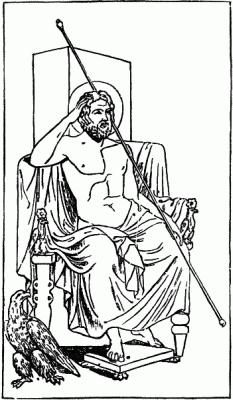
Each city had a guardian spirit, each stream its nymph, each wood its faun; also there were gods to whom the boundary stones of estates were dedicated. There was a goddess of fruits called Pomona, and a god of fruits named Vertumnus. In their names the fields and the crops were solemnly blest, and all were sacred to Saturn. He, according to the old legends, had first taught husbandry, and when he reigned in Italy there was a golden age, when every one had his own field, lived by his own handiwork, and kept no slaves. There was a feast in honor of this time every year called the Saturnalia, when for a few days the slaves were all allowed to act as if they were free, and have all kinds of wild sports and merriment. Afterwards, when Greek learning came in, Saturn was mixed up with the Greek Kronos, or Time, who devours his offspring, and the reaping-hook his figures used to carry for harvest became Time's scythe. The sky-god, Zeus or Deus Pater (or father), was shortened into Jupiter; Juno was his wife, and Mars was god of war, and in Greek times was supposed to be the same as Ares; Pallas Athene was joined with the Latin Minerva; Hestia, the goddess of the hearth, was called Vesta; and, in truth, we talk of the Greek gods by their Latin names. The old Greek tales were not known to the Latins in their first times, but only afterwards learnt from the Greeks. They seem to have thought of their gods as graver, higher beings, further off, and less capricious and fanciful than the legends about the weather had made them seem to the Greeks. Indeed, these Latins were a harder, tougher, graver, fiercer, more business-like race altogether than the Greeks; not so clever, thoughtful, or poetical, but with more of what we should now call sterling stuff in them.
At least so it was with that great nation which spoke their language, and seems to have been an offshoot from them. Rome, the name of which is said to mean the famous, is thought to have been at first a cluster of little villages, with forts to protect them on the hills, and temples in the forts. Jupiter had a temple on the Capitoline Hill, with cells for his worship, and that of Juno and Minerva; and the two-faced Janus, the god of gates, had his upon the Janicular Hill. Besides these, there were the Palatine, the Esquiline, the Aventine, the Cælian, and the Quirinal. The people of these villages called themselves Quirites, or spearmen, when they formed themselves into an army and made war on their neighbors, the Sabines and Latins, and by-and-by built a wall enclosing all the seven hills, and with a strip of ground within, free from houses, where sacrifices were offered and omens sought for.
The history of these people was not written till long after they had grown to be a mighty and terrible power, and had also picked up many Greek notions. Then they seem to have made their history backwards, and worked up their old stories and songs to explain the names and customs they found among them, and the tales they told were formed into a great history by one Titus Livius. It is needful to know these stories which every one used to believe to be really history; so we will tell them first, beginning, however, with a story told by the poet Virgil.