The Romans began to see what mischiefs their quarrels did, and they agreed to send three of their best and wisest men to Greece to study the laws of Solon at Athens, and report whether any of them could be put in force at Rome.
To get the new code of laws which they brought home put into working order, it was agreed for the time to have no consuls, prætors, nor tribunes, but ten governors, perhaps in imitation of the nine Athenian archons. They were called Decemvirs (decem, ten; vir, a man), and at their head was Lucius Appius Claudius, the grandson of him who had killed himself to avoid being condemned for his harshness. At first they governed well, and a very good set of laws was drawn up, which the Romans called the Laws of the Ten Tables; but Appius soon began to give way to the pride of his nature, and made himself hated. There was a war with the Æqui, in which the Romans were beaten. Old Sicinius Dentatus said it was owing to bad management, and, as he had been in one hundred and twenty battles, everybody believed him. Thereupon Appius Claudius sent for him, begged for his advice, and asked him to join the army that he might assist the commanders. They received him warmly, and, when he advised them to move their camp, asked him to go and choose a place, and sent a guard with him of one hundred men. But these were really wretches instructed to kill him, and as soon as he was in a narrow rocky pass they set upon him. The brave old warrior set his back against a rock and fought so fiercely that he killed many, and the rest durst not come near him, but climbed up the rock and crushed him with stones rolled down on his head. Then they went back with a story that they had been attacked by the enemy, which was believed, till a party went out to bury the dead, and found there were only Roman corpses all lying round the crushed body of Sicinius, and that none were stripped of their armor or clothes. Then the true history was found out, but the Decemvirs sheltered the commanders, and would believe nothing against them.
Appius Claudius soon after did what horrified all honest men even more than this treachery to the brave old soldier. The Forum was not only the place of public assembly for state affairs, but the regular market-place, where there were stalls and booths for all the wares that Romans dealt in—meat stalls, wool shops, stalls where wine was sold in earthenware jars or leathern bottles, and even booths where reading and writing was taught to boys and girls, who would learn by tracing letters in the sand, and then by writing them with an iron pen on a waxen table in a frame, or with a reed upon parchment. The children of each family came escorted by a slave—the girls by their nurse, the boys by one called a pedagogue.
Appius, when going to his judgment-seat across the Forum, saw at one of these schools a girl of fifteen reading her lesson. She was so lovely that he asked her nurse who she was, and heard that her name was Virginia, and that she was the daughter of an honorable plebeian and brave centurion named Virginius, who was absent with the army fighting with the Æqui, and that she was to marry a young man named Icilius as soon as the campaign was over. Appius would gladly have married her himself, but there was a patrician law against wedding plebeians, and he wickedly determined that if he could not have her for his wife he would have her for his slave.
There was one of his clients named Marcus Claudius, whom he paid to get up a story that Virginius' wife Numitoria, who was dead, had never had any child at all, but had bought a baby of one of his slaves and had deceived her husband with it, and thus that poor Virginia was really his slave. As the maiden was reading at her school, this wretch and a band of fellows like him seized upon her, declaring that she was his property, and that he would carry her off. There was a great uproar, and she was dragged as far as Appius' judgment-seat; but by that time her faithful nurse had called the poor girl's uncle Numitorius, who could answer for it that she was really his sister's child. But Appius would not listen to him, and all that he could gain was that judgment should not be given in the matter until Virginius should have been fetched from the camp.
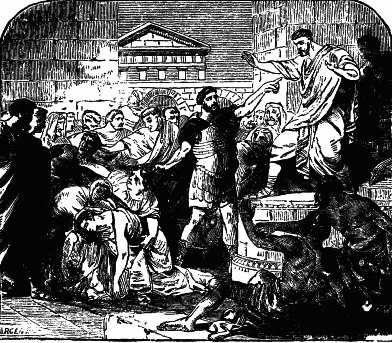
Virginius had set out from the camp with Icilius before the messengers of Appius had reached the general with orders to stop him, and he came to the Forum leading his daughter by the hand, weeping, and attended by a great many ladies. Claudius brought his slave, who made false oath that she had sold her child to Numitoria; while, on the other hand, all the kindred of Virginius and his wife gave such proof of the contrary as any honest judge would have thought sufficient, but Appius chose to declare that the truth was with his client. There was a great murmur of all the people, but he frowned at them, and told them he knew of their meetings, and that there were soldiers in the Capitol ready to punish them, so they must stand back and not hinder a master from recovering his slave.
Virginius took his poor daughter in his arms as if to give her a last embrace, and drew her close to the stall of a butcher where lay a great knife. He wiped her tears, kissed her, and saying, "My own dear little girl, there is no way but this," he snatched up the knife and plunged it into her heart, then drawing it out he cried, "By this blood, Appius, I devote thy blood to the infernal gods."
He could not reach Appius, but the lictors could not seize him, and he mounted his horse and galloped back to the army, four hundred men following him, and he arrived still holding the knife. Every soldier who heard the story resolved no longer to bear with the Decemvirs, but to march back to the city at once and insist on the old government being restored. The Decemvir generals tried to stop them, but they only answered, "We are men with swords in our hands." At the same time there was such a tumult in the city, that Appius was forced to hide himself in his own house while Virginia's corpse was carried on a bier through the streets, and every one laid garlands, scarfs, and wreaths of their own hair upon it. When the troops arrived, they and the people joined in demanding that the Decemvirs should be given up to them to be burnt alive, and that the old magistrates should be restored. However, two patricians, Lucius Valerius and Marcus Horatius, were able so to arrange matters that the nine comparatively innocent Decemvirs were allowed to depose themselves, and Appius only was sent to prison, where he killed himself rather than face the trial that awaited him. The new code of laws, however, remained, but consuls, prætors, tribunes, and all the rest of the magistrates were restored, and in the year 445 a law was passed which enabled patricians and plebeians to intermarry.