After the end of the Punic war, Carthage fell into trouble with her hired soldiers, and did not interfere with the Romans for a long time, while they went on to arrange the government of Sicily into what they called a province, which was ruled by a proprætor for a year after his magistracy at home. The Greek kingdom of Syracuse indeed still remained as an ally of Rome, and Messina and a few other cities were allowed to choose their own magistrates and govern themselves.
Soon after, Sardinia and Corsica were given up to the Romans by the hired armies of the Carthaginians, and as the natives fought hard against Rome, when they were conquered they were for the most part sold as slaves. These two islands likewise had a proprætor.
The Romans now had all the peninsula south of themselves, and as far north as Ariminim (now shortened into Rimini), but all beyond belonged to the Gauls—the Cisalpine Gauls, or Gauls on this side the Alps, as the Romans called them; while those on the other side were called Transalpine Gauls, or Gauls across the Alps. These northern Gauls were gathering again for an inroad on the south, and in the midst of the rumors of this danger there was a great thunderstorm at Rome, and the Capitol was struck by lightning. The Sybilline books were searched into to see what this might mean, and a warning was found, "Beware of the Gauls." Moreover, there was a saying that the Greeks and Gauls should one day enjoy the Forum; but the Romans fancied they could satisfy this prophecy by burying a man and woman of each nation, slaves, in the middle of the Forum, and then they prepared to attack the Gauls in their own country before the inroad could be made. There was a great deal of hard fighting, lasting for years; and in the course of it the consul, Caius Flaminius, began the great road which has since been called after him the Flaminian Way, and was the great northern road from Rome, as the Appian Way was the southern.
The great hero of the war was Marcus Claudius Marcellus, who had already made himself known for his dauntless courage. As consul, he fought a desperate battle on the banks of the Po with the Gauls of both sides the Alps, and himself killed their king or chief, Viridomar. He brought the spoils to Rome, and hung them in the Temple of Jupiter. It was only the third time in the history of Rome that such a thing had been done. Cisalpine Gaul was thus subdued, and another road was made to secure it; while in the short peace that followed the gates of the Temple of Janus were shut, having stood open ever since the reign of Numa.
The Romans were beginning to make their worship the same with that of the Greeks. They sent offerings to Greek temples, said that their old gods were the same as those of the Greeks, only under different names, and sent an embassy to Epidaurus to ask for a statue of Esculapius, the god of medicine and son of Phoebus Apollo. The emblem of Esculapius was a serpent, and tame serpents were kept about his temple at Epidaurus. One of these glided into the Roman galley that had come for the statue, and it was treated with great respect by all the crew until they sailed up the Tiber, when it made its way out of the vessel and swam to the island which had been formed by the settling of the mud round the heap of corn that had been thrown into the river when Porsena wasted the country. This was supposed to mean that the god himself took possession of the place, and a splendid temple there rose in his honor.
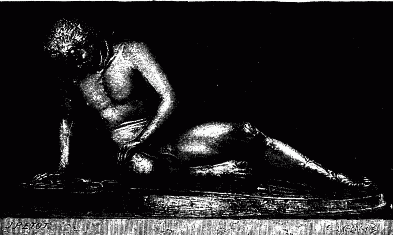
Another imitation of the Greeks which came into fashion at this time had a sad effect on the Romans. The old funerals in Greek poems had ended by games and struggles between swordsmen. Two brothers of the Brutus family first showed off such a game at their father's funeral, and it became a regular custom, not only at funerals, but whenever there was need to entertain the people, to show off fights of swordsmen. The soldier captives from conquered nations were used in this way; and some persons kept schools of slaves, who were trained for these fights and called gladiators. The battle was a real one, with sharp weapons, for life or death; and when a man was struck down, he was allowed to live or sentenced to death according as the spectators turned down or turned up their thumbs. The Romans fancied that the sight trained them to be brave, and to despise death and wounds; but the truth was that it only made them hard-hearted, and taught them to despise other people's pain—a very different thing from despising their own.
Another thing that did great harm was the making it lawful for a man to put away a wife who had no children. This ended by making the Romans much less careful to have one good wife, and the Roman ladies became much less noble and excellent than they had been in the good old days.
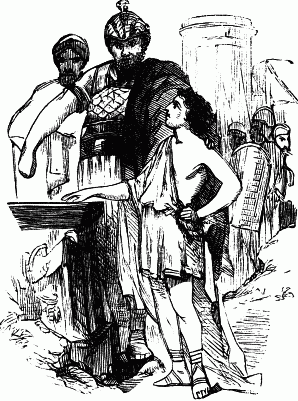
In the meantime, the Carthaginians, having lost the three islands, began to spread their settlements further in Spain, where their chief colony was New Carthage, or, as we call it, Carthagena. The mountains were full of gold mines, and the Iberians, the nation who held them, were brave and warlike, so that there was much fighting to train up fresh armies. Hamilcar, the chief general in command there, had four sons, whom he said were lion whelps being bred up against Rome. He took them with him to Spain, and at a great sacrifice for the success of his arms the youngest and most promising, Hannibal, a boy of nine years old, was made to lay his hand on the altar of Baal and take an oath that he would always be the enemy of the Romans. Hamilcar was killed in battle, but Hannibal grew up to be all that he had hoped, and at twenty-six was in command of the army. He threatened the Iberians of Saguntum, who sent to ask help from Rome. A message was sent to him to forbid him to disturb the ally of Rome; but he had made up his mind for war, and never even asked the Senate of Carthage what was to be done, but went on with the siege of Saguntum. Rome was busy with a war in Illyria, and could send no help, and the Saguntines held out with the greatest bravery and constancy, month after month, till they were all on the point of starvation, then kindled a great fire, slew all their wives and children, and let Hannibal win nothing but a pile of smoking ruins.
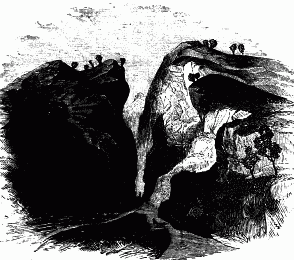
Again the Romans sent to Carthage to complain, but the Senate there had made up their minds that war there must be, and that it was a good time when Rome had a war in Illyria on her hands, and Cisalpine Gaul hardly subdued; and they had such a general as Hannibal, though they did not know what a wonderful scheme he had in his mind, namely, to make his way by land from Spain to Italy, gaining the help of the Gauls, and stirring up all those nations of Italy who had fought so long against Rome. His march, which marks the beginning of the Second Punic War, started from the banks of the Ebro in the beginning of the summer of 219. His army was 20,000 foot and 12,000 horse, partly Carthaginian, partly Gaul and Iberian. The horsemen were Moorish, and he had thirty-seven elephants. He left his brother Hasdrubal with 10,000 men at the foot of the Pyrenees and pushed on, but he could not reach the Alps before the late autumn, and his passage is one of the greatest wonders of history. Roads there were none, and he had to force his way up the passes of the Little St. Bernard through snow and ice, terrible to the men and animals of Africa, and fighting all the way, so that men and horses perished in great numbers, and only seven of the elephants were left when he at length descended into the plains of Northern Italy, where he hoped the Cisalpine Gauls would welcome him.