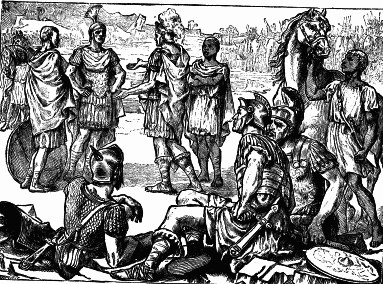
When the Romans heard that Hannibal had passed the Pyrenees, they had two armies on foot, one under Publius Cornelius Scipio, which was to go to Spain, and the other under Tiberius Sempronius Longus, to attack Africa. They changed their plan, and kept Sempronius to defend Italy, while Scipio went by sea to Marsala, a Greek colony in Gaul, to try to stop Hannibal at the Rhone; but he was too late, and therefore, sending on most of his army to Spain, he came back himself with his choicest troops. With these he tried to stop the enemy from crossing the river Ticinus, but he was defeated and so badly wounded that his life was only saved by the bravery of his son, who led him out of the battle.
Before he was able to join the army again, Sempronius had fought another battle with Hannibal on the banks of the Trebia and suffered a terrible defeat. But winter now came on, and the Carthaginians found it very hard to bear in the marshes of the Arno. Hannibal himself was so ill that he only owed his life to the last of his elephants, which carried him safely through when he was almost blind, and in the end he lost an eye. In the spring he went on ravaging the country in hopes to make the two new consuls, Flaminius and Servilius, fight with him, but they were too cautious, until at last Flaminius attacked him in a heavy fog on the shore of Lake Trasimenus. It is said that an earthquake shook the ground, and that the eager warriors never perceived it; but again the Romans lost, Flaminius was killed, and there was a dreadful slaughter, for Hannibal had sworn to give no quarter to a Roman. The only thing that was hopeful for Rome was that neither Gauls, Etruscans, nor Italians showed any desire to rise in favor of Hannibal; and though he was now very near Rome, he durst not besiege it without the help of the people around to bring him supplies, so he only marched southwards, hoping to gain the support of the Greek colonies. A dictator was appointed, Quintus Fabius Maximus, who saw that, by strengthening all the garrisons in the towns and cutting off all provisions, he should wear the enemy out at last. As he always put off a battle, he was called Cunctator, or the Delayer; but at last he had the Carthaginians enclosed as in a trap in the valley of the river Vulturnus, and hoped to cut them off, posting men in ambush to fall on them on their morning's march. Hannibal guessed that this must be the plan; and at night he had the cattle in the camp collected, fastened torches to their horns, and drove them up the hills. The Romans, fancying themselves surrounded by the enemy, came out of their hiding-places to fall back on the camp, and Hannibal and his army safely escaped. This mischance made the Romans weary of the Delayer's policy, and when the year was out, and two consuls came in, though one of them, Lucius Æmilius Paulus, would have gone on in the same cautious plan of starving Hannibal out without a battle, the other, Caius Terentius Varro, who commanded on alternate days with him, was determined on a battle. Hannibal so contrived that it was fought on the plain of Cannæ, where there was plenty of space to use his Moorish horse. It was Varro's day of command, and he dashed at the centre of the enemy; Hannibal opened a space for him, then closed in on both sides with his terrible horse, and made a regular slaughter of the Romans. The last time that the consul Æmilius was seen was by a tribune named Lentulus, who found him sitting on a stone faint and bleeding, and would have given him his own horse to escape, but Æmilius answered that he had no mind to have to accuse his comrade of rashness, and had rather die. A troop of enemies coming up, Lentulus rode off, and looking back, saw his consul fall, pierced with darts. So many Romans had been killed, that Hannibal sent to Carthage a basket containing 10,000 of the gold rings worn by the knights.
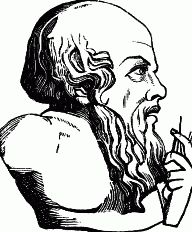
Hannibal was only five days' march beyond Rome, and his officers wanted him to turn back and attack it in the first shock of the defeat, but he could not expect to succeed without more aid from home, and he wanted to win over the Greek cities of the south; so he wintered in Campania, waiting for the fresh troops he expected from Africa or from Spain, where his brother Mago was preparing an army. But the Carthaginians did not care about Hannibal's campaigns in Italy, and sent no help; and Publius Cornelius Scipio and his brother, with a Roman army in Spain, were watching Mago and preventing him from marching, until at last he gave them battle and defeated and killed them both. But he was not allowed to go to Italy to his brother, who, in the meantime, found his army so unstrung and ill-disciplined in the delightful but languid Campania, that the Romans declared the luxuries of Capua were their best allies. He stayed in the south, however, trying to gain the alliance of the king of Macedon, and stirring up Syracuse to revolt. Marcellus, who was consul for the third time, was sent to reduce the city, which made a famous defence, for it contained Archimedes, the greatest mathematician of his time, who devised wonderful machines for crushing the besiegers in unexpected ways; but at last Marcellus found a weak part of the walls and surprised the citizens. He had given orders that Archimedes should be saved, but a soldier broke into the philosopher's room without knowing him, and found him so intent on his study that he had never heard the storming of the city. The man brandished his sword. "Only wait," muttered Archimedes, "till I have found out my problem;" but the man, not understanding him, killed him.
Hannibal remained in Italy, maintaining himself there with wonderful skill, though with none of the hopes with which he had set out. His brother Hasdrubal did succeed in leaving Spain with an army to help him, but was met on the river Metaurus by Tiberius Claudius Nero, beaten, and slain. His head was cut off by Nero's order, and thrown into Hannibal's camp to give tidings of his fate.
Young Scipio, meantime, had been sent to Spain, where he gained great advantages, winning the friendship of the Iberians, and gaining town after town till Mago had little left but Gades and the extreme south. Scipio was one of the noblest of the Romans, brave, pious, and what was more unusual, of such sweet and winning temper, that it was said of him that wherever he went he might have been a king.
On returning to Rome, he showed the Senate that the best way to get Hannibal out of Italy was to attack Africa. Cautious old Fabius doubted, but Scipio was sent to Sicily, where he made an alliance with Massinissa, the Moorish king in Africa; and, obtaining leave to carry out his plan, he was sent thither, and so alarmed Carthage, that Hannibal was recalled to defend his own country, where he had not been since he was a child. A great battle took place at Zama between him and Hannibal, in which Scipio was the conqueror, and the loss of Carthage was so terrible that the Romans were ready to have marched in on her and made her their subject, but Scipio persuaded them to be forbearing. Carthage was to pay an immense tribute, and swear never to make war on any ally of Rome. And thus ended the Second Punic War, in the year 201.