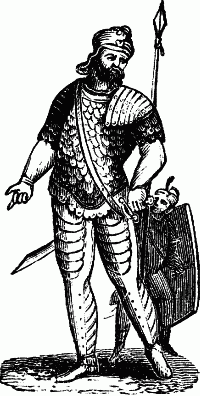
You remember in the Greek history the burning of Troy, and how Priam and all his family were cut off. Among the Trojans there was a prince called Æneas, whose father was Anchises, a cousin of Priam, and his mother was said to be the goddess Venus. When he saw that the city was lost, he rushed back to his house, and took his old father Anchises on his back, giving him his Penates, or little images of household gods, to take care of, and led by the hand his little son Iulus, or Ascanius, while his wife Creusa followed close behind, and all the Trojans who could get their arms together joined him, so that they escaped in a body to Mount Ida; but just as they were outside the city he missed poor Creusa, and though he rushed back and searched for her everywhere, he never could find her. For the sake of his care for his gods, and for his old father, he is always known as the pious Æneas.
In the forests of Mount Ida he built ships enough to set forth with all his followers in quest of the new home which his mother, the goddess Venus, gave him hopes of. He had adventures rather like those of Ulysses as he sailed about the Mediterranean. Once in the Strophades, some clusters belonging to the Ionian Islands, when he and his troops had landed to get food, and were eating the flesh of the numerous goats which they found climbing about the rocks, down on them came the harpies, horrible birds with women's faces and hooked hands, with which they snatched away the food and spoiled what they could not eat. The Trojans shot at them, but the arrows glanced off their feathers and did not hurt them. However, they all flew off except one, who sat on a high rock, and croaked out that the Trojans would be punished for thus molesting the harpies by being tossed about till they should reach Italy, but there they should not build their city till they should have been so hungry as to eat their very trenchers.
They sailed away from this dismal prophetess, and touched on the coast of Epirus, where Æneas found his cousin Helenus, son to old Priam, reigning over a little new Troy, and married to Andromache, Hector's wife, whom he had gained after Pyrrhus had been killed. Helenus was a prophet, and gave Æneas much advice. In especial he said that when the Trojans should come to Italy, they would find, under the holly-trees by the river side, a large white old sow lying on the ground, with a litter of thirty little pigs round her, and this should be a sign to them where they were to build their city.
By his advice the Trojans coasted round the south of Sicily, instead of trying to pass the strait between the dreadful Scylla and Charybdis, and just below Mount Etna an unfortunate man came running down to the beach begging to be taken in. He was a Greek, who had been left behind when Ulysses escaped from Polyphemus' cave, and had made his way to the forests, where he had lived ever since. They had just taken him in when they saw Cyclops coming down, with a pine tree for a staff, to wash the burning hollow of his lost eye in the sea, and they rowed off in great terror.
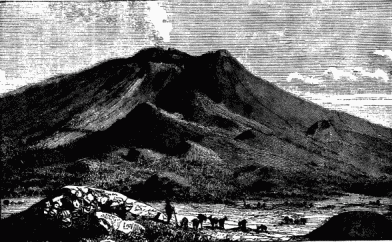
Poor old Anchises died shortly after, and while his son was still sorrowing for him, Juno, who hated every Trojan, stirred up a terrible tempest, which drove the ships to the south, until, just as the sea began to calm down, they came into a beautiful bay, enclosed by tall cliffs with woods overhanging them. Here the tired wanderers landed, and, lighting a fire, Æneas went in quest of food. Coming out of the forest, they looked down from a hill, and beheld a multitude of people building a city, raising walls, houses, towers, and temples. Into one of these temples Æneas entered, and to his amazement he found the walls sculptured with all the story of the siege of Troy, and all his friends so perfectly represented, that he burst into tears at the sight.
Just then a beautiful queen, attended by a whole troop of nymphs, came into the temple. This lady was Dido; her husband, Sichæus, had been king of Tyre, till he was murdered by his brother Pygmalion, who meant to have married her, but she fled from him with a band of faithful Tyrians and all her husband's treasure, and had landed on the north coast of Africa. There she begged of the chief of the country as much land as could be enclosed by a bullock's hide. He granted this readily; and Dido, cutting the hide into the finest possible strips, managed to measure off with it ground enough to build the splendid city which she had named Carthage. She received Æneas most kindly, and took all his men into her city, hoping to keep them there for ever, and make him her husband. Æneas himself was so happy there, that he forgot all his plans and the prophecies he had heard, until Jupiter sent Mercury to rouse him to fulfil his destiny. He obeyed the call; and Dido was so wretched at his departure that she caused a great funeral pile to be built, laid herself on the top, and stabbed herself with Æneas' sword; the pile was burnt, and the Trojans saw the flame from their ships without knowing the cause.
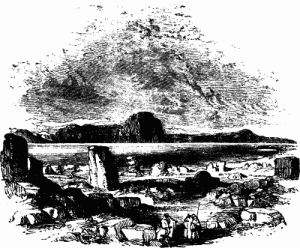
By-and-by Æneas landed at a place in Italy named Cumæ. There dwelt one of the Sybils. These were wondrous virgins whom Apollo had endowed with deep wisdom; and when Æneas went to consult the Cumæan Sybil, she told him that he must visit the under-world of Pluto to learn his fate. First, however, he had to go into a forest, and find there and gather a golden bough, which he was to bear in his hand to keep him safe. Long he sought it, until two doves, his mother's birds, came flying before him to show him the tree where gold gleamed through the boughs, and he found the branch growing on the tree as mistletoe grows on the thorn.
Guarded with this, and guided by the Sybil, after a great sacrifice, Æneas passed into a gloomy cave, where he came to the river Styx, round which flitted all the shades who had never received funeral rites, and whom the ferryman, Charon, would not carry over. The Sybil, however, made him take Æneas across, his boat groaning under the weight of a human body. On the other side stood Cerberus, but the Sybil threw him a cake of honey and of some opiate, and he lay asleep, while Æneas passed on and found in myrtle groves all who had died for love, among them, to his surprise, poor forsaken Dido. A little further on he found the home of the warriors, and held converse with his old Trojan friends. He passed by the place of doom for the wicked, Tartarus; and in the Elysian fields, full of laurel groves and meads of asphodel, he found the spirit of his father Anchises, and with him was allowed to see the souls of all their descendants, as yet unborn, who should raise the glory of their name. They are described on to the very time when the poet wrote to whom we owe all the tale of the wanderings of Æneas, namely, Virgil, who wrote the Æneid, whence all these stories are taken. He further tells us that Æneas landed in Italy just as his old nurse Caiëta died, at the place which is still called Gaëta. After they had buried her, they found a grove, where they sat down on the grass to eat, using large round cakes or biscuits to put their meat on. Presently they came to eating up the cakes. Little Ascanius cried out, "We are eating our very tables;" and Æneas, remembering the harpy's words, knew that his wanderings were over.