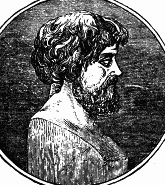
Scipio remained in Africa till he had arranged matters and won such a claim to Massinissa's gratitude that this king of Numidia was sure to watch over the interests of Rome. Scipio then returned home, and entered Rome with a grand triumph, all the nobler for himself that he did not lead Hannibal in his chains. He had been too generous to demand that so brave an enemy should be delivered up to him. He received the surname of Africanus, and was one of the most respected and beloved of Romans. He was the first who began to take up Greek learning and culture, and to exchange the old Roman ruggedness for the graces of philosophy and poetry. Indeed the Romans were beginning to have much to do with the Greeks, and the war they entered upon now was the first for the sake of spreading their own power. All the former ones had been in self-defence, and the new one did in fact spring out of the Punic war, for the Carthaginians had tried to persuade Philip, king of Macedon, to follow in the track of Pyrrhus, and come and help Hannibal in Southern Italy. The Romans had kept him off by stirring up the robber Ætolians against him; and when he began to punish these wild neighbors, the Romans leagued themselves with the old Greek cities which Macedon oppressed, and a great war took place.
Titus Quinctius Flaminius commanded in Greece for four years, first as consul and then as proconsul. His crowning victory was at Cynocephalæ, or the Dogshead Rocks, where he so broke the strength of Macedon that at the Isthmian games he proclaimed the deliverance of Greece, and in their joy the people crowded round him with crowns and garlands, and shouted so loud that birds in the air were said to have dropped down at the sound.
Macedon had cities in Asia Minor, and the king of Syria's enemy, Antiochus the Great, hoped to master them, and even to conquer Greece by the help of Hannibal, who had found himself unable to live in Carthage after his defeat, and was wandering about to give his services to any one who was a foe of Rome.
As Rome took the part of Philip, as her subject and ally, there was soon full scope for his efforts; but the Syrians were such wretched troops that even Hannibal could do nothing with them, and the king himself would not attend to his advice, but wasted his time in pleasure in the isle of Euboea. So the consul Acilius first beat them at Thermopylæ, and then, on Lucius Cornelius Scipio being sent to conduct the war, his great brother Africanus volunteered to go with him as his lieutenant, and together they followed Antiochus into Asia Minor, and gained such advantages that the Syrian was obliged to sue for peace. The Romans replied by requiring of him to give up all Asia Minor as far as Mount Tarsus, and in despair he risked a battle in Magnesia, and met with a total defeat; 80,000 Greeks and Syrians being overthrown by 50,000 Romans. Neither Africanus nor Hannibal were present in this battle, since the first was ill, and the second was besieged in a city in Pamphylia; but while terms of peace were being made, the two are said have met on friendly terms, and Scipio asked Hannibal whom he thought the greatest of generals. "Alexander," was the answer. "Whom the next greatest?" "Pyrrhus." "Whom do you rank as the third?" "Myself," said Hannibal. "But if you had beaten me?" asked Scipio. "Then I would have placed myself before Alexander."
The Romans insisted that Hannibal should be dismissed by Antiochus, though Scipio declared that this was ungenerous; but they dreaded his never-ceasing enmity; and when he took refuge with the king of Bothnia, they still required that he should be given up or driven a way. On this, Hannibal, worn-out and disappointed, put an end to his own life by poison, saying he would rid the Romans of their fear of an old man.
The provinces taken from Antiochus were given to Eumenes, king of Pergamus, who was to reign over them as tributary to the Romans. Lucius Scipio received the surname of Asiaticus, and the two brothers returned to Rome; but they had been too generous and merciful to the conquered to suit the grasping spirit that had begun to prevail at Rome, and directly after his triumph Lucius was accused of having taken to himself an undue share of the spoil. His brother was too indignant at the shameful accusation to think of letting him justify himself, but tore up his accounts in the face of the people. The tribune, Nævius, thereupon spitefully called upon him to give an account of the spoil of Carthage taken twenty years before. The only reply he gave was to exclaim, "This is the day of the victory of Zama. Let us give thanks to the gods for it;" and he led all that was noble and good in Rome with him to the temple of Jupiter and offered the anniversary sacrifice. No one durst say another word against him or his brother; but he did not choose to remain among the citizens who had thus insulted him, but went away to his estate at Liternum, and when he died, desired to be buried there, saying that he would not even leave his bones to his ungrateful country. The Cornelian family was the only one among the higher Romans who buried instead of burning their dead. He left no son, only a daughter, who was married to Tiberius Sempronius Gracchus, a brave officer who was among those who were sent to finish reducing Spain. It was a long, terrible war, fought city by city, inch by inch; but Gracchus is said to have taken no less than three hundred fortresses. But he was a milder conqueror than some of the Romans, and tried to tame and civilize the wild races instead of treating them with the terrible severity shown by Marcus Porcius Cato, the sternest of all old Romans. However, by the year 178 Spain had been reduced to obedience, and the cities and the coast were in good order, though the mountains harbored fierce tribes always ready for revolt.
Gracchus died early, and Cornelia, his widow, devoted herself to the cause of his three children, refusing to be married again, which was very uncommon in a Roman lady. When a lady asked her to show her her ornaments, she called her two boys, Tiberius and Caius, and their sister Sempronia, and said, "These are my jewels;" and when she was complimented on being the daughter of Africanus, she said that the honor she should care more for was the being called "the mother of the Gracchi."
It was not, however, one of her sons that was chosen to carry on their grandfather's name and the sacrifices of the Cornelian family. Probably Caius was not born when Scipio died, for his choice had been the second son of his sister and of Lucius Æmilius Paulus (son of him who died at Cannæ.) This child being adopted by his uncle, was called Publius Cornelius Scipio Æmilianus, and when he grew up was to marry his cousin Sempronia.