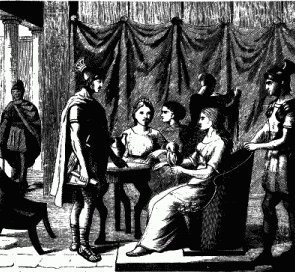
Young Tiberius Sempronius Gracchus, the eldest of Cornelia's jewels, was sent in the year 137 to join the Roman army in Spain. As he went through Etruria, which, as every one knew, had been a thickly peopled, fertile country in old times, he was shocked to see its dreariness and desolation. Instead of farms and vineyards, there were great bare spaces of land, where sheep, kids, or goats were feeding. These vast tracts belonged to Romans, who kept slaves to attend to the flocks; while all the corn that was used in Rome came from Sicily or Africa, and the poorer Romans lived in the city itself—idle men, chiefly trusting to distributions of corn, and unable to work for themselves because they had no ground to till; and as to trades and handicrafts, the rich men had everything they wanted made in their own houses by their slaves.
No wonder the Romans were losing their old character. This was the very thing that the Licinian law had been intended to prevent, by forbidding any citizen to have more than a certain quantity of land, and giving the state the power of resuming it. The law was still there, but it had been disused and forgotten; estates had been gathered into the hands of families and handed down, till now, though there were 400,000 citizens, only 2,000 were men of property.
While Tiberius was serving in Spain, he decided on his plan. As his family was plebeian, he could be a tribune of the people, and as soon as he came home he stood and was elected. Then he proposed reviving the Licinian law, that nobody should have more than 500 acres, and that the rest should be divided among those who had nothing, leaving, however, a larger portion to those who had many children.
There was, of course, a terrible uproar; the populace clamoring for their rights, and the rich trying to stop the measure. They bribed one of the other tribunes to forbid it; but there was a fight, in which Tiberius prevailed, and he and his young brother Caius, and his father-in-law Appius Claudius, were appointed as triumvers to see the law carried out. Then the rich men followed their old plan of spreading reports among the people that Tiberius wanted to make himself a king, and had accepted a crown and purple robe from some foreign envoy. When his year of office was coming to an end, he sought to be elected tribune again, but the patricians said it was against the law. There was a great tumult, in the course of which he put his hand to his head, either to guard it from a blow or to beckon his friends. "He demands the diadem," shouted his enemies, and there was a great struggle, in which three hundred people were killed. Tiberius tried to take refuge in the Temple of Jupiter, but the doors were closed against him; he stumbled, was knocked down with a club, and killed.
However, the Sempronian law had been made, and the people wanted, of course, to have it carried out, while the nobles wanted it to be a dead letter. Scipio Æmilianus, the brother-in-law of the Gracchi, had been in Spain all this time, but he had so much disapproved of Tiberius' doings that he was said to have exclaimed, on hearing of his death, "So perish all who do the like." But when he came home, he did so much to calm and quiet matters, that there was a cry to make him Dictator, and let him settle the whole matter. Young Caius Gracchus, who thought the cause would thus be lost, tried to prevent the choice by fixing on him the name of tyrant. To which Scipio calmly replied, "Rome's enemies may well wish me dead, for they know that while I live Rome cannot perish."
When he went home, he shut himself into his room to prepare his discourse for the next day, but in the morning he was found dead, without a wound, though his slaves declared he had been murdered. Some suspected his wife Sempronia, others even her mother Cornelia, but the Senate would not have the matter enquired into. He left no child, and the Africanus line of Cornelius ended with him.
Caius Gracchus was nine years younger than his brother, and was elected tribune as soon as he was old enough. He was full of still greater schemes than his brother. His mother besought him to be warned by his brother's fate, but he was bent on his objects, and carried some of them out. He had the Sempronian law reaffirmed, though he could not act on it; but in the meantime he began a regular custom of having corn served out to the poorer citizens, and found work for them upon roads and bridges; also he caused the state to clothe the soldiers, instead of their doing it at their own expense. Another scheme which he first proposed was to make the Italians of the countries now one with Roman territory into citizens, with votes like the Romans themselves; but this again angered the patricians, who saw they should be swamped by numbers and lose their power.
He also wanted to found a colony of plebeians on the ruins of Carthage, and when his tribuneship was over he went to Africa to see about it; but when he came home the patricians had arranged an attack on him, and he was insulted by the lictor of the consul Opimius. The patricians collected on one side, the poorer sort around Caius on the Aventine Hill; but the nobles were the strongest, the plebeians fled, and Caius withdrew with one slave into a sacred grove, whence he hoped to reach the Tiber; but the wood was surrounded, his retreat was cut off, and he commanded the slave to kill him that he might not fall alive into the hands of his enemies, after which the poor faithful fellow killed himself, unable to bear the loss of his master. The weight of Caius' head in gold had been promised by the Senate, and the man who found the body was said to have taken out the brains and filled it up with lead that his reward might be larger. Three thousand men were killed in this riot, ten times as many as at Tiberius' death.
Opimius was so proud of having overthrown Caius, that he had a medal struck with Hercules slaying the monsters. Cornelia, broken-hearted, retired to a country-house; but in a few years the feeling turned, great love was shown to the memory of the two brothers, statues were set up in their honor, and when Cornelia herself died, her statue was inscribed with the title she had coveted, "The mother of the Gracchi."
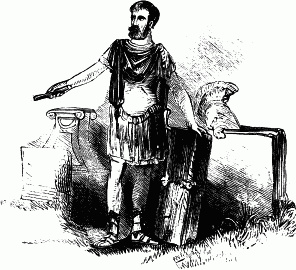
Things were indeed growing worse and worse. The Romans were as brave as ever in the field, and were sure in the end to conquer any nation they came in contact with; but at home, the city was full of overgrown rich men, with huge hosts of slaves, and of turbulent poor men, who only cared for their citizenship for the sake of the corn they gained by it, and the games exhibited by those who stood for a magistracy. Immense sums were spent in hiring gladiators and bringing wild animals to be baited for their amusement; and afterwards, when sent out to govern the provinces, the expenses were repaid by cruel grinding and robbing the people of the conquered states.