There was great fear at Rome, among the friends of Cinna and Marius, at the prospect of Sulla's return. A fire broke out in the Capitol, and this added to their terror, for the Books of the Sybil were burnt, and all her prophecies were lost. Cinna tried to oppose Sulla's landing, but was killed by his own soldiers at Brundusium.
Sulla, with his victorious army, could not be stopped. Sertorius fled to Spain, but Marius' son tried, with the help of the Samnites, to resist, and held out Præneste, but the Samnites were beaten in a terrible battle outside the walls, and when the people of the city saw the heads of the leaders carried on spear points, they insisted on giving up. Young Marius and a Samnite noble hid themselves in a cave, and as they had no hope, resolved to die; so they fought, hoping to kill each other, and when Marius was left alive, he caused himself to be slain by a slave.
Sulla marched on towards Rome, furious at the resistance he met with, and determined on a terrible vengeance. He could not enter the city till he was ready to dismiss his army and have his triumph, so the Senate came out to meet him in the temple of Bellona. As they took their seats, they heard dreadful shrieks and cries. "No matter," said Sulla; "it is only some wretches being punished." The wretches were the 8000 Samnite prisoners he had taken at the battle of Præneste, and brought to be killed in the Campus Martius; and with these shocking sounds to mark that he was in earnest, the purple-faced general told the trembling Senate that if they submitted to him he would be good to them, but that he would spare none of his enemies, great or small.
And his men were already in the city and country, slaughtering not only the party of Marius, but every one against whom any one of them had a spite, or whose property he coveted. Marius' body, which had been buried and not burnt, was taken from the grave and thrown into the Tiber; and such horrible deeds were done that Sulla was asked in the Senate where the execution was to stop. He showed a list of eighty more who had yet to die; and the next day and the next he brought other lists of two hundred and thirty each. These dreadful lists were called proscriptions, and any one who tried to shelter the victims was treated in the same manner. The property of all who were slain was seized, and their children declared incapable of holding any public office.
Among those who were in danger was the nephew of Marius' wife, Caius Julius Cæsar, but, as he was of a high patrician family, Sulla only required of him to divorce his wife and marry a stepdaughter of his own. Cæsar refused, and fled to the Sabine hills, where pursuers were sent after him; but his life was begged for by his friends at Rome, especially by the Vestal Virgins, and Sulla spared his life, saying, however, "Beware; in that young trifler is more than one Marius." Cæsar went to join the army in the East for safety, and thus broke off the idle life of pleasure he had been leading in Rome.
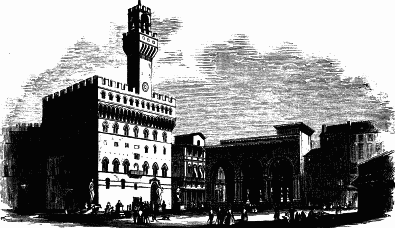
The country people were even more cruelly punished than the citizens: whole cities were destroyed and districts laid waste; the whole of Etruria was ravaged, the old race entirely swept away, and the towns ruined beyond revival, while the new city of Florence was built with their remains, and all we know of them is from the tombs which have of late years been opened.
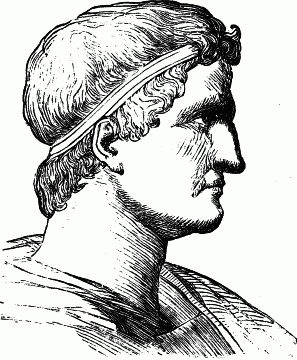
Both the consuls had perished, and Sulla caused himself to be named Dictator. He had really a purpose in all the horrors he had perpetrated, namely, to clear the way for restoring the old government at Rome, which Marius and his Italians had been overthrowing. He did not see that the rule which had worked tolerably well while Rome was only a little city with a small country round it, would not serve when it was the head of numerous distant countries, where the governors, like himself and Marius, grew rich, and trained armies under them able to overpower the whole state at home. So he set to work to put matters as much as possible in the old order. So many of the Senate had been killed, that he had to make up the numbers by putting in three hundred knights; and, to supply the lack of other citizens, after the hosts who had perished, he allowed the Italians to go on coming in to be enrolled as citizens; and ten thousand slaves, who had belonged to his victims, were not only set free, but made citizens as his own clients, thus taking the name of Cornelius. He also much lessened the power of the tribunes of the people, and made a law that when a man had once been a tribune he should never be chosen for any of the higher offices of the state. By these means he sought to keep up the old patrician power, on which he believed the greatness of Rome depended; though, after all, the grand old patrician families had mostly died off, and half the Senate were only knights made noble.
After this Sulla resigned the dictatorship, for he was growing old, and had worn out his health by his riot and luxury. He spent his time in a villa near Rome, talking philosophy with his friends, and dictating the history of his own life in Greek. When he died, he bade them burn his body, contrary to the practice of the Cornelii, no doubt fearing it would be treated like that of Marius.
The most promising of the men of his party who were growing up and coming forward was Cnæus Pompeius, a brave and worthy man, who had while quite young, gained such a victory over a Numidian prince that Sulla himself gave him the title of Magnus, or the Great. He was afterwards sent to Spain, where Sertorius held out for eight years against the Roman power with the help of the native chiefs, but at last was put to death by his own followers. Things were altogether in a bad state. There were great struggles in Rome at every election, for the officers of the state were now chiefly esteemed for the sake of the three or five years' government in the provinces to which they led. No expense was thought too great in shows of beasts and gladiators by which to win the votes of the people; for, after the year of office, the candidate meant amply to repay himself by what he could squeeze out of the unhappy province under his charge, and nobody cared for cruelty or injustice to any one but a Roman citizen.
Numbers of gladiators were kept and trained to fight in these shows; and while the Spanish war was going on, a whole school of them—seventy-eight in number—who were kept at Capua, broke out, armed themselves with the spits, hooks, and axes in a butcher's shop, and took refuge in the crater of Mount Vesuvius, which at that time showed no signs of being an active volcano. There, under their leader Spartacus, they gathered together every gladiator slave or who could run away to them, and Spartacus wanted them to march northward, force their way through Italy, climb the Alps, and reach their homes in Thrace and Gaul; but the plunder of Italy tempted them, and they would not go, till an army was sent against them under Marcus Licinius Crassus—called Dives, or the Rich, from the spoil he had gained during the proscription. Then Spartacus hoped to escape in a fleet of pirate ships from Cilicia, and to hold out in the passes of Mount Taurus; but the Cilician pirates deceived him, sailed away with his money, and left him to his fate, and he and his gladiators were all slain by Crassus and Pompeius, who had been called home from Spain.