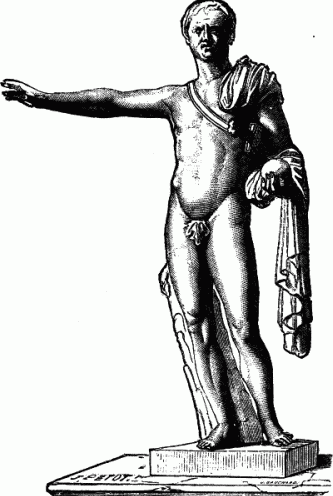
Cnæus Pompeius Magnus and Lucius Licinius Crassus Dives were consuls together in the year 70; but Crassus, though he feasted the people at 10,000 tables, was envied and disliked, and would never have been elected but for Pompeius, who was a great favorite with the people, and so much trusted, both by them and the nobles, that it seems to have filled him with pride, for he gave himself great airs, and did not treat his fellow-consul as an equal.
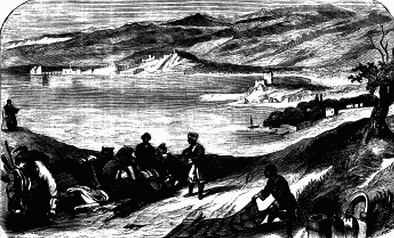
When his term of office was over, the most pressing thing to be done was to put down the Cilician pirates. In the angle formed between Asia Minor and Syria, with plenty of harbors formed by the spurs of Mount Taurus, there had dwelt for ages past a horde of sea robbers, whose swift galleys darted on the merchant ships of Tyre and Alexandria; and now, after the ruin of the Syrian kingdom, they had grown so rich that their state galleys had silken sails, oars inlaid with ivory and silver, and bronze prows. They robbed the old Greek temples and the Eastern shrines, and even made descents on the Italian cities, besides stopping the ships which brought wheat from Sicily and Alexandria to feed the Romans.
To enable Pompeius to crush them, authority was given him for three years over all the Mediterranean and fifty miles inland all round, which was nearly the same thing as the whole empire. He divided the sea into thirteen commands, and sent a party to fight the pirates in each; and this was done so effectually, that in forty days they were all hunted out of the west end of the gulf, whither he pursued them with his whole force, beat them in a sea-fight, and then besieged them; but, as he was known to be a just and merciful man, they came to terms with him, and he scattered them about in small colonies in distant cities, so that they might cease to be mischievous.
In the meantime, the war with Mithridates had broken out again, and Lucius Lucullus, who had been consul after Pompeius, was fighting with him in the East; but Lucullus did not please the Romans, though he met with good success, and had pushed Mithridates so hard that there was nothing left for Pompeius but to complete the conquest, and he drove the old king beyond Caucasus, and then marched into Syria, where he overthrew the last of the Seleucian kings, Antiochus, and gave him the little kingdom of Commagene to spend the remainder of his life in, while Syria and Phoenicia were made into a great Roman province.
Under the Maccabees, Palestine had struggled into being independent of Syria, but only by the help of the Romans, who, as usual, tried to ally themselves with small states in order to make an excuse for making war on large ones. There was now a great quarrel between two brothers of the Maccabean family, and one of them, Hyrcanus, came to ask the aid of Pompeius. The Roman army marched into the Holy Land, and, after seizing the whole country, was three months besieging Jerusalem, which, after all, it only took by an attack when the Jews were resting on the Sabbath day. Pompeius insisted on forcing his way into the Holy of Holies, and was very much disappointed to find it empty and dark. He did not plunder the treasury of the Temple, but the Jews remarked that, from the time of this daring entrance, his prosperity seemed to fail him. Before he left the East, however, old Mithridates, who had taken refuge in the Crimea, had been attacked by his own favorite son, and, finding that his power was gone, had taken poison; but, as his constitution was so fortified by antidotes that it took no effect, he caused one of his slaves to kill him.
The son submitted to the Romans, and was allowed to reign on the Bosphorus; but Pompeius had extended the Roman Empire as far as the Euphrates; for though a few small kings still remained, it was only by suffrance from the Romans, who had gained thirty-nine great cities. Egypt, the Parthian kingdom on the Tigris, and Armenia in the mountains, alone remained free.
While all this was going on in the East, there was a very dangerous plot contrived at Rome by a man named Lucius Sergius Catilina, and seven other good-for-nothing nobles, for arming the mob, even the slaves and gladiators, overthrowing the government, seizing all the offices of state, and murdering all their opponents, after the example first set by Marius and Cinna.

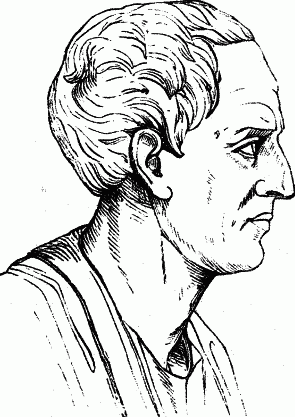
Happily such secrets are seldom kept; one of the plotters told the woman he was in love with, and she told one of the consuls, Marcus Tullius Cicero. Cicero was one of the wisest and best men in Rome, and the one whom we really know the best, for he left a great number of letters to his friends, which show us the real mind of the man. He was of the order of the knights, and had been bred up to be a lawyer and orator, and his speeches came to be the great models of Roman eloquence. He was a man of real conscience, and he most deeply loved Rome and her honor; and though he was both vain and timid, he could put these weaknesses aside for the public good. Before all the Senate he impeached Catilina, showing how fully he knew all that he intended. Nothing could be done to him by law till he had actually committed his crime, and Cicero wanted to show him that all was known, so as to cause him to flee and join his friends outside. Catilina tried to face it out, but all the senators began to cry out against him, and he dashed away in terror, and left the city at night. Cicero announced it the next day in a famous speech, beginning, "He is gone; he has rushed away; he has burst forth." Some of his followers in guilt were left at Rome, and just then some letters were brought to Cicero by some of a tribe of Gauls whom they had invited to help them in the ruin of the Senate. This was positive proof, and Cicero caused the nine worst to be seized, and, having proved their guilt, there was a consultation in the Senate as to their fate. Julius Cæsar wanted to keep them prisoners for life, which he said was worse than death, as that, he believed, would end everything; but all the rest of the Senate were for their death, and they were all strangled, without giving them a chance of defending themselves or appealing to the people. Cicero beheld the execution himself, and then went forth to the crowd, merely saying, "They have lived."
Catilina, meantime, had collected 20,000 men in Italy, but they were not half-armed, and the newly-returned proconsul, Metellus, made head against him; while the other consul, Caius Antonius, was recalled from Macedonia with his army. As he was a friend of Catilina, he did not choose to fight with him, and gave up the command to his lieutenant, by whom the wretch was defeated and slain. His head was cut off and sent to Rome.