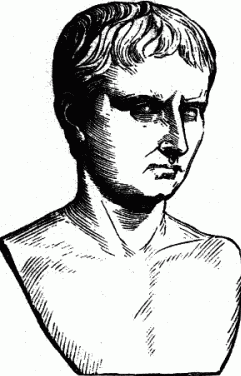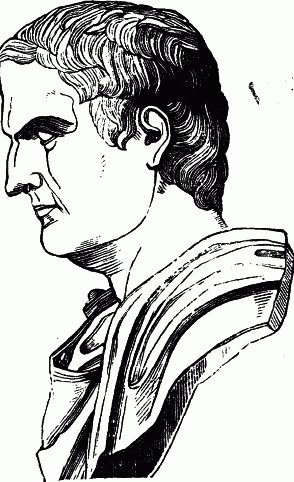
The murderers of Cæsar had expected the Romans to hail them as deliverers from a tyrant, but his great friend Marcus Antonius, who was, together with him, consul for that year, made a speech over his body as it lay on a couch of gold and ivory in the Forum ready for the funeral. Antonius read aloud Cæsar's will, and showed what benefits he had intended for his fellow-citizens, and how he loved them, so that love for him and wrath against his enemies filled every hearer. The army, of course, were furious against the murderers; the Senate was terrified, and granted everything Antonius chose to ask, provided he would protect them, whereupon he begged for a guard for himself that he might be saved from Cæsar's fate, and this they gave him; while the fifteen murderers fled secretly, mostly to Cisalpine Gaul, of which Decimus Brutus was governor.
Cæsar had no child but the Julia who had been wife to Pompeius, and his heir was his young cousin Caius Octavius, who changed his name to Caius Julius Cæsar Octavianus, and, coming to Rome, demanded his inheritance, which Antonius had seized, declaring that it was public money; but Octavianus, though only eighteen, showed so much prudence and fairness that many of the Senate were drawn towards him rather than Antonius, who had always been known as a bad, untrustworthy man; but the first thing to be done was to put down the murderers—Decimus Brutus was in Gaul, Marcus Brutus and Cassius in Macedonia, and Sextus Pompeius had also raised an army in Spain.
Good men in the Senate dreaded no one so much as Antonius, and put their hope in young Octavianus. Cicero made a set of speeches against Antonius, which are called Philippics, because they denounce him as Demosthenes used to denounce Philip of Macedon, and like them, too, they were the last flashes of spirit in a sinking state; and Cicero, in those days, was the foremost and best man who was trying at his own risk to save the old institutions of his country. But it was all in vain; they were too rotten to last, and there were not enough of honest men to make a stand against a violent unscrupulous schemer like Antonius, above all now that the clever young Octavianus saw it was for his interest to make common cause with him, and with a third friend of Cæsar, rich but dull, named Marcus Æmilius Lepidus. They called on Decimus Brutus to surrender his forces to them, and marched against him. Then his troops deserted him, and he tried to escape into the Alps, but was delivered up to Antonius and put to death.
Soon after, Antonius, Lepidus, and Octavianus all met on a little island in the river Rhenus and agreed to form a triumvirate for five years for setting things to rights once more, all three enjoying consular power together; and, as they had the command of all the armies, there was no one to stop them. Lepidus was to stay and govern Rome, while the other two hunted down the murderers of Cæsar in the East. But first, there was a deadly vengeance to be taken in the city upon all who could be supposed to have favored the murder of Cæsar, or who could be enemies to their schemes. So these three sat down with a list of the citizens before them to make a proscription, each letting a kinsman or friend of his own be marked for death, provided he might slay one related to another of the three. The dreadful list was set up in the Forum, and a price paid for the heads of the people in it, so that soldiers, ruffians, and slaves brought them in; but it does not seem that—as in the other two proscriptions—there was random murder, and many bribed their assassins and escaped from Italy. Octavianus had marked the fewest and tried to save Cicero, but Antonius insisted on his death. On hearing that he was in the fatal roll, Cicero had left Rome with his brother, and slowly travelled towards the coast from one country house to another till he came to Antium, whence he meant to sail for Greece; but there he was overtaken. His brother was killed at once, but he was put into a boat by his slaves, and went down the coast to Formiæ, where he landed again, and, going to a house near, said he would rather die in his own country which he had so often saved. However, when the pursuers knocked at the gate, his slaves placed him in a litter and hurried him out at another door. He was, however, again overtaken, and he forbade his slaves to fight for him, but stretched out his throat for the sword, with his eyes full upon it. His head was carried to Antonius, whose wife Fulvia actually pierced the tongue with her bodkin in revenge for the speeches it had made against her husband.
After this dreadful work, Antonius and Octavianus went across to Greece, where Marcus Brutus had collected the remains of the army that had fought under Pompeius. He had been made much of at Athens, where his statue had been set up beside that of Harmodius and Aristogeiton, the slayers of Pisistratus. Cassius had plundered Asia Minor, and the two met at Sardis. It is said that the night before they were to pass into Macedonia, Brutus was sitting alone in his tent, when he saw the figure of a man before him. "Who art thou?" he asked, and the answer was, "I am thine evil genius, Brutus; I will meet thee again at Philippi."
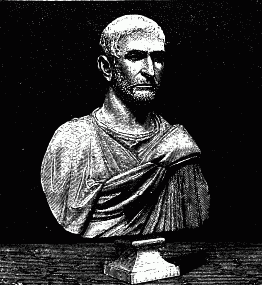
And it was at Philippi that Brutus and Cassius found themselves face to face with Antonius and Octavianus. Each army was divided into two, and Brutus, who fought against Octavianus, put his army to flight, but Cassius was driven back by Antonius; and seeing a troop of horsemen coming towards him, he thought all was lost, and threw himself upon a sword. Brutus gathered the troops together, and after twenty days renewed the fight, when he was routed, fled, and hid himself, but after some hours put himself to death, as did his wife Porcia when she heard of his end.
After this, Octavianus went back to Italy, while Antonius stayed to pacify the East. When he was at Tarsus, the lovely queen of Egypt came, resolved to win him over. She sailed up the Cydnus in a beautiful galley, carved, gilded, and inlaid with ivory, with sails of purple silk and silvered oars, moving to the sound of flutes, while she lay on the deck under a star-spangled canopy arrayed as Venus, with her ladies as nymphs, and little boys as Cupids fanning her. Antonius was perfectly fascinated, and she took him back to Alexandria with her, heeding nothing but her and the delights with which she entertained him, though his wife Fulvia and his brother were struggling to keep up his power at Rome. He did come home, but only to make a fresh agreement with Octavianus, by which Fulvia was given up and he married Octavia, the widow of Marcellus and sister of Octavianus. But he could not bear to stay long away from Cleopatra, and, deserting Octavia, he returned to Egypt, where the most wonderful revelries were kept up. Stories are told of eight wild boars being roasted in one day, each being begun a little later than the last, that one might be in perfection when Antonius should call for his dinner. Cleopatra vowed once that she would drink the most costly of draughts, and, taking off an earring of inestimable price, dissolved it in vinegar and swallowed it.
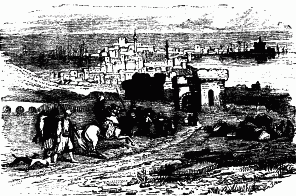
In the meantime, Octavianus and Lepidus together had put down Decimus, and Lepidus had then tried to overcome Octavianus, but was himself conquered and banished; for Octavianus, was a kindly man, who never shed blood if he could help it, and, now that he was alone at Rome, won every one's heart by his gracious ways, while Antonius' riots in Egypt were a scandal to all who loved virtue and nobleness. So far was the Roman fallen that he even promised Cleopatra to conquer Italy and make Alexandria the capital of the world. Octavia tried to win him back, but she was a grave, virtuous Roman matron, and coarse, dissipated Antonius did not care for her compared with the enticing Egyptian queen. It was needful at last for Octavianus to destroy this dangerous power, and he mustered a fleet and army, while Antonius and Cleopatra sailed out of Alexandria with their ships and gave battle off the Cape of Actium. In the midst, either fright or treachery made Cleopatra sail away, and all the Egyptian ships with her, so that Antonius turned at once and fled with her. They tried to raise the East in their favor, but all their allies deserted them, and their soldiers went over to Alexandria, where Octavianus followed them. Then Cleopatra betrayed her lover, and put into the hands of Octavianus the ships in which he might have fled. He killed himself, and Cleopatra surrendered, hoping to charm young Octavianus as she had done Julius and Antonius, but when she saw him grave and unmoved, and found he meant to exhibit her in his triumph, she went to the tomb of Antonius and crowned it with flowers. The next day she was found on her couch, in her royal robes, dead, and her two maids dying too. "Is this well?" asked the man who found her. "It is well for the daughter of kings," said her maid with her last breath. Cleopatra had long made experiments on easy ways of death, and it was believed that an asp was brought to her in a basket of figs as the means of her death.