Virgil goes on to tell at much length how the king of the country, Latinus, at first made friends with Æneas, and promised him his daughter Lavinia in marriage; but Turnus, an Italian chief who had before been a suitor to Lavinia, stirred up a great war, and was only captured and killed after much hard fighting. However, the white sow was found in the right place with all her little pigs, and on the spot was founded the city of Alba Longa, where Æneas and Lavinia reigned until he died, and his descendants, through his two sons, Ascanius or Iulus, and Æneas Silvius, reigned after him for fifteen generations.
The last of these fifteen was Amulius, who took the throne from his brother Numitor, who had a daughter named Rhea Silvia, a Vestal virgin. In Greece, the sacred fire of the goddess Vesta was tended by good men, but in Italy it was the charge of maidens, who were treated with great honor, but were never allowed to marry under pain of death. So there was great anger when Rhea Silvia became the mother of twin boys, and, moreover, said that her husband was the god Mars. But Mars did not save her from being buried alive, while the two babes were put in a trough on the waters of the river Tiber, there to perish. The river had overflowed its banks, and left the children on dry ground, where, however, they were found by a she-wolf, who fondled and fed them like her own offspring, until a shepherd met with them and took them home to his wife. She called them Romulus and Remus, and bred them up as shepherds.
When the twin brothers were growing into manhood, there was a fight between the shepherds of Numitor and Amulius, in which Romulus and Remus did such brave feats that they were led before Numitor. He enquired into their birth, and their foster-father told the story of his finding them, showing the trough in which they had been laid; and thus it became plain that they were the grandsons of Numitor. On finding this out, they collected an army, with which they drove away Amulius, and brought their grandfather back to Alba Longa.
They then resolved to build a new city for themselves on one of the seven low hills beneath which ran the yellow river Tiber; but they were not agreed on which hill to build, Remus wanting to build on the Aventine Hill, and Romulus on the Palatine. Their grandfather advised them to watch for omens from the gods, so each stood on his hill and watched for birds. Remus was the first to see six vultures flying, but Romulus saw twelve, and therefore the Palatine Hill was made the beginning of the city, and Romulus was chosen king. Remus was affronted, and when the mud wall was being raised around the space intended for the city, he leapt over it and laughed, whereupon Romulus struck him dead, crying out, "So perish all who leap over the walls of my city."
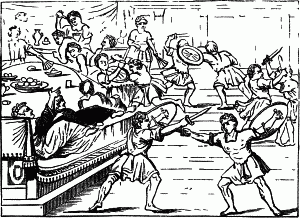
Romulus traced out the form of the city with the plough, and made it almost a square. He called the name of it Rome, and lived in the midst of it in a mud-hovel, covered with thatch, in the midst of about fifty families of the old Trojan race, and a great many young men, outlaws and runaways from the neighboring states, who had joined him. The date of the building of Rome was supposed to be A.D. 753; and the Romans counted their years from it, as the Greeks did from the Olympiads, marking the date A.U.C., anno urbis conditæ, the year of the city being built. The youths who joined Romulus could not marry, as no one of the neighboring nations would give his daughter to one of these robbers, as they were esteemed. The nearest neighbors to Rome were the Sabines, and the Romans cast their eyes in vain on the Sabine ladies, till old Numitor advised Romulus to proclaim a great feast in honor of Neptune, with games and dances. All the people in the country round came to it, and when the revelry was at its height each of the unwedded Romans seized on a Sabine maiden and carried her away to his own house. Six hundred and eighty-three girls were thus seized, and the next day Romulus married them all after the fashion ever after observed in Rome. There was a great sacrifice, then each damsel was told, "Partake of your husband's fire and water;" he gave her a ring, and carried her over his threshold, where a sheepskin was spread, to show that her duty would be to spin wool for him, and she became his wife.
Romulus himself won his own wife, Hersilia, among the Sabines on this occasion; but the nation of course took up arms, under their king Tatius, to recover their daughters. Romulus drew out his troops into Campus Martius, or field of Mars, just beneath the Capitol, or great fort on the Saturnian Hill, and marched against the Sabines; but while he was absent, Tarpeia, the daughter of the governor of the little fort he had left on the Saturnian Hill, promised to let the Sabines in on condition they would give her what they wore on their left arms, meaning their bracelets; but they hated her treason even while they took advantage of it, and no sooner were they within the gate than they pelted her with their heavy shields, which they wore on their left arms, and killed her. The cliff on the top of which she died is still called the Tarpeian rock, and criminals were executed by being thrown from the top of it. Romulus tried to regain the Capitol, but the Sabines rolled down stones on the Romans, and he was stunned by one that struck him on the head; and though he quickly recovered and rallied his men, the battle was going against him, when all the Sabine women, who had been nearly two years Roman wives, came rushing out, with their little children in their arms and their hair flying, begging their fathers and husbands not to kill one another. This led to the making of a peace, and it was agreed that the Sabines and Romans should make but one nation, and that Romulus and Tatius should reign together at Rome. Romulus lived on the Palatine Hill, Tatius on the Tarpeian, and the valley between was called the Forum, and was the market-place, and also the spot where all public assemblies were held. All the chief arrangements for war and government were believed by the Romans to have been laws of Romulus. However, after five years, Tatius was murdered at a place called Lavinium, in the middle of a sacrifice, and Romulus reigned alone till in the middle of a great assembly of his soldiers outside the city, a storm of thunder and lightning came on, and every one hurried home, but the king was nowhere to be found; for, as some say, his father Mars had come down in the tempest and carried him away to reign with the gods, while others declared that he was murdered by persons, each of whom carried home a fragment of his body that it might never be found. It matters less which way we tell it, since the story of Romulus was quite as much a fable as that of Æneas; only it must be remembered as the Romans themselves believed it. They worshipped Romulus under the name of Quirinus, and called their chief families Quirites, both words coming from ger (a spear); and the she-wolf and twins were the favorite badge of the empire. The Capitoline Hill, the Palatine, and the Forum all still bear the same names.