Domitian is called the last of the twelve Cæsars, though all who came after him called themselves Cæsar. He had no son, and a highly esteemed old senator named Cocceius Nerva became Emperor. He was an upright man, who tried to restore the old Roman spirit; and as he thought Christianity was only a superstition which spoiled the ancient temper, he enacted that all should die who would not offer incense to the gods, and among these died St. Ignatius, Bishop of Antioch, who had been bred up among the Apostles. He was taken to Rome, saw his friend St. Polycarp, Bishop of Smyrna, on the way, and wrote him one of a set of letters which remain to this day. He was then thrown to the lions in the Colosseum.
It seems strange that the good Emperors were often worse persecutors than the bad ones, but the fact was that the bad ones let the people do as they pleased, as long as they did not offend them; while the good ones were trying to bring back what they read of in Livy's history, of plain living and high thinking, and shut their ears to knowing more of the Christians than that they were people who did not worship the gods. Moreover, Julius Trajanus, whom Nerva adopted, and who began to reign after him in 98, did not persecute actively, but there were laws in force against the Christians. When Pliny the younger was proprætor of the province of Pontica in Asia Minor, he wrote to ask the Emperor what to do about the Christians, telling him what he had been able to find out about them from two slave girls who had been tortured; namely, that they were wont to meet together at night or early morning, to sing together, and eat what he called a harmless social meal. Trajan answered that he need not try to hunt them out, but that, if they were brought before him, the law must take its course. In Rome, the chief refuge of the Christians was in the Catacombs, or quarries of tufa, from which the city was chiefly built, and which were hollowed out in long galleries. Slaves and convicts worked them, and they were thus made known to the Christians, who buried their dead in places hollowed at the sides, used the galleries for their churches, and often hid there when there was search made for them.
Trajan was so good a ruler that he bears the title of Optimus, the Best, as no one else has ever done. He was a great captain too, and conquered Dacia, the country between the rivers Danube, Theiss, and Pruth, and the Carpathian Hills; and he also defeated the Parthians, and said if he had been a younger man he would have gone as far as Alexander. As it was, the empire was at its very largest in his reign, and he was a very great builder and improver, so that one of his successors called him a wall-flower, because his name was everywhere to be seen on walls and bridges and roads—some of which still remain, as does his tall column at Rome, with a spiral line of his conquests engraven round it from top to bottom. He was on his way back from the East when, in 117, he died at Cilicia, leaving the empire to another brave warrior, Publius Ætius Hadrianus, who took the command with great vigor, but found he could not keep Dacia, and broke down the bridge over the Danube. He came to Britain, where the Roman settlements were tormented by the Picts. There he built the famous Roman wall from sea to sea to keep them out. He was wonderfully active, and hastened from one end of the empire to the other wherever his presence was needed. There was a revolt of the Jews in the far East, under a man who pretended to be the Messiah, and called himself the Son of a Star. This was put down most severely, and no Jew was allowed to come near Jerusalem, over which a new city was built, and called after the Emperor's second name, Ælia Capitolina; and, to drive the Jews further away, a temple to Jupiter was built where the Temple had been, and one to Venus on Mount Calvary.
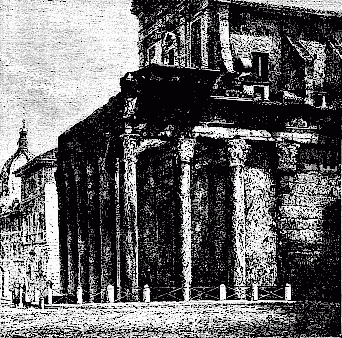
But Hadrian did not persecute, and listened kindly to an explanation of the faith which was shown him at Athens by Quadratus, a Christian philosopher. Hadrian built himself a grand towerlike monument, surrounded by stages of columns and arches, which was to be called the Mole of Hadrian, and still stands, though stripped of its ornaments. Before his death, in 138, he had chosen his successor, Titus Aurelius Antoninus, a good upright man, a philosopher, and 52 years old; for it had been found that youths who became Emperors had their heads turned by such unbounded power, while elder men cared for the work and duty. Antoninus was so earnest for his people's welfare that they called him Pius. He avoided wars, only defended the empire; but he was a great builder, for he raised another rampart in Britain, much further north, and set up another column at Rome, and in Gaul built a great amphitheatre at Nismes, and raised the wonderful aqueduct which is still standing, and is called the Pont du Gard.
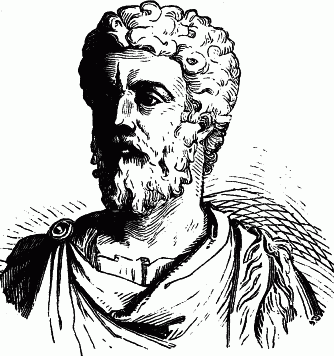
His son-in-law, whom he adopted and who succeeded him, is commonly called Marcus Aurelius, as a choice among his many names. He was a deep student and Stoic philosopher, with an earnest longing for truth and virtue, though he knew not how to seek them where alone they could be found; and when earthquake, pestilence and war fell on his empire, and the people thought the gods were offended, he let them persecute the Christians, whose faith he despised, because the hope of Resurrection and of Heaven seemed weak and foolish to him beside his stern, proud, hopeless Stoicism. So the aged Polycarp, Bishop of Smyrna, the last pupil of the Apostles themselves, was sentenced to be burnt in the theatre of his own city, though, as the fire curled round him in a curtain of flame without touching him, he was actually slain with the sword. And in Gaul, especially at Vienne, there was a fearful persecution which fell on women of all ranks, and where Blandina the slave, under the most unspeakable torments, was specially noted for her brave patience.
Aurelius was fighting hard with the German tribes on the Danube, who gave him no rest, and threatened to break into the empire. While pursuing them, he and his army were shut into a strong place where they could get no water, and were perishing with thirst, when a whole legion, all Christian soldiers, knelt down and prayed. A cloud came up, a welcome shower of rain descended, and was the saving of the thirsty host. It was said that the name of the Thundering Legion was given to this division in consequence, though on the column reared by Aurelius it is Jupiter who is shown sending rain on the thirsty host, who are catching it in their shields. After this there was less persecution, but every sort of trouble—plague, earthquake, famine, and war—beset the empire on all sides, and the Emperor toiled in vain against these troubles, writing, meantime, meditations that show how sad and sick at heart he was, and how little comfort philosophy gave him, while his eyes were blind to the truth. He died of a fever in his camp, while still in the prime of life, in the year 180, and with him ended the period of good Emperors, which the Romans call the age of the Antonines. Aurelius was indeed succeeded by his son Commodus, but he was a foolish good-for-nothing youth, who would not bear the fatigues and toils of real war, though he had no shame in showing off in the arena, and is said to have fought there seven hundred and fifty times, besides killing wild beasts. He boasted of having slain one hundred lions with one hundred arrows, and a whole row of ostriches with half-moon shaped arrows which cut off their heads, the poor things being fastened where he could not miss them, and the Romans applauding as if for some noble deed. They let him reign sixteen years before he was murdered, and then a good old soldier named Pertinax began to reign; but the Prætorian Guard had in those sixteen years grown disorderly, and the moment they felt the pressure of a firm hand they attacked the palace, killed the Emperor, cut off his head, and ran with it to the senate-house, asking who would be Emperor. An old senator was foolish enough to offer them a large sum if they would choose him, and this put it into their heads to rush out to the ramparts and proclaim that they would sell the empire to the highest bidder.
A vain, old, rich senator, named Didius Julianus, was at supper with his family when he heard that the Prætorians were selling the empire by auction, and out he ran, and actually bought it at the rate of about £200 to each man. The Emperor being really the commander-in-chief, with other offices attached to the dignity, the soldiers had a sort of right to the choice; but the other armies at a distance, who were really fighting and guarding the empire, had no notion of letting the matter be settled by the Prætorians, mere guardsmen, who stayed at home and tried to rule the rest; so each army chose its own general and marched on Rome, and it was the general on the Danube, Septimius Severus, who got there first; whereupon the Prætorians killed their foolish Emperor and joined him.