It was understood between the Romans and the Sabines that they should have by turns a king from each nation, and, on the disappearance of Romulus, a Sabine was chosen, named Numa Pompilius, who had been married to Tatia, the daughter of the Sabine king Tatius, but she was dead, and had left one daughter. Numa had, ever since her death, been going about from one grove or fountain sacred to the gods to another offering up sacrifices, and he was much beloved for his gentleness and wisdom. There was a grove near Rome, in a valley, where a fountain gushed forth from the rock; and here Egeria, the nymph of the stream, in the shade of the trees, counselled Numa on his government, which was so wise that he lived at peace with all his neighbors. When the Romans doubted whether it was really a goddess who inspired him, Egeria convinced them, for the next time he had any guests in his house, the earthenware plates with homely fare on them were changed before their eyes into golden dishes with dainty food. Moreover, there was brought from heaven a bronze shield, which was to be carefully kept, since Rome would never fall while it was safe. Numa had eleven other shields like it made and hung in the temple of Mars, and, yearly, a set of men dedicated to the office bore them through the city with songs and dances. Just as all warlike customs were said to have been invented by Romulus, all peaceful and religious ones were held to have sprung from Numa and his Egeria. He was said to have fixed the calendar and invented the names of the months, and to have built an altar to Good Faith to teach the Romans to keep their word to one another and to all nations, and to have dedicated the bounds of each estate to the Dii Termini, or Landmark Gods, in whose honor there was a feast yearly. He also was said to have had such power with Jupiter as to have persuaded him to be content without receiving sacrifices of men and women. In short, all the better things in the Roman system were supposed to be due to the gentle Numa.
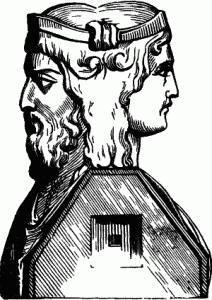
At the gate called Janiculum stood a temple to the watchman god Janus, whose figure had two faces, and held the keys, and after whom was named the month January. His temple was always open in time of war, and closed in time of peace. Numa's reign was counted as the first out of only three times in Roman history that it was shut.
Numa was said to have reigned thirty-eight years, and then he gradually faded away, and was buried in a stone coffin outside the Janicular gate, all the books he had written being, by his desire, buried with him. Egeria wept till she became a fountain in her own valley; and so ended what in Roman faith answered to the golden age of Greece.
The next king was of Roman birth, and was named Tullus Hostilius. He was a great warrior, and had a war with the Albans until it was agreed that the two cities should join together in one, as the Romans and Sabines had done before; but there was a dispute which should be the greater city in the league and it was determined to settle it by a combat. In each city there was a family where three sons had been born at a birth, and their mothers were sisters. Both sets were of the same age—fine young men, skilled in weapons; and it was agreed that the six should fight together, the three whose family name was Horatius on the Roman side, the three called Curiatius on the Alban side, and whichever set gained the mastery was to give it to his city.
They fought in the plain between the camps, and very hard was the strife until two of the Horatii were killed and all the three Curiatii were wounded, but the last Horatius was entirely untouched. He began to run, and his cousins pursued him, but at different distances, as one was less hindered by his wound than the others. As soon as the first came up. Horatius slew him, and so the second and the third: as he cut down this last he cried out, "To the glory of Rome I sacrifice thee." As the Alban king saw his champion fall, he turned to Tullus Hostilius and asked what his commands were. "Only to have the Alban youth ready when I need them," said Tullus.
A wreath was set on the victor's head, and, loaded with the spoil of the Curiatii, he was led into the city in triumph. His sister came hurrying to meet him; she was betrothed to one of the Curiatii, and was in agony to know his fate; and when she saw the garment she had spun for him hanging blood-stained over her brother's shoulders, she burst into loud lamentations. Horatius, still hot with fury, struck her dead on the spot, crying, "So perish every Roman who mourns the death of an enemy of his country." Even her father approved the cruel deed, and would not bury her in his family tomb—so stern were Roman feelings, putting the honor of the country above everything. However, Horatius was brought before the king for the murder, and was sentenced to die; but the people entreated that their champion might be spared, and he was only made to pass under what was called the yoke, namely, spears set up like a doorway.
Tullus Hostilius gained several victories over his neighbors, but he was harsh and presuming, and offended the gods, and, when he was using some spell such as good Numa had used to hold converse with Jupiter, the angry god sent lightning and burnt up him and his family. The people then chose Ancus Martins, the son of Numa's daughter, who is said to have ruled in his grandfather's spirit, though he could not avoid wars with the Latins. The first bridge over the Tiber, named the Sublician, was said to have been built by him. In his time there came to Rome a family called Tarquin. Their father was a Corinthian, who had settled in an Etruscan town named Tarquinii, whence came the family name. He was said to have first taught writing in Italy, and, indeed, the Roman letters which we still use are Greek letters made simpler. His eldest son, finding that because of his foreign blood he could rise to no honors in Etruria, set off with his wife Tanaquil, and their little son Lucius Tarquinius, to settle in Rome. Just as they came in sight of Rome, an eagle swooped down from the sky, snatched off little Tarquin's cap, and flew up with it, but the next moment came down again and put it back on his head. On this Tanaquil foretold that her son would be a great king, and he became so famous a warrior when he grew up, that, as the children of Ancus were too young to reign at their father's death, he was chosen king. He is said to have been the first Roman king who wore a purple robe and golden crown, and in the valley between the Palatine and Aventine Hills he made a circus, where games could be held like those of the Greeks; also he placed stone benches and stalls for shops round the Forum, and built a stone wall instead of a mud one round the city. He is commonly called Tarquinus Priscus, or the elder.
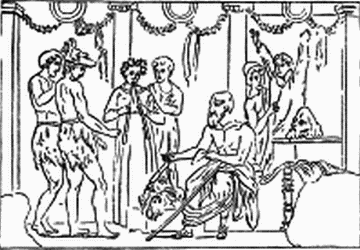
There was a fair slave girl in his house, who was offering cakes to Lar, the household spirit, when he appeared to her in bodily form. When she told the king's mother, Tanaquil, she said it was a token that he wanted to marry her, and arrayed her as a bride for him. Of this marriage there sprang a boy called Servius Tullus. When this child lay asleep, bright flames played about his head, and Tanaquil knew he would be great, so she caused her son Tarquin to give him his daughter in marriage when he grew up. This greatly offended the two sons of Ancus Martius, and they hired two young men to come before him as wood-cutters, with axes over their shoulders, pretending to have a quarrel about some goats, and while he was listening to their cause they cut him down and mortally wounded him. He had lost his sons, and had only two baby grandsons, Aruns and Tarquin, who could not reign as yet; but while he was dying, Tanaquil stood at the window and declared that he was only stunned and would soon be well. This, as she intended, so frightened the sons of Ancus that they fled from Rome; and Servius Tullus, coming forth in the royal robes, was at once hailed as king by all the people of Rome, being thus made king that he might protect his wife's two young nephews, the two little Tarquins.