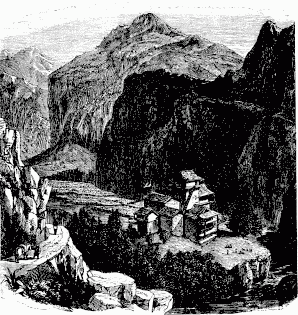
The Frank, Arbogastes, who had killed Valentinian did not make himself Emperor, but set up a heathen philosopher called Eugenius, who for a little while restored all the heathen pomp and splendor, and opened the temples again, threatening even to take away the churches and turn the chief one at Milan into a stable. They knew that Theodosius would soon come to attack them, so they prepared for a great resistance in the passes of the Julian Alps, and the image of the Thundering Jupiter was placed to guard them.
Theodosius had collected his troops and marched under the Labarum—that is to say, the Cross of Constantine, which had been the ensign of the imperial army ever since the battle of the Milvian Bridge. It was the cross combined with the two first Greek letters of the name Christ, [Symbol: Greek chi & rho combined], and was carried, as the eagles had been, above a purple silk banner. The men of Eugenius bore before them a figure of Hercules, and in the first battle they gained the advantage, for the more ignorant Eastern soldiers, though Christians, could not get rid of the notion that there was some sort of power in a heathen god, and thought Jupiter and Hercules were too strong for them.
But Theodosius rallied them and led them back, so that they gained a great victory, and a terrible storm and whirlwind which fell at the same time upon the host of Eugenius made the Christian army feel the more sure that God fought on their side. Eugenius was taken and put to death, and Arbogastes fell on his own sword.
Theodosius thus united the empires of the East and West once more. He was a brave and gallant soldier, and a good and conscientious man, and was much loved and honored; but he could be stern and passionate, and he was likewise greatly feared. At Antioch, the people had been much offended at a tax which Theodosius had laid on them; they rose in rebellion, overthrew his statues and those of his family, and dragged them about in the mud. No sooner was this done than they began to be shocked and terrified, especially because of the insult to the statue of the Empress, who was lately dead after a most kind and charitable life. The citizens in haste sent off messengers, with the Bishop at their head, to declare their grief and sorrow, and entreat the Emperor's pardon. All the time they were gone the city gave itself up to prayer and fasting, listening to sermons from the priest, John—called from his eloquence Chrysostom, or Golden Mouth—who preached repentance for all the most frequent sins, such as love of pleasure, irreverence at church, etc. The Bishop on his way met the Emperor's deputies who were charged to enquire into the crime and punish the people; and he redoubled his speed in reaching Constantinople, where he so pleaded the cause of the people that Theodosius freely forgave them, and sent him home to keep a happy Easter with them. This was while he was still Emperor only of the East.
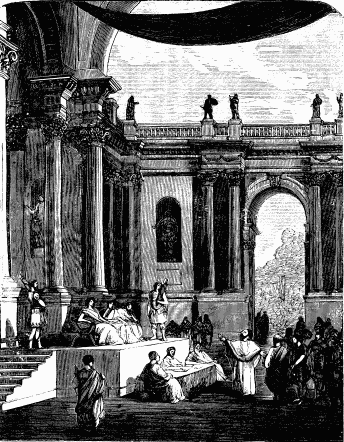
But when he was in Italy with Valentinian, three years later, there was another great sedition at Thessalonica. The people there were as mad as were most of the citizens of the larger towns upon the sports of the amphitheatre, and were vehemently fond of the charioteers whom they admired on either side. Just before some races that were expected, one of the favorite drivers committed a crime for which he was imprisoned. The people, wild with fury, rose and called for his release; and when this was denied to them, they fell on the magistrates with stones, and killed the chief of them, Botheric, the commander of the forces. The news was taken to Milan, where the Emperor then was, and his wrath was so great and terrible that he commanded that the whole city should suffer. The soldiers, who were glad both to revenge their captain and to gain plunder, hastened to put his command into execution; the unhappy people were collected in the circus, and slaughtered so rapidly and suddenly, that when Theodosius began to recover from his passion, and sent to stay the hands of the slayers, they found the city burning and the streets full of corpses.
St. Ambrose felt it his duty to speak forth in the name of the Church against such fury and cruelty; and when Theodosius presented himself at the church door to come to the Holy Communion, Ambrose met him there, and turned him back as a blood-stained sinner unfit to partake of the heavenly feast, and bidding him not add sacrilege to murder.
Theodosius pleaded that David had sinned even more deeply, and yet had been forgiven. "If you have sinned like him, repent like him," said Ambrose; and the Emperor went back weeping to his palace, there to remain as a penitent. Easter was the usual time for receiving penitents back to the Church, but at Christmas the Emperor presented himself again, hoping to win the Bishop's consent to his return at once; but Ambrose was firm, and again met him at the gate, rebuking him for trying to break the rules of the Church.
"No," said Theodosius; "I am not come to break the laws, but to entreat you to imitate the mercy of God whom we serve, who opens the gates of mercy to contrite sinners."
On seeing how deep was his repentance, Ambrose allowed him to enter the Church, though it was not for some time that he was admitted to the Holy Communion, and all that time he fasted and never put on his imperial robes. He also made a law that no sentence of death should be carried out till thirty days after it was given, so as to give time to see whether it were hasty or just.
During this reign another heresy sprang up, denying the Godhead of God the Holy Ghost, and, in consequence, Theodosius called together another Council of the Church, at which was added to the Nicene Creed those latter sentences which follow the words, "I believe in the Holy Ghost." In this reign, too, began to be sung the Te Deum, which is generally known as the hymn of St. Ambrose. It was first used at Milan, but whether he wrote it or not is uncertain, though there is a story that he had it sung for the first time at the baptism of St. Augustine.
Theodosius only lived six months after his defeat of Eugenius, dying at Milan in 395, when only fifty years old. He was the last who really deserved the name of a Roman Emperor, though the title was kept up, and Rome had still much to undergo. He left two young sons named Arcadius and Honorius, between whom the empire was divided.