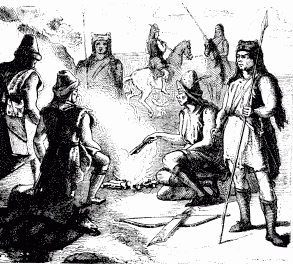
The terrible enemy who was coming against the unhappy Roman Empire was the nation of Huns, a wild, savage race, who were of the same stock as the Tartars, and dwelt as they do in the northern parts of Asia, keeping huge herds of horses, spending their life on horseback, and using mares' milk as food. They were an ugly, small, but active race, and used to cut their children's faces that the scars might make them look more terrible to their enemies. Just at this time a great spirit of conquest had come upon them, and they had, as said before, driven the Goths over the Danube fifty years ago, and seized the lands we still call Hungary. A most mighty and warlike chief called Attila had become their head, and wherever he went his track was marked by blood and flame, so that he was called "The Scourge of God." His home was on the banks of the Theiss, in a camp enclosed with trunks of trees, for he did not care to dwell in cities or establish a kingdom, though the wild tribes of Huns from the furthest parts of Asia followed his standard—a sword fastened to a pole, which was said to be also his idol.
He threatened to fall upon the two empires, and an embassy was sent to him at his camp. The Huns would not dismount, and thus the Romans were forced to address them on horseback. The only condition upon which he would abstain from invading the empire was the paying of an enormous tribute, beyond what almost any power of theirs could attempt to raise. However, he did not then attack Italy, but turned upon Gaul. So much was he hated and dreaded by the Teutonic nations, that all Goths, Franks, and Burgundians flocked to join the Roman forces under Aëtius to drive him back. They came just in time to save the city of Orleans from being ravaged by him, and defeated him in the battle of Chalons with a great slaughter; but he made good his retreat from Gaul with an immense number of captives, whom he killed in revenge.
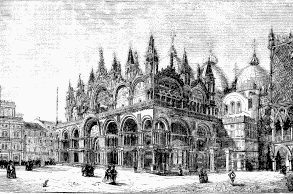
The next year he demanded that Valentinian's sister, Honoria, should be given to him, and when she was refused, he led his host into Italy and destroyed all the beautiful cities of the north. A great many of the inhabitants fled into the islands among the salt marshes and pools at the head of the Adriatic Sea, between the mouths of the rivers Po and Adige, where no enemy could reach them; and there they built houses and made a town, which in time became the great city of Venice, the queen of the Adriatic.
Aëtius was still in Gaul, the wretched Valentinian at Ravenna was helpless and useless, and Attila proceeded towards Rome. It was well for Rome that she had a brave and devoted Pope in Leo. I., who went out at the head of his clergy to meet the barbarian in his tent, and threaten him with the wrath of Heaven if he should let loose his cruel followers upon the city. Attila was struck with his calm greatness, and, remembering that Alaric had died soon after plundering Rome, became afraid. He consented to accept of Honoria's dowry instead of herself, and to be content with a great ransom for the city of Rome. He then turned to his camp on the Danube with all his horde, and soon after his arrival he married a young girl whom he had made prisoner. The next morning he was found dead on his bed in a pool of his own blood, and she was gone; but as there was no wound about him, it was thought that he had broken a blood-vessel in the drunken fit in which he fell asleep, and that she had fled in terror. His warriors tore their cheeks with their daggers, saying that he ought to be mourned only with tears of blood; but as they had no chief as able and daring as he, they gradually fell back again to their north-eastern settlements, and troubled Europe no more.
Valentinian thought the danger over, and when Aëtius came back to Ravenna, he grew jealous of his glory and stabbed him with his own hand. Soon after he offended a senator named Maximus, who killed him in revenge, became Emperor, and married his widow, Eudoxia, the daughter of Theodosius II. of Constantinople, telling her that it was for love of her that her husband was slain. Eudoxia sent a message to invite the dreadful Genseric, king of the Vandals, to come and deliver her from a rebel who had slain the lawful Emperor. Genseric's ships were ready, and sailed into the Tiber; while the Romans, mad with terror, stoned Maximus in their streets. Nobody had any courage or resolution but the Pope Leo, who went forth again to meet the barbarian and plead for his city; but Genseric being an Arian, had not the same awe of him as the wild Huns, hated the Catholics, and was eager for the prey. He would accept no ransom instead of the plunder, but promised that the lives of the Romans should be spared. This was the most dreadful calamity that Rome, once the queen of cities, had undergone. The pillage lasted fourteen days, and the Vandals stripped churches, houses, and all alike, putting their booty on board their ships; but much was lost in a storm between Italy and Africa. The golden candlestick and shew-bread table belonging to the Temple at Jerusalem were carried off to Carthage with the spoil, and no less than sixty thousand captives, among them the Empress Eudoxia, who had been the means of bringing in Genseric, with her two daughters. The Empress was given back to her friends at Constantinople, but one of her daughters was kept by the Vandals, and was married to the son of Genseric. After plundering all the south of Italy, Genseric went back to Africa without trying to keep Rome or set up a kingdom; and when he was gone, the Romans elected as Emperor a senator named Avitus, a Gaul by birth, a peaceful and good man.
His daughter had married a most excellent Gaulish gentleman named Sidonius Apollinaris, who wrote such good poetry that the Romans placed his bust crowned with laurel in the Capitol. He wrote many letters, too, which are preserved to this time, and show that, in the midst of all this crumbling power of Rome, people in Southern Gaul managed to have many peaceful days of pleasant country life. But Sidonius' quiet days came to an end when, layman and lawyer as he was, the people of Clermont begged him to be their Bishop. The Church stood, whatever fell, and people trusted more to their Bishop than to any one else, and wanted him to be the ablest man they could find. So Sidonius took the charge of them, and helped them to hold out their mountain city of Clermont for a whole year against the Goths, and gained good terms for them at last, though he himself had to suffer imprisonment and exile from these Arian Goths because of his Catholic faith.