The Teutonic nations soon lost their spirit when they had settled in the luxurious Roman cities, and as they were as fierce as ever, their kings tore one another to pieces. A very able Emperor, named Justinian, had come to the throne in the East, and in his armies there had grown up a Thracian who was one of the greatest and best generals the world has ever seen. His name was Belisarius, and strange to say, both he and the Emperor had married the daughters of two charioteers in the circus races. The Empress was named Theodora, the general's wife Antonina, and their acquaintance first made Belisarius known to Justinian, who, by his means, ended by winning back great part of the Western Empire.
He began with Africa, where Genseric's grandson was reigning over the Vandals, and paying so little heed to his defences that Belisarius landed without any warning, and called all the multitudes of old Roman inhabitants to join him, which they joyfully did. He defeated the Vandals in battle, entered Carthage, and restored the power of the empire. He brought away the golden candlestick and treasures of the Temple, and the cross believed to be the true one, and carried them to Constantinople, whence the Emperor sent them back to the Church of the Holy Sepulchre at Jerusalem.
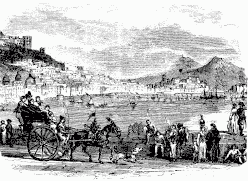
Just as Belisarius had returned to Constantinople, a piteous entreaty came to Justinian from Amalosontha, the daughter of Theodoric, who had been made prisoner by Theodotus, the husband she had chosen. It seemed to be opening a way for getting back Italy, and Justinian sent off Belisarius; but before he had sailed, the poor Gothic queen had been strangled in her bath. Belisarius, however, with 4500 horse and 3000 foot soldiers, landed in Sicily and soon conquered the whole island, all the people rejoicing in his coming. He then crossed to Rhegium, and laid siege to Naples. As usual, the inhabitants were his friends, and one of them showed him the way to enter the city through an old aqueduct which opened into an old woman's garden.
Theodotus was a coward as well as a murderer, and fled away, while a brave warrior named Vitiges was proclaimed king by the Goths at Rome. But with the broken walls and all the Roman citizens against him, Vitiges thought it best not to try to hold out against Belisarius, and retreated to Ravenna, while Rome welcomed the Eastern army as deliverers. But Vitiges was collecting an army at Ravenna, and in three months was besieging Rome again. Never had there been greater bravery and patience than Vitiges showed outside the walls of Rome, and Belisarius inside, during the summer of 536. There was a terrible famine within; all kinds of strange food were used in scanty measure, and the Romans were so impatient of suffering, that Belisarius was forced to watch them day and night to prevent them betraying him to the enemy. Indeed, while the siege lasted a whole year, nearly all the people of Rome died of hunger and wretchedness; and the Goths, in the unhealthy Campagna around, died of fevers and agues, until they, too, had all perished except a small band, which Vitiges led back to Ravenna, whither Belisarius followed him, besieged him, made him prisoner, and carried him to Constantinople. Justinian gave him an estate where he could live in peace.
The Moors in Africa revolted, and Belisarius next went to subdue them. While he was there, the Goths in Italy began to recover from the blow he had given them, and chose a brave young man named Totila to be their king. In a very short time he had won back almost all Italy, for there really were hardly any men left, and even Justinian had only two small armies to dispose of, and those made up of Thracians and Isaurians from the shores of the Black Sea. One of these was sent with Belisarius to attack the Goths, but was not strong enough to do more than just hold Totila in check, and Justinian would not even send him all the help possible, because he dreaded the love the army bore to him. After four years of fighting with Totila he was recalled, and a slave named Narces, who had always lived in the women's apartment in the palace, was sent to take the command. He was really able and skilled, and being better supported, he gained a great victory near Rome, in which Totila was killed, and another near Naples, which quite overcame the Ostrogoths, so that they never became a power again. Italy was restored to the Empire, and was governed by an officer from Constantinople, who lived at Ravenna, and was called the Exarch.
Belisarius, in the meantime, was sent to fight with the king of Persia, Chosroës, a very warlike prince, who had overrun Syria and carried off many prisoners from Antioch. Belisarius gained victory after victory over him, and had just driven him back over the rivers, when again came a recall, and Narses was sent out to finish the war. Theodora, the Empress, wanted to reign after her husband, and had heard that, on a report coming to the army of his death, Belisarius had said that he should give his vote for Justin, the right heir. So she worked on the fears all Emperors had—that their troops might proclaim a successful general as Emperor, and again Belisarius was ordered home, while Narses was sent to finish what he had begun.
There was one more war for this great man when the wild Bulgarians invaded Thrace, and though his soldiers were little better than timid peasants, he drove them back and saved the country. But Justinian grew more and more jealous of him, and, fancying untruly that he was in a plot for placing Justin on the throne, caused him to be thrown into prison, and sent him out from thence stripped of everything, and with his eyes torn out. He found a little child to lead him to a church door, where he used to sit with a wooden dish before him for alms. When it was known who the blind beggar was, there was such an uproar among the people that Justinian was obliged to give him back his palace and some of his riches; but he did not live much longer.
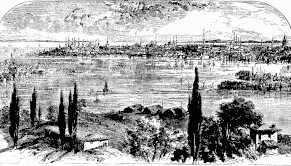
Though Justinian behaved so unjustly and ungratefully to this great man and faithful servant, he is noted for better things, namely, for making the Church of St. Sophia, or the Holy Wisdom, which Constantine had built at Constantinople, the most splendid of all buildings, and for having the whole body of Roman laws thoroughly overlooked and put into order. Many even of the old heathen laws were very good ones, but there were others connected with idolatry that needed to be done away with; and in the course of years so many laws and alterations had been made, that it was the study of a lifetime even to know what they were, or how to act on them. Justinian set his best lawyers to put them all in order, so that it might be more easy to work by them. The Roman citizens in Greece, Italy, and all the lands overrun by the Teutonic nations were still judged by their own laws, so that this was a very useful work; and it was so well done that the conquerors took them up in time, and the Roman law was the great model studied everywhere by those who wished to understand the rules of jurisprudence, that is, of law and justice. Thus in another way Rome conquered her conquerors.
Justinian died in 563, and was succeeded by his nephew Justin, whose wife Sophia behaved almost as ill to Narses as Theodora had done to Belisarius, for while he was doing his best to defend Italy from the savage tribes who were ready at any moment to come over the Alps, she sent him a distaff, and ordered him back to his old slavery in the palace.