No sooner was Narses called home than another terrible nation of Teutones, who had hitherto dwelt in the North, began to come over the Alps. These were the Longbeards, or Lombards, as they were more commonly called; fierce and still heathen. Their king, Alboin, had carried off Rosamond, the daughter of Kunimund, king of the Gepids, another Teutonic tribe. There was a most terrible war, in which Kunimund was killed and all his tribe broken up and joined with the Lombards. With the two united, Alboin invaded Italy and conquered all the North. Ravenna, Verona, Milan, and all the large towns held out bravely against them, but were taken at last, except Venice, which still owned the Emperor at Constantinople. Alboin had kept the skull of Kunimund as a trophy, and had had it set in gold for a drinking-cup, as his wild faith made him believe that the reward of the brave in the other world would be to drink mead from the skulls of their fallen enemies. In a drunken fit at Verona, he sent for Rosamond and made her pledge him in this horrible cup. She had always hated him, and this made her revenge her father's death by stabbing him to the heart in the year 573. The Lombard power did not, however, fall with him; his nephew succeeded him, and ruled over the country we still call Lombardy. Rome was not taken by them, but was still in name belonging to the Emperor, though he had little power there, and the Senate governed it in name, with all the old magistrates. The Prætor at the time the Lombards arrived was a man of one of the old noble families, Anicius Gregorius, or, as we have learned to call him, Gregory. He had always been a good and pious man, and while he took great care to fulfil all the duties of his office, his mind was more and more drawn away from the world, till at last he became a monk of St. Benedict, gave all his vast wealth to build and endow monasteries and hospitals, and lived himself in an hospital for beggars, nursing them, studying the Holy Scriptures, and living only on pulse, which his mother sent him every day in a silver dish—the only remnant of his wealth—till one day, having nothing else to give a shipwrecked sailor who asked alms, he bestowed it on him.
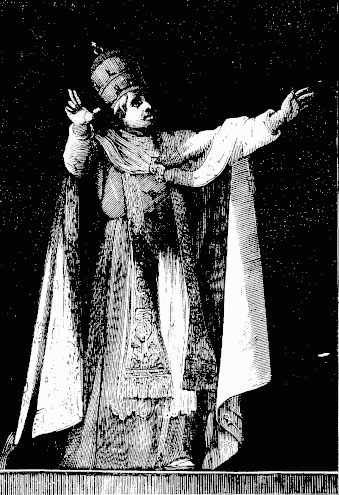
He was made one of the seven deacons who were called Cardinal Deacons, because they had charge of the poor of the principal parishes of Rome; and it was when going about on some errand of kindness that he saw the English slave children in the market, and planned the conversion of their country; but the people would not let him leave Rome, and in 590, the Senate, the clergy, and the people chose him Pope. It was just then that a terrible pestilence fell on Rome, and he made the people form seven great processions—of clergy, of monks, of nuns, of children, of men, of wives, and of widows—all singing litanies to entreat that the plague might be turned away. Then it was that he beheld an angel standing on the tomb of Hadrian, and the plague ceased. Ever after, the great old tomb has been called the Castle of St. Angelo.
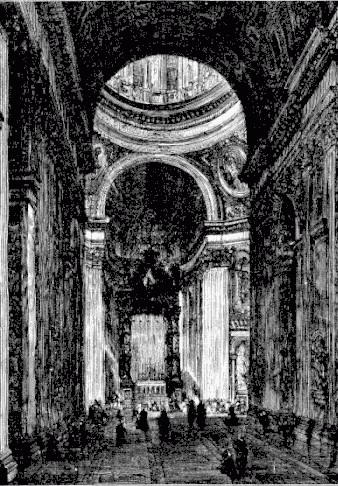
It was a troublous time, but Gregory was so much respected that he was able to keep Rome orderly and safe, and to make peace between the Emperor Maurice and the Lombards' king, Agilulf, who had an excellent wife, Theodolinda. She was a great friend of the Pope, wrote a letter to him, and did all she could to support him. The Eastern Empire was still owned at Rome, but when there was an attempt to make out that the Patriarch of Constantinople was superior to the Pope, Gregory upheld the principle that no Patriarch had any right to be above the rest, nor to be called Universal Bishop. Gregory was a very great man, and the justice and wisdom of his management did much to make the Romans look to their Pope as the head of affairs even after his death in 604.
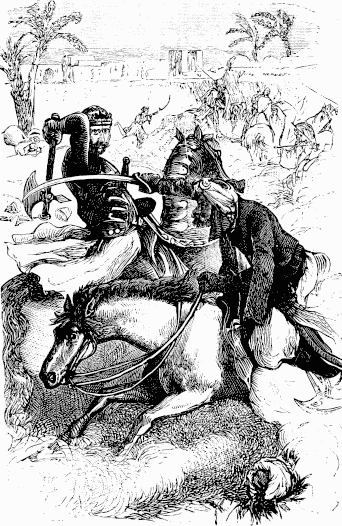
The Greek Empire sent an officer to govern the extreme South of Italy, which, like Rome and Venice, still owned the Emperor; but all the troops that could be hired were soon wanted to fight with the Arabs, whose false prophet Mahommed had taught them to spread religion with the sword. There was no one capable of making head against the Lombards, and the Popes only kept them off by treaties and good management; and at last, in 741, Pope Gregory III. put himself under the protection of Charles Martel, the great Frank captain who had beaten the Mahometans at the battle of Tours. Charles Martel was rewarded by being made a Roman senator, so was his son Pippin, who was also king of the Franks, and his grandson Charles the Great, who had to come often to Italy to protect Rome, and at last broke up the Lombard kingdom, was chosen Roman Emperor as of old, and crowned by Pope Leo III. in the year 800. From that time there was again the Western Empire, commonly called the Holy Roman Empire, the Emperor, or Cæsar—Kaisar, as the Germans still call him—being generally also king of Germany and king of Lombardy. Rome was all this time chiefly under the power of the Popes, who grew in course of years to be more and more of princes, and at the same time to claim more power over the Church, calling themselves Universal Bishops contrary to the teaching of St. Gregory the Great. All this, however, belongs to the history of Europe in modern times, and will be found in the history of Germany, since there were many struggles between the Popes and Emperors. For Rome has really had two histories, and those who visit Rome and study the wonderful buildings there may dwell on the old or the new, the pagan or the Christian, as their minds lead them, or else on that strange middle time when idolatry and Christianity were struggling together.