Servius Tullus was looked on by the Romans as having begun making their laws, as Romulus had put their warlike affairs in order, and Numa had settled their religion. The Romans were all in great clans or families, all with one name, and these were classed in tribes. The nobler ones, who could count up from old Trojan, Latin, or Sabine families, were called Patricians—from pater, a father—because they were fathers of the people; and the other families were called Plebeian, from plebs, the people. The patricians formed the Senate or Council of Government, and rode on horseback in war, while the plebeians fought on foot. They had spears, round shields, and short pointed swords, which cut on each side of the blade. Tullus is said to have fixed how many men of each tribe should be called out to war. He also walled in the city again with a wall five miles round; and he made many fixed laws, one being that when a man was in debt his goods might be seized, but he himself might not be made a slave. He was the great friend of the plebeians, and first established the rule that a new law of the Senate could not be made without the consent of the Comitia, or whole free people.
The Sabines and Romans were still striving for the mastery, and a husbandman among the Sabines had a wonderfully beautiful cow. An oracle declared that the man who sacrificed this cow to Diana upon the Aventine Hill would secure the chief power to his nation. The Sabine drove the cow to Rome, and was going to kill her, when a crafty Roman priest told him that he must first wash his hands in the Tiber, and while he was gone sacrificed the cow himself, and by this trick secured the rule to Rome. The great horns of the cow were long after shown in the temple of Diana on the Aventine, where Romans, Sabines, and Latins every year joined in a great sacrifice.
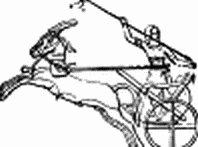
The two daughters of Servius were married to their cousins, the two young Tarquins. In each pair there was a fierce and a gentle one. The fierce Tullia was the wife of the gentle Aruns Tarquin; the gentle Tulla had married the proud Lucius Tarquin. Aruns' wife tried to persuade her husband to seize the throne that had belonged to his father, and when he would not listen to her, she agreed with his brother Lucius that, while he murdered her sister, she should kill his brother, and then that they should marry. The horrid deed was carried out, and old Servius, seeing what a wicked pair were likely to come after him, began to consider with the Senate whether it would not be better to have two consuls or magistrates chosen every year than a king. This made Lucius Tarquin the more furious, and going to the Senate, where the patricians hated the king as the friend of the plebeians, he stood upon the throne, and was beginning to tell the patricians that this would be the ruin of their greatness, when Servius came in and, standing on the steps of the doorway, ordered him to come down. Tarquin sprang on the old man and hurled him backward, so that the fall killed him, and his body was left in the street. The wicked Tullia, wanting to know how her husband had sped, came out in her chariot on that road. The horses gave back before the corpse. She asked what was in their way; the slave who drove her told her it was the king's body. "Drive on," she said. The horrid deed caused the street to be known ever after as "Sceleratus," or the wicked. But it was the plebeians who mourned for Servius; the patricians in their anger made Tarquin king, but found him a very hard and cruel master, so that he is generally called Tarquinius Superbus, or Tarquin the proud. In his time the Sybil of Cumæ, the same wondrous maiden of deep wisdom who had guided Æneas to the realms of Pluto, came, bringing nine books of prophecies of the history of Rome, and offered them to him at a price which he thought too high, and refused. She went away, destroyed three, and brought back the other six, asking for them double the price of the whole. He refused. She burnt three more, and brought him the last three with the price again doubled, because the fewer they were, the more precious. He bought them at last, and placed them in the Capitol, whence they were now and then taken to be consulted as oracles.
Rome was at war with the city of Gabii, and as the city was not to be subdued by force, Tarquin tried treachery. His eldest son, Sextus Tarquinius, fled to Gabii, complaining of ill-usage of his father, and showing marks of a severe scourging. The Gabians believed him, and he was soon so much trusted by them as to have the whole command of the army and manage everything in the city. Then he sent a messenger to his father to ask what he was to do next. Tarquin was walking through a cornfield. He made no answer in words, but with a switch cut off the heads of all the poppies and taller stalks of corn, and bade the messenger tell Sextus what he had seen. Sextus understood, and contrived to get all the chief men of Gabii exiled or put to death, and without them the city fell an easy prey to the Romans.
Tarquin sent his two younger sons and their cousin to consult the oracle at Delphi, and with them went Lucius Junius, who was called Brutus because he was supposed to be foolish, that being the meaning of the word; but his folly was only put on, because he feared the jealousy of his cousins. After doing their father's errand, the two Tarquins asked who should rule Rome after their father. "He," said the priestess, "who shall first kiss his mother on his return." The two brothers agreed that they would keep this a secret from their elder brother Sextus, and, as soon as they reached home, both of them rushed into the women's rooms, racing each to be the first to embrace their mother Tullia; but at the very entrance of Rome Brutus pretended to slip, threw himself on the ground and kissed his Mother Earth, having thus guessed the right meaning of the answer.
He waited patiently, however, and still was thought a fool when the army went out to besiege the city of Ardea; and while the troops were encamped round it, some of the young patricians began to dispute which had the best wife. They agreed to put it to the test by galloping late in the evening to look in at their homes and see what their wives were about. Some were idling, some were visiting, some were scolding, some were dressing, some were asleep; but at Collatia, the farm of another of the Tarquin family, thence called Collatinus, they found his beautiful wife Lucretia among her maidens spinning the wool of the flocks. All agreed that she was the best of wives; but the wicked Sextus Tarquin only wanted to steal her from her husband, and going by night to Collatia, tried to make her desert her lord, and when she would not listen to him he ill-treated her cruelly, and told her that he should accuse her to her husband. She was so overwhelmed with grief and shame that in the morning she sent for her father and husband, told them all that that happened, and saying that she could not bear life after being so put to shame, she drew out a dagger and stabbed herself before their eyes—thinking, as all these heathen Romans did, that it was better to die by one's own hand than to live in disgrace.
Lucius Brutus had gone to Collatia with his cousin, and while Collatinus and his father-in-law stood horror-struck, he called to them to revenge this crime. Snatching the dagger from Lucretia's breast, he galloped to Rome, called the people together in the Forum, and, holding up the bloody weapon in his hand, he made them a speech, asking whether they would any longer endure such a family of tyrants. They all rose as one man, and choosing Brutus himself and Collatinus to be their leaders, as the consuls whom Servius Tullus had thought of making, they shut the gates of Rome, and would not open them when Tarquin and his sons would have returned. So ended the kingdom of Rome.