"The Chaldaeans, that bitter and hasty nation."—Habak. 1. 6.
The Babylonians, who, under Nabopolassar and Nebuchadnezzar, held the second place among the nations of the East, were emphatically a mixed race. The ancient people from whom they were in the main descended—the Chaldaeans of the First Empire—possessed this character to a considerable extent, since they united Cusbite with Turanian blood, and contained moreover a slight Semitic and probably a slight Arian element. But the Babylonians of later times—the Chaldaeans of the Hebrew prophets—must have been very much more a mixed race than their earlier namesakes—partly in consequence of the policy of colonization pursued systematically by the later Assyrian kings, partly from the direct influence exerted upon them by conquerors. Whatever may have been the case with the Arab dynasty, which bore sway in the country from about B.C. 1546 till B.C. 1300, it is certain that the Assyrians conquered Babylon about B.C. 1300, and almost certain that they established an Assyrian family upon the throne of Nimrod, which held for some considerable time the actual sovereignty of the country. It was natural that under a dynasty of Semites, Semitic blood should flow freely into the lower region, Semitic usages and modes of thought become prevalent, and the spoken language of the country pass from a Turanian or Turano-Cushite to a Semitic type. The previous Chaldaean race blended, apparently, with the new comers, and people was produced in which the three elements—the Semitic, the Turanian, and the Cushite—held about equal shares. The colonization of the Sargonid kings added probably other elements in small proportions, and the result was that among all the nations inhabiting Western Asia there can have been none so thoroughly deserving the title of a "mingled people" as the Babylonians of the later Empire.
In mixtures of this kind it is almost always found that some one element practically preponderates, and assumes to itself the right of fashioning and forming the general character of the race. It is not at all necessary that this formative element should be larger than any other; on the contrary, it may be and sometimes is extremely small; for it does not work by its mass, but by its innate force and strong vital energy. In Babylonia, the element which showed itself to possess this superior vitality, which practically asserted its pre-eminence and proceeded to mold the national character, was the Semitic. There is abundant evidence that by the time of the later Empire the Babylonians had become thoroughly Semitized; so much so, that ordinary observers scarcely distinguished them from their purely Semitic neighbors, the Assyrians. No doubt there were differences which a Hippocrates or an Aristotle could have detected—differences resulting from mixed descent, as well as differences arising from climate and physical geography; but, speaking broadly, it must be said that the Semitic element, introduced into Babylonia from the north, had so prevailed by the time of the establishment of the Empire that the race was no longer one sui generis, but was a mere variety of the well-known and widely spread Semitic type.
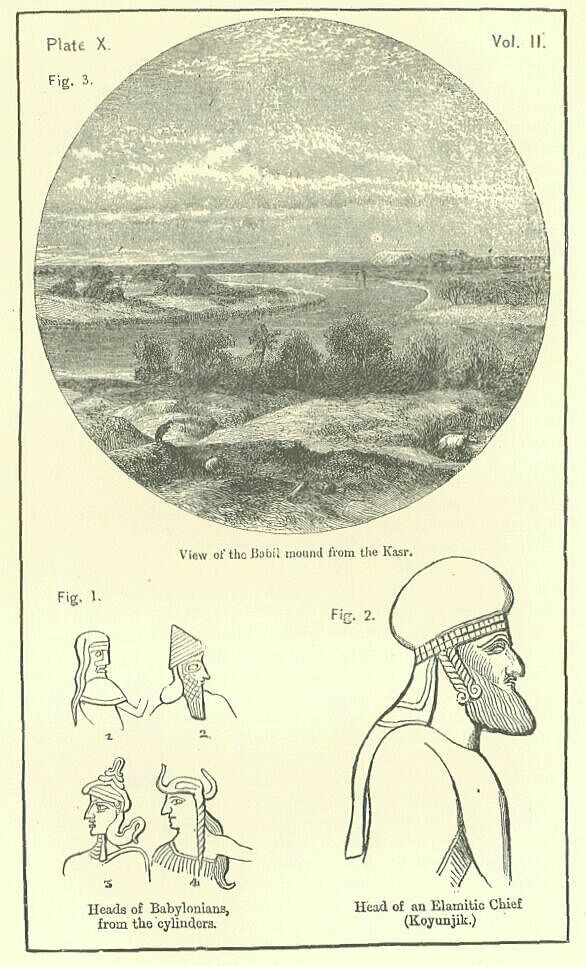
We possess but few notices, and fewer assured representations, from which to form an opinion of the physical characteristics of the Babylonians. Except upon the cylinders, there are extant only three or four representations of the human forms by Babylonian artists, and in the few cases where this form occurs we cannot always feel at all certain that the intention is to portray a human being. A few Assyrian bas-reliefs probably represent campaigns in Babylonia; but the Assyrians vary their human type so little that these sculptures must not be regarded as conveying to us very exact information. Tho cylinders are too rudely executed to be of much service, and they seem to preserve an archaic type which originated with the Proto-Chaldaeans. If we might trust the figures upon them as at all nearly representing the truth, we should have to regard the Babylonians as of much slighter and sparer frames than their northern neighbors, of a physique in fact approaching to meagreness. The Assyrian sculptures, however, are far from bearing out this idea; from them it would seem that the frames of the Babylonians were as brawny and massive as those of the Assyrians themselves, while in feature there was not much difference between the nations. [PLATE IX., Fig. 3.] Foreheads straight but not high, noses well formed but somewhat depressed, full lips, and a well-marked rounded chin, constitute the physiognomy of the Babylonians as it appears upon the sculptures of their neighbors. This representation is not contradicted by the few specimens of actual sculpture left by themselves. In these the type approaches nearly to the Assyrian, while there is still, such an amount of difference as renders it tolerably easy to distinguish between the productions of the two nations. The eye is larger, and not so decidedly almond-shaped; the nose is shorter, and its depression is still more marked; while the general expression of the countenance is altogether more commonplace.
These differences may be probably referred to the influence which was exercised upon the physical form of the race by the primitive or Proto-Chaldaean element, an influence which appears to have been considerable. This element, as has been already observed, was predominantly Cushite; and there is reason to believe that the Cushite race was connected not very remotely with the negro. In Susiana, where the Cushite blood was maintained in tolerable purity—Elymseans and Kissians existing side by side, instead of blending together—there was, if we may trust the Assyrian remains, a very decided prevalency of a negro type of countenance, as the accompanying specimens, carefully copied from the sculptures, will render evident. [PLATE IX., Fig. 6.] The head was covered with short crisp curls; the eye was large, the nose and mouth nearly in the same line, the lips thick. Such a physiognomy as the Babylonian appears to have been would naturally arise from an intermixture of a race like the Assyrian with one resembling that which the later sculptures represent as the main race inhabiting Susiana.
Herodotus remarks that the Babylonians wore their hair long; and this remark is confirmed to some extent by the native remains. These in general represent the hair as forming a single stiff and heavy curl at the back of the head (No. 3). Sometimes, however, they make it take the shape of long flowing locks, which depend over the back (No. 1), or over the back and shoulders (No. 4), reaching nearly to the waist. Occasionally, in lieu of these commoner types, wo have one which closely resembles the Assyrian, the hair forming a round mass behind the head (No. 2), on which we can sometimes trace indications of a slight wave. [PLATE X., Fig. 1.] The national fashion, that to which Herodotus alludes, seems to be represented by the three commoner modes. Where the round mass is worn, we have probably an Assyrian fashion, which the Babylonians aped during the time of that people's pre-eminence.
Besides their flowing hair, the Babylonians are represented frequently with a large beard. This is generally longer than the Assyrian, descending nearly to the waist. Sometimes it curls crisply upon the face, but below the chin depends over the breast in long, straight locks. At other times it droops perpendicularly from the cheeks and the under lip.15 Frequently, however, the beard is shaven off, and the whole face is smooth and hairless.
The Chaldaean females, as represented by the Assyrians, are tall and large-limbed. Their physiognomy is Assyrian, their hair not very abundant. The Babylonian cylinders, on the other hand, make the hair long and conspicuous, while the forms are quite as spare and meagre as those of the men.
On the whole, it is most probable that the physical type of the later Babylonians was nearly that of their northern neighbors. A somewhat sparer form, longer and more flowing hair, and features less stern and strong, may perhaps have characterized them. They were also, it is probable, of a darker complexion than the Assyrians, being to some extent Ethiopians by descent, and inhabiting a region which lies four degrees nearer to the tropics than Assyria. The Cha'ab Arabs, the present possessors of the more southern parts of Babylonia, are nearly black; and the "black Syrians," of whom Strabo speaks, seem intended to represent the Babylonians.
Among the moral and mental characteristics of the people, the first place is due to their intellectual ability. Inheriting a legacy of scientific knowledge, astronomical and arithmetical, from the Proto-Chaldaeans, they seem to have not only maintained but considerably advanced these sciences by their own efforts. Their "wisdom and learning" are celebrated by the Jewish prophets Isaiah, Jeremiah, and Daniel; the Father of History records their valuable inventions; and an Aristotle was not ashamed to be beholden to them for scientific data. They were good observers of astronomical phenomena, careful recorders of such observations, and mathematicians of no small repute. Unfortunately, they mixed with their really scientific studies those occult pursuits which, in ages and countries where the limits of true science are not known, are always apt to seduce students from the right path, having attractions against which few men are proof, so long as it is believed that they can really accomplish the end that they propose to themselves. The Babylonians were astrologers no less than astronomers; they professed to cast nativities, to expound dreams, and to foretell events by means of the stars; and though there were always a certain number who kept within the legitimate bounds of science, and repudiated the astrological pretensions of their brethren, yet on the whole it must be allowed that their astronomy was fatally tinged with a mystic and unscientific element.
In close connection with the intellectual ability of the Babylonians was the spirit of enterprise which led them to engage in traffic and to adventure themselves upon the ocean in ships. In a future chapter we shall have to consider the extent and probable direction of this commerce. It is sufficient to observe in the present place that the same turn of mind which made the Phoenicians anciently the great carriers between the East and West, and which in modern times has rendered the Jews so successful in various branches of trade, seems to have characterized the Semitized Babylonians, whose land was emphatically "a land of traffic," and their chief city "a city of merchants."
The trading spirit which was thus strongly developed in the Babylonian people led naturally to the two somewhat opposite vices of avarice and over-luxuriousness. Not content with honorable gains, the Babylonians "coveted an evil covetousness," as we learn both from Habakkuk and Jeremiah. The "shameful custom" mentioned by Herodotus, which required as a religious duty that every Babylonian woman, rich or poor, highborn or humble, should once in her life prostitute herself in the temple of Beltis, was probably based on the desire of attracting strangers to the capital, who would either bring with them valuable commodities or purchase the productions of the country. The public auction of marriageable virgins had most likely a similar intention. If we may believe Curtius, strangers might at any time purchase the gratification of any passion they might feel, from the avarice of parents or husbands.
The luxury of the Babylonians is a constant theme with both sacred and profane writers. The "daughter of the Chaldaeans" was "tender and delicate," "given to pleasures," apt to "dwell carelessly." Her young men made themselves "as princes to look at—exceeding in dyed attire upon their heads,"—painting their faces, wearing earrings, and clothing themselves in robes of soft and rich material. Extensive polygamy prevailed. The pleasures of the table were carried to excess. Drunkenness was common. Rich unguents were invented. The tables groaned under the weight of gold and silver plate. In every possible way the Babylonians practised luxuriousness of living, and in respect of softness and self-indulgence they certainly did not fall short of any nation of antiquity.
There was, however, a harder and sterner side to the Babylonian character. Despite their love of luxury, they were at all times brave and skilful in war; and, during the period of their greatest strength, they were one of the most formidable of all the nations of the East. Habakkuk describes them, drawing evidently from the life, as "bitter and hasty," and again as "terrible and dreadful—their horses' hoofs swifter than the leopard's, and more fierce than the evening wolves." Hence they "smote the people in wrath with a continual stroke"—they "made the earth to tremble, and did shake kingdoms"—they carried all before them in their great enterprises, seldom allowing themselves to be foiled by resistance, or turned from their course by pity. Exercised for centuries in long and fierce wars with the well-armed and well-disciplined Assyrians, they were no sooner quit of this enemy, and able to take an aggressive attitude, than they showed themselves no unworthy successors of that long-dominant nation, so far as energy, valor, and military skill constitute desert. They carried their victorious arms from the shores of the Persian Gulf to the banks of the Nile; wherever they went, they rapidly established their power, crushing all resistance, and fully meriting the remarkable title, which they seem to have received from those who had felt their attacks, of "the hammer of the whole earth."
The military successes of the Babylonians were accompanied with needless violence, and with outrages not unusual in the East, which the historian must nevertheless regard as at once crimes and follies. The transplantation of conquered races—a part of the policy of Assyria which the Chaldaeans adopted—may perhaps have been morally defensible, notwithstanding the sufferings which it involved. But the mutilations of prisoners, the weary imprisonments, the massacre of non-combatants, the refinement of cruelty shown in the execution of children before the eyes of their fathers—these and similar atrocities, which are recorded of the Babylonians, are wholly without excuse, since they did not so much terrify as exasperate the conquered nations, and thus rather endangered than added strength or security to the empire. A savage and inhuman temper is betrayed by these harsh punishments—a temper common in Asiatics, but none the less reprehensible on that account—one that led its possessors to sacrifice interest to vengeance, and the peace of a kingdom to a tiger-like thirst for blood. Nor was this cruel temper shown only towards the subject nations and captives taken in war. Babylonian nobles trembled for their heads if they incurred by a slight fault the displeasure of the monarch; and even the most powerful class in the kingdom, the learned and venerable "Chaldaeans," ran on one occasion the risk of being exterminated, because they could not expound a dream which the king had forgotten. If a monarch displeased his court, and was regarded as having a bad disposition, it was not thought enough simply to make away with him, but he was put to death by torture. Among recognized punishments were cutting to pieces and casting into a heated furnace. The houses of offenders were pulled down and made into dunghills. These practices imply a "violence" and cruelty beyond the ordinary Oriental limit; and we cannot be surprised that when final judgment was denounced against Babylon, it was declared to be sent, in a great measure, "because of men's blood, and for the violence of the land-of the city, and all that dwelt therein."
It is scarcely necessary to add that the Babylonians were a proud people. Pride is unfortunately the invariable accompaniment of success, in the nation, if not in the individual; and the sudden elevation of Babylon from a subject to a dominant power must have been peculiarly trying, more especially to the Oriental temperament. The spirit which culminated in Nebuchadnezzar, when, walking in the palace of his kingdom, and surveying the magnificent buildings which he had raided on every side from the plunder of the conquered nations, and by the labor of their captive bands, he exclaimed, "Is not the great Babylon which I have built by the might of my power and for the honor of my majesty?"—was rife in the people generally, who, naturally enough, believed themselves superior to every other nation upon the earth. "I am, and there is none else beside me," was the thought, if not the speech, of the people, whose arrogancy was perhaps somewhat less offensive than that of the Assyrians, but was quite as intense and as deep-seated.
The Babylonians, notwithstanding their pride, their cruelty, their covetousness, and their love of luxury, must be pronounced to have been, according to their lights, a religious people. The temple in Babylonia is not a mere adjunct of the palace, but has almost the same pre-eminence over other buildings which it claims in Egypt. The vast mass of the Birs-i-Nimrud is sufficient to show that an enormous amount of labor was expended in the erection of sacred edifices; and the costly ornamentation lavished on such buildings is, as we shall hereafter find, even more remarkable than their size. Vast sums wore also expended on images of the gods, necessary adjuncts of the religion; and the whole paraphernalia of worship exhibited a rare splendor and magnificence. The monarchs were devout worshippers of the various deities, and gave much of their attention to the building and repair of temples, the erection of images, and the like. They bestowed on their children names indicative of religious feeling, and implying real faith in the power of the gods to protect their votaries. The people generally affected similar names—names containing, in almost every case, a god's name as one of their elements. The seals or signets which formed almost a necessary part of each man's costume were, except in rare instances, of a religious character. Even in banquets, where we might have expected that thoughts of religion would be laid aside, it seems to have been the practice during the drinking to rehearse the praises of the deities.
We are told by Nicolas of Damascus that the Babylonians cultivated two virtues especially, honesty and calmness. Honesty is the natural, almost the necessary virtue of traders, who soon find that it is the best policy to be fair and just in their dealings. We may well believe that this intelligent people had the wisdom to see their true interests, and to understand that trade can never prosper unless conducted with integrity and straightforwardness. The very fact that their trade did prosper, that their goods were everywhere in request, is sufficient proof of their commercial honesty, and of their superiority to those tricks which speedily ruin a commerce.
Calmness is not a common Oriental virtue. It is not even in general very highly appreciated, being apt to strike the lively, sensitive, and passionate Eastern as mere dulness and apathy. In China, however, it is a point of honor that the outward demeanor should be calm and placid under any amount of provocation; and indignation, fierceness, even haste, are regarded as signs of incomplete civilization, which the disciples of Confucius love to note in their would-be rivals of the West.
We may conceive that some similar notion was entertained by the proud Babylonians, who no doubt regarded themselves as infinitely superior in manners and culture, no less than in scientific attainments, to the "barbarians" of Persia and Greece. While rage boiled in their hearts, and commands to torture and destroy fell from their tongues, etiquette may have required that the countenance should be unmoved, the eye serene, the voice low and gentle. Such contrasts are not uncommonly seen in the polite Mandarin, whose apparent calmness drives his European antagonist to despair; and it may well be that the Babylonians of the sixth and seventh centuries before our era had attained to an equal power of restraining the expression of feeling. But real gentleness, meekness, and placability were certainly not the attributes of a people who were so fierce in their wars and so cruel in their punishments.