The history of the Babylonian Empire commences with Nabopolassar, who appears to have mounted the throne in the year B.C. 625; but to understand the true character of the kingdom which he set up, its traditions and its national spirit, we must begin at a far earlier date. We must examine, in however incomplete and cursory a manner, the middle period of Babylonian history, the time of obscurity and comparative insignificance, when the country was as a general rule, subject to Assyria, or at any rate played but a secondary part in the affairs of the East. We shall thus prepare the way for our proper subject, while at the same time we shall link on the history of the Fourth to that of the First Monarchy, and obtain a second line of continuous narrative, connecting the brilliant era of Cyaxares and Nebuchadnezzar with the obscure period of the first Cushite kings.
It has been observed that the original Chaldaean monarchy lasted, under various dynasties from about B.C. 2400 to B.C. 1300, when it was destroyed by the Assyrians, who became masters of Babylonia under the first Tiglathi-Nin, and governed it for a short time from their own capital. Unable, however, to maintain this unity very long, they appear to have set up in the country an Assyrian dynasty, over which they claimed and sometimes exercised a kind of suzerainty, but which was practically independent and managed both the external and internal affairs of the kingdom at its pleasure. The first king of this dynasty concerning whom we have any information is a Nebuchadnezzar, who was contemporary with the Assyrian monarch Asshur-ris-ilim, and made two attacks upon his territories. The first of these was by the way of the Diyaleh and the outlying Zagros hills, the line taken by the great Persian military road in later times. The second was directly across the plain. If we are to believe the Assyrian historian who gives an account of the campaigns, both attacks were repulsed, and after his second failure the Babylonian monarch fled away into his own country hastily. We may perhaps suspect that a Babylonian writer would have told a different story. At any rate Asshur-ris-ilim was content to defend his own territories and did not attempt to retaliate upon his assailant. It was not till late in the reign of his son and successor, Tiglath-Pileser I., that any attempt was made to punish the Babylonians for their audacity. Then, however, that monarch invaded the southern kingdom, which had passed into the hands of a king named Merodach-iddin-akhi, probably a son of Nebuchadnezzar. After two years of fighting, in which he took Eurri-Galzu (Akkerkuf), the two Sipparas, Opis, and even Babylon itself, Tiglath-Pileser retired, satisfied apparently with his victories; but the Babylonian monarch was neither subdued nor daunted. Hanging on the rear of the retreating force, he harassed it by cutting off its baggage, and in this way he became possessed of certain Assyrian idols, which he carried away as trophies to Babylon. War continued between the two countries during the ensuing reigns of Merodach-shapik-ziri in Babylon and Asshur-bil-kala in Assyria, but with no important successes, so far as appears, on either side.
The century during which these wars took place between Assyria and Babylonia, which corresponds with the period of the later Judges in Israel, is followed by an obscure interval, during which but little is known of either country. Assyria seems to have been at this time in a state of great depression. Babylonia, it may be suspected, was flourishing; but as our knowledge of its condition comes to us almost entirely through the records of the sister country, which here fail us, we can only obtain a dim and indistinct vision of the greatness now achieved by the southern kingdom. A notice of Asshur-izir-pal's seems to imply that Babylon, during the period in question, enlarged her territories at the expense of Assyria, and another in Macrobius, makes it probable that she held communications with Egypt. Perhaps these two powers, fearing the growing strength of Assyria, united against her, and so checked for a while that development of her resources which they justly dreaded.
However, after two centuries of comparative depression, Assyria once more started forward, and Babylonia was among the first of her neighbors whom she proceeded to chastise and despoil. About the year B.C. 880 Asshur-izir-pal led an expedition to the south-east and recovered the territory which, had been occupied by the Babylonians during the period of weakness. Thirty years later, his son, the Black-Obelisk king, made the power of Assyria still more sensibly felt. Taking advantage of the circumstance that a civil war was raging in Babylonia between the legitimate monarch Merodach-sum-adin, and his young brother, he marched into the country, took a number of the towns, and having defeated and slain the pretender, was admitted into Babylon itself. From thence he proceeded to overrun Chaldaea, or the district upon the coast, which appears at this time to have been independent of Babylon, and governed by a number of petty kings. The Babylonian monarch probably admitted the suzerainty of the invader, but was not put to any tribute. The Chaldaean chiefs, however, had to submit to this indignity. The Assyrian monarch returned to his capital, having "struck terror as far as the sea." Thus Assyrian influence was once more extended over the whole of the southern country, and Babylonia resumed her position of a secondary power, dependent on the great monarchy of the north.
But she was not long allowed to retain even the shadow of an autonomous rule. In or about the year B.C. 821 the son and successor of the Black-Obelisk king, apparently without any pretext, made a fresh invasion of the country. Mero-dach-belatzu-ikm, the Babylonian monarch, boldly met him in the field, but was defeated in two pitched battles (in the latter of which he had the assistance of powerful allies) and was forced to submit to his antagonist. Babylon, it is probable, became at once an Assyrian tributary, and in this condition she remained till the troubles which came upon Assyria towards the middle of the eighth century B.C. gave an opportunity for shaking off the hated yoke. Perhaps the first successes were obtained by Pul, who, taking advantage of Assyria's weakness under Asshur-dayan III. (ab. B.C. 770), seems to have established a dominion over the Euphrates valley and Western Mesopotamia, from which he proceeded to carry his arms into Syria and Palestine. Or perhaps Pul's efforts merely, by still further weakening Assyria, paved the way for Babylon to revolt, and Nabonassar, who became king of Babylon in B.C. 747, is to be regarded as the re-establisher of her independence. In either case it is apparent that the recovery of independence was accompanied, or rapidly followed, by a disintegration of the country, which was of evil omen for its future greatness. While Nabonassar established himself at the head of affairs in Babylon, a certain Yakin, the father of Merodach-Baladan, became master of the tract upon the coast; and various princes, Nadina, Zakiru, and others, at the same time obtained governments, which they administered in their own name towards the north. The old Babylonian kingdom was broken up; and the way was prepared for that final subjugation which was ultimately affected by the Sargonids.
Still, the Babylonians seemed to have looked with complacency on this period, and they certainly made it an era from which to date their later history. Perhaps, however, they had not much choice in this matter. Nabonassar was a man of energy and determination. Bent probably on obliterating the memory of the preceding period of subjugation, he "destroyed the acts of the kings who had preceded him;" and the result was that the war of his accession became almost necessarily the era from which subsequent events had to be dated.
Nabonassar appears to have lived on friendly terms with Tiglath-Pileser, the contemporary monarch of Assyria, who early in his reign invaded the southern country, reduced several princes of the districts about Babylon to subjection, and forced Merodach-Baladan, who had succeeded his father, Yakin, in the low region, to become his tributary. No war seems to have been waged between Tiglath-Pileser and Nabonassar. The king of Babylon may have seen with satisfaction the humiliation of his immediate neighbors and rivals, and may have felt that their subjugation rather improved than weakened his own position. At any rate it tended to place him before the nation as their only hope and champion—the sole barrier which protected their country from a return of the old servitude.
Nabonassar held the throne of Babylon for fourteen years, from B.C. 747 to B.C. 733. It has generally been supposed that this period is the same with that regarded by Herodotus as constituting the reign of Semiramis. As the wife or as the mother of Nabonassar, that lady (according to many) directed the affairs of the Babylonian state on behalf of her husband or her son. The theory is not devoid of a certain plausibility, and it is no doubt possible that it may be true; but at present it is a mere conjecture, wholly unconfirmed by the native records; and we may question whether on the whole it is not more probable that the Semiramis of Herodotus is misplaced. In a former volume it was shown that a Semiramis flourished in Assyria towards the end of the ninth and the beginning of the eighth centuries B.C.—-during the period, that is, of Babylonian subjection to Assyria. She may have been a Babylonian princess, and have exercised an authority in the southern capital. It would seem therefore to be more probable that she is the individual whom Herodotus intends, though he has placed her about half a century too late, than that there were two persons of the same name within so short a time, both queens, and both ruling in Mesopotamia.
Nabonassar was succeeded in the year B.C. 733 by a certain Nadius, who is suspected to have been among the independent princes reduced to subjection by Tiglath-Pileser in his Babylonian expedition. Nadius reigned only two years—from B.C. 733 to B.C. 731—when he was succeeded by Ghinzinus and Porus, two princes whose joint rule lasted from B.C. 731 to B.C. 726. They were followed by an Elulseus, who has been identified with the king of that name called by Menander king of Tyre—the Luliya of the cuneiform inscriptions; but it is in the highest degree improbable that one and the same monarch should have borne sway both in Phoenicia and Chaldaea at a time when Assyria was paramount over the whole of the intervening country. Elulseus therefore must be assigned to the same class of utterly obscure monarchs with his predecessors, Porus, Chinzinus, and Nadius; and it is only with Merodach-Baladan, his successor, that the darkness becomes a little dispelled, and we once more see the Babylonian throne occupied by a prince of some reputation and indeed celebrity.
Merodach-Baladan was the son of a monarch, who in the troublous times that preceded, or closely followed, the era of Nabonassar appears to have made himself master of the lower Babylonian territory—the true Chaldaea—and to have there founded a capital city, which he called after his own name, Bit-Yakin. On the death of his father Merodach-Baladan inherited this dominion; and it is here that we first find him, when, during the reign of Nabonassar, the Assyrians under Tiglath-Pileser II. invade the country. Forced to accept the position of Assyrian tributary under this monarch, to whom he probably looked for protection against the Babylonian king, Nabonassar, Merodach-Baladan patiently bided his time, remaining in comparative obscurity during the two reigns of Tiglath-Pileser and Shalmaneser his successor, and only emerging contemporaneously with the troubles which ushered in the dynasty of the Sargonids. In B.C. 721—the year in which Sargon made himself master of Nineveh—Merodach-Baladan extended his authority over the upper country, and was recognized as king of Babylon. Here he maintained himself for twelve years; and it was probably at some point of time within this space that he sent embassadors to Hezekiah at Jerusalem, with orders to inquire into the particulars of the curious astronomical marvel, or miracle, which had accompanied the sickness and recovery of that monarch. It is not unlikely that the embassy, whereof this was the pretext, had a further political object. Morodach-Baladan, aware of his inability to withstand singly the forces of Assyria, was probably anxious to form a powerful league against the conquering state, which threatened to absorb the whole of Western Asia into its dominion. Hezekiah received his advances favorably, as appears by the fact that he exhibited to him all his treasures. Egypt, we may presume, was cognizant of the proceedings, and gave them her support. An alliance, defensive if not also offensive, was probably concluded between Egypt and Judaea on the one hand, Babylon, Susiana, and the Aramaean tribes of the middle Euphrates on the other. The league would have been formidable but for one circumstance—Assyria lay midway between the allied states, and could attack either moiety of the confederates separately at her pleasure. And the Assyrian king was not slow to take advantage of his situation. In two successive years Sargon marched his troops against Egypt and against Babylonia, and in both directions carried all before him. In Egypt he forced Sabaco to sue for peace. In Babylonia (B.C. 710) he gained a great victory over Merodach-Baladan and his allies, the Aramaeans and Susianians, took Bit-Yakin, into which the defeated monarch had thrown himself, and gained possession of his treasures and his person. Upon this the whole country submitted; Merodach-Baladan was carried away captive into Assyria; and Sargon himself, mounting the throne, assumed the title-rarely taken by an Assyrian monarch of "King of Babylon."
But this state of things did not continue long. Sargon died in the year B.C. 704, and coincident with his death we find a renewal of troubles in Babylonia. Assyria's yoke was shaken off; various pretenders started up; a son of Sargon and brother of Sennacherib re-established Assyrian influence for a brief space; but fresh revolts followed. A certain Hagisa became king of Babylon for a month. Finally, Merodach-Baladan, again appeared upon the scene, having escaped from his Assyrian prison, murdered Hagisa, and remounted the throne from which he had been deposed seven years previously. But the brave effort to recover independence failed. Sennacherib in his second year, B.C. 703, descended upon Babylonia, defeated the army which Merodach-Baladan brought against him, drove that monarch himself into exile, after a reign of six months, and re-attached his country to the Assyrian crown. From this time to the revolt of Nabopolassar—a period of above three quarters of a century—Babylonia with few and brief intervals of revolt, continued an Assyrian fief. The assyrian kings governed her either by means of viceroys, such as Belibus, Regibelus, Mesesimordachus, and Saos-duchinus, or directly in their own persons, as was the case during the reign of Esarhaddon, and during the later years of Asshur-bani-pal.
The revolts of Babylon during this period have been described at length in the history of Assyria. Two fall into the reign of Sennacherib, one into that of Asshur-bani-pal, his grandson. In the former, Merodach-Baladan, who had not yet given up his pretensions to the lower country, and a certain Susub, who was acknowledged as king at Babylon, were the leaders. In the latter, Saos-duchinus, the Assyrian viceroy, and brother of Asshur-bani-pal, the Assyrian king, seduced from his allegiance by the hope of making himself independent headed the insurrection. In each case the struggle was brief, being begun and ended within the year. The power of Assyria at this time so vastly preponderated over that of her ancient rival that a single campaign sufficed on each occasion of revolt to crush the nascent insurrection.
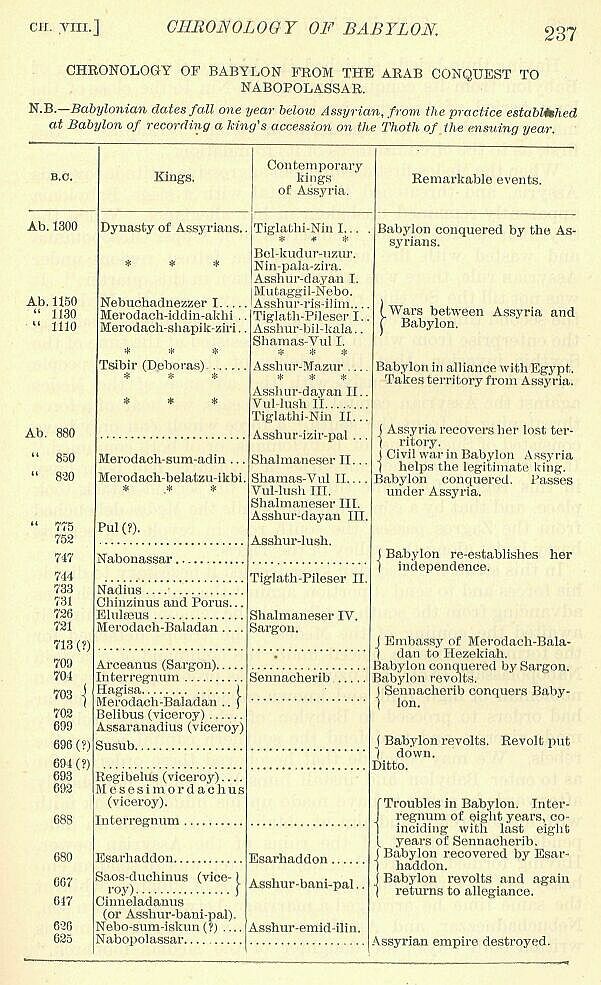
A tabular view of the chronology of this period is appended.
Having thus briefly sketched the history of the kingdom of Babylon from its conquest by Tiglathi-Nin to the close of the long period of Assyrian predominance in Western Asia, we may proceed to the consideration of the "Empire." And first, as to the circumstances of its foundation.
When the Medes first assumed an aggressive attitude towards Assyria, and threatened the capital with a siege, Babylonia apparently remained unshaken in her allegiance. When the Scythian hordes spread themselves over Upper Mesopotamia and wasted with fire and sword the fairest regions under Assyrian rule, there was still no defection in this quarter. It was not till the Scythic ravages were over, and the Medes for the second time poured across Zagros into Adiabene, resuming the enterprise from which they had desisted at the time of the Scythic invasion, that the fidelity of the Southern people wavered. Simultaneously with the advance of the Medes against the Assyrian capital from the east, we hear of a force threatening it from the south, a force which can only have consisted of Susianians, of Babylonians, or of both combined. It is probable that the emissaries of Cyaxares had been busy in this region for some time before his second attack took place, and that by a concerted plan while the Medes debouched from the Zagros passes, the south rose in revolt and sent its hasty levies along the valley of the Tigris.
In this strait the Assyrian king deemed it necessary to divide his forces and to send a portion against the enemy which was advancing from the south, while with the remainder he himself awaited the coming of the Medes. The troops detached for the former service he placed under the command of a certain Nabopolassar? (Nabu-pal-uzur), who was probably an Assyrian nobleman of high rank and known capacity. Nabopolassar had orders to proceed to Babylon, of which he was probably made viceroy, and to defend the southern capital against the rebels. We may conclude that he obeyed these orders so far as to enter Babylon and install himself in office; but shortly afterwards he seems to have made up his mind to break faith with his sovereign, and aim at obtaining for himself an independent kingdom out of the ruins of the Assyrian power. Having formed this resolve, his first step was to send an embassy to Cyaxares, and to propose terms of alliance, while at the same time he arranged a marriage between his own son, Nebuchadnezzar, and Amuhia, or Amyitis (for the name is written both ways), the daughter of the Median monarch.
Cyaxares gladly accepted the terms offered; the young persons were betrothed; and Nabopolassar immediately led, or sent, a contingent of troops to join the Medes, who took an active part in the great siege which resulted in the capture and destruction of the Assyrian capital.
A division of the Assyrian Empire between the allied monarchs followed. While Cyaxares claimed for his own share Assyria Proper and the various countries dependent on Assyria towards the north and the north-west, Nabopolassar was rewarded by his timely defection, not merely by independence but by the transfer to his government of Susiana on the one hand and of the valley of the Euphrates, Syria, and Palestine on the other. The transfer appears to have been effected quietly, the Babylonian yoke being peacefully accepted in lieu of the Assyrian without the necessity arising for any application of force. Probably it appeared to the subjects of Assyria, who had been accustomed to a monarch holding his court alternately at Nineveh and at Babylon, that the new power was merely a continuation of the old, and the monarch a legitimate successor of the old line of Ninevite kings.
Of the reign of Nabopolassar the information which has come down to us is scanty. It appears by the canon of Ptolemy that he dated his accession to the throne from the year B.C. 625, and that his reign lasted twenty-one years, from B.C. 625 to B.C. 604. During the greater portion of this period the history of Babylon is a blank. Apparently the "golden city" enjoyed her new position at the head of an empire too much to endanger it by aggression; and, her peaceful attitude provoking no hostility, she was for a while left unmolested by her neighbors. Media, bound to her by formal treaty as well as by dynastic interests, could be relied upon as a firm friend; Persia was too weak, Lydia too remote, to be formidable; in Egypt alone was there a combination of hostile feeling with military strength such as might have been expected to lead speedily to a trial of strength; but Egypt was under the rule of an aged and wary prince, one trained in the school of adversity, whose years forbade his engaging in any distant enterprise, and whose prudence led him to think more of defending his own country than of attacking others. Thus, while Psammetichus lived, Babylon had little to fear from any quarter, and could afford to "give herself to pleasures and dwell carelessly."
The only exertion which she seems to have been called upon to make during her first eighteen years of empire resulted from the close connection which had been established between herself and Media. Cyaxares, as already remarked, proceeded from the capture of Nineveh to a long series of wars and conquests. In some, if not in all, of these he appears to have been assisted by the Babylonians, who were perhaps bound by treaty to furnish a contingent as often as he required it, Either Nabopolassar himself, or his son Nebuchadnezzar, would lead out the troops on such occasions; and thus the military spirit of both prince and people would be pretty constantly exercised.
It was as the leader of such a contingent that Nabopolassar was able on one occasion to play the important part of peacemaker in one of the bloodiest of all Cyaxares' wars. After five years' desperate fighting the Medes and Lydians were once more engaged in conflict when an eclipse of the sun took place. Filled with superstitious dread the two armies ceased to contend, and showed a disposition for reconciliation, of which the Babylonian monarch was not slow to take advantage. Having consulted with Syennesis of Cilicia, the foremost man of the allies on the other side, and found him well disposed to second his efforts, he proposed that the sword should be returned to the scabbard, and that a conference should be held to arrange terms of peace. This timely interference proved effectual. A peace was concluded between the Lydians and the Medes, which was cemented by a royal intermarriage: and the result was to give to Western Asia, where war and ravage had long been almost perpetual, nearly half a century of tranquillity.
Successful in his mediation, almost beyond his hopes, Nabopolassar returned from Asia Minor to Babylon. He was now advanced in years, and would no doubt gladly have spent the remainder of his days in the enjoyment of that repose which is so dear to those who feel the infirmities of age creeping upon them. But Providence had ordained otherwise. In B.C. 610—probably the very year of the eclipse—Psammetichus died, and was succeeded by his son Neco, who was in the prime of life and who in disposition was bold and enterprising. This monarch very shortly after his accession cast a covetous eye upon Syria, and in the year B.C. 608, having made vast preparations, he crossed his frontier and invaded the territories of Nabopolassar. Marching along the usual route, by the Shephilah and the plain of Esdraelon, he learned, when he neared Megiddo, that a body of troops was drawn up at that place to oppose him, Josiah, the Jewish king, regarding himself as bound to resist the passage through his territories of an army hostile to the monarch of whom he held his crown, had collected his forces, and, having placed them across the line of the invader's march, was calmly awaiting in this position the approach of his master's enemy. Neco hereupon sent ambassadors to persuade Josiah to let him pass, representing that he had no quarrel with the Jews, and claiming a divine sanction to his undertaking. But nothing could shake the Jewish monarch's sense of duty; and Neco was consequently forced to engage with him, and to drive his troops from their position. Josiah, defeated and mortally wounded, returned to Jerusalem, where he died. Neco pressed forward through Syria to the Euphrates; and carrying all before him, established his dominion over the whole tract lying between Egypt on the one hand, and the "Great River" upon the other. On his return three months later he visited Jerusalem, deposed Jehoahaz, a younger son of Josiah, whom the people had made king, and gave the crown to Jehoiakim, his elder brother. It was probably about this time that he besieged and took Gaza, the most important of the Philistine towns next to Ashdod.
The loss of this large and valuable territory did not at once arouse the Babylonian monarch from his inaction or induce him to make any effort for its recovery. Neco enjoyed his conquests in quiet for the space of at least three full years. At length, in the year B.C. 605, Nabopolassar, who felt himself unequal to the fatigues of a campaign, resolved to entrust his forces to Nebuchadnezzar, his son, and to send him to contend with the Egyptians. The key of Syria at this time was Carchemish, a city situated on the right bank of the Euphrates, probably near the site which was afterwards occupied by Hierapolis. Here the forces of Neco were drawn up to protect his conquests, and here Nebuchadnezzar proceeded boldly to attack them. A great battle was fought in the vicinity of the river, which was utterly disastrous to the Egyptians, who "fled away" in confusion, and seem not to have ventured on making a second stand. Nebuchadnezzar rapidly recovered the lost territory, received the submission of Jehoiakim, king of Judah, restored the old frontier line, and probably pressed on into Egypt itself, hoping to cripple or even to crush his presumptuous adversary. But at this point he was compelled to pause. News arrived from Babylon that Nabopolassar was dead; and the Babylonian prince, who feared a disputed succession, having first concluded a hasty arrangement with Neco, returned at his best speed to his capital.
Arriving probably before he was expected, he discovered that his fears were groundless. The priests had taken the direction of affairs during his absence, and the throne had been kept vacant for him by the Chief Priest, or Head of the Order. No pretender had started up to dispute his claims. Doubtless his military prestige, and the probability that the soldiers would adopt his cause, had helped to keep back aspirants; but perhaps it was the promptness of his return, as much as anything, that caused the crisis to pass off without difficulty.
Nebuchadnezzar is the great monarch of the Babylonian Empire, which, lasting only 88 years—from B.C. 625 to B.C. 538—was for nearly half the time under his sway. Its military glory is due chiefly to him, while the constructive energy, which constitutes its especial characteristic, belongs to it still more markedly through his character and genius. It is scarcely too much to say that, but for Nebuchadnezzar, the Babylonians would have had no place in history. At any rate, their actual place is owing almost entirely to this prince, who to the military talents of an able general added a grandeur of artistic conception and a skill in construction which place him on a par with the greatest builders of antiquity.
We have no complete, or even general account of Nebuchadnezzar's wars. Our chief, our almost sole, information concerning them is derived from the Jewish writers. Consequently, those wars only which interested these writers, in other words those whose scene is Palestine or its immediate vicinity, admit of being placed before the reader. If Nebuchadnezzar had quarrels with the Persians, or the Arabians, or the Medes, or the tribes in Mount Zagros, as is not improbable, nothing is now known of their course or issue. Until some historical document belonging to his time shall be discovered, we must be content with a very partial knowledge of the external history of Babylon during his reign. We have a tolerably full account of his campaigns against the Jews, and some information as to the general course of the wars which he carried on with Egypt and Phoenicia; but beyond these narrow limits we know nothing.
It appears to have been only a few years after Nebuchadnezzar's triumphant campaign against Neco that renewed troubles broke out in Syria. Phoenicia revolted under the leadership of Tyre; and about the same time Jehoiakim, the Jewish king, having obtained a promise of aid from the Egyptians, renounced his allegiance. Upon this, in his seventh year (B.C. 598), Nebuchadnezzar proceeded once more into Palestine at the head of a vast army, composed partly of his allies, the Medes, partly of his own subjects. He first invested Tyre; but, finding that city too strong to be taken by assault, he left a portion of his army to continue the siege, while he himself pressed forward against Jerusalem. On his near approach, Jehoiakim, seeing that the Egyptians did not care to come to his aid, made his submission; but Nebuchadnezzar punished his rebellion with death, and, departing from the common Oriental practice, had his dead body treated with indignity. At first he placed upon the throne Jehoia-chin, the son of the late monarch, a youth of eighteen; but three months later, becoming suspicious (probably not without reason) of this prince's fidelity, he deposed him and had him brought a captive to Babylon, substituting in his place his uncle, Zedekiah, a brother of Jehoiakim and Jehoahaz. Meanwhile the siege of Tyre was pressed, but with little effect. A blockade is always tedious; and the blockade of an island city, strong in its navy, by an enemy unaccustomed to the sea, and therefore forced to depend mainly upon the assistance of reluctant allies, must have been a task of such extreme difficulty that one is surprised it was not given up in despair. According to the Tyrian historians their city resisted all the power of Nebuchadnezzar for thirteen years. If this statement is to be relied on, Tyre must have been still uncaptured, when the time came for its sister capital to make that last effort for freedom in which it perished.
After receiving his crown from Nebuchadnezzar, Zedekiah continued for eight years to play the part of a faithful vassal. At length, however, in the ninth year, he fancied he saw a way to independence. A young and enterprising monarch, Uaphris—the Apries of Herodotus—had recently mounted the Egyptian throne. If the alliance of this prince could be secured, there was, Zedekiah thought, a reasonable hope that the yoke of Babylon might be thrown off and Hebrew autonomy re-established. The infatuated monarch did not see that, do what he would, his country had no more than a choice of masters, that by the laws of political attraction Judaea must gravitate to one or other of the two great states between which it had the misfortune of lying. Hoping to free his country, he sent ambassadors to Uaphris, who were to conclude a treaty and demand the assistance of a powerful contingent, composed of both foot and horse. Uaphris received the overture favorably; and Zedekiah at once revolted from Babylon, and made preparations to defend himself with vigor. It was not long before the Babylonians arrived. Determined to crush the daring state, which, weak as it was, had yet ventured to revolt against him now for the fourth time, Nebuchadnezzar came in person, "he and all his host," against Jerusalem, and after overcoming and pillaging the open country, "built forts" and besieged the city. Uaphris, upon this, learning the danger of his ally, marched out of Egypt to his relief; and the Babylonian army, receiving intelligence of his approach, raised the siege and proceeded in quest of their new enemy. According to Josephus a battle was fought, in which the Egyptians were defeated; but it is perhaps more probable that they avoided an engagement by a precipitate retreat into their own country. At any rate the attempt effectually to relieve Jerusalem failed. After a brief interval the siege was renewed; a complete blockade was established; and in a year and a half from the time of the second investment, the city fell.
Nebuchadnezzar had not waited to witness this success of his arms. The siege of Tyre was still being pressed at the date of the second investment of Jerusalem, and the Chaldaean monarch had perhaps thought that his presence on the borders of Phoenicia was necessary to animate his troops in that quarter. If this was his motive in withdrawing from the Jewish capital, the event would seem to have shown that he judged wisely. Tyre, if it fell at the end of its thirteen years' siege, must have been taken in the very year which followed the capture of Jerusalem, B.C. 585. We may suppose that Nebuchadnezzar, when he quitted Jerusalem and took up his abode at Eiblah in the Coele-Syrian valley, turned his main attention to the great Phoenician city, and made arrangements which caused its capture in the ensuing year.
The recovery of these two important cities secured to the Babylonian monarch the quiet possession thenceforth of Syria and Palestine. But still he had not as yet inflicted any chastisement upon Egypt; though policy, no less than honor, required that the aggressions of this audacious power should be punished. If we may believe Josephus, however, the day of vengeance was not very long delayed. Within four years of the fall of Tyre, B.C. 581, Nebuchadnezzar, he tells us, invaded Egypt, put Uaphris, the monarch who had succored Zedekiah, to death, and placed a creature of his own upon the throne. Egyptian history, it is true, forbids our accepting this statement as correct in all its particulars. Uaphris appears certainly to have reigned at least as late as B.C. 569, and according to Herodotus, he was put to death, not by a foreign invader, but by a rebellious subject. Perhaps we may best harmonize the conflicting statements on the subject by supposing that Josephus has confounded two distinct invasions of Egypt, one made by Nebuchadnezzar in his twenty-third year, B.C. 581, which had no very important consequences, and the other eleven years later, B.C. 570, which terminated in the deposition of Uaphris, and the establishment on the throne of a new king, Amasis, who received a nominal royalty from Chaldaean monarch.
Such—as far as they are known—were the military exploits of this great king. He defeated Neco, recovered Syria, crushed rebellion in Judaea, took Tyre, and humiliated Egypt. According to some writers his successes did not stop here. Megasthenes made him subdue most of Africa, and thence pass over into Spain and conquer the Iberians. He even went further, and declared that, on his return from these regions, he settled his Iberian captives on the shores of the Euxine in the country between Armenia and the Caucasus! Thus Nebuchadnezzar was made to reign over an empire extending from the Atlantic to the Caspian, and from the Caucasus to the Great Sahara.
The victories of Nebuchadnezzar were not without an effect on his home administration and on the construction of the vast works with which his name is inseparably associated. It was through them that he obtained that enormous command of "naked human strength" which enabled him, without undue oppression of his own people, to carry out on the grandest scale his schemes for at once beautifying and benefiting his kingdom. From the time when he first took the field at the head of an army he adopted the Assyrian system of forcibly removing almost the whole population of a conquered country, and planting it in a distant part of his dominions. Crowds of captives—the produce of his various wars—Jews, Egyptians, Phoenicians, Syrians, Ammonites, Moabites, were settled in various parts of Mesopotamia, more especially about Babylon. From these unfortunates forced labor was as a matter of course required; and it seems to have been chiefly, if not solely, by their exertions that the magnificent series of great works was accomplished, which formed the special glory of the Fourth Monarchy.
The chief works expressly ascribed to Nebuchadnezzar by the ancient writers are the following: He built the great wall of Babylon, which, according to the lowest estimate, must have contained more than 500,000,000 square feet of solid masonry, and must have required three or four times that number of bricks. He constructed a new and magnificent palace in the neighborhood of the ancient residence of the kings. He made the celebrated "Hanging Garden" for the gratification of his wife, Amyitis. He repaired and beautified the great temple of Belus at Babylon. He dug the huge reservoir near Sippara, said to have been 140 miles in circumference, and 180 feet deep, furnishing it with flood-gates, through which its water could be drawn off for purposes of irrigation. He constructed a number of canals, among them the Nahr Malcha or "Royal River," a broad and deep channel which connected the Euphrates with the Tigris. He built quays and breakwaters along the shores of the Persian Gulf, and he at the same time founded the city of Diridotis or Teredon in the vicinity of that sea.
To these constructions may be added, on the authority either of Nebuchadnezzar's own inscriptions or of the existing remains, the Birs-i-Nimrud, or great temple of Nebo at Bor-sippa; a vast reservoir in Babylon itself, called the Yapur-Shapu; an extensive embankment along the course of the Tigris, near Baghdad; and almost innumerable temples, walls, and other public buildings at Cutha, Sippara, Borsippa, Babylon, Chilmad, Bit-Digla, etc. The indefatigable monarch seems to have either rebuilt, or at least repaired, almost every city and temple throughout the entire country. There are said to be at least a hundred sites in the tract immediately about Babylon, which give evidence, by inscribed bricks bearing his legend, of the marvellous activity and energy of this king.
We may suspect that among the constructions of Nebuchadnezzar was another great work, a work second in utility to none of those above mentioned, and requiring for its completion an enormous amount of labor. This is the canal called by the Arabs the Kerek Saideh, or canal of Saideh, which they ascribe to a wife of Nebuchadnezzar, a cutting 400 miles in length, which commenced at Hit on the Euphrates, and was carried along the extreme western edge of the alluvium close to the Arabian frontier, finally falling into the sea at the head of the Bubian creek, about twenty miles to the west of the Shat el-Arab. The traces of this canal which still remain indicate a work of such magnitude and difficulty that we can scarcely ascribe it with probability to any monarch who has held the country since Nebuchadnezzar.
The Pallacopas, or canal of Opa (Palga Opa), which left the Euphrates at Sippara (Mosaib) and ran into a great lake in the neighborhood of Borsippa, whence the lands in the neighborhood were irrigated, may also have been one of Nebuchadnezzar's constructions. It was an old canal, much out of repair, in the time of Alexander, and was certainly the work, not of the Persian conquerors, but of some native monarch anterior to Cyrus. The Arabs, who call it the Nahr Abba, regard it as the oldest canal in the country.
Some glimpses into the private life and personal character of Nebuchadnezzar are afforded us by certain of the Old Testament writers. We see him in the Book of Daniel at the head of a magnificent Court, surrounded by "princes, governors, and captains, judges, treasurers, councillors, and sheriffs;" waited on by eunuchs selected with the greatest care, "well-favored" and carefully educated; attended, whenever he requires it, by a multitude of astrologers and other "wise men," who seek to interpret to him the will of Heaven. He is an absolute monarch, disposing with a word of the lives and properties of his subjects, even the highest. All offices are in his gift. He can raise a foreigner to the second place in the kingdom, and even set him over the entire priestly order. His wealth is enormous, for he makes of pure gold an image, or obelisk, ninety feet high and nine feet broad. He is religious after a sort, but wavers in his faith, sometimes acknowledging the God of the Jews as the only real deity, sometimes relapsing into an idolatrous worship, and forcing all his subjects to follow his example. Even then, however, his polytheism is of a kind which admits of a special devotion to a particular deity, who is called emphatically "his god." In temper he is hasty and violent, but not obstinate; his fierce resolves are taken suddenly and as suddenly repented of; he is moreover capable of bursts of gratitude and devotion, no less than of accesses of fury; like most Orientals, he is vainglorious but he can humble himself before the chastening hand of the Almighty; in his better moods he shows a spirit astonishing in one of his country and time—a spirit of real piety, self-condemnation, and self-abasement, which renders him one of the most remarkable characters in Scripture.
A few touches of a darker hue must be added to this portrait of the great Babylonian king from the statements of another contemporary, the prophet Jeremiah. The execution of Jehoi-akim, and the putting out of Zedekiah's eyes, though acts of considerable severity, may perhaps be regarded as justified by the general practice of the age, and therefore as not indicating in Nebuchadnezzar any special ferocity of disposition. But the ill-treatment of Jehoiakim's dead body, the barbarity of murdering Zedekiah's sons before his eyes, and the prolonged imprisonment both of Zedekiah and of Jehoiachin, though the latter had only contemplated rebellion, cannot be thus excused. They were unusual and unnecessary acts, which tell against the monarch who authorized them, and must be considered to imply a real cruelty of disposition, such as is observable in Sargon and Asshur-bani-pal. Nebuchadnezzar, it is plain, was not content with such a measure of severity as was needed to secure his own interests, but took a pleasure in the wanton infliction of suffering on those who had provoked his resentment.
On the other hand, we obtain from the native writer, Berosus, one amiable trait which deserves a cursory mention. Nebuchadnezzar was fondly attached to the Median princess who had been chosen for him as a wife by his father from political motives. Not content with ordinary tokens of affection, he erected, solely for her gratification, the remarkable structure which the Greeks called the "Hanging Garden." A native of a mountainous country, Amyitis disliked the tiresome uniformity of the level alluvium, and pined for the woods and hills of Media. It was to satisfy this longing by the best substitute which circumstances allowed that the celebrated Garden was made. Art strove to emulate nature with a certain measure of success, and the lofty rocks and various trees of this wonderful Paradise, if they were not a very close imitation of Median mountain scenery, were at any rate a pleasant change from the natural monotony of the Babylonian plain, and must have formed a grateful retreat for the Babylonian queen, whom they reminded at once of her husband's love and of the beauty of her native country.
The most remarkable circumstance in Nebuchadnezzar's life remains to be noticed. Towards the close of his reign, when his conquests and probably most of his great works were completed, in the midst of complete tranquillity and prosperity, a sudden warning was sent him. He dreamt a strange dream, and when he sought to know its meaning, the Prophet Daniel was inspired to tell him that it portended his removal from the kingly office for the space of seven years, in consequence of a curious and very unusual kind of madness. This malady, which is not unknown to physicians, has been termed "Lycanthropy." It consists in the belief that one is not a man but a beast, in the disuse of language, the rejection of all ordinary human food, and sometimes in the loss of the erect posture and a preference for walking on all fours. Within a year of the time that he received the warning, Nebuchadnezzar was smitten. The great king became a wretched maniac. Allowed to indulge in his distempered fancy, he eschewed human habitations, lived in the open air night and day, fed on herbs, disused clothing, and became covered with a rough coat of hair. His subjects generally, it is probable, were not allowed to know of his condition, although they could not but be aware that he was suffering from some terrible malady. The queen most likely held the reins of power, and carried on the government in his name. The dream had been interpreted to mean that the lycanthropy would not be permanent; and even the date of recovery had been announced, only with a certain ambiguity. The Babylonians were thereby encouraged to await events, without taking any steps that would have involved them in difficulties if the malady ceased. And their faith and patience met with a reward. After suffering obscuration for the space of seven years, suddenly the king's intellect returned to him. His recovery was received with joy by his Court. Lords and councillors gathered about him. He once more took the government into his own hands, issued his proclamations, and performed the other functions of royalty. He was now an old man, and his reign does not seem to have been much prolonged; but "the glory of his kingdon," his "honor and brightness" returned; his last days were as brilliant as his first: his sun set in an unclouded sky, shorn of none of the rays that had given splendor to its noonday. Nebuchadnezzar expired at Babylon in the forty-fourth year of his reign, B.C. 561, after an illness of no long duration. He was probably little short of eighty years old at his death.
The successor of Nebuchadnezzar was his son Evil-Mero-dach, who reigned only two years, and of whom very little is known. We may expect that the marvellous events of his father's life, which are recorded in the Book of Daniel, had made a deep impression upon him, and that he was thence inclined to favor the persons, and perhaps the religion, of the Jews. One of his first acts was to release the unfortunate Jehoiachin from the imprisonment in which he had languished for thirty-five years, and to treat him with kindness and respect. He not only recognized his royal rank, but gave him precedence over all the captive kings resident at Babylon. Josephus says that he even admitted Jehoiachin into the number of his most intimate friends. Perhaps he may have designed him some further advancement, and may in other respects have entertained projects which seemed strange and alarming to his subjects. At any rate he had been but two years upon the throne when a conspiracy was formed against him; he was accused of lawlessness and intemperance; his own brother-in-law, Neriglissar, the husband of a daughter of Nebuchadnezzar, headed the malcontents; and Evil-Merodach lost his life with his crown.
Neriglissar, the successful conspirator, was at once acknowledged king. He is probably identical with the "Nergal-shar-ezer, Rab-Mag," of Jeremiah, who occupied a prominent position among the Babylonian nobles left to press the siege of Jerusalem when Nebuchadnezzar retired to Riblah. The title of "Rab-Mag," is one that he bears upon his bricks. It is doubtful what exactly his office was; for we have no reason to believe that there were at this time any Magi at Babylon; but it was certainly an ancient and very high dignity of which even kings might be proud. It is remarkable that Neriglissar calls himself the son of Bel-sum-iskun, "king of Babylon"—a monarch whose name does not appear in Ptolemy's list, but who is probably to be identified with a chieftain so called, who assumed the royal title in the troubles which preceded the fall of the Assyrian Empire.
During his short reign of four years, or rather three years and a few months, Neriglissar had not time to distinguish himself by many exploits. So far as appears, he was at peace with all his neighbors, and employed his time principally in the construction of the Western Palace at Babylon, which was a large building placed at one corner of a fortified inclosure, directly opposite the ancient royal residence, and abutting on the Euphrates. If the account which Diodorus gives of this palace be not a gross exaggeration of the truth, it must have been a magnificent erection, elaborately ornamented with painting and sculpture in the best style of Babylonian art, though in size it may have been inferior to the old residence of the kings on the other side of the river.
Neriglissar reigned from B.C. 559 to B.C. 556, and dying a natural death in the last-named year, left his throne to his son, Laborosoarchod, or Labossoracus. This prince, who was a mere boy, and therefore quite unequal to the task of governing a great empire in critical times, was not allowed to retain the crown many months. Accused by those about him—whether justly or unjustly we cannot say—of giving many indications of a bad disposition, he was deposed and put to death by torture. With him power passed from the House of Nabopolassar, which had held the throne for just seventy years.
On the death of Laborosoarchod the conspirators selected one of their number, a certain Nabonadius or Nabannidochus, and invested him with the sovereignty. He was in no way related to the late monarch, and his claim to succeed must have been derived mainly from the part which he had played in the conspiracy. But still he was a personage of some rank, for his father had, like Neriglissar, held the important office of Rab Mag. It is probable that one of his first steps on ascending the throne was to connect himself by marriage with the royal house which had preceded him in the kingdom. Either the mother of the late king Laborosoarchod, and widow of Neriglissar, or possibly some other daughter of Nebuchadnezzar, was found willing to unite her fortune with those of the new sovereign, and share the dangers and the dignity of his position. Such a union strengthened the hold of the reigning monarch on the allegiance of his subjects, and tended still more to add stability to his dynasty. For as the issue of such a marriage would join in one the claims of both royal houses, he would be sure to receive the support of all parties in the state. Very shortly after the accession of Nabonadius (B.C. 555) he received an embassy from the far north-west. An important revolution had occurred on the eastern frontier of Babylonia three years before, in the reign of Neriglissar; but its effects only now began to make themselves felt among the neighboring nations. Had Cyrus, on taking the crown, adopted the policy of Astyages, the substitution of Persia for Media as the ruling Arian nation would have been a matter of small account. But there can be little doubt that he really entered at once on a career of conquest, Lydia, at any rate, felt herself menaced by the new power, and seeing the danger which threatened the other monarchies of the time, if they allowed the great Arian kingdom to attack them severally with her full force, proposed a league whereby the common enemy might, she thought, be resisted with success. Ambassadors seem to have been sent from Sardis to Babylon in the very year in which Nabonadius became king. He therefore had at once to decide whether he would embrace the offer made him, and uniting with Lydia and Egypt in a league against Persia, make that power his enemy, or refuse the proffered alliance and trust to the gratitude of Cyrus for the future security of his kingdom. It would be easy to imagine the arguments pro and contra which presented themselves to his mind at this conjuncture; but as they would be destitute of a historical foundation, it is perhaps best to state simply the decision at which he is known to have arrived. This was an acceptance of the Lydian offer. Nabonadius consented to join the proposed league; and a treaty was probably soon afterwards concluded between the three powers whereby they united in an alliance offensive and defensive against the Persians.
Knowing that he had provoked a powerful enemy by this bold act, and ignorant how soon he might be called upon to defend his kingdom, from the entire force of his foe, which might be suddenly hurled against him almost at any moment, Nabonadius seems to have turned his attention at once to providing means of defence. The works ascribed by Herodotus to a queen, Nitocris, whom he makes the mother of Nabonadius (Labynetus) must be regarded as in reality constructions of that monarch himself, undertaken with the object of protecting Babylon from Cyrus. They consisted in part of defences within the city, designed apparently to secure it against an enemy who should enter by the river, in part of hydraulic works intended to obstruct the advances of an army by the usual route. The river had hitherto flowed in its natural bed through the middle of the town. Nabonadius confined the stream by a brick embankment carried the whole way along both banks, after which he built on the top of the embankment a wall of a considerable height, pierced at intervals by gateways, in which were set gates of bronze. He likewise made certain cuttings, reservoirs, and sluices at some distance from Babylon towards the north, which were to be hindrances to an enemy's march, though in what way is not very apparent. Some have supposed that besides these works there was further built at the same time a great wall which extended entirely across the tract between the two rivers—a huge barrier a hundred feet high and twenty thick—meant, like the Roman walls in Britain and the great wall of China, to be insurmountable by an unskillful foe; but there is ground for suspecting that this belief is ill-founded, having for its sole basis a misconception of Xenophon's.
Nabonadius appears to have been allowed ample time to carry out to the full his system of defences, and to complete all his preparations. The precipitancy of Croesus, who plunged into a war with Persia single-handed, asking no aid from his allies, and the promptitude of Cyrus, who allowed him no opportunity of recovering from his first false step, had prevented Nabonadius from coming into actual collision with Persia in the early part of his reign. The defeat of Croesus in the battle of Pteria, the siege of Sardis, and its capture, followed so rapidly on the first commencement of hostilities, that whatever his wishes may have been, Nabonadius had it not in his power to give any help to his rash ally. Actual war was thus avoided at this time; and no collision having occurred, Cyrus could defer an attack on the great kingdom of the south until he had consolidated his power in the north and the northeast, which he rightly regarded as of the last importance. Thus fourteen years intervened between the capture of Sardis by the Persian arms and the commencement of the expedition against Babylon.
When at last it was rumored that the Persian king had quitted Ecbatana (B.C. 539) and commenced his march to the south-west, Nabonadius received the tidings with indifference. His defences were completed: his city was amply provisioned; if the enemy should defeat him in the open field, he might retire behind his walls, and laugh to scorn all attempts to reduce his capital either by blockade or storm. It does not appear to have occurred to him that it was possible to protect his territory. With a broad, deep, and rapid river directly interposed between him and his foe, with a network of canals spread far and wide over his country, with an almost inexhaustible supply of human labor at his command for the construction of such dikes, walls, or cuttings as he should deem advisable, Nabonadius might, one would have thought, have aspired to save his land from invasion, or have disputed inch by inch his enemy's advance towards the capital. But such considerations have seldom had much force with Orientals, whose notions of war and strategy are even now of the rudest and most primitive description. To measure one's strength as quickly as possible with that of one's foe, to fight one great pitched battle in order to decide the question of superiority in the field, and then, if defeated, either to surrender or to retire behind walls, has been the ordinary conception of a commander's duties in the East from the time of the Ramesside kings to our own day. No special blame therefore attaches to Nabonadius for his neglect. He followed the traditional policy of Oriental monarchs in the course which he took. And his subjects had less reason to complain of his resolution than most others, since the many strongholds in Babylonia must have afforded them a ready refuge, and the great fortified district within which Babylon itself stood must have been capable of accommodating with ease the whole native population of the country.
If we may trust Herodotus, the invader, having made all his preparations and commenced his march, came to a sudden pause midway between Ecbatana and Babylon. One of the sacred white horses, which drew the chariot of Ormazd, had been drowned in crossing a river; and Cyrus had thereupon desisted from his march, and, declaring that he would revenge himself on the insolent stream, had set his soldiers to disperse its waters into 360 channels. This work employed him during the whole summer and autumn; nor was it till another spring had come that he resumed his expedition. To the Babylonians such a pause must have appeared like irresolution. They must have suspected that the invader had changed his mind and would not venture across the Tigris. If the particulars of the story reached them, they probably laughed at the monarch who vented his rage on inanimate nature, while he let his enemies escape scot free.
Cyrus, however, had a motive for his proceedings which will appear in the sequel. Having wintered on the banks of the Gyndes in a mild climate, where tents would have been quite a sufficient protection to his army, he put his troops in motion at the commencement of spring, crossed the Tigris apparently unopposed, and soon came in sight of the capital. Here he found the Babylonian army drawn out to meet him under the command of Nabonadius himself, who had resolved to try the chance of a battle. An engagement ensued, of which we possess no details; our informants simply tell us that the Babylonian monarch was completely defeated, and that, while most of his army sought safety within the walls of the capital, he himself with a small body of troops threw himself into Borsippa, an important town lying at a short distance from Babylon towards the south-west. It is not easy to see the exact object of this movement. Perhaps Nabonadius thought that the enemy would thereby be obliged to divide his army, which might then more easily be defeated; perhaps he imagined that by remaining without the walls he might be able to collect such a force among his subjects and allies as would compel the beleaguering army to withdraw. Or, possibly, he merely followed an instinct of self-preservation, and fearing that the soldiers of Cyrus might enter Babylon with his own, if he fled thither, sought refuge in another city.
It might have been supposed that his absence would have produced anarchy and confusion in the capital; but a step which he had recently taken with the object of giving stability to his throne rendered the preservation of order tolerably easy. At the earliest possible moment—probably when he was about fourteen—he had associated with him in the government his son, Belshazzar, or Bel-shar-uzur, the grandson of the great Nebuchadnezzar. This step, taken most likely with a view to none but internal dangers, was now found exceedingly convenient for the purposes of the war. In his father's absence Belshazzar took the direction of affairs within the city, and met and foiled for a considerable time all the assaults of the Persians. He was young and inexperienced, but he had the counsels of the queen-mother to guide and support him, as well as those of the various lords and officers of the court. So well did he manage the defence that after a while Cyrus despaired, and as a last resource ventured on a stratagem in which it was clear that he must either succeed or perish.
Withdrawing the greater part of his army from the vicinity of the city, and leaving behind him only certain corps of observation, Cyrus marched away up the course of the Euphrates for a certain distance, and there proceeded to make a vigorous use of the spade. His soldiers could now appreciate the value of the experience which they had gained by dispersing the Gyndes, and perceive that the summer and autumn of the preceding year had not been wasted. They dug a channel or channels from the Euphrates, by means of which a great portion of its water would be drawn off, and hoped in this way to render the natural course of the river fordable.
When all was prepared, Cyrus determined to wait for the arrival of a certain festival, during which the whole population were wont to engage in drinking and revelling, and then silently in the dead of night to turn the water of the river and make his attack. It fell out as he hoped and wished. The festival was held with even greater pomp and splendor than usual; for Belshazzar, with the natural insolence of youth, to mark his contempt of the besieging army, abandoned himself wholly to the delights of the season, and himself entertained a thousand lords in his palace. Elsewhere the rest of the population was occupied in feasting and dancing. Drunken riot and mad excitement held possession of the town; the siege was forgotten; ordinary precautions were neglected. Following the example of their king, the Babylonians gave themselves up for the night to orgies in which religious frenzy and drunken excess formed a strange and revolting medley.
Meanwhile, outside the city, in silence and darkness, the Persians watched at the two points where the Euphrates entered and left the walls. Anxiously they noted the gradual sinking of the water in the river-bed; still more anxiously they watched to see if those within the walls would observe the suspicious circumstance and sound an alarm through the town. Should such an alarm be given, all their labors would be lost. If, when they entered the river-bed, they found the river-walls manned and the river-gates fast-locked, they would be indeed "caught in a trap." Enfiladed on both sides by an enemy whom they could neither see nor reach, they would be overwhelmed and destroyed by his missiles before they could succeed in making their escape. But, as they watched, no sounds of alarm reached them—only a confused noise of revel and riot, which showed that the unhappy townsmen were quite unconscious of the approach of danger.
At last shadowy forms began to emerge from the obscurity of the deep river-bed, and on the landing-places opposite the river-gates scattered clusters of men grew into solid columns—the undefended gateways were seized—a war-shout was raised—the alarm was taken and spread—and swift runners started off to "show the King of Babylon that his city was taken at one end." In the darkness and confusion of the night a terrible massacre ensued. The drunken revellers could make no resistance. The king paralyzed with fear at the awful handwriting upon the wall, which too late had warned him of his peril, could do nothing even to check the progress of the assailants, who carried all before them everywhere. Bursting into the palace, a band of Persians made their way to the presence of the monarch, and slew him on the scene of his impious revelry. Other bands carried fire and sword through the town. When morning came, Cyrus found himself undisputed master of the city, which, if it had not despised his efforts, might with the greatest ease have baffled them.
The war, however, was not even yet at an end. Nabonadius still held Borsippa, and, if allowed to remain unmolested, might have gradually gathered strength and become once more a formidable foe. Cyrus, therefore, having first issued his orders that the outer fortifications of Babylon should be dismantled, proceeded to complete his conquest by laying siege to the town where he knew that Nabonadius had taken refuge. That monarch, however, perceiving that resistance would be vain, did not wait till Borsippa was invested, but on the approach of his enemy surrendered himself. Cyrus rewarded his submission by kind and liberal treatment. Not only did he spare his life, but (if we may trust Abydenus) he conferred on him the government of the important province of Carmania.
Thus perished the Babylonian empire. If we seek the causes of its fall, we shall find them partly in its essential military inferiority to the kingdom that had recently grown up upon its borders, partly in the accidental circumstance that its ruler at the time of the Persian attack was a man of no great capacity. Had Nebuchadnezzar himself, or a prince of his mental calibre, been the contemporary of Cyrus, the issue of the contest might have been doubtful. Babylonia possessed naturally vast powers of resistance—powers which, had they been made use of to the utmost, might have tired out the patience of the Persians. That lively, active, but not over-persevering people would scarcely have maintained a siege with the pertinacity of the Babylonians themselves or of the Egyptians. If the stratagem of Cyrus had failed—and its success depended wholly on the Babylonians exercising no vigilance—the capture of the town would have been almost impossible. Babylon was too large to be blockaded; its walls were too lofty to be scaled, and too massive to be battered down by the means possessed by the ancients. Mining in the soft alluvial soil would have been dangerous work, especially as the town ditch was deep and supplied with abundant water from the Euphrates. Cyrus, had he failed in his night attack, would probably have at once raised the siege; and Babylonian independence might perhaps in that case have been maintained down to the time of Alexander.
Even thus, however, the "Empire" would not have been continued. So soon as it became evident that the Babylonians were no match for the Persians in the field, their authority over the subject nations was at an end. The Susianians, the tribes of the middle Euphrates, the Syrians, the Phoenicians, the Jews, the Idumseans, the Ammonites and Moabites, would have gravitated to the stronger power, even if the attack of Cyrus on Babylon itself had been repulsed. For the conquests of Cyrus in Asia Minor, the Oxus region, and Afghanistan, had completely destroyed the balance of power in Western Asia, and given to Persia a preponderance both in men and in resources against which the cleverest and most energetic of Babylonian princes would have struggled in vain. Persia must in any case have absorbed all the tract between Mount Zagros and the Mediterranean, except Babylonia Proper; and thus the successful defence of Babylon would merely have deprived the Persian Empire of a province.
In its general character the Babylonian Empire was little more than a reproduction of the Assyrian. The same loose organization of the provinces under native kings rather than satraps almost universally prevailed, with the same duties on the part of suzerain and subjects and the same results of ever-recurring revolt and re-conquest. Similar means were employed under both empires to check and discourage rebellion—mutilations and executions of chiefs, pillage of the rebellious region, and wholesale deportation of its population. Babylon, equally with Assyria, failed to win the affections of the subject nations, and, as a natural result, received no help from them in her hour of need. Her system was to exhaust and oppress the conquered races for the supposed benefit of the conquerors, and to impoverish the provinces for the adornment and enrichment of the capital. The wisest of her monarch's thought it enough to construct works of public utility in Babylonia Proper, leaving the dependent countries to themselves, and doing nothing to develop their resources. This selfish system was, like most selfishness, short-sighted; it alienated those whom it would have been true policy to conciliate and win. When the time of peril came, the subject nations were no source of strength to the menaced empire, On the contrary, it would seem that some even turned against her and made common cause with the assailants.
Babylonian civilization differed in many respects from Assyrian, to which however it approached more nearly than to any other known type. Its advantages over Assyrian were in its greater originality, its superior literary character, and its comparative width and flexibility. Babylonia seems to have been the source from which Assyria drew her learning, such as it was, her architecture, the main ideas of her mimetic art, her religious notions, her legal forms, and a vast number of her customs and usages. But Babylonia herself, so far as we know, drew her stores from no foreign country. Hers was apparently the genius which excogitated an alphabet—worked out the simpler problems of arithmetic—invented implements for measuring the lapse of time—conceived the idea of raising enormous structures with the poorest of all materials, clay—discovered the art of polishing, boring, and engraving gems—reproduced with truthfulness the outlines of human and animal forms—attained to high perfection in textile fabrics—studied with success the motions of the heavenly bodies—conceived of grammar as a science—elaborated a system of law—saw the value of an exact chronology—in almost every branch of science made a beginning, thus rendering it comparatively easy for other nations to proceed with the superstructure. To Babylonia, far more than to Egypt, we owe the art and learning of the Greeks. It was from the East, not from Egypt, that Greece derived her architecture, her sculpture, her science, her philosophy, her mathematical knowledge—in a word, her intellectual life. And Babylon was the source to which the entire stream of Eastern civilization may be traced. It is scarcely too much to say that, but for Babylon, real civilization might not even yet have dawned upon the earth. Mankind might never have advanced beyond that spurious and false form of it which in Egypt, India, China, Japan, Mexico, and Peru, contented the aspirations of the species.
The Inscription begins with the various titles of Nebuchadnezzar. It then contains prayers and invocations to the Gods, Merodach and Nebo. The extent of N.'s power is spoken of—it reaches from one sea to the other.
An account is then given of the wonders of Babylon, viz.:
1. The great temple of Merodach. (The mound of Babil is the tower or ziggurat of this.)
2. The Borsippa temple (or Birs).
3. Various other temples in Babylon and Borsippa.
The subjoined description of the city follows: "The double inclosure which Nabopolassar my father had made but not completed, I finished. Nabopolassar made its ditch. With two long embankments of brick and mortar he bound its bed. He made the embankment of the Arahha. He lined the other side of the Euphrates with brick. He made a bridge (?) over the Euphrates, but did not finish its buttresses (?). From... (the name of a place) he made with bricks burnt as hard as stones, by the help of the great Lord Merodach, a way (for) a branch of the Shimat to the waters of the Yapur-Shapu, the great reservoir of Babylon, opposite to the gate of Nin.
"The Ingur-Bel and the Nimiti-Bel—the great double wall of Babylon—I finished. With two long embankments of brick and mortar I built the sides of its ditch. I joined it on with that which my father had made. I strengthened the city. Across the river to the west I built the wall of Babylon with brick. The Yapur-Shapu-the reservoir of Babylon—by the grace of Merodach I filled completely full of water. With bricks burnt as hard as stones, and with bricks in huge masses like mountains (?), the Yapur-Shapu, from the gate of Mula as far as Nana, who is the protectress of her votaries, by the grace of his godship (i.e. Merodach) I strengthened. With that which my father had made I joined it. I made the way of Nana, the protectress of her votaries. The great gates of the Ingur-Bel and the Nimiti-Bel-the reservoir of Babylon, at the time of the flood (lit. of fulness), inundated them. These gates I raised. Against the waters their foundations with brick and mortar I built. [Here follows a description of the gates, with various architectural details, an account of the decorations, hangings, etc.] For the delight of mankind I filled the reservoir. Behold! besides the Ingur-Bel, the impregnable fortification of Babylon. I constructed inside Babylon on the eastern side of the river a fortification such as no king had ever made before me, viz., a long rampart, 4000 ammas square, as an extra defence. I excavated the ditch: with brick and mortar I bound its bed; a long rampart at its head (?) I strongly built. I adorned its gates. The folding doors and the pillars I plated with copper. Against presumptuous enemies, who were hostile to the men of Babylon, great waters, like the waters of the ocean, I made use of abundantly. Their depths were like the depths of the vast ocean. I did not allow the waters to overflow, but the fulness of their floods I caused to flow on, restraining them with a brick embankment.... Thus I completely made strong the defences of Babylon. May it last forever!"
[Here follows a similar account of works at Borsippa.] "In Babylon—the city which is the delight of my eyes, and which I have glorified—when the waters were in flood, they inundated the foundations of the great palace called Taprati-nisi, or 'the Wonder of Mankind;' (a palace) with many chambers and lofty towers; the high-place of Royalty; (situated) in the land of Babylon, and in the middle of Babylon; stretching from the Ingur-Bel to the bed of the Shebil, the eastern canal, (and) from the bank of the Sippara river, to the water of the Yapur-Shapu; which Nabopolassar my father built with brick and raised up; when the reservoir of Babylon was full, the gates of this palace were flooded. I raised the mound of brick on which it was built, and made smooth its platform. I cut off the floods of the water, and the foundations (of the palace) I protected against the water with bricks and mortar: and I finished it completely. Long beams I set up to support it: with pillars and beams plated with copper and strengthened with iron I built up its gates. Silver and gold, and precious stones whose names were almost unknown [here follow several unknown names of objects, treasures of the palace], I stored up inside, and placed there the treasure-house of my kingdom. Four years (?), the seat of my kingdom in the city..., which....did not rejoice (my) heart. In all my dominions I did not build a high-place of power; the precious treasures of my kingdom I did not lay up. In Babylon, buildings for myself and the honor of my kingdom I did not lay out. In the worship of Merodach my lord, the joy of my heart (?), in Babylon, the city of his sovereignty and the seat of my empire, I did not sing his praises (?), and I did not furnish his altars (i.e. with victims), nor did I clear out the canals." [Here follow further negative clauses.]
"As a further defence in war, at the Ingur-Bel, the impregnable outer wall, the rampart of the Babylonians—with two strong lines of brick and mortar I made a strong fort, 400 ammas square inside the Nimiti-Bel, the inner defence of the Babylonians. Masonry of brick within them (the lines) I constructed. With the palace of my father I connected it. In a happy month and on an auspicious day its foundations I laid in the earth like.... I completely finished its top. In fifteen days I completed it, and made it the high-place of my kingdom. [Here follows a description of the ornamentation of the palace.] A strong fort of brick and mortar in strength I constructed. Inside the brick fortification another great fortification of long stones, of the size of great mountains, I made. Like Shedim I raised up its head. And this building I raised for a wonder; for the defence of the people I constructed it."
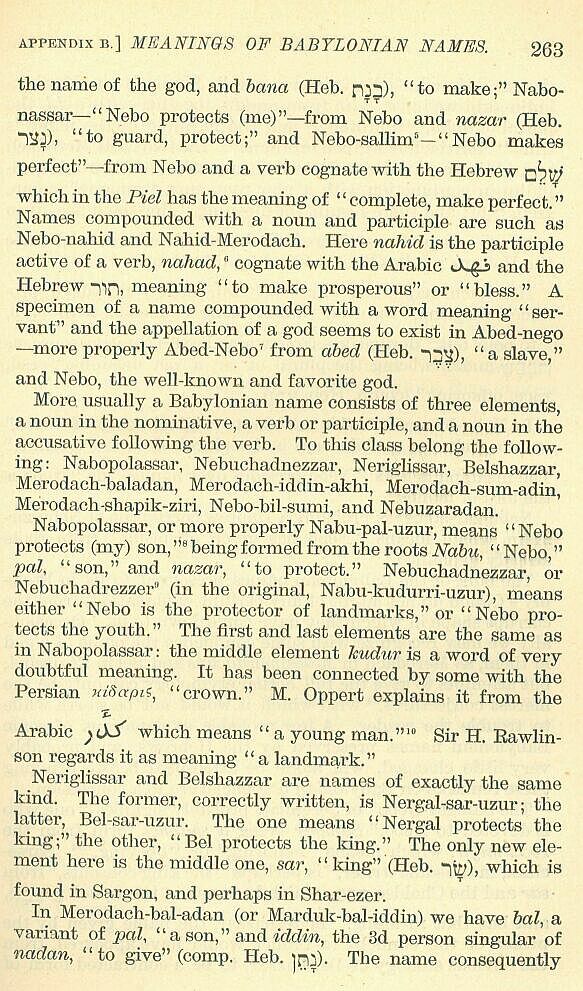
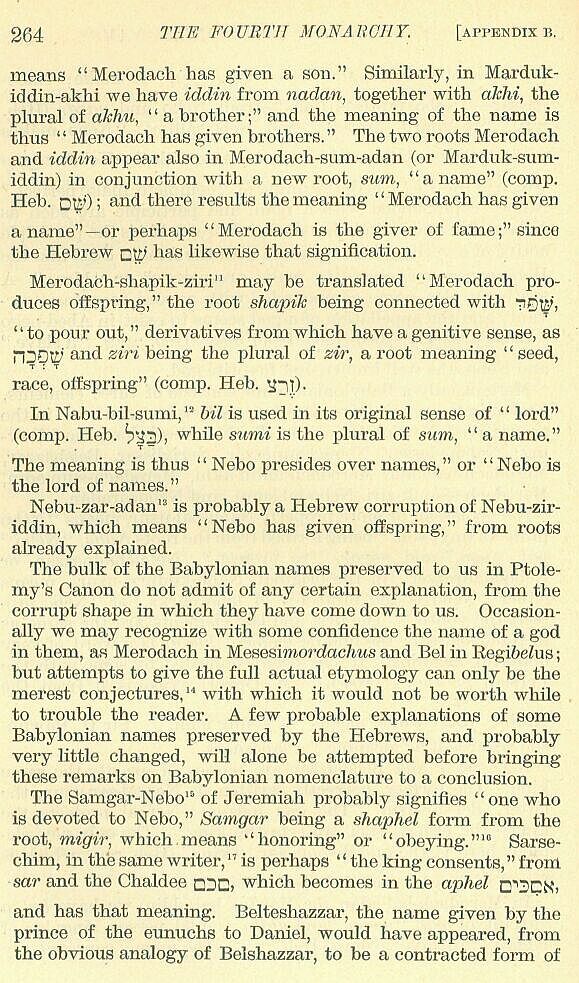
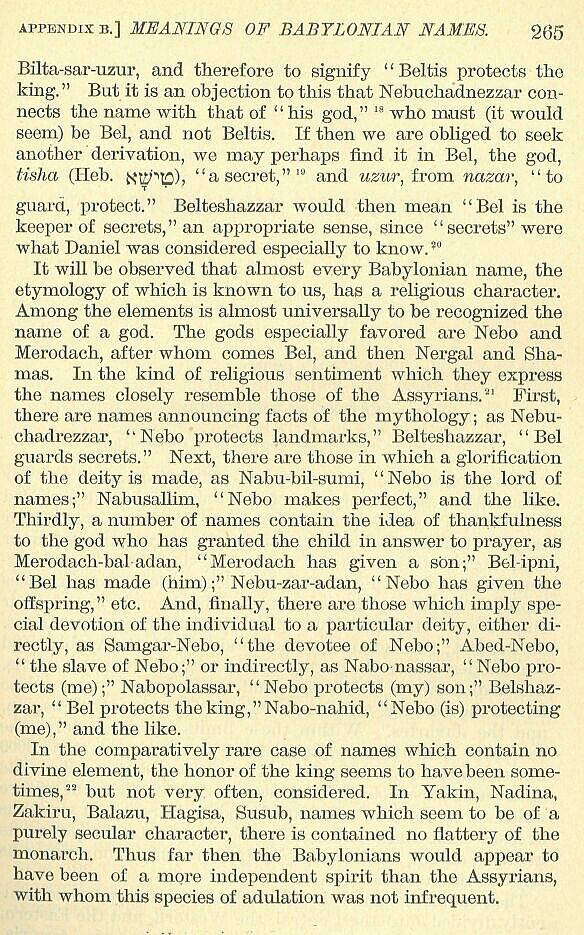
The names of the Babylonians, like those of the Assyrians, were significant. Generally, if not always, they were composed of at least two elements. These might be a noun in the nominative case with a verb following it, a noun in the nominative with a participle in apposition, or a word meaning "servant" followed by the name of a god. Under the first class came such names as "Bel-ipni"—"Bel has made (me)"—from Bel,