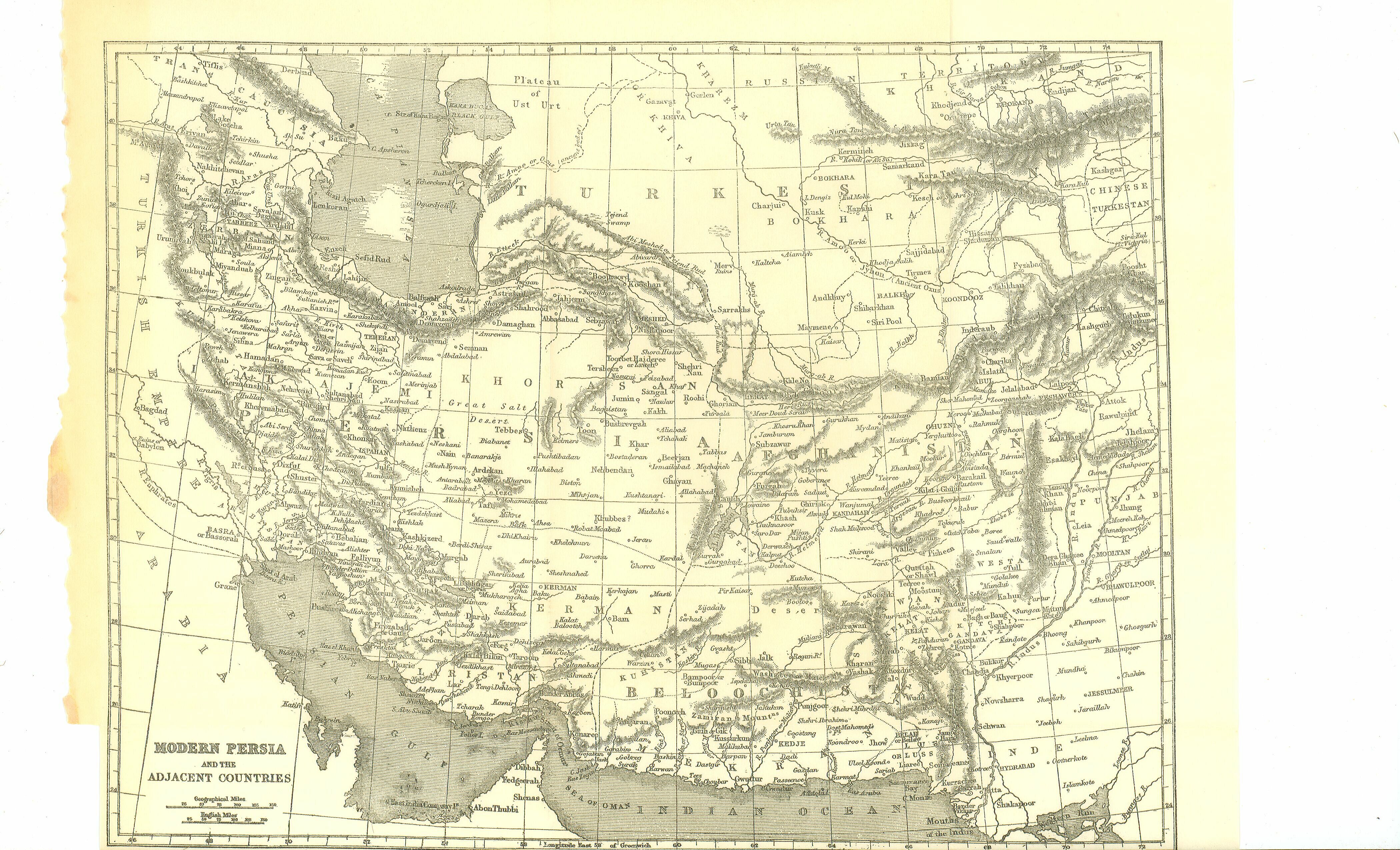
Click on the image to enlarge.
"I saw the man pushing westward, and northward, and southward; so that no beast might stand before him, neither was there any that could deliver out of his hand; but he did according to his will, and became great."—Daniel, viii. 4.
The history of the Persian Empire dates from the conquest of Astyages by Cyrus, and therefore commences with the year B.C. 558. But the present inquiry must be carried considerably further back, since in this, as in most other cases, the Empire grew up out of a previously existing monarchy. Darius Hystaspis reckons that there had been eight Persians kings of his race previously to himself; and though it is no doubt possible that some of the earlier names may be fictitious, yet we can scarcely suppose that he was deceived, or that he wished to deceive, as to the fact that long anterior to his own reign, or that of his elder contemporary, Cyrus, Persia had been a monarchy, governed by a line of princes of the same clan, or family, with himself. It is our business in this place, before entering upon the brilliant period of the Empire, to cast a retrospective glance over the earlier ages of obscurity, and to collect therefrom such scattered notices as are to be found of the Persians and their princes or kings before they suddenly attracted the general attention of the civilized world by their astonishing achievements under the great Cyrus.
The more ancient of-the sacred books of the Jews, while distinctly noticing the nation of the Medes, contain no mention at all of Persia or the Persians. The Zendavesta, the sacred volume of the people themselves, is equally silent on the subject. The earliest appearance of the Persians in history is in the inscriptions of the Assyrian kings, which begin to notice them about the middle of the ninth century B.C. At this time Shalmaneser II. found them in south-western Armenia, where they were in close contact with the Medes, of whom, however, they seem to have been wholly independent. Like the modern Kurds in this same region, they owned no subjection to a single head, but were under the government of numerous petty chieftains, each the lord of a single town or of a small mountain district. Shalmaneser informs us that he took tribute from twenty-five such chiefs. Similar tokens of submission were paid also to his son and grandson. After this the Assyrian records are silent as to the Persians for nearly a century, and it is not until the reign of Sennacherib that we once more find them brought into contact with the power which aspired to be mistress of Asia. At the time of their reappearance they are no longer in Armenia, but have descended the line of Zagros and reached the districts which lie north and north-east of Susiana, or that part of the Bakhtiyari chain which, if it is not actually within Persia Proper, at any rate immediately adjoins upon it. Arrived thus far, it was easy for them to occupy the region to which they have given permanent name; for the Bakhtiyari mountains command it and give a ready access to its valleys and plains.
The Persians would thus appear not to have completed their migrations till near the close of the Assyrian period, and it is probable that they did not settle into an organized monarchy much before the fall of Nineveh. At any rate we hear of no Persian ruler of note or name in the Assyrian records, and the reign of petty chiefs would seem therefore to have continued at least to the time of Asshur-bani-pal, up to which date we have ample records. The establishment, however, about the year B.C. 660, or a little later, of a powerful monarchy in the kindred and neighboring Media, could not fail to attract attention, and might well provoke imitation in Persia; and the native tradition appears to have been that about this time. Persian royalty began in the person of a certain Achaemenes (Hakhamanish), from whom all their later monarchs, with one possible exception, were proud to trace their descent.
The name Achaemenes cannot fail to arouse some suspicion. The Greek genealogies render us so familiar with heroes eponymi—imaginary personages, who owe their origin to the mere fact of the existence of certain tribe or race names, to account for which they were invented—that whenever, even in the history of other nations, we happen upon a name professedly personal, which stands evidently in close connection with a tribal designation, we are apt at once to suspect it of being fictitious. But in the East tribal and even ethnic names were certainly sometimes derived from actual persons; and it may be questioned whether the Persians, or the Iranic stock generally, had the notion of inventing personal eponyms. The name Achaemenes, therefore, in spite of its connection with the royal clan name of Achaemenidae, may stand as perhaps that of a real Persian king, and, if so, as probably that of the first king, the original founder of the monarchy, who united the scattered tribes in one, and thus raised Persia into a power of considerable importance.
The immediate successor of Achaemenes appears to have been his son, Teispes. Of him and of the next three monarchs, the information that we possess is exceedingly scanty. The very names of one or two in the series are uncertain. One tradition assigns either to the second or the fourth king of the list the establishment of friendly relations with a certain Pharnaces, King of Cappadocia, by an intermarriage between a Persian princess, Atossa, and the Cappadocian monarch. The existence of communication at this time between petty countries politically unconnected, and placed at such a distance from one another as Cappadocia and Persia, is certainly what we should not have expected; but our knowledge of the general condition of Western Asia at the period is too slight to justify us in a positive rejection of the story, which indicates, if it be true, that even during this time of comparative obscurity, the Persian monarchs were widely known, and that their alliance was thought a matter of importance.
The political condition of Persia under these early monarchs is a more interesting question than either the names of the kings or the foreign alliances which they attracted. According to Herodotus, that condition was one of absolute and unqualified subjection to the sway of the Medes, who conquered Persia and imposed their yoke upon the people before the year B.C. 634. The native records, however, and the accounts which Xenophon preferred, represent Persia as being at this time a separate and powerful state, either wholly independent of Media, or, at any rate, held in light bonds of little more than nominal dependence. On the whole, it appears most probable that the true condition of the country was that which this last phrase expresses. It maybe doubted whether there had ever been a conquest; but the weaker and less developed of the two kindred states owned the suzerainty of the stronger, and though quite unshackled in her internal administration, and perhaps not very much interfered with in her relations towards foreign countries, was, formally, a sort of Median fief, standing nearly in the position in which Egypt now stands to Turkey. The position was irksome to the sovereigns rather than unpleasant to the people. It detracted from the dignity of the Persian monarchs, and injured their self-respect; it probably caused them occasional inconvenience, since from time to time they would have to pay their court to their suzerain; and it seems towards the close of the Median period to have involved an obligation which must have been felt, if not as degrading, at any rate as very disagreeable. The monarch appears to have been required to send his eldest son as a sort of hostage to the Court of his superior, where he was held in a species of honorable captivity, not being allowed to quit the Court and return home without leave, but being otherwise well treated. The fidelity of the father was probably supposed to be in this way secured while it might be hoped that the son would be conciliated, and made an attached and willing dependent.
When Persian history first fairly opens upon us in the pages of Xenophon and of Nicolaus Damascenus, this is the condition of things which we find existing. Cambyses, the father of Cyrus the Great—called Atradates by the Syrian writer—is ruler of Persia, and resides in his native country, while his son Cyrus is permanently, or at any rate usually, resident at the Median Court, where he is in high favor with the reigning monarch, Astyages. According to Xenophon, who has here the support of Herodotus, he is Astyages' grandson, his father, Cambyses, being married to Mandane, that monarch's daughter. According to Nicolaus, who in this agrees with Ctesias, he is no way related to Astyages, who retains him at his court because he is personally attached to him. In the narrative of the latter writer, which has already been preferred in these volumes, the young prince, while at the Court, conceives the idea of freeing his own country by a revolt, and enters into secret communication with his father for the furtherance of his object. His father somewhat reluctantly assents, and preparations are made, which lead to the escape of Cyrus and the commencement of a war of independence. The details of the struggle, as they are related by Nicolaus, have been already given. After repeated defeats, the Persians finally make a stand at Pasargadae, their capital, where in two great battles they destroy the power of Astyages, who himself remains a prisoner in the hands of his adversary.
In the course of the struggle the father of Cyrus had fallen, and its close, therefore, presented Cyrus himself before the eyes of the Western Asiatics as the undisputed lord of the great Arian Empire which had established itself on the ruins of the Semitic. Transfers of sovereignty are easily made in the East, where independence is little valued, and each new conqueror is hailed with acclamations from millions. It mattered nothing to the bulk of Astyages' subjects whether they were ruled from Ecbatana or Pasargadae, by Median or Persian masters. Fate had settled that a single lord was to bear sway over the tribes and nations dwelling between the Persian Gulf and the Euxine; and the arbitrament of the sword had now decided that this single lord should be Cyrus. We may readily believe the statement of Nicolaus that the nations previously subject to the Medes vied with each other in the celerity and zeal with which they made their submission to the Persian conqueror. Cyrus succeeded at once to the full inheritance of which he had dispossessed Astyages, and was recognized as king by all the tribes between the Halys and the desert of Khorassan.
He was at this time, if we may trust Dino, exactly forty years of age, and was thus at that happy period in life when the bodily powers have not yet begun to decay, while the mental are just reaching their perfection. Though we may not be able to trust implicitly the details of the war of independence which have come down to us, yet there can be no doubt that he had displayed in its course very remarkable courage and conduct. He had intended, probably, no more than to free his country from the Median yoke; by the force of circumstances he had been led on to the destruction of the Median power, and to the establishment of a Persian Empire in its stead. With empire had come an enormous accession of wealth. The accumulated stores of ages, the riches of the Ninevite kings—the "gold," the "silver," and the "pleasant furniture" of those mighty potentates, of which there was "none end"—together with all the additions made to these stores by the Median monarchs, had fallen into his hands, and from comparative poverty he had come per saltum into the position of one of the wealthiest—if not of the very wealthiest—of princes. An ordinary Oriental would have been content with such a result, and have declined to tempt fortune any more. But Cyrus was no ordinary Oriental. Confident in his own powers, active, not to say restless, and of an ambition that nothing could satiate, he viewed, the position which he had won simply as a means of advancing himself to higher eminence. According to Ctesias, he was scarcely seated upon the throne, when he led an expedition to the far north-east against the renowned Bactrians and Sacans; and at any rate, whether this be true or no—and most probably it is an anticipation of later occurrences—it is certain that, instead of folding his hands, Cyrus proceeded with scarcely a pause on a long career of conquest, devoting his whole life to the carrying out of his plans of aggression, and leaving a portion of his schemes, which were too extensive for one life to realize, as a legacy to his successor. The quarter to which he really first turned his attention seems to have been the north-west. There, in the somewhat narrow but most fertile tract between the river Halys and the Egean Sea, was a state which seemed likely to give him trouble—a state which had successfully resisted all the efforts of the Medes to reduce it, and which recently, under a warlike prince, had shown a remarkable power of expansion. An instinct of danger warned the scarce firmly-settled monarch to fix his eye at once upon Lydia; in the wealthy and successful Croesus, the Lydian king, he saw one whom dynastic interests might naturally lead to espouse the quarrel of the conquered Mede, and whose power and personal qualities rendered him a really formidable rival.
The Lydian monarch, on his side, did not scruple to challenge a contest. The long strife which his father had waged with the great Cyaxares had terminated in a close alliance, cemented by a marriage, which made Croesus and Astyages brothers. The friendship of the great power of Western Asia, secured by this union, had set Lydia free to pursue a policy of self-aggrandizement in her own immediate, neighborhood. Rapidly, one after another, the kingdoms of Asia Minor had been reduced; and, excepting the mountain districts of Lycia and Cilicia, all Asia within the Halys now owned the sway of the Lydian king. Contented with his successes, and satisfied that the tie of relationship secured him from attack on the part of the only power which he had need to fear, Croesus had for some years given himself up to the enjoyment of his gains and to an ostentatious display of his magnificence. It was a rude shock to the indolent and self-complacent dreams of a sanguine optimism, which looked that "to-morrow should be as to-day, only much more abundant," when tidings came that revolution had raised its head in the far south-east, and that an energetic prince, in the full vigor of life, and untrammelled by dynastic ties, had thrust the aged Astyages from his throne, and girt his own brows with the Imperial diadem. Croesus, according to the story, was still in deep grief on account of the untimely death of his eldest son, when the intelligence reached him. Instantly rousing himself from his despair, he set about his preparations for the struggle, which his sagacity saw to be inevitable. After consultation of the oracles of Greece, he allied himself with the Grecian community, which appeared to him on the whole to be the most powerful. At the same time he sent ambassadors to Babylon and Memphis, to the courts of Labynetus and Amasis, with proposals for an alliance offensive and defensive between the three secondary powers of the Eastern world against that leading power whose superior strength and resources were felt to constitute a common danger. His representations were effectual. The kings of Babylon and Egypt, alive to their own peril, accepted his proposals; and a joint league was formed between the three monarchs and the republic of Sparta for the purpose of resisting the presumed aggressive spirit of the Medo-Persians.
Cyrus, meanwhile, was not idle. Suspecting that a weak point in his adversary's harness would be the disaffection of some of his more recently conquered subjects, he sent emissaries into Asia Minor to sound the dispositions of the natives. These emissaries particularly addressed themselves to the Asiatic Greeks, who, coming of a freedom-loving stock, and having been only very lately subdued, would it was thought, be likely to catch at an opportunity of shaking off the yoke of their conqueror. But, reasonable as such hopes must have seemed, they were in this instance doomed to disappointment. The Ionians, instead of hailing Cyrus as a liberator, received his overtures with suspicion. They probably thought that they were sure not to gain, and that they might possibly lose, by a change of masters. The yoke of Croesus had not, perhaps, been very oppressive; at any rate it seemed to them preferable to "bear the ills they had," rather than "fly to others" which might turn out less tolerable.
Disappointed in this quarter, the Persian prince directed his efforts to the concentration of a large army, and its rapid advance into a position where it would be excellently placed both for defence and attack. The frontier province of Cappadocia, which was only separated from the dominions of the Lydian monarch by a stream of moderate size, the Halys, was a most defensible country, extremely fertile and productive, abounding in natural fastnesses, and inhabited by a brave and warlike population. Into this district Cyrus pushed forward his army with all speed, taking, as it would seem, not the short route through Diarbekr, Malatiyah, and Gurun, along which the "Royal Road" afterwards ran, but the more circuitous one by Erzerum, which brought him into Northern Cappadocia, or Pontus, as it was called by the Romans. Here, in a district named Pteria, which cannot have been very far from the coast, he found his adversary, who had crossed the Halys, and taken several Cappadocian towns, among which was the chief city of the Pterians. Perceiving that his troops considerably outnumbered those of Crcesus, he lost no time in giving him battle. The action was fought in the Pterian country, and was stoutly contested, terminating at nightfall without any decisive advantage to either party. The next day neither side made any movement; and Crcesus, concluding from his enemy's inaction that, though he had not been able to conquer him, he had nothing to fear from his desire of vengeance or his spirit of enterprise, determined on a retreat. He laid the blame of his failure, we are told, on the insufficient number of his troops, and purposed to call for the contingents of his allies, and renew the war with largely augmented forces in the ensuing spring.
Cyrus, on his part, allowed the Lydians to retire unmolested, thus confirming his adversary in the mistaken estimate which he had formed of Persian courage and daring. Anticipating the course which Croesus would adopt under the circumstances, he kept his army well in hand, and, as soon as the Lydians were clean gone, he crossed the Halys, and marched straight upon Sardis. Croesus, deeming himself safe from molestation, had no sooner reached his capital than he had dismissed the bulk of his troops to their homes for the winter, merely giving them orders to return in the spring, when he hoped to have received auxiliaries from Sparta, Babylon, and Egypt. Left thus almost without defence, he suddenly heard that his audacious foe had followed on his steps, had ventured into the heart of his dominions, and was but a short distance from the capital. In this crisis he showed a spirit well worthy of admiration. Putting himself at the head of such an army of native Lydians as he could collect at a few hours' notice, he met the advancing foe in the rich plain a little to the east of Sardis, and gave him battle immediately. It is possible that even under these disadvantageous circumstances he might in fair fight have been victorious, for the Lydian cavalry were at this time excellent, and decidedly superior to the Persian. But Cyrus, aware of their merits, had recourse to stratagem, and by forming his camels in front, so frightened the Lydian horses that they fled from the field. The riders dismounted and fought on foot, but their gallantry was unavailing. After a prolonged and bloody combat the Lydian army was defeated, and forced to take refuge behind the walls of the capital.
Croesus now in hot haste sent off fresh messengers to his allies, begging them to come at once to his assistance. He had still a good hope of maintaining himself till their arrival, for his city was defended by walls, and was regarded by the natives as impregnable. An attempt to storm the defences failed; and the siege must have been turned into a blockade but for an accidental discovery. A Persian soldier had approached to reconnoitre the citadel on the side where it was strongest by nature, and therefore guarded with least care, when he observed one of the garrison descend the rock after his helmet, which had fallen from his head, pick it up, and return with it. Being an expert climber, he attempted the track thus pointed out to him, and succeeded in reaching the summit. Several of his comrades followed in his steps; the citadel was surprised, and the town taken and plundered.
Thus fell the greatest city of Asia Minor after a siege of fourteen days. The Lydian monarch, it is said, narrowly escaped with his life from the confusion of the sack; but, being fortunately recognized in time, was made prisoner, and brought before Cyrus. Cyrus at first treated him with some harshness, but soon relented, and, with that clemency which was a common characteristic of the earlier Persian kings, assigned him a territory for his maintenance, and gave him an honorable position at Court, where he passed at least thirty years, in high favor, first with Cyrus, and then with Cambyses. Lydia itself was absorbed at once into the Persian Empire, together with most of its dependencies, which submitted as soon as the fall of Sardis was known. There still, however, remained a certain amount of subjugation to be effected. The Greeks of the coast, who had offended the Great King by their refusal of his overtures, were not to be allowed to pass quietly into the condition of tributaries; and there were certain native races in the south-western corner of Asia Minor which declined to submit without a struggle to the new conqueror. But these matters were not regarded by Cyrus as of sufficient importance to require his own personal superintendence. Having remained at Sardis for a few weeks, during which time he received an insulting message from Sparta, whereto he made a menacing reply, and having arranged for the government of the newly-conquered province and the transmission of its treasures to Ecbatana, he quitted Lydia for the interior, taking Croesus with him, and proceeded towards the Median capital. He was bent on prosecuting without delay his schemes of conquest in other quarters—schemes of a grandeur and a comprehensiveness unknown to any previous monarch.
Scarcely, however, was he departed when Sardis became the scene of an insurrection. Pactyas, a Lydian, who had been entrusted with the duty of conveying the treasures of Croesus and his more wealthy subjects to Ecbatana, revolted against Tabalus, the Persian commandant of the town, and being joined by the native population and numerous mercenaries, principally Greeks, whom he hired with the treasure that was in his hands, made himself master of Sardis, and besieged Tabalus in the citadel. The news reached Cyrus while he was upon his march; but, estimating the degree of its importance aright, he did not suffer it to interfere with his plans. He judged it enough to send a general with a strong body of troops to put down the revolt, and continued his own journey eastward. Mazares, a Mede, was the officer selected for the service. On arriving before Sardis, he found that Pactyas had relinquished his enterprise and fled to the coast, and that the revolt was consequently at an end. It only remained to exact vengeance. The rebellious Lydians were disarmed. Pactyas was pursued with unrelenting hostility, and demanded, in succession, of the Cymaeans, the Mytilenseans, and the Chians, of whom the last-mentioned surrendered him. The Greek cities which had furnished Pactyas with auxiliaries were then attacked, and the inhabitants of the first which fell, Priene, were one and all sold as slaves.
Mazares soon afterwards died, and was succeeded by Ha-pagus, another Mede, who adopted a somewhat milder policy towards the unfortunate Greeks. Besieging their cities one by one, and taking them by means of banks or mounds piled up against the walls, he, in some instances, connived at the inhabitants escaping in their ships, while, in others, he allowed them to take up the ordinary position of Persian subjects, liable to tribute and military service, but not otherwise molested. So little irksome were such terms to the Ionians of this period that even those who dwelt in the islands off the coast, with the single exception of the Samians—though they ran no risk of subjugation, since the Persians did not possess a fleet—accepted voluntarily the same position, and enrolled themselves among the subjects of Cyrus.
One Greek continental town alone suffered nothing during this time of trouble. When Cyrus refused the offers of submission, which reached him from the Ionian and AEolian Greeks after his capture of Sardis, he made an exception in favor of Miletus, the most important of all the Grecian cities in Asia. Prudence, it is probable, rather than clemency, dictated this course, since to detach from the Grecian cause the most powerful and influential of the states was the readiest way of weakening the resistance they would be able to make. Miletus singly had defied the arms of four successive Lydian kings, and had only succumbed at last to the efforts of the fifth, Croesus. If her submission had been now rejected, and she had been obliged to take counsel of her despair, the struggle between the Greek cities and the Persian generals might have assumed a different character.
Still more different might have been the result, if the cities generally had had the wisdom to follow a piece of advice which the great philosopher and statesman of the time, Thales, the Milesian, is said to have given them. Thales suggested that the Ionians should form themselves into a confederation, to be governed by a congress which should meet at Teos, the several cities retaining their own laws and internal independence, but being united for military purposes into a single community. Judged by the light which later events, the great Ionian revolt especially, throw upon it, this advice is seen to have been of the greatest importance. It is difficult to say what check, or even reverse, the arms of Persia might not have at this time sustained, if the spirit of Thales had animated his Asiatic countrymen generally; if the loose Ionic Amphictyony, which in reality left each state in the hour of danger to its own resources, had been superseded by a true federal union, and the combined efforts of the thirteen Ionian communities had been directed to a steady resistance of Persian aggression and a determined maintenance of their own independence. Mazares and Harpagus would almost certainly have been baffled, and the Great King himself would probably have been called off from his eastern conquests to undertake in person a task which after all he might have failed to accomplish.
The fall of the last Ionian town left Harpagus free to turn his attention to the tribes of the south-west which had not yet made their submission—the Carians, the Dorian Greeks, the Caunians, and the people of Lycia. Impressing the services of the newly-conquered Ionians and AEolians, he marched first against Caria, which offered but a feeble resistance. The Dorians of the continent, Myndians, Halicarnassians, and Cnidians. submitted still more tamely, without any struggle at all; but the Caunians and Lycians showed a different spirit. These tribes, which were ethnically allied, and of a very peculiar type, had never yet, it would seem, been subdued by any conqueror. Prizing highly the liberty they had enjoyed so long, they defended themselves with desperation. When they were defeated in the field they shut themselves up within the walls of their chief cities, Caunus and Xanthus, where, finding resistance impossible, they set fire to the two places with their own hands, burned their wives, children, slaves, and valuables, and then sallying forth, sword in hand, fell on the besiegers' lines, and fought till they were all slain.
Meanwhile Cyrus was pursuing a career of conquest in the far east. It was now, according to Herodotus, who is, beyond all question, a better authority than Ctesias for the reign of Cyrus, that the reduction of the Bactrians and the Sacans, the chief nations of what is called by moderns Central Asia, took place. Bactria was a country which enjoyed the reputation of having been great and glorious at a very early date. In one of the most ancient portions of the Zendavesta it was celebrated as "Bahhdi eredhwo-drafsha," or "Bactria" with the lofty banner; and traditions not wholly to be despised made it the native country of Zoroaster. There is good reason to believe that, up to the date of Cyras, it had maintained its independence, or at any rate that it had been untouched by the great monarchies which for above seven hundred years had borne sway in the western parts of Asia. Its people were of the Iranic stock, and retained in their remote and somewhat savage country the simple and primitive habits of the race. Though their arms were of indifferent character, they were among the best soldiers to be found in the East, and always showed themselves a formidable enemy. According to Ctesias, when Cyrus invaded them, they fought a pitched battle with his army, in which the victory was with neither party. They were not, he said, reduced by force of arms at all, but submitted voluntarily when they found that Cyrus had married a Median princess. Herodotus, on the contrary, seems to include the Bactrians among the nations which Cyrus subdued, and probability is strongly in favor of this view of the matter. So warlike a nation is not likely to have submitted unless to force; nor is there any ground to believe that a Median marriage, had Cyrus contracted one, would have made him any the more acceptable to the Bactrians.
On the conquest of Bactria followed, we may be tolerably sure, an attack upon the Sacae. This people, who must certainly have bordered on the Bactrians, dwelt probably either on the Pamir Steppe, or on the high plain of Chinese Tartary, east of the Bolar range—the modern districts of Kashgar and Yarkand. They were reckoned excellent soldiers. They fought with the bow, the dagger, and the battle-axe, and were equally formidable on horseback and on foot. In race they were probably Tatars or Turanians, and their descendants or their congeners are to be seen in the modern inhabitants of these regions. According to Ctesias, their women took the field in almost equal numbers with their men; and the mixed army which resisted Cyrus amounted, including both sexes, to half a million. The king who commanded them was a certain Amorges, who was married to a wife called Sparethra. In an engagement with the Persians he fell into the enemy's hands, whereupon Sparethra put herself at the head of the Sacan forces, defeated Cyrus, and took so many prisoners of importance that the Persian monarch was glad to release Amorges in exchange for them. The Sacse, however, notwithstanding this success, were reduced, and became subjects and tributaries of Persia.
Among other countries subdued by Cyrus in this neighborhood, probably about the same period, may be named Hyrcania, Parthia, Chorasmia, Sogdiana, Aria (or Herat), Drangiana, Arachosia, Sattagydia, and Gandaria. The brief epitome which we possess of Ctesias omits to make any mention of these minor conquests, while Herodotus sums them all up in a single line; but there is reason to believe that the Cnidian historian gave a methodized account of their accomplishment, of which scattered notices have come down to us in various writers. Arrian relates that there was a city called Cyropolis, situated on the Jaxartes, a place of great strength defended by very lofty walls, which had been founded by the Great Cyrus. This city belonged to Sogdiana. Pliny states that Capisa, the chief city of Capisene, which lay not far from the upper Indus, was destroyed by Cyrus. This place is probably Kafshan, a little to the north of Kabul. Several authors tell us that the Ariaspse, a people of Drangiana, assisted Cyrus with provisions when he was warring in their neighborhood, and received from him in return a new name, which the Greeks rendered by "Euergetse"—"Benefactors." The Ariaspae must have dwelt near the Hamoon, or Lake of Seistan. We have thus traces of the conqueror's presence in the extreme north on the Jaxartes, in the extreme east in Affghanistan, and towards the south as far as Seistan and the Helmend; nor can there be any reasonable doubt that he overran and reduced to subjection the whole of that vast tract which lies between the Caspian on the west, the Indus valley and the desert of Tartary towards the east, the Jaxartes or Sir Deria on the north, and towards the south the Great Deserts of Seistan and Khorassan.
More uncertainty attaches to the reduction of the tract lying south of these deserts. Tradition said that Cyrus had once penetrated into Gedrosia on an expedition against the Indians, and had lost his entire army in the waterless and trackless desert; but there is no evidence at all that he reduced the country. It appears to have been a portion of the Empire in the reign of Darius Hystaspis, but whether that monarch, or Cambyses, or the great founder of the Persian power conquered it, cannot at present be determined.
The conquest of the vast tract lying between the Caspian and the Indus, inhabited (as it was) by a numerous, valiant, and freedom-loving population, may well have occupied Cyrus for thirteen or fourteen years. Alexander the Great spent in the reduction of this region, after the inhabitants had in a great measure lost their warlike qualities, as much as five years, or half the time occupied by his whole series of conquests. Cyrus could not have ventured on prosecuting his enterprises, as did the Macedonian prince, continuously and without interruption, marching straight from one country to another without once revisiting his capital. He must from time to time have returned to Ecbatana or Pasargadae; and it is on the whole most probable that, like the Assyrian monarchs, he marched out from home on a fresh expedition almost every year. Thus it need cause us no surprise that fourteen years were consumed in the subjugation of the tribes and nations beyond the Iranic desert to the north and the north-east, and that it was not till B.C. 539, when he was nearly sixty years of age, that the Persian monarch felt himself free to turn his attention to the great kingdom of the south.
The expedition of Cyrus against Babylon has been described already. Its success added to the Empire the rich and valuable provinces of Babylonia, Susiana, Syria, and Palestine, thus augmenting its size by about 240,000 or 250,000 square miles. Far more important, however, than this geographical increase was the removal of the last formidable rival—the complete destruction of a power which represented to the Asiatics the old Semitic civilization, which with reason claimed to be the heir and the successor of Assyria, and had a history stretching back for a space of nearly two thousand years. So long as Babylon, "the glory of kingdoms," "the praise of the whole earth," retained her independence, with her vast buildings, her prestige of antiquity, her wealth, her learning, her ancient and grand religious system, she could scarcely fail to be in the eyes of her neighbors the first power in the world, if not in mere strength, yet in honor, dignity, and reputation. Haughty and contemptuous herself to the very last, she naturally imposed on men's minds, alike by her past history and her present pretensions; nor was it possible for the Persian monarch to feel that he stood before his subjects as indisputably the foremost man upon the earth until he had humbled in the dust the pride and arrogance of Babylon. But, with the fall of the Great City, the whole fabric of Semetic greatness was shattered. Babylon became "an astonishment and a hissing"—all her prestige vanished—and Persia stepped manifestly into the place, which Assyria had occupied for so many centuries, of absolute and unrivalled mistress of Western Asia.
The fall of Babylon was also the fall of an ancient, widely spread, and deeply venerated religious system. Not of course, that the religion suddenly disappeared or ceased to have votaries, but that, from a dominant system, supported by all the resources of the state, and enforced by the civil power over a wide extent of territory, it became simply one of many tolerated beliefs, exposed to frequent rebuffs and insults, and at all times overshadowed by a new and rival system—the comparatively pure creed of Zoroastrianism, The conquest of Babylon by Persia was, practically, if not a death-blow, at least a severe wound, to that sensuous idol-worship which had for more than twenty centuries been the almost universal religion in the countries between the Mediterranean and the Zagros mountain range. The religion never recovered itself—was never reinstated. It survived, a longer or a shorter time, in places. To a slight extent it corrupted Zoroastrianism; but, on the whole, from the date of the fall of Babylon it declined. "Bel bowed down; Nebo stooped;" "Merodach was broken in pieces." Judgment was done upon the Babylonian graven images; and the system, of which they formed a necessary part, having once fallen from its proud pre-eminence, gradually decayed and vanished.
Parallel with the decline of the old Semitic idolatry was the advance of its direct antithesis, pure spiritual Monotheism. The same blow which laid the Babylonian religion in the dust struck off the fetters from Judaism. Purified and refined by the precious discipline of adversity, the Jewish system, which Cyrus, feeling towards it a natural sympathy, protected, upheld, and replaced in its proper locality, advanced from this time in influence and importance, leavening little by little the foul mass of superstition and impurity which came in contact with it. Proselytism grew more common. The Jews spread themselves wider. The return from, the captivity, which Cyrus authorized almost immediately after the capture of Babylon, is the starting point from which we may trace a gradual enlightenment of the heathen world by the dissemination of Jewish beliefs and practices—such dissemination being greatly helped by the high estimation in which the Jewish system was held by the civil authority, both while the empire of the Persians lasted, and when power passed to the Macedonians.
On the fall of Babylon its dependencies seem to have submitted to the conqueror, with a single exception. Phoenicia, which had never acquiesced contentedly either in Assyrian or in Babylonian rule, saw, apparently, in the fresh convulsion that was now shaking the East, an opportunity for recovering autonomy. It was nearly half a century since her last struggle to free herself had terminated unsuccessfully. A new generation had grown up since that time—a generation which had seen nothing of war, and imperfectly appreciated its perils. Perhaps some reliance was placed on the countenance and support of Egypt, which, it must have been felt, would view with satisfaction any obstacle to the advance of a power wherewith she was sure, sooner or later, to come into collision. At any rate, it was resolved to make the venture. Phoenicia, on the destruction of her distant suzerain, quietly resumed her freedom; abstained from making any act of submission to the conqueror; while, however, at the same time, she established friendly relations for commercial purposes with one of the conqueror's vassals, the prince who had been sent into Palestine to re-establish the Jews at Jerusalem.
It might have been expected that Cyrus, after his conquest of Babylon, would have immediately proceeded towards the south-west. The reduction of Egypt had, according to Herodotus, been embraced in the designs which he formed fifteen years earlier. The non-submission of Phoenicia must have been regarded as an act of defiance which deserved signal chastisement. It has been suspected that the restoration of the Jews was prompted, at least in part, by political motives, and that Cyrus, when he re-established them in their country, looked to finding them of use to him in the attack which he was meditating upon Egypt. At any rate it is evident that their presence would have facilitated his march through Palestine, and given him a point d'appui, which could not but have been of value. These considerations make it probable that an Egyptian expedition would have been determined on, had not circumstances occurred to prevent it.
What the exact circumstances were, it is impossible to determine. According to Herodotus, a sudden desire seized Cyrus to attack the Massagetae, who bordered his Empire to the north-east. He led his troops across the Araxes (Jaxartes?), defeated the Massagetae by stratagem in a great battle, but was afterwards himself defeated and slain, his body falling into the enemy's hands, who treated it with gross indignity. According to Ctesias, the people against whom he made his expedition were the Derbices, a nation bordering upon India, Assisted by Indian allies, who lent them a number of elephants, this people engaged Cyrus, and defeated him in a battle, wherein he received a mortal wound. Reinforced, however, by a body of Sacae, the Persians renewed the struggle, and gained a complete victory, which was followed by the submission of the nation. Cyrus, however, died of his wound on the third day after the first battle.
This conflict of testimony clouds with uncertainty the entire closing scene of the life of Cyrus. All that we can lay down as tolerably well established is, that instead of carrying out his designs against Egypt, he engaged in hostilities with one of the nations on his north-eastern frontier, that he conducted the war with less than his usual success, and in the course of it received a wound of which he died (B.C. 529), after he had reigned nine-and-twenty years. That his body did not fall into the enemy's hands appears, however, to be certain from the fact that it was conveyed into Persia Proper, and buried at Pasargadae.
It may be suspected that this expedition, which proved so disastrous to the Persian monarch, was not the mere wanton act which it appears to be in the pages of our authorities. The nations of the north-east were at all times turbulent and irritable, with difficulty held in check by the civilized power that bore rule in the south and west. The expedition of Cyrus, whether directed against the Massagetae or the Derbices, was probably intended to strike terror into the barbarians of these regions, and was analogous to those invasions which were undertaken under the wisest of the Roman Emperors, across the Rhine and Danube, against Germans, Goths, and Sarmatae. The object of such inroads was not to conquer, but to alarm—it was hoped by an imposing display of organized military force to deter the undisciplined hordes of the prolific North from venturing across the frontier and carrying desolation through large tracts of the Empire. Defensive warfare has often an aggressive look. It may have been solely with the object of protecting his own territories from attack that Cyrus made his last expedition across the Jaxertes, or towards the upper Indus.
The character of Cyrus, as represented to us by the Greeks, is the most favorable that we possess of any early Oriental monarch. Active, energetic, brave, fertile in stratagems, he has all the qualities required to form a successful military chief. He conciliates his people by friendly and familiar treatment, but declines to spoil them by yielding to their inclinations when they are adverse to their true interests. He has a ready humor, which shows itself in smart sayings and repartees, that take occasionally the favorite Oriental turn of parable or apologue. He is mild in his treatment of the prisoners that fall into his hands, and ready to forgive even the heinous crime of rebellion. He has none of the pride of the ordinary eastern despot, but converses on terms of equality with those about him. We cannot be surprised that the Persians, contrasting him with their later monarchs, held his memory in the highest veneration, and were even led by their affection for his person to make his type of countenance their standard of physical beauty.
The genius of Cyrus was essentially that of a conqueror, not of an administrator. There is no trace of his having adopted anything like a uniform system for the government of the provinces which he subdued. In Lydia he set up a Persian governor, but assigned certain important functions to a native; in Babylon he gave the entire direction of affairs into the hands of a Mede, to whom he allowed the title and style of king; in Judaea he appointed a native, but made him merely "governor" or "deputy;" in Sacia he maintained as tributary king the monarch who had resisted his arms. Policy may have dictated the course pursued in each instance, which may have been suited to the condition of the several provinces; but the variety allowed was fatal to consolidation, and the monarchy, as Cyrus left it, had as little cohesion as any of those by which it was preceded.
Though originally a rude mountain-chief, Cyrus, after he succeeded to empire, showed himself quite able to appreciate the dignity and value of art. In his constructions at Pasargadae he combined massiveness with elegance, and manifested a taste at once simple and refined. He ornamented his buildings with reliefs of an ideal character. It is probably to him that we owe the conception of the light tapering stone shaft, which is the glory of Persian architecture. If the more massive of the Persepolitan buildings are to be ascribed to him, we must regard him as haying fixed the whole plan and arrangement which was afterwards followed in all Persian palatial edifices.
In his domestic affairs Cyrus appears to have shown the same moderation and simplicity which we observe in his general conduct. He married, as it would seem, one wife only, Cassandane, the daughter of Pharnaspes, who was a member of the royal family. By her he had issue two sons and at least three daughters. The sons were Cambyses and Smerdis; the daughters Atossa, Artystone, and one whose name is unknown to us. Cassandane died before her husband, and was deeply mourned by him. Shortly before his own death he took the precaution formally to settle the succession. Leaving the general inheritance of his vast dominions to his elder son, Cambyses, he declared it to be his will that the younger should be entrusted with the actual government of several large and important provinces. He thought by this plan to secure the well-being of both the youths, never suspecting that he was in reality consigning both to untimely ends, and even preparing the way for an extraordinary revolution.
The ill effect of the unfortunate arrangement thus made appeared almost immediately. Cambyses was scarcely settled upon the throne before he grew jealous of his brother, and ordered him to be privately put to death. His cruel orders were obeyed, and with so much secrecy that neither the mode of the death, nor even the fact, was known to more than a few. Smerdis was generally believed to be still alive; and thus an opportunity was presented for personation—a form of imposture very congenial to Orientals, and one which has often had very disastrous consequences. We shall find in the sequel this opportunity embraced, and results follow of a most stirring and exciting character.
It required time, however, to bring to maturity the fruits of the crime so rashly committed. Cambyses, in the meanwhile, quite unconscious of danger, turned his attention to military matters, and determined on endeavoring to complete his father's scheme of conquest by the reduction of Egypt. Desirous of obtaining a ground of quarrel less antiquated than the alliance, a quarter of a century earlier, between Amasis and Croesus, he demanded that a daughter of the Egyptian king should be sent to him as a secondary wife. Amasis, too timid to refuse, sent a damsel named Nitetis, who was not his daughter; and she, soon after her arrival, made Cambyses acquainted with the fraud. A ground of quarrel was thus secured, which might be put forward when it suited his purpose; and meanwhile every nerve was being strained to prepare effectually for the expedition. The difficulty of a war with Egypt lay in her inaccessibility. She was protected on all sides by seas or deserts; and, for a successful advance upon her from the direction of Asia, it was desirable both to obtain a quiet passage for a large army through the desert of El-Tij, and also to have the support of a powerful fleet in the Mediterranean. This latter was the paramount consideration. An army well supplied with camels might carry its provisions and water through the desert, and might intimidate or overpower the few Arab tribes which inhabited it; but, unless the command of the sea was gained and the navigation of the Nile closed, Memphis might successfully resist attack. Cambyses appears to have perceived with sufficient clearness the conditions on which victory depended, and to have applied himself at once to securing them. He made a treaty with the Arab Sheikh who had the chief influence over the tribes of the desert; and at the same time he set to work to procure the services of a powerful naval force. By menaces or negotiations he prevailed upon the Phoenicians to submit themselves to his yoke, and having thus obtained a fleet superior to that of Egypt, he commenced hostilities by robbing her of a dependency which possessed considerable naval strength, in this way still further increasing the disparity between his own fleet and that of his enemy. Against the combined ships of Phoenicia, Cyprus, Ionia, and AEolis, Egypt was powerless, and her fleets seem to have quietly yielded the command of the sea. Cambyses was thus able to give his army the support of a naval force, as it marched along the coast, from Carmel probably to Pelusium; and when, having defeated the Egyptians at the last-named place, he proceeded against Memphis, he was able to take possession of the Nile, and to blockade the Egyptian capital both by land and water.
It appears that four years were consumed by the Persian monarch in his preparations for his Egyptian expedition. It was not until B.C. 525 that he entered Egypt at the head of his troops, and fought the great battle which decided the fate of the country. The struggle was long and bloody. Psammenitus, who had succeeded his father Amasis, had the services, not only of his Egyptian subjects, but a large body of mercenaries besides, Greeks and Carians. These allies were zealous in his cause, and are said to have given him a horrible proof of their attachment. One of their body had deserted to the Persians some little time before the expedition, and was believed to have given important advice to the invader. He had left his children behind in Egypt; and these his former comrades now seized, and led out in front of their lines, where they slew them before their father's eyes, and, having so done, mixed their blood in a bowl with water and wine, and drank, one and all, of the mixture. The battle followed immediately after; but, in spite of their courage and fanaticism, the Egyptian army was completely defeated. According to Ctesias, fifty thousand fell on the vanquished side, while the victors lost no more than seven thousand. Psammenitus, after his defeat, threw himself into Memphis, but, being blockaded by land and prevented from receiving supplies from the sea, after a stout resistance, he surrendered. The captive monarch received the respectful treatment which Persian clemency usually accorded to fallen sovereigns. Herodotus even goes so far as to intimate that, if he had abstained from conspiracy, he would probably have been allowed to continue ruler of Egypt, exchanging, of course, his independent sovereignty for a delegated kingship held at the pleasure of the Lord of Asia.
The conquest of Egypt was immediately followed by the submission of the neighboring tribes. The Libyans of the desert tract which borders the Nile valley to the west, and even the Greeks of the more remote Barca and Cyrene, sent gifts to the conqueror and consented to become his tributaries. But Cambyses placed little value on such petty accessions to his power. Inheriting the grandeur of view which had characterized his father, he was no sooner master of Egypt than he conceived the idea of a magnificent series of conquests in this quarter, whereby he hoped to become Lord of Africa no less than of Asia, or at any rate to leave himself without a rival of any importance on the vast continent which his victorious arms had now opened to him. Apart from Egypt, Africa possessed but two powers capable, by their political organization and their military strength, of offering him serious resistance. These were Ethiopia and Carthage—the one the great power of the South, the equal, if not even the superior, of Egypt—the other the great power of the West—remote, little known, but looming larger for, the obscurity in which she was shrouded, and attractive from her reputed wealth. The views of Cambyses comprised the reduction of both these powers, and also the conquest of the oasis of Ammon. As a good Zoroastrian, he was naturally anxious to exhibit the superiority of Ormazd to all the "gods of the nations;" and, as the temple of Ammon in the oasis had the greatest repute of all the African shrines, this design would be best accomplished by its pillage and destruction. It is probable that he further looked to the subjugation of all the tribes on the north coast between the Nile valley and the Carthaginian territory; for he would undoubtedly have sent an army along the shore to act in concert with his fleet, had he decided ultimately on making the expedition. An unexpected obstacle, however, arose to prevent him. The Phoenicians, who formed the main strength of his navy, declined to take any part in an attack on Carthage, since the Carthaginians were their colonists, and the relations between the two people had always been friendly. Cambyses did not like to force their inclinations, on account of their recent voluntary submission; and as, without their aid, his navy was manifestly unequal to the proposed service, he felt obliged to desist from the undertaking.
While the Carthaginian scheme was thus nipped in the bud, the enterprises which Cambyses attempted to carry out led to nothing but disaster. An army, fifty thousand strong, despatched from Thebes against Ammon, perished to a man amid the sands of the Libyan desert. A still more numerous force, led by Cambyses himself towards the Ethiopian frontier, found itself short of supplies on its march across Nubia, and was forced to return, without glory, after suffering considerable loss. It became evident that the abilities of the Persian monarch were not equal to his ambition—that he insufficiently appreciated the difficulties and dangers of enterprises—while a fatal obstinacy prevented him from acknowledging and retrieving an error while retrieval was possible. The Persians, we may be sure, grew dispirited under such a leader; and the Egyptians naturally took heart. It seems to have been shortly after the return of Cambyses from his abortive expedition against Ethiopia that symptoms of an intention to revolt began to manifest themselves in Egypt. The priests declared an incarnation of Apis, and the whole country burst out into rejoicings. It was probably now that Psammenitus, who had hitherto been kindly treated by his captor, was detected in treasonable intrigues, condemned to death, and executed. At the same time, the native officers who had been left in charge of the city of Memphis were apprehended and capitally punished. Such stringent measures had all the effect that was expected from them; they wholly crushed the nascent rebellion; they left, however, behind them a soreness, felt alike by the conqueror and the conquered, which prevented the establishment of a good understanding between the Great King and his new subjects. Cambyses knew that he had been severe, and that his severity had made him many enemies; he suspected the people, and still more suspected the priests, their natural leaders; he soon persuaded himself that policy required in Egypt a departure from the principles of toleration which were ordinarily observed towards their subjects by the Persians, and a sustained effort on the part of the civil power to bring the religion, and its priests, into contempt. Accordingly, he commenced a serious of acts calculated to have this effect. He stabbed the sacred calf, believed to be incarnate Apis; he ordered the body of priests who had the animal in charge to be publicly scourged; he stopped the Apis festival by making participation in it a capital offence; he opened the receptacles of the dead, and curiously examined the bodies contained in them, he intruded himself into the chief sanctuary at Memphis, and publicly scoffed at the grotesque image of Phtha; finally, not content with outraging in the same way the inviolable temple of the Cabeiri, he wound up his insults by ordering that their images should be burnt. These injuries and indignities rankled in the minds of the Egyptians, and probably had a large share in producing that bitter hatred of the Persian yoke which shows itself in the later history on so many occasions; but for the time the policy was successful: crushed beneath the iron heel of the conqueror—their faith in the power of their gods shaken, their spirits cowed, their hopes shattered—the Egyptian subjects of Cambyses made up their minds to submission. The Oriental will generally kiss the hand that smites him, if it only smite hard enough. Egypt became now for a full generation the obsequious slave of Persia, and gave no more trouble to her subjugator than the weakest or the most contented of the provinces.
The work of subjection completed, Cambyses, having been absent from his capital longer than was at all prudent, prepared to return home. He had proceeded on his way as far as Syria, when intelligence reached him of a most unexpected nature. A herald suddenly entered his camp and proclaimed, in the hearing of the whole army, that Cambyses, son of Cyrus, had ceased to reign, and that the allegiance of all Persian subjects was henceforth to be paid to Smerdis, son of Cyrus. At first, it is said, Cambyses thought that his instrument had played him false, and that his brother was alive and had actually seized the throne; but the assurances of the suspected person, and a suggestion which he made, convinced him of the contrary, and gave him a clue to the real solution of the mystery. Prexaspes, the nobleman inculpated, knew that the so-called Smerdis must be an impostor, and suggested his identity with a certain Magus, whose brother had been intrusted by Cambyses with the general direction of his household and the care of the palace. He was probably led to make the suggestion by his knowledge of the resemblance borne by this person to the murdered prince, which was sufficiently close to make personation possible. Cambyses was thus enabled to appreciate the gravity of the crisis, and to consider whether he could successfully contend with it or no. Apparently, he decided in the negative. Believing that he could not triumph over the conspiracy which had decreed his downfall, and unwilling to descend to a private station—perhaps even uncertain whether his enemies would spare his life—he resolved to fly to the last refuge of a dethroned king, and to end all by suicide. Drawing his short sword from its sheath, he gave himself a wound, of which he died in a few days.
It is certainly surprising that the king formed this resolution. He was at the head of an army, returning from an expedition, which, if not wholly successful, had at any rate added to the empire an important province. His father's name was a tower of strength; and if he could only have exposed the imposture that had been practised on them, he might have counted confidently on rallying the great mass of the Persians to his cause. How was it that he did not advance on the capital, and at least strike one blow for empire? No clear and decided response can be made to this inquiry; but we may indistinctly discern a number of causes which may have combined to produce in the monarch's mind the feeling of despondency whereto he gave way. Although he returned from Egypt a substantial conqueror, his laurel wreath was tarnished by ill-success; his army, weakened by its losses, and dispirited by its failures, was out of heart; it had no trust in his capacity as a commander, and could not be expected to fight with enthusiasm on his behalf. There is also reason to believe that he was generally unpopular on account of his haughty and tyrannical temper, and his contempt of law and usage, where they interfered with the gratification of his desires. Though we should do wrong to accept as true all the crimes laid to his charge by the Egyptians, who detested his memory, we cannot doubt the fact of his incestuous marriage with his sister, Atossa, which was wholly repugnant to the religious feelings of his nation. Nor can we well imagine that there was no foundation at all for the stories of the escape of Croesus, the murder of the son of Prexaspes, and the execution in Egypt on a trivial charge of twelve noble Persians. His own people called Cambyses a "despot" or "master," in contrast with Cyrus, whom they regarded as a "father," because, as Herodotus says, he was "harsh and reckless," whereas his father was mild and beneficent. Further, there was the religious aspect of the revolution, which had taken place, in the background. Cambyses may have known that in the ranks of his army there was much sympathy with Magism, and may have doubted whether, if the whole conspiracy were laid bare, he could count on anything like a general adhesion of his troops to the Zoroastrian cause. These various grounds, taken together, go far towards accounting for a suicide which at first sight strikes us as extraordinary, and is indeed almost unparalleled.
Of the general character of Cambyses little more need be said. He was brave, active, and energetic, like his father: but he lacked his father's strategic genius, his prudence, and his fertility in resources. Born in the purple, he was proud and haughty, careless of the feelings of others, and impatient of admonition or remonstrance. His pride made him obstinate in error; and his contempt of others led on naturally to harshness, and perhaps even to cruelty. He is accused of "habitual drunkenness," and was probably not free from the intemperance which was a common Persian failing; but there is not sufficient ground for believing that his indulgence was excessive, much less that it proceeded to the extent of affecting his reason. The "madness of Cambyses," reported to and believed in by Herodotus, was a fiction of the Egyptian priests, who wished it to be thought that their gods had in this way punished his impiety. The Persians had no such tradition, but merely regarded him as unduly severe and selfish. A dispassionate consideration of all the evidence on the subject leads to the conclusion that Cambyses lived and died in the possession of his reason, having neither destroyed it through inebriety nor lost it by the judgment of Heaven.
The death of Cambyses (B.C. 522) left the conspirators, who had possession of the capital, at liberty to develop their projects, and to take such steps as they thought best for the consolidation and perpetuation of their power. The position which they occupied was one of peculiar delicacy. On the one hand, the impostor had to guard against acting in any way which would throw suspicion on his being really Smerdis, the son of Cyrus. On the other, he had to satisfy the Magian priests, to whom he was well known, and on whom he mainly depended for support, if his imposture should be detected. These priests must have desired a change of the national religion, and to effect this must have been the true aim and object of the revolution. But it was necessary to proceed with the utmost caution. An open proclamation that Magism was to supersede Zoroastrianism would have seemed a strange act in an Achaemenian prince, and could scarcely have failed to arouse doubts which might easily terminate in discovery. The Magian brothers shrank from affronting this peril, and resolved, before approaching it, to obtain for the new government an amount of general popularity which would make its overthrow in fair fight difficult. Accordingly the new reign was inaugurated by a general remission of tribute and military service for the space of three years—a measure which was certain to give satisfaction to all the tribes and nations of the Empire, except the Persians. Persia Proper was at all times exempt from tribute, and was thus, so far, unaffected by the boon granted, while military service was no doubt popular with the ruling nation, for whose benefit the various conquests were effected. Still Persia could scarcely take umbrage at an inactivity which was to last only three years, while to the rest of the Empire the twofold grace accorded must have been thoroughly acceptable.
Further to confirm his uncertain hold upon the throne, the Pseudo-Smerdis took to wife all the widows of his predecessor. This is a practice common in the East; and there can be no doubt that it gives a new monarch a certain prestige in the eyes of his people. In the present case, however, it involved a danger. The wives of the late king were likely to be acquainted with the person of the king's brother; Atossa, at any rate, could not fail to know him intimately. If the Magus allowed them to associate together freely, according to the ordinary practice, they would detect his imposture and probably find a way to divulge it. He therefore introduced a new system into the seraglio. Instead of the free intercourse one with another which the royal consorts had enjoyed previously, he established at once the principle of complete isolation. Each wife was assigned her own portion of the palace; and no visiting of one wife by another was permitted. Access to them from without was altogether forbidden, even to their nearest relations; and the wives were thus cut off wholly from the external world, unless they could manage to communicate with it by means of secret messages. But precautions of this kind, though necessary, were in themselves suspicious; they naturally suggested an inquiry into their cause and object. It was a possible explanation of them that they proceeded from an extreme and morbid jealousy; but the thought could not fail to occur to some that they might be occasioned by the fear of detection.
However, as time went on, and no discovery was actually made, the Magus grew bolder, and ventured to commence that reformation of religion which he and his order had so much at heart. He destroyed the Zoroastrian temples in various places, and seems to have put down the old worship, with its hymns in praise of the Zoroastrian deities. He instituted Magian rites in lieu of the old ceremonies, and established his brother Magians as the priest-caste of the Persian nation. The changes introduced were no doubt satisfactory to the Medes, and to many of the subject races throughout the Empire. They were even agreeable to a portion of the Persian people, who leant towards a more material worship and a more gorgeous ceremonial than had contented their ancestors. If the faithful worshippers of Ormazd saw them with dismay, they were too timid to resist, and tacitly acquiesced in the religious revolution.
In one remote province the change gave a fresh impulse to a religious struggle which was there going on, adding strength to the side of intolerance. The Jews had now been engaged for fifteen or sixteen years in the restoration of their temple, according to the permission granted them by Cyrus. Their enterprise was distasteful to the neighboring Samaritans, who strained every nerve to prevent its being brought to a successful issue, and as each new king mounted the Persian throne, made a fresh effort to have the work stopped by authority. Their representations had had no effect upon Cambyses; but when they were repeated on the accession of the Pseudo-Smerdis, the result was different. An edict was at once sent down to Palestine, reversing the decree of Cyrus, and authorizing the inhabitants of Samaria to interfere forcibly in the matter, and compel the Jews to desist from building. Armed with this decree, the Samaritan authorities hastened to Jerusalem, and "made the Jews to cease by force and power."
These revelations of a leaning towards a creed diverse from that of the Achaemenian princes, combined with the system of seclusion adopted in the palace—a system not limited to the seraglio, but extending also to the person of the monarch, who neither quitted the palace precincts himself, nor allowed any of the Persian nobles to enter them—must have turned the suspicions previously existing into a general belief and conviction that the monarch seated on the throne was not Smerdis the son of Cyrus, but an impostor. Yet still there was for a while no outbreak. It mattered nothing to the provincials who ruled them, provided that order was maintained, and that the boons granted them at the opening of the new reign were not revoked or modified. Their wishes were no doubt in favor of the prince who had remitted their burthens; and in Media a peculiar sympathy would exist towards one who had exalted Magism. Such discontent as was felt would be confined to Persia, or to Persia and a few provinces of the north-east, where the Zoroastrian faith may have maintained itself.
At last, among the chief Persians, rumors began to arise. These were sternly repressed at the outset, and a reign of terror was established, during which men remained silent through fear. But at length some of the principal nobles, convinced of the imposture, held secret council together, and discussed the measures proper to be adopted under the circumstances. Nothing, however, was done until the arrival at the capital of a personage felt by all to be the proper leader of the nation in the existing crisis. This was Darius, the son of Hystaspes, a prince of the blood royal who probably stood in the direct line of the succession, failing the issue of Cyrus. At the early age of twenty he had attracted the attention of that monarch, who suspected him even then of a design to seize the throne. He was now about twenty-eight years of age, and therefore at a time of life suited for vigorous enterprise; which was probably the reason why his father, Hystaspes, who was still alive, sent him to the capital, instead of proceeding thither in person. Youth and vigor were necessary qualifications for success in a struggle against the holders of power; and Hystaspes no longer possessed those advantages. He therefore yielded to his son that headship of the movement to which his position would have entitled him; and, with the leadership in danger, he yielded necessarily his claim to the first place, when the time of peril should be past and the rewards of victory should come to be apportioned.
Darius, on his arrival at the capital, was at once accepted as head of the conspiracy, and with prudent boldness determined on pushing matters to an immediate decision. Overruling the timidity of a party among the conspirators, who urged delay, he armed his partisans, and proceeded, without a moment's pause, to the attack. According to the Greek historians, he and his friends entered the palace in a body, and surprised the Magus in his private apartments, where they slew him after a brief struggle. But the authority of Darius discredits the Greek accounts, and shows us, though with provoking brevity, that the course of events must have been very different. The Magus was not slain in the privacy of his palace, at Susa or Ecbatana, but met his death in a small and insignificant fort in the part of Media called "the Maesan plain," or, more briefly, "Nisaea," whither he appears to have fled with a band of followers. Whether he was first attacked in the capital, and escaping threw himself into this stronghold, or receiving timely warning of his danger withdrew to it before the outbreak occurred, or merely happened to be at the spot when the conspirators decided to make their attempt, we have no means of determining. We only know that the scene of the last struggle was Sictachotes, in Media; that Darius made the attack accompanied by six Persian nobles of high rank; and that the contest terminated in the slaughter of the Magus and of a number of his adherents, who were involved in the fall of their master.
Nor did the vengeance of the successful conspirators stop here. Speeding to the capital, with the head of the Magus in their hands, and exhibiting everywhere this proof at once of the death of the late king and of his imposture, they proceeded to authorize and aid in carrying out, a general massacre of the Magian priests, the abettors of the later usurpation. Every Magus who could be found was poniarded by the enraged Persians; and the caste would have been well-nigh exterminated, if it had not been for the approach of night. Darkness brought the carnage to an end; and the sword, once sheathed, was not again drawn. Only, to complete the punishment of the ambitious religionists who had insulted and deceived the nation, the day of the massacre was appointed to be kept annually as a solemn festival, under the name of the Magophonia; and a law was passed that on that day no Magus should leave his house.
The accession of Darius to the vacant throne now took place (Jan. 1, B.C. 521). According to Herodotus it was preceded by a period of debate and irresolution, during which the royal authority was, as it were, in commission among the Seven; and in this interval he places not only the choice of a king, but an actual discussion on the subject of the proper form of government to be established. Even his contemporaries, however, could see that this last story was unworthy of credit and it may be questioned whether any more reliance ought to be placed on the remainder of the narrative. Probably the true account of the matter is, that, having come to a knowledge of the facts of the case, the heads of the seven great Persian clans or families met together in secret conclave and arranged all their proceedings beforehand. No government but the monarchical could be thought of for a moment, and no one could assert any claim to be king but Darius. Darius went into the conspiracy as a pretender to the throne: the other six were simply his "faithful men," his friends and well-wishers. While, however, the six were far from disputing Darius's right, they required and received for themselves a guarantee of certain privileges, which may either have belonged to them previously, by law or custom, as the heads of the great clans, or may have been now for the first time conceded. The king-bound himself to choose his wives from among the families of the conspirators only, and sanctioned their claim to have free access to his person at all times without asking his permission. One of their number, Otanes, demanded and obtained even more. He and his house were to remain "free," and were to receive yearly a magnificent kaftan, or royal present. Thus, something like a check on unbridled despotism was formally and regularly established; an hereditary nobility was acknowledged; the king became to some extent dependent on his grandees; he could not regard himself as the sole fountain of honor; six great nobles stood round the throne as its supports; but their position was so near the monarch that they detracted somewhat from his prestige and dignity.
The guarantee of these privileges was, we may be sure, given, and the choice of Darius as king made, before the attack upon the. Magus began. It would have been madness to allow an interval of anarchy. When Darius reached the capital, with the head of the Pseudo-Smerdis in his possession, he no doubt proceeded at once to the palace and took his seat upon the vacant throne. No opposition was offered to him. The Persians gladly saw a scion of their old royal stock installed in power. The provincials were too far off to interfere. Such malcontents as might be present would be cowed by the massacre that was going on in the streets. The friends and intimates of the fallen monarch would be only anxious to escape notice. The reign of the new king no doubt commenced amid those acclamations which are never wanting in the East when a sovereign first shows himself to his subjects.
The measures with which the new monarch inaugurated his reign had for their object the re-establishment of the old worship. He rebuilt the Zoroastrian temples which the Magus had destroyed, and probably restored the use of the sacred chants and the other accustomed ceremonies. It may be suspected that his religious zeal proceeded often to the length of persecution, and that the Magian priests were not the only persons who, under the orders which he issued, felt the weight of the secular arm. His Zoroastrian zeal was soon known through the provinces; and the Jews forthwith resumed the building of their temple, trusting that their conduct would be consonant with his wishes. This trust was not misplaced: for, when the Samaritans once more interfered and tried to induce the new king to put a stop to the work, the only result was a fresh edict, confirming the old decree of Cyrus, forbidding interference, and assigning a further grant of money, cattle, corn, etc., from the royal stores, for the furtherance of the pious undertaking. Its accomplishment was declared to be for the advantage of the king and his house, since, when the temple was finished, sacrifices would be offered in it to "the God of Heaven," and prayer would be made "for the life of the king and of his sons." Such was the sympathy which still united pure Zoroastrianism with the worship of Jehovah. But the reign, which, so far, might have seemed to be auspiciously begun, was destined ere long to meet opposition, and even to encounter armed hostility, in various quarters. In the loosely organized empires of the early type, a change of sovereign, especially if accompanied by revolutionary violence, is always regarded as an opportunity for rebellion. Doubt as to the condition of the capital paralyzes the imperial authority in the provinces; and bold men, taking advantage of the moment of weakness, start up in various places, asserting independence, and seeking to obtain for themselves kingdoms out of the chaos which they see around them. The more remote provinces are especially liable to be thus affected, and often revolt successfully on such an occasion. It appears that the circumstances under which Darius obtained the throne were more than usually provocative of the spirit of disaffection and rebellion. Not only did the governors of remote countries, like Egypt and Lydia, assume an attitude incompatible with their duty as subjects, but everywhere, even in the very heart of the Empire, insurrection raised its head; and for six long years the new king was constantly employed in reducing one province after another to obedience. Susiana, Babylonia, Persia itself, Media, Assyria, Armenia, Hyrcania, Parthia, Margiana, Sagartia, and Sacia, all revolted during this space, and were successively chastised and recovered. It may be suspected that the religious element entered into some of these struggles, and that the unusual number of the revolts and the obstinate character of many of them were connected with the downfall of Magism and the restoration of the pure Zoroastrian faith, which Darius was bent on effecting. But this explanation can only be applied partially. We must suppose, besides, a sort of contagion of rebellion—an awakening of hopes, far and wide, among the subject nations, as the rumor that serious troubles had broken out reached them, and a resolution to take advantage of the critical state of things, spreading rapidly from one people to another.
A brief sketch of these various revolts must now be given. They commenced with a rising in Susiana, where a certain Atrines assumed the name and state of king, and was supported by the people. Almost simultaneously a pretender appeared in Babylon, who gave out that he was the son of the late king, Nabonidus, and bore the world-renowned name of Nebuchadnezzar. Darius, regarding this second revolt as the more important of the two, while he dispatched a force to punish the Susianians, proceeded in person against the Babylonian pretender. The rivals met at the river Tigris, which the Babylonians held with a naval force, while their army was posted on the right bank, ready to dispute the passage. Darius, however, crossed the river in their dispute, and, defeating the troops of his antagonist, pressed forward against the capital. He had nearly reached it, when the pretender gave him battle for the second time at a small town on the banks of the Euphrates. Fortune again declared in favor of the Persians, who drove the host of their enemy into the water and destroyed great numbers. The soi-disant Nebuchadnezzar escaped with a few horsemen and threw himself into Babylon; but the city was ill prepared for a siege, and was soon taken, the pretender falling into the hands of his enemy, who caused him to be executed.
Meanwhile, in Susiana, Atrines, the original leader of the rebellion, had been made prisoner by the troops sent against him, and, being brought to Darius while he was on his march against Babylon, was put to death. But this severity had little effect. A fresh leader appeared in the person of a certain Martes, a Persian who, taking example from the Babylonian rebel, assumed a name which connected him with the old kings of the country, and probably claimed to be their descendant, but the hands of Darius were now free by the termination of the Babylonian contest, and he was able to proceed towards Susiana himself. This movement, apparently, was unexpected; for when the Susianians heard of it they were so alarmed that they laid hands on the pretender and slew him.
A more important rebellion followed. Three of the chief provinces of the empire, Media, Armenia, and Assyria, revolted in concert. A Median monarch was set up, who called himself Xathrites, and claimed descent from the great Oyaxares; and it would seem that the three countries immediately acknowledged his sway. Darius, seeing how formidable the revolt was, determined to act with caution. Settling himself at the newly-conquered city of Babylon, he resolved to employ his generals against the rebels, and in this way to gauge the strength of the outbreak, before adventuring his own person into the fray. Hydarnes, one of the Seven conspirators, was sent into Media with an army, while Dadarses, an Armenian, was dispatched into Armenia, and Vomises, a Persian, was ordered to march through Assyria into the same country. All three generals were met by the forces of the pretender, and several battles were fought, with results that seem not to have been very decisive. Darius claims the victory on each occasion for his own generals; but it is evident that his arms made little progress, and that, in spite of several small defeats, the rebellion maintained a bold front, and was thought not unlikely to be successful. So strong was this feeling that two of the eastern provinces, Hyrcania and Parthia, deserted the Persian cause in the midst of the struggle, and placed themselves under the rule of Xathrites. Either this circumstance, or the general position of affairs, induced Darius at length to take the field in person. Quitting Babylon, he marched into Media, and being met by the pretender near a town called Kudrus, he defeated him in a great battle. This is no doubt the engagement of which Herodotus speaks, and which he rightly regards as decisive. The battle of Kudrus gave Ecbatana into the hands of Darius, and made the Median prince an outcast and a fugitive. He fled towards the East, probably intending to join his partisans in Hyrcania and Parthia, but was overtaken in the district of Rhages and made prisoner by the troops of Darius. The king treated his captive with extreme severity. Having cut off his nose, ears, and tongue, he kept him for some time chained to the door of his palace, in order that there might be no doubt of his capture. When this object had been sufficiently secured, the wretched sufferer was allowed to end his miserable existence. He was crucified in his capital city, Ecbatana, before the eyes of those who had seen his former glory.
The rebellion was thus crushed in its original seat, but it had still to be put down in the countries whereto it had extended itself. Parthia and Hyrcania, which had embraced the cause of the pretender, were still maintaining a conflict with their former governor, Hystaspes, Darius's father. Darius marched as far as Rhages to his father's assistance, and dispatched from that point a body of Persian troops to reinforce him. With this important aid Hystaspes once more gave the rebels battle, and succeeded in defeating them so entirely that they presently made their submission.
Troubles, meanwhile, had broken out in Sagartia. A native chief, moved probably by the success which had for a while attended the Median rebel who claimed to rule as the descendant and representative of Cyaxares, came forward with similar pretensions, and was accepted by the Sargartians as their monarch. This revolt, however, proved unimportant. Darius suppressed it with the utmost facility by means of a mixed army of Persians and Medes, whom he placed under a Median leader, Tachamaspates. The pretender was captured and treated almost exactly in the same way as the Mede whose example he had followed. His nose and ears were cut off; he was chained for a while at the palace door; and finally he was crucified at Arbela.
Another trifling revolt occurred about the same time in Margiana. The Margians rebelled and set up a certain Phraates, a native, to be their king. But the satrap of Bactria, within whose province Margiana lay, quelled the revolt almost immediately.
Hitherto, however thickly troubles had come upon him, Darius could have the satisfaction of feeling that he was contending with foreigners, and that his own nation at any rate was faithful and true. But now this consolation was to be taken from him. During his absence in the provinces of the north-east Persia itself revolted against his authority, and acknowledged for king an impostor, who, undeterred by the fate of Gomates, and relying on the obscurity which still hung over the end of the real Smerdis, assumed his name, and claimed to be the legitimate occupant of the throne. The Persians at home were either deceived a second time, or were willing to try a change of ruler; but the army of Darius, composed of Persians and Medes, adhered to the banner under which they had so often marched to victory, and enabled Darius, after a struggle of some duration, to re-establish his sway. The impostor suffered two defeats at the hands of Artabardes, one of Darius's generals, while a force which he had detached to excite rebellion in Arachosia was engaged by the satrap of that province and completely routed. The so-called Smerdis was himself captured, and suffered the usual penalty of unsuccessful revolt, crucifixion.
Before, however, these results were accomplished—while the fortune of war still hung in the balance—a fresh danger threatened. Encouraged by the disaffection which appeared to be so general, and which had at length reached the very citadel of the Empire, Babylon revolted for the second time. A man, named Aracus, an Armenian by descent, but settled in Babylonia, headed the insurrection, and, adopting the practice of personation so usual at the time, assumed the name and style of "Nebuchadnezzar, son of Nabonidus." Less alarmed on this occasion than at the time of the first revolt, the king was content to send a Median general against the new pretender. This officer, who is called Intaphres, speedily chastised the rebels, capturing Babylon, and taking Aracus prisoner. Crucifixion was again the punishment awarded to the rebel leader.
A season of comparative tranquillity seems now to have set in; and it may have been in this interval that Darius found time to chastise the remoter governors, who without formally declaring themselves independent, or assuming the title of king, had done acts savoring of rebellion. Oroetes, the governor of Sardis, who had comported himself strangely even under Cambyses, having ventured to entrap and put to death an ally of that monarch's, Polycrates of Samos, had from the time of the Magian revolution assumed an attitude quite above that of a subject. Having a quarrel with Mitrobates, the governor of a neighboring province, he murdered him and annexed his territory. When Darius sent a courier to him with a message the purport of which he disliked, he set men to waylay and assassinate him. It was impossible to overlook such acts; and Darius must have sent an army into Asia Minor, if one of his nobles had not undertaken to remove Oroetes in another way. Arming himself with several written orders bearing the king's seal, he went to Sardis, and gradually tried the temper of the guard which the satrap kept round his person. When he found them full of respect for the royal authority and ready to do whatever the king commanded, he produced an order for the governor's execution, which they carried into effect immediately.
The governor of Egypt, Aryandes, had shown a guilty ambition in a more covert way. Understanding that Darius had issued a gold coinage of remarkable purity, he, on his own authority and without consulting the king, issued a silver coinage of a similar character. There is reason to believe that he even placed his name upon his coins; an act which to the Oriental mind distinctly implied a claim of independent sovereignty. Darius taxed him with a design to revolt, and put him to death on the charge, apparently without exciting any disturbance.
Still, however, the Empire was not wholly tranquillized. A revolt in Susiana, suppressed by the conspirator Gobryas, and another among the Sacse of the Tigris, quelled by Darius in person, are recorded on the rock of Behistun, in a supplementary portion of the Inscription. We cannot date, unless it be by approximation, these various troubles; but there is reason to believe that they were almost all contained within a space not exceeding five or six years. The date of the Behistun Inscription is fixed by internal evidence to about B.C. 516-515—in other words, to the fifth or sixth year of the reign of Darius. Its erection seems to mark the termination of the first period of the reign, or that of disturbance, and the commencement of the second period, or that of tranquillity, internal progress, and patronage of the fine arts by the monarch.
It was natural that Darius, having with so much effort and difficulty reduced the revolted provinces to obedience, should proceed to consider within himself how the recurrence of such a time of trouble might be prevented. His experience had shown him how weak were the ties which had hitherto been thought sufficient to hold the Empire together, and how slight an obstacle they opposed to the tendency, which all great empires have, to disruption. But, however natural it might be to desire a remedy for the evils which afflicted the State, it was not easy to devise one. Great empires had existed in Western Asia for above seven hundred years, and had all suffered more or less from the same inherent weakness; but no one had as yet invented a cure, or even (so far as appears) conceived the idea of improving on the rude system of imperial sway which the first conqueror had instituted. It remained for Darius, not only to desire, but to design—not only to design, but to bring into action—an entirely new form and type of government. He has been well called "the true founder of the Persian state." He found the Empire a crude and heterogeneous mass of ill-assorted elements, hanging loosely together by the single tie of subjection to a common head; he left it a compact and regularly organized body, united on a single well-ordered system, permanently established everywhere.
On the nature and details of this system it will be necessary to speak at some length. It was the first, and probably the best, instance of that form of government which, taking its name from the Persian word for provincial ruler, is known generally as the system of "satrapial" administration. Its main principles were, in the first place, the reduction of the whole Empire to a quasi-uniformity by the substitution of one mode of governing for several; secondly, the substitution of fixed and definite burthens on the subject in lieu of variable and uncertain calls; and thirdly, the establishment of a variety of checks and counterpoises among the officials to whom it was necessary that the crown should delegate its powers, which tended greatly to the security of the monarch and the stability of the kingdom. A consideration of the modes in which these three principles were applied will bring before us in a convenient form the chief points of the system.
Uniformity, or a near approach to it, was produced, not so much by the abolition of differences as by superadding one and the same governmental machinery in all parts of the Empire. It is an essential feature of the satrapial system that it does not aim at destroying differences, or assimilating to one type the various races and countries over which it is extended. On the contrary, it allows, and indeed encourages, the several nations to retain their languages, habits, manners, religion, laws, and modes of local government. Only it takes care to place above all these things a paramount state authority, which is one and the same everywhere, whereon the unity of the kingdom is dependent. The authority instituted by Darius was that of his satraps. He divided the whole empire into a number of separate governments—a number which must have varied at different times, but which seems never to have fallen short of twenty. Over each government he placed a satrap, or supreme civil governor, charged with the collection and transmission of the revenue, the administration of justice, the maintenance of order, and the general supervision of the territory. These satraps were nominated by the king at his pleasure from any class of his subjects, and held office for no definite term, but simply until recalled, being liable to deprivation or death at any moment, without other formality than the presentation of the royal firman. While, however, they remained in office they were despotic—they represented the Great King, and were clothed with a portion of his majesty—they had palaces, Courts, body-guards, parks or "paradises," vast trains of eunuchs and attendants, well-filled, seraglios. They wielded the power of life and death. They assessed the tribute on the several towns and villages within their jurisdiction at their pleasure, and appointed deputies—called sometimes, like themselves, satraps—over cities or districts within their province, whose office was regarded as one of great dignity. They exacted from the provincials, for their own support and that of their Court, over and above the tribute due to the crown, whatever sum they regarded them as capable of furnishing. Favors, and even justice, had to be purchased from them by gifts. They were sometimes guilty of gross outrages on the persons and honor of their subjects. Nothing restrained their tyranny but such sense of right as they might happen to possess, and the fear of removal or execution if the voice of complaint reached the monarch.
Besides this uniform civil administration, the Empire was pervaded throughout by one and the same military system. The services of the subject nations as soldiers were, as a general rule, declined, unless upon rare and exceptional cases. Order was maintained by large and numerous garrisons of foreign troops—Persians and Medes—quartered on the inhabitants, who had little sympathy with those among whom they lived, and would be sure to repress sternly any outbreak. All places of much strength were occupied in this way; and special watch was kept upon the great capitals, which were likely to be centres of disaffection. Thus a great standing army, belonging to the conquering race, stood everywhere on guard throughout the Empire, offending the provincials no doubt by their pride, their violence, and their contemptuous bearing, but rendering a native revolt under ordinary circumstances hopeless.
Some exceptions to the general uniformity had almost of necessity to be made in so vast and heterogeneous an empire as the Persian. Occasionally it was thought wise to allow the continuance of a native dynasty in a province; and the satrap had in such a case to share with the native prince a divided authority. This was certainly the case in Cilicia, and probably in Paphlagonia and Phoenicia. Tribes also, included within the geographical limits of a satrapy, were sometimes recognized as independent; and petty wars were carried on between these hordes and their neighbors. Robber bands in many places infested the mountains, owing no allegiance to any one, and defied alike the satrap and the standing army.
The condition of Persia Proper was also purely exceptional. Persia paid no tribute, and was not counted as a satrapy. Its inhabitants were, however, bound, when the king passed through their country, to bring him gifts according to their means. This burthen may have been felt sensibly by the rich, but it pressed very lightly on the poor, who, if they could not afford an ox or a sheep, might bring a little milk or cheese, a few dates, or a handful of wild fruit. On the other hand, the king was bound, whenever he visited Pasargadae, to present to each Persian woman who appeared before him a sum equal to twenty Attic drachmas, or about sixteen shillings of our money. This custom commemorated the service rendered by the sex in the battle wherein Cyrus first repulsed the forces of Astyages.
The substitution of definite burthens on the subject in lieu of variable and uncertain charges was aimed at, rather than effected, by the new arrangement of the revenue which is associated with the name of Darius. This arrangement consisted in fixing everywhere the amount of tribute in money and in kind which each satrapy was to furnish to the crown. A definite money payment, varying, in ordinary satrapies, from 170 to 1000 Babylonian silver talents,330 or from L42,000. to L250,000. of our money, and amounting, in the exceptional case of the Indian satrapy, to above a million sterling, was required annually by the sovereign, and had to be remitted by the satrap to the capital. Besides this, a payment, the nature and amount of which was also fixed, had to be made in kind, each province being required to furnish that commodity, or those commodities, for which it was most celebrated. This latter burthen must have pressed very unequally on different portions of the Empire, if the statement of Herodotus be true that Babylonia and Assyria paid one-third of it. The payment seems to have been very considerable in amount. Egypt had to supply grain sufficient for the nutriment of 120,000 Persian troops quartered in the country. Media had to contribute 100,000 sheep, 4000 mules, and 3000 horses; Cappadocia, half the above number of each kind of animal; Armenia furnished 20,000 colts; Cilicia gave 360 white horses and a sum of 140 talents (L35,000.) in lieu of further tribute in kind. Babylonia, besides corn, was required to furnish 500 boy eunuchs. These charges, however, were all fixed by the crown, and may have been taken into consideration in assessing the money payment, the main object of the whole arrangement evidently being to make the taxation of each province proportionate to its wealth and resources.
The assessment of the taxation upon the different portions of his province was left to the satrap. We do not know on what principles he ordinarily proceeded, or whether any uniform principles at all were observed throughout the Empire. But we find some evidence that, in places at least, the mode of exaction and collection was by a land-tax. The assessment upon individuals, and the actual collection from them, devolved, in all probability, on the local authorities, who distributed the burthen imposed upon their town, village, or district as they thought proper. Thus the foreign oppressor did not come into direct contact with the mass of the conquered people, who no doubt paid the calls made upon them with less reluctance through the medium of their own proper magistrates.
If the taxation of the subject had stopped here, he would have had no just ground of complaint against his rulers. The population of the Empire cannot be estimated at less than forty millions of souls. The highest estimate of the value of the entire tribute, both in money and kind, will scarcely place it at more than ten millions sterling. Thus far, then, the burthen of taxation would certainly not have exceeded five shillings a head per annum. Perhaps it would not have reached half that amount. But, unhappily, neither was the tribute the sole tax which the crown exacted from its subjects, nor had the crown the sole right of exacting taxation. Persian subjects in many parts of the Empire paid, besides their tribute, a water-rate, which is expressly said to have been very productive. The rivers of the Empire were the king's; and when water was required for irrigation, a state officer superintended the opening of the sluices, and regulated the amount of the precious fluid which might be drawn off by each tribe or township. For the opening of the sluices a large sum was paid to the officer, which found its way into the coffers of the state. Further, it appears that such things as fisheries—and if so, probably salt-works, mines, quarries, and forests—were regarded as crown property, and yielded large sums to the revenue. They appear to have been farmed to responsible persons, who undertook to pay at a certain fixed rate, and made what profit they could by the transaction. The price of commodities thus farmed would be greatly enhanced to the consumer.
By these means the actual burthen of taxation upon the subject was rendered to some extent uncertain and indefinite, and the benefits of the fixed tribute system were diminished. But the chief drawback upon it has still to be mentioned. While the claims of the crown upon its subjects were definite and could not be exceeded, the satrap was at liberty to make any exactions that he pleased beyond them. There is every reason to believe that he received no stipend, and that, consequently, the burthen of supporting him, his body-guard, and his Court was intended to fall on the province which had the benefit of his superintendence. Like a Roman proconsul, he was to pay himself out of the pockets of his subjects; and, like that class of persons, he took care to pay himself highly. It has been calculated that one satrap of Babylon drew from his province annually in actual coin a sum equal to L100,000. of our money. We can scarcely doubt that the claims made by the provincial governors were, on the average, at least equal to those of the crown; and they had the disadvantage of being irregular, uncertain, and purely arbitrary.
Thus, what was gained by the new system was not so much the relief of the subject from uncertain taxation as the advantage to the crown of knowing beforehand what the revenue would be, and being able to regulate its expenditure accordingly. Still a certain amount of benefit did undoubtedly accrue to the provincials from the system; since it gave them the crown for their protector. So long as the payments made to the state were irregular, it was, or at least seemed to be, for the interest of the crown to obtain from each province as much as it could anyhow pay. When the state dues were once fixed, as the crown gained nothing by the rapacity of its officers, but rather lost, since the province became exhausted, it was interested in checking greed, and seeing that the provinces were administered by wise and good satraps.
The control of its great officers is always the main difficulty of a despotic government, when it is extended over a large space of territory and embraces many millions of men. The system devised by Darius for checking and controlling his satraps was probably the best that has ever yet been brought into operation. His plan was to establish in every province at least three officers holding their authority directly from the crown, and only responsible to it, who would therefore act as checks one upon another. These were the satrap, the military commandant, and the secretary. The satrap was charged with the civil administration, and especially with the department of finance. The commandant was supreme over the troops. The office of the secretary is less clearly defined; but it probably consisted mainly in keeping the Court informed by despatches of all that went on in the province. Thus, if the satrap were inclined to revolt, he had, in the first place, to persuade the commandant, who would naturally think that, if he ran the risk, it might as well be for himself; and, further, he had to escape the lynx eyes of the secretary, whose general right of superintendence gave him entrance everywhere, and whose prospects of advancement would probably depend a good deal upon the diligence and success with which he discharged the office of "King's Eye" and "Ear." So, if the commandant were ambitious of independent sway, he must persuade the satrap, or he would have no money to pay his troops; and he too must blind the secretary, or else bribe him into silence. As for the secretary, having neither men nor money at his command, it was impossible that he should think of rebellion.
But the precautions taken against revolt did not end here. Once a year, according to Xenophon, or more probably at irregular intervals, an officer came suddenly down from the Court with a commission to inspect a province. Such persons were frequently of royal rank, brothers or sons of the king. They were accompanied by an armed force, and were empowered to correct whatever was amiss in the province, and in case of necessity to report to the crown the insubordination or incompetency of its officers. If this system had been properly maintained, it is evident that it would have acted as a most powerful check upon misgovernment, and would have rendered revolt almost impossible.
Another mode by which it was sought to secure the fidelity of the satraps and commandants was by choosing them from among the king's blood relations, or else attaching them to the crown by marriage with one of the princesses. It was thought that the affection of sons and brothers would be a restraint upon their ambition, and that even connections by marriage would feel that they had an interest in upholding the power and dignity of the great house with which they had been thought worthy of alliance. This system, which was entensively followed by Darius, had on the whole good results, and was at any rate preferable to that barbarous policy of prudential fratricide which has prevailed widely in Oriental governments.
The system of checks, while it was effectual for the object at which it specially aimed, had one great disadvantage. It weakened the hands of authority in times of difficulty. When danger, internal or external, threatened, it was an evil that the powers of government should be divided, and the civil authority lodged in the hands of one officer, the military in those of another. Concentration of power is needed for rapid and decisive action, for unity of purpose, and secrecy both of plan and of execution. These considerations led to a modification of the original idea of satrapial government, which was adopted partially at first—in provinces especially exposed to danger, internal or external—but which ultimately became almost universal. The offices of satrap, or civil administrator, and commandant, or commander of the troops, were vested in the same person, who came in this way to have that full and complete authority which is possessed by Turkish pashas and modern Persian khans or beys—an authority practically uncontrolled. This system was advantageous for the defence of a province against foes; but it was dangerous to the stability of the Empire, since it led naturally to the occurrence of formidable rebellions.
Two minor points in the scheme of Darius remain to be noticed, before this account of his governmental system can be regarded as complete. These are his institution of posts, and his coinage of money.
In Darius's idea of government was included rapidity of communication. Regarding it as of the utmost importance that the orders of the Court should be speedily transmitted to the provincial governors, and that their reports and those of the royal secretaries should be received without needless delay, he established along the lines of routes already existing between the chief cities of the Empire a number of post-houses, placed at regular intervals, according to the estimated capacity of a horse to gallop at his best speed without stopping. At each post-house were maintained, at the cost of the state, a number of couriers and several relays of horses. When a despatch was to be forwarded it was taken to the first post-house along the route, where a courier received it, and immediately mounting on horseback galloped with it to the next station. Here it was delivered to a new courier, who, mounted on a fresh horse, took it the next stage on its journey; and thus it passed from hand to hand till it reached its destination. According to Xenophon, the messengers travelled by night as well as by day; and the conveyance was so rapid that some even compared it to the flight of birds. Excellent inns or caravanserais were to be found at every station; bridges or ferries were established upon all the streams; guard-houses occurred here and there, and the whole route was kept secure from the brigands who infested the Empire. Ordinary travellers were glad to pursue so convenient a line of march; it does not appear, however, that they could obtain the use of post-horses even when the government was in no need of them. The coinage of Darius consisted, it is probable, both of a gold and silver issue. It is not perhaps altogether certain that he was the first king of Persia who coined money; but, if the term "daric" is really derived from his name, that alone would be a strong argument in favor of his claim to priority. In any case, it is indisputable that he was the first Persian king who coined on a large scale, and it is further certain that his gold coinage was regarded in later times as of peculiar value on account of its purity. His gold darics appear to have contained, on an average, not quite 124 grains of pure metal, which would make their value about twenty two shillings of our money. They were of the type usual at the time both in Lydia and in Greece—flattened lumps of metal, very thick in comparison with the size of their surface, irregular, and rudely stamped. The silver darics were similar in general character, but exceeded the gold in size. Their weight was from 224 to 230 grains, and they would thus have been worth not quite three shillings of our money. It does not appear that any other kinds of coins besides these were ever issued from the Persian mint. They must, therefore, it would seem, have satisfied the commercial needs of the people.
From this review of the governmental system of Darius we must now return to the actions of his later life. The history of an Oriental monarchy must always be composed mainly of a series of biographies; for, as the monarch is all in all in such communities, his sayings, doings, and character, not only determine, but constitute, the annals of the State. In the second period of his reign, that which followed on the time of trouble and disturbance, Darius (as has been already observed) appears to have pursued mainly the arts of peace. Bent on settling and consolidating his Empire, he set up everywhere the satrapial form of government, organized and established his posts, issued his coinage, watched over the administration of justice, and in various ways exhibited a love of order and method, and a genius for systematic arrangement. At the same time he devoted considerable attention to ornamental and architectural works, to sculpture, and to literary composition. He founded the royal palace at Susa, which was the main residence of the later kings. At Persepolis he certainly erected one very important building; and it is on the whole most probable that he designed—if he did not live to execute—the Chehl Minor itself—the chief of the magnificent structures upon the great central platform. The massive platform itself, with its grand and stately steps, is certainly of his erection, for it is inscribed with his name. He gave his works all the solidity and strength that is derivable from the use of huge blocks of a good hard material. He set the example of ornamenting the stepped approached to a palace with elaborate bas-reliefs. He designed and caused to be constructed in his own lifetime the rock-tomb at Nakhsh-i-Rustam, in which his remains were afterwards laid. The rock-sculpture at Behistun was also his work. In attention to the creation of permanent historical records he excelled all the Persian kings, both before him and after him. The great Inscription of Behistun has no parallel in ancient times for length, finish, and delicacy of execution, unless it be in Assyria or in Egypt. The only really historical inscription at Persepolis is one set up by Darius. He was the only Persian king, except perhaps one, who placed an inscription upon his tomb. The later monarchs in their records do little more than repeat certain religious phrases and certain forms of self-glorification which occur in the least remarkable inscriptions of their great predecessor. He alone oversteps those limits, and presents us with geographical notices and narratives of events profoundly interesting to the historian.
During this period of comparative peace, which may have extended from about B.C. 516 to B.C. 508 or 507, the general tranquillity was interrupted by at least one important expedition. The administrational merits of Darius are so great that they have obscured his military glories, and have sent him down to posterity with the character of an unwarlike monarch—if not a mere "peddler," as his subjects said, yet, at any rate, a mere consolidator and arranger. But the son of Hystaspes was no carpet prince. He had not drawn the sword against his domestic foes to sheath it finally and forever when his triumph over them was completed. On the contrary, he regarded it as incumbent on him to carry on the aggressive policy of Cyrus and Cambyses, his great predecessors, and like them to extend in one direction or another the boundaries of the Empire. Perhaps he felt that aggression was the very law of the Empire's being, since if the military spirit was once allowed to become extinct in the conquering nation, they would lose the sole guarantee of their supremacy. At any rate, whatever his motive, we find him, after he had snatched a brief interval of repose, engaging in great wars both towards his eastern and his western frontier—wars which in both instances had results of considerable importance.
The first grand expedition was towards the East. Cyrus, as we have seen, had extended the Persian sway over the mountains of Affghanistan and the highlands from which flow the tributaries of the Upper Indus. From these eminences the Persian garrisons looked down on a territory possessing every quality that could attract a powerful conqueror. Fertile, well-watered, rich in gold, peopled by an ingenious yet warlike race, which would add strength no less than wealth to its subjugators, the Punjab lay at the foot of the Sufeid Koh and Suliman ranges, inviting the attack of those who could swoop down when they pleased upon the low country. It was against this region that Darius directed his first great aggressive effort. Having explored the course of the Indus from Attock to the sea by means of boats, and obtained, we may suppose, in this way some knowledge of the country and its inhabitants, he led or sent an expedition into the tract, which in a short time succeeded in completely reducing it. The Punjab, and probably the whole valley of the Indus, was annexed, and remained subject till the later times of the Empire. The results of this conquest were the acquisition of a brave race, capable of making excellent soldiers, an enormous increase of the revenue, a sudden and vast influx of gold into Persia, which led probably to the introduction of the gold coinage, and the establishment of commercial relations with the natives, which issued in a regular trade carried on by coasting-vessels between the mouths of the Indus and the Persian Gulf.
The next important expedition—one probably of still greater magnitude—took exactly the opposite direction. The sea which bounded the Persian dominion to the west and the north-west narrowed in two places to dimensions not much exceeding those of of the greater Asiatic rivers. The eye which looked across the Thracian Bosphorus or the Hellespont seemed to itself to be merely contemplating the opposite bank of a pretty wide stream. Darius, consequently being master of Asia Minor, and separated by what seemed to him so poor a barrier from fertile tracts of vast and indeed indefinite extent, such as were nowhere else to be found on the borders of his empire, naturally turned his thoughts of conquest to this quarter. His immediate desire was, probably, to annex Thrace; but he may have already entertained wider views, and have looked to embracing in his dominions the lovely isles and coasts of Greece also, so making good the former threats of Cyrus. The story of the voyage and escape of Democedes, related by Herodotus with such amplitude of detail, and confirmed to some extent from other sources, cannot be a mere myth without historical foundation. Nor is it probable that the expedition was designed merely for the purpose of "indulging the exile with a short visit to his native country," or of collecting "interesting information." If by the king's orders a vessel was fitted out at Sidon to explore the coasts of Greece under the guidance of Democedes, which proceeded as far as Crotona in Magna Grsecia, we may be tolerably sure that a political object lay at the bottom of the enterprise. It would have exactly the same aim and end as the eastern voyage of Scylax, and would be intended, like that, to pave the way for a conquest. Darius was therefore, it would seem, already contemplating the reduction of Greece Proper, and did not require to have it suggested to him by any special provocation. Mentally, or actually, surveying the map of the world, so far as it was known to him, he saw that in this direction only there was an attractive country readily accessible. Elsewhere his Empire abutted on seas, sandy deserts, or at best barren steppes; here, and here only, was there a rich prize close at hand and (as it seemed) only waiting to be grasped.
But if the aggressive force of Persia was to be turned in this direction, if the stream of conquest was to be set westward along the flanks of Rhodope and Haemus, it was essential to success, and even to safety, that the line of communication with Asia should remain intact. Now, there lay on the right flank of an army marching into Europe a vast and formidable power, known to be capable of great efforts, which, if allowed to feel itself secure from attack, might be expected at any time to step in, to break the line of communication between the east and west, and to bring the Persians who should be engaged in conquering Pseonia, Macedonia, and Greece, into imminent danger. It is greatly to the credit of Darius that he saw this peril—saw it and took effectual measures to guard against it. The Scythian expedition was no insane project of a frantic despot, burning for revenge, or ambitious of an impossible conquest. It has all the appearance of being a well-laid plan, conceived by a moderate and wise prince, for the furtherance of a great design, and the permanent advantage of his empire. The lord of South-Western Asia was well aware of the existence beyond his northern frontier of a standing menace to his power. A century had not sufficed to wipe out the recollection of that terrible time when Scythian hordes had carried desolation far and wide over the fairest of the regions that were now under the Persian dominion. What had occurred once might recur. Possibly, as a modern author suggests, "the remembrance of ancient injuries may have been revived by recent aggressions." It was at any rate essential to strike terror into the hordes of the Steppe Region in order that Western Asia might attain a sense of security. It was still more essential to do so if the north-west was to become the scene of war, and the Persians were to make a vigorous effort to establish themselves permanently in Europe. Scythia, it must be remembered, reached to the banks of the Danube. An invader, who aspired to the conquest even of Thrace, was almost forced into collision with her next neighbor.
Darius, having determined on his course, prefaced his expedition by a raid, the object of which was undoubtedly to procure information. He ordered Ariaramnes, satrap of Cappadocia, to cross the Euxine with a small fleet, and, descending suddenly upon the Scythian coast, to carry off a number of prisoners. Ariaramnes executed the commission skilfully, and was so fortunate as to make prize of a native of high rank, the brother of a Scythian chief or king. From this person and his companions the Persian monarch was able to obtain all the information which he required. Thus enlightened, he proceeded to make his preparations. Collecting a fleet of 600 ships, chiefly from the Greeks of Asia, and an army estimated at from 700,000 to 800,000 men, which was made up of contingents from all the nations under his rule, he crossed the Bosphorus by a bridge of boats constructed by Mandrocles a Samian; marched through Thrace along the line of the Little Balkan, receiving the submission of the tribes as he went; crossed the Great Balkan; conquered the Getae, who dwelt between that range and the Danube; passed the Danube by a bridge, which the Ionian Greeks had made with their vessels just above the apex of the Delta; and so invaded Scythia. The natives had received intelligence of his approach, and had resolved not to risk a battle. They retired as he advanced, and endeavored to bring his army into difficulties by destroying the forage, driving off the cattle, and filling in the wells. But the commissariat of the Persians was, as usual, well arranged. Darius remained for more than two months in Scythia without incurring any important losses. He succeeded in parading before the eyes of the whole nation the immense military power of his empire. He no doubt inflicted considerable damage on the hordes, whose herds he must often have captured, and whose supplies of forage he curtailed. It is difficult to say how far he penetrated. Herodotus was informed that he marched east to the Tanais (Don), and thence north to the country of the Budini, where he burnt the staple of Gelonus, which cannot well have been below the fiftieth parallel, and was probably not far from Voronej. It is certainly astonishing that he should have ventured so far inland, and still more surprising that, having done so, he should have returned with his army well-nigh intact. But we can scarcely suppose the story that he destroyed the staple of the Greek trade a pure fiction. He would be glad to leave his mark in the country, and might make an extraordinary effort to reach the only town that was to be found in the whole steppe region. Having effected his purpose by its destruction, he would retire, falling back probably upon the coast, where he could obtain supplies from his fleet. It is beyond dispute that he returned with the bulk of his army, having suffered no loss but that of a few invalid troops whom he sacrificed. Attempts had been made during his absence to induce the Greeks, who guarded the bridge over the Danube, to break it, and so hinder his return; but they were unsuccessful. Darius recrossed the river after an interval of somewhat more than two months, victorious according to his own notions, and regarded himself as entitled thenceforth to enumerate among the subject races of his empire "the Scyths beyond the sea." On his return march through Thrace, he met, apparently, with no opposition. Before passing the Bosphorus, he gave a commission to one of his generals, a certain Megabazus, to complete the reduction of Thrace, and assigned him for the purpose a body of 80,000 men, who remained in Europe while Darius and the rest of his army crossed into Asia.
Megabazus appears to have been fully worthy of the trust reposed in him. In a single campaign (B.C. 506) he overran and subjugated the entire tract between the Propontis and the Strymon, thus pushing forward the Persian dominion to the borders of Macedonia. Among the tribes which he conquered were the Perinthians, Greeks; the Pseti, Cicones, Bistones, Sapaei, Dersaei and Edoni, Thracians; and the Paeoplae and Siripasones, Pseonians. These last, to gratify a whim of Darius, were transported into Asia. The Thracians who submitted were especially those of the coast, no attempt, apparently, being made to penetrate the mountain fastnesses and bring under subjection the tribes of the interior.
The first contact between Persia and Macedonia possesses peculiar interest from the circumstances of the later history. An ancestor of Alexander the Great sat upon the throne of Macedon when the general of Darius was brought in his career of conquest to the outskirts of the Macedonian power. The kingdom was at this time comparatively small, not extending much beyond Mount Bermius on the one hand, and not reaching very far to the east of the Axius on the other. Megabazus saw in it, we may be sure, not the fated destroyer of the Empire which he was extending, but a petty state which the mere sound of the Persian name would awe into subjection. He therefore, instead of invading the country, contented himself with sending an embassy, with a demand for earth and water, the symbols, according to Persian custom, of submission. Amyntas, the Macedonian king, consented, to the demand at once; and though, owing to insolent conduct on the part of the ambassadors, they were massacred with their whole retinue, yet this circumstance did not prevent the completion of Macedonian vassalage. When a second embassy was sent to inquire into the fate of the first, Alexander, the son of Amyntas, who had arranged the massacre, contrived to have the matter hushed up by bribing one of the envoys with a large sum of money and the hand of his sister, Gygsea. Macedonia took up the position of a subject kingdom, and owned for her true lord the great monarch of Western Asia.
Megabazus, having accomplished the task assigned him, proceeded to Sardis, where Darius had remained almost, if not quite, a full year His place was taken by Otanes, the son of Sisamnes, a different person from the conspirator, who rounded off the Persian conquests in these parts by reducing, probably in B.C. 505, the cities of Byzantium, Chalcedon, Antandrus, and Lamponium, with the two adjacent islands of Letnnos and Imbrus. The inhabitants of all were, it appears, taxable, either with having failed to give contingents towards the Scythian expedition, or with having molested it on its return—crimes these, which Otanes thought it right to punish by their general enslavement.
Darius, meanwhile, had proceeded to the seat of government, which appears at this time to have been Susa. He had perhaps already built there the great palace, whose remains have been recently disinterred by English enterprise; or he may have wished to superintend the work of construction. Susa, which was certainly from henceforth the main Persian capital, possessed advantages over almost any other site. Its climate was softer than that of Ecbatana and Persepolis, less sultry than that of Babylon. Its position was convenient for communicating both with the East and with the West. Its people were plastic, and probably more yielding and submissive than the Medes or the Persians. The king, fatigued with his warlike exertions, was glad for a while to rest and recruit himself at Susa, in the tranquil life of the Court. For some years he appears to have conceived no new aggressive project; and he might perhaps have forgotten his designs upon Greece altogether, had not his memory been stirred by a signal and extraordinary provocation.
The immediate circumstances which led to the Ionian Revolt belong to Greek rather than to Persian history, and have been so fully treated of by the historians of the Hellenic race that a knowledge of them may be assumed as already possessed by the reader. What is chiefly remarkable about them is, that they are so purely private and personal. A chance quarrel between Aristagoras of Miletus and the Persian Megabates, pecuniary difficulties pressing on the former, and the natural desire of Histiseus, father-in-law of Aristagoras, to revisit his native place, were undoubtedly the direct and immediate causes of what became a great national outbreak. That there must have been other and wider predisposing causes can scarcely be doubted. Among them two may be suggested. The presence of Darius in Asia Minor, and his friendliness towards the tyrants who bore sway in most of the Greek cities, were calculated to elate those persons in their own esteem, and to encourage in them habits and acts injurious or offensive to their subjects. Their tyranny under these circumstances would become more oppressive and galling. At the same time the popular mind could not fail to associate together the native despot and the foreign lord, who (it was clear to all) supported and befriended each other. If the Greeks of Asia, like so many of their brethren in Europe, had grown weary of their tyrants and were desirous of rising against them, they would be compelled to contemplate the chances of a successful resistance to the Persians. And here there were circumstances in the recent history calculated to inspirit them and give them hopes. Six hundred Greek ships, manned probably by 120,000 men, had been lately brought together, and had formed a united fleet. The fate of the Persian land-army had depended on their fidelity. It is not surprising that a sense of strength should have been developed, and something like a national spirit should have grown up in such a condition of things.
If this were the state of feeling among the Greeks, the merit of Aristagoras would be, that he perceived it, and, regardless of all class prejudices, determined to take advantage of the chance which it gave him of rising superior to his embarrassments. Throwing himself on the popular feeling, the strength of which he had estimated aright, he by the same act gave freedom to the cities, and plunged his nation into a rebellion against Persia. It was easy for reason to show, when the matter was calmly debated, that the probabilities of success against the might of Darius were small. But the arrest of the tyrants by Aristagoras, and his deliverance of them into the hands of their subjects, was an appeal to passion against which reason was powerless. No state could resist the temptation of getting rid of the tyranny under which it groaned. But the expulsion of the vassal committed those who took part in it to resist in arms the sovereign lord.
In the original revolt appear to have been included only the cities of Ionia and AEolis. Aristagoras felt that some further strength was needed, and determined to seek it in European Greece. Repulsed from Sparta, which was disinclined to so distant an expedition, he applied for aid to cities on which he had a special claim. Miletus counted Athens as her mother state; and Eretria was indebted to her for assistance in her great war with Chalcis. Applying in these quarters Aristagoras succeeded better, but still obtained no very important help. Athens voted him twenty ships, Eretria five and with the promise of these succors he hastened back to Asia.
The European contingent soon afterwards arrived; and Aristagoras, anxious to gain some signal success which should attract men to his cause, determined on a most daring enterprise. This was no less than an attack on Sardis, the chief seat of the Persian power in these parts, and by far the most important city of Asia Minor. Sailing to Ephesus, he marched up the valley of the Cayster, crossed Mount Tmolus, and took the Lydian capital at the first onset. Artaphernes, the satrap, was only able to save the citadel; the invaders began to plunder the town, and in the confusion it caught fire and was burnt. Aristagoras and his troops hastily retreated, but were overtaken before they could reach Ephesus by the Persians quartered in the province, who fell upon them and gave them a severe defeat. The expedition then broke up; the Asiatic Greeks dispersed among their cities; the Athenians and Eretrians took ship and sailed home.
Results followed that could scarcely have been anticipated. The failure of the expedition was swallowed up in the glory of its one achievement. It had taken Sardis—it had burnt one of the chief cities of the Great King. The news spread like wildfire on every side, and was proclaimed aloud in places where the defeat of Ephesus was never even whispered. Everywhere revolt burst out. The Greeks of the Hellespont—not only those of Asia but likewise those of Europe—the Carians and Caunians of the south-western coast—even the distant Cyprians broke into rebellion; the Scythians took heart and made a plundering raid through the Great King's Thracian territories;4 vassal monarchs, like Miltiades, assumed independence, and helped themselves to some of the fragments of the Empire that seemed falling to pieces. If a great man, a Miltiades or a Leondias, had been at the head of the movement, and if it had been decently supported from the European side, a successful issue might probably have been secured.
But Aristagoras was unequal to the occasion; and the struggle for independence, which had promised so fair, was soon put down. Despite a naval victory gained by the Greeks over the Phoenician fleet off Cyprus, that island was recovered by the Persians within a year. Despite a courage and a perseverance worthy of a better fate, the Carians were soon afterwards forced to succumb. The reduction of the Hellespontine Greeks and of the AEolians followed. The toils now closed around Ionia, and her cities began to be attacked one by one; whereupon the incapable Aristagoras, deserting the falling cause, betook himself to Europe, where a just Nemesis pursued him: he died by a Thracian sword. After this the climax soon arrived. Persia concentrated her strength upon Miletus, the cradle of the revolt, and the acknowledged chief of the cities; and though her sister states came gallantly to her aid, and a fleet was collected which made it for a while doubtful which way victory might incline, yet all was of no avail. Laziness and insubordination began and treachery completed the work which all the force of Persia might have failed to accomplish; the combined Ionian fleet was totally defeated in the battle of Lade; and soon after Miletus herself fell. The bulk of her inhabitants were transported into inner Asia and settled upon the Persian Gulf. The whole Ionian coast was ravaged, and the cities punished by the loss of their most beautiful maidens and youths. The islands off the coast were swept of their inhabitants. The cities on the Hellespont and Sea of Marmora were burnt. Miltiades barely escaped from the Chersonese with the loss of his son and his kingdom. The flames of rebellion were everywhere ruthlessly trampled out; and the power of the Great King was once more firmly established over the coasts and islands of the Propontis and the Egean Sea.
It remained, however, to take vengeance upon the foreigners who had dared to lend their aid to the king's revolted subjects, and had borne a part in the burning of Sardis. The pride of the Persians felt such interference as an insult of the grossest kind: and the tale may well be true that Darius, from the time that he first heard the news, employed an officer to bid him daily "remember Athens." The schemes which he had formerly entertained with respect to the reduction of Greece recurred with fresh force to his mind; and the task of crushing the revolt was no sooner completed than he proceeded to attempt their execution. Selecting Mardonius, son of Gobryas the conspirator, and one of his own sons-in-law, for general, he gave him the command of a powerful expedition, which was to advance by way of Thrace, Macedonia, and Thessaly, against Eretria and Athens. At the same time, with a wisdom which we should scarcely have expected in an Oriental, he commissioned him, ere he quitted Asia, to depose the tyrants who bore rule in the Greek cities, and to allow the establishment of democracies in their stead. Such a measure was excellently calculated to preserve the fidelity of the Hellenic population and to prevent any renewal of disturbance. It gave ample employment to unquiet spirits by opening to them a career in their own states—and it removed the grievance which, more than anything else, had produced the recent rebellion.
Mardonius having effected this change proceeded into Europe. He had a large land force and a powerful navy, and at first was successful both by land and sea. The fleet took Thasos, an island valuable for its mines; and the army forced the Macedonians to exchange their position of semi-independence for that of full Persian subjects, liable to both tribute and military service. But this fair dawn was soon overcast. As the fleet was rounding Athos a terrible tempest arose which, destroyed 300 triremes and more than 20,000 men, some of whom were devoured by sea-monsters, while the remainder perished by drowning. On shore, a night attack of the Brygi, a Thracian tribe dwelling in the tract between the Strymon and the Axius, brought disaster upon the land force, numbers of which were slain, while Mardonius himself received a wound. This disgrace, indeed, was retrieved by subsequent operations, which forced the Brygi to make their submission; but the expedition found itself in no condition to advance further, and Mardonius retreated into Asia.
Darius, however, did not allow failure to turn him from his purpose. The attack of Mardonius was followed within two years by the well-known expedition under Datis (B.C. 490), which, avoiding the dangers of Athos, sailed direct to its object, crossing the Egean by the line of the Cyclades, and falling upon Eretria and Attica. Eretria's punishment warned the Athenians to resist to the uttermost; and the skill of Miltiades, backed by the valor of his countrymen, gave to Athens the great victory of Marathon. Datis fell back upon Asia, having suffered worse disasters than his predecessor, and bore to the king the melancholy tidings that his vast force of from 100,000 to 200,000 men had been met and worsted by 20,000 Athenians and Plataeans.
Still Darius was not shaken in his resolution. He only issued fresh orders for the collection of men, ships, and materials. For three years Asia resounded with the din of preparation; and it is probable that in the fourth year a fresh expedition would have been led into Greece, had not an important occurrence prevented it. Egypt, always discontented with its subject position under a race which despised its religion, and perhaps occasionally persecuted it, broke out into open revolt (B.C. 487). Darius, it seems, determined to divide his forces, and proceed simultaneously against both enemies; he even contemplated leading one of the two expeditions in person; but before his preparations were completed his vital powers failed. He died in the year following the Egyptian revolt (B.C. 486), in the sixty-third year of his age, and the thirty-sixth of his reign, leaving his crown to his eldest son by Atossa, Xerxes.
The character of Darius will have revealed itself with tolerable clearness in the sketch which has been here given of the chief events of his reign. But a brief summary of some of its main points may not be superfluous. Darius Hystaspis was, next to Cyrus, the greatest of the Persian kings; and he was even superior to Cyrus in some particulars. His military talent has been underrated. Though not equal to the founder of the Empire in this respect, he deserves the credit of energy, vigor, foresight, and judicious management in his military expeditions, of promptness in resolving and ability in executing, of discrimination in the selection of generals, and of a power of combination not often found in Oriental commanders. He was personally brave, and quite willing to expose himself, even in his old age, to dangers and hardships. But he did not unnecessarily thrust himself into peril. He was content to employ generals, where the task to be accomplished did not seem to be beyond their powers; and he appears to have been quite free from an unworthy jealousy of their successes. He was a man of kindly and warm feeling—strongly attached to his friends; he was clement and even generous towards conquered foes. When he thought the occasion required it, he could be severe but his inclination was towards mildness and indulgence. He excelled all the other Persian kings in the arts of peace. To him, and him alone, the Empire owed its organization. He was a skilful administrator, a good financier, and a wise and far-seeing ruler. Of all the Persian princes he is the only one who can be called "many-sided." He was organizer, general, statesman, administrator, builder, patron of arts and literature, all in one. Without him Persia would probably have sunk as rapidly as she rose, and would be known to us only as one of the many meteor powers which have shot athwart the horizon of the East.
Xerxes, the eldest son of Darius by Atossa, succeeded his father by virtue of a formal act of choice. It was a Persian custom that the king, before he went out of his dominions on an expedition, should nominate a successor. Darius must have done this before his campaign in Thrace and Scythia; and if Xerxes was then, as is probable, a mere boy, it is impossible that he should have received the appointment. Artobazanes, the eldest of all Darius's sons, whose mother, a daughter of Gobryas, was married to Darius before he became king, was most likely then nominated, and was thenceforth regarded as the heir-apparent. When, however, towards the close of his reign Darius again proposed to head a foreign expedition, an opportunity occurred of disturbing this arrangement, of which Atossa, Darius's favorite wife, whose influence over her husband was unbounded, determined to take advantage. According to the law, a fresh signification of the sovereign's will was now requisite; and Atossa persuaded Darius to make it in favor of Xerxes. The pleas put forward were, first, that he was the eldest son of the king, and secondly, that he was descended from Cyrus. This latter argument could not fail to have weight. Backed by the influence of Atossa, it prevailed over all other considerations; and hence Xerxes obtained the throne.
If we may trust the informants of Herodotus, it was the wish of Xerxes on his accession to discontinue the preparations against Greece, and confine his efforts to the re-conquest of Egypt. Though not devoid of ambition, he may well have been distrustful of his own powers; and, having been nurtured in luxury, he may have shrunk from the perils of a campaign in unknown regions. But he was surrounded by advisers who had interests opposed to his inclinations, and who worked on his facile temper till they prevailed on him to take that course which seemed best calculated to promote their designs. Mardonius was anxious to retrieve his former failure, and expected, if Greece were conquered, that the rich prize would become his own satrapy. The refugee princes of the family of Pisistratus hoped to be reinstated under Persian influence as dependent despots of Athens. Demaratus of Sparta probably cherished a similar expectation with regard to that capital. The Persian nobles generally, who profited by the spoils of war, and who were still full of the military spirit, looked forward with pleasure to an expedition from which they anticipated victory, plunder, and thousands of valuable captives. The youthful king was soon persuaded that the example of his predecessors required him to undertake some fresh conquest, while the honor of Persia absolutely demanded that the wrongs inflicted upon her by Athens should be avenged. Before, however, turning his arms against Greece, two revolts required his attention. In the year B.C. 485—the second of his reign—he marched into Egypt, which he rapidly reduced to obedience and punished by increasing its burthens. Soon afterwards he seems to have provoked a rebellion of the Babylonians by acts which they regarded as impious, and avenged by killing their satrap, Zopyrus, and proclaiming their independence. Megabyzus, the son of Zopyrus, recovered the city, which was punished by the plunder and ruin of its famous temple and the desolation of many of its shrines.
Xerxes was now free to bend all his efforts against Greece, and, appreciating apparently to the full the magnitude and difficulty of the task, resolved that nothing should be left undone which could possibly be done in order to render success certain. The experience of former years had taught some important lessons. The failure of Datis had proved that such an expedition as could be conveyed by sea across the Egean would be insufficient to secure the object sought, and that the only safe road for a conqueror whose land force constituted his real strength was along the shores of the European continent. But if a large army took this long and circuitous route, it must be supported by a powerful fleet; and this involved a new danger. The losses of Mardonius off Athos had shown the perils of Egean navigation, and taught the lesson that the naval force must be at first far more than proportionate to the needs of the army, in order that it might still be sufficient notwithstanding some considerable disasters. At the same time they had indicated one special place of danger, which might be avoided, if proper measures were taken. Xerxes, in the four years which followed on the reduction of Egypt, continued incessantly to make the most gigantic preparations for his intended attack upon Greece, and among them included all the precautions which a wise foresight could devise in order to ward off every conceivable peril. A general order was issued to all the satraps throughout the Empire, calling on them to levy the utmost force of their province for the new war; while, as the equipment of Oriental troops depends greatly on the purchase and distribution of arms by their commander, a rich reward was promised to the satrap whose contingent should appear at the appointed place and time in the most gallant array. Orders for ships and transports of different kinds were given to the maritime states, with such effect that above 1200 triremes and 3000 vessels of an inferior description were collected together. Magazines of corn were formed at various points along the intended line of route. Above all, it was determined to bridge the Hellespont by a firm and compact structure, which it was thought would secure the communication of the army from interruption by the elements; and at the same time it was resolved to cut through the isthmus which joined Mount Athos to the continent, in order to preserve the fleet from disaster at that most perilous part of the proposed voyage. These remarkable works, which made a deep impression on the minds of the Greeks, have been ascribed to a mere spirit of ostentation on the part of Xerxes; the vain-glorious monarch wished, it is supposed, to parade his power, and made a useless bridge and an absurd cutting merely for the purpose of exhibiting to the world the grandeur of his ideas and the extent of his resources. But there is no necessity for travelling beyond the line of ordinary human motive in order to discover a reason for the works in question. The bridge across the Hellespont was a mere repetition of the construction by which Darius had passed into Europe when he made his Scythian expedition, and probably seemed to a Persian not a specially dignified or very wonderful way of crossing so narrow a strait, but merely the natural mode of passage. The only respect in which the bridge of Xerxes differed from constructions with which the Persians were thoroughly familiar, was in its superior solidity and strength. The shore-cables were of unusual size and weight, and apparently of unusual materials; the formation of a double line—of two bridges, in fact, instead of one—was almost without a parallel; and the completion of the work by laying on the ordinary plank-bridge a solid causeway composed of earth and brushwood, with a high bulwark on either side, was probably, if not unprecedented, at any rate very uncommon. Boat-bridges were usually, as they are even now in the East, somewhat rickety constructions, which animals unaccustomed to them could with difficulty be induced to cross. The bridge of Xerxes was a high-road, as AEschylus calls it along, which men, horses, and vehicles might pass with as much comfort and facility as they could move on shore.
The utility of such a work is evident. Without it Xerxes must have been reduced to the necessity of embarking in ships, conveying across the strait, and disembarking, not only his entire host, but all its stores, tents, baggage, horses, camels, and sumpter-beasts. If the numbers of his army approached even the lowest estimate that has been formed of them, it is not too much to say that many weeks must have been spent in this operation. As it was, the whole expedition marched across in seven days. In the case of ship conveyance, continual accidents would have happened: the transport would from time to time have been interrupted by bad weather; and great catastrophes might have occurred. By means of the bridge the passage was probably effected without any loss of either man or beast. Moreover, the bridge once established, there was a safe line of communication thenceforth between the army in Europe and the headquarters of the Persian power in Asia, along which might pass couriers, supplies, and reinforcements, if they should be needed. Further, the grandeur, massiveness, and apparent stability of the work was calculated to impose upon the minds of men, and to diminish their power of resistance by impressing them strongly with a sense of the irresistible greatness and strength of the invader.
The canal of Athos was also quite a legitimate and judicious undertaking. [PLATE LXI.] No portion of the Greek coast is so dangerous as that about Athos. Greek boatmen even at the present day refuse to attempt the circumnavigation; and probably any government less apathetic than that of the Turks would at once re-open the old cutting. The work was one of very little difficulty, the breadth of the isthmus being less than a mile and a half, the material sand and marl, and the greatest height of the natural ground above the level of the sea about fifty feet. The construction of a canal in such a locality was certainly better than the formation of a ship-groove or Diolcus—the substitute for it proposed by Ferodotus, [PLATE LXI.] not to mention that it is doubtful whether at the time that this cutting was made ship-grooves were known even to the Greeks.
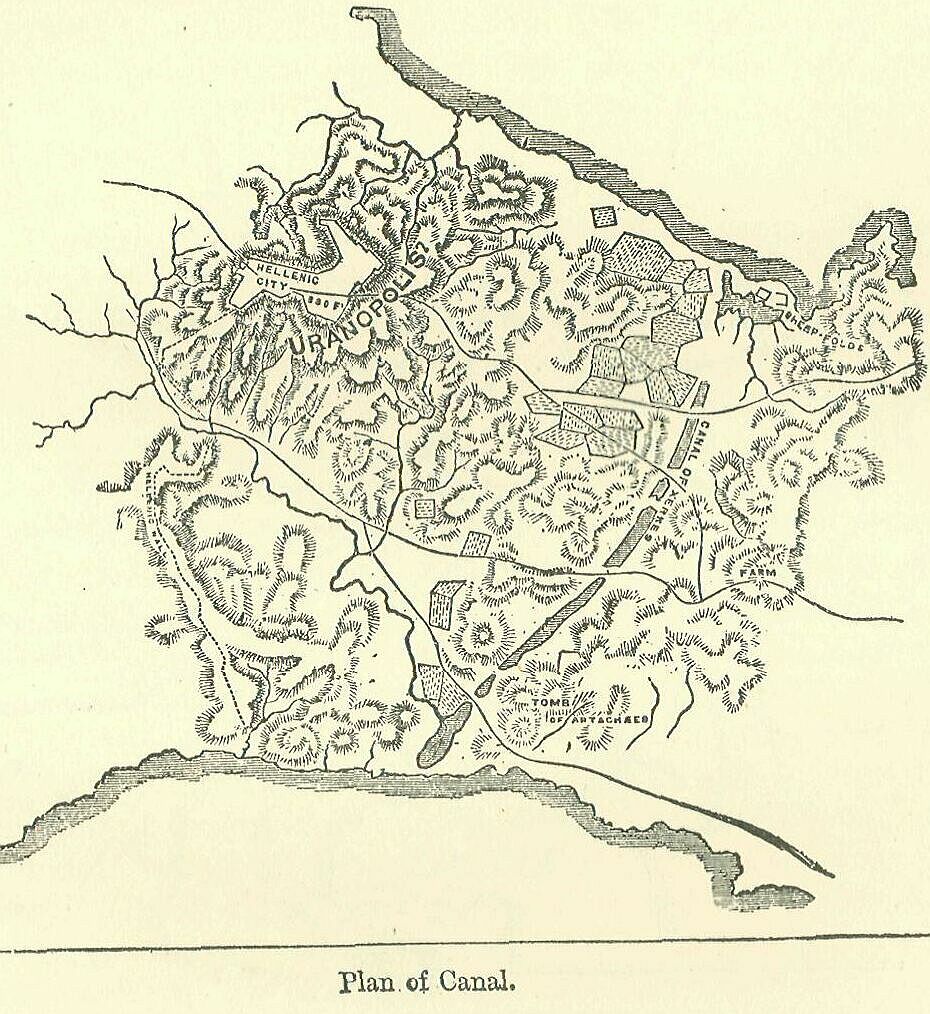
Xerxes, having brought his preparations into a state of forwardness, having completed his canal and his bridge—after one failure with the latter, for which the constructors and the sea were punished—proceeded, in the year B.C. 481, along the "Royal Road" from Susa to Sardis, and wintered at the Lydian capital. His army is said to have accompanied him; but more probably it joined him in the spring, flocking in, contingent after contingent, from the various provinces of his vast Empire. Forty-nine nations, according to Herodotus, served under his standard; and their contingents made up a grand total of eighteen hundred thousand men. Of these, eighty thousand were cavalry, while twenty thousand rode in chariots or on camels; the remainder served on foot. There are no sufficient means of testing these numbers. Figures in the mouth of an Oriental are vague and almost unmeaning; armies are never really counted: there is no such thing as a fixed and definite "strength" of a division or a battalion. Herodotus tells us that a rough attempt at numbering the infantry of the host was made on this occasion; but it was of so rude and primitive a description that little dependence can be placed on the results obtained by it. Ten thousand men were counted, and were made to stand close together; a line was then drawn round them, and a wall built on the line to the height of a man's waist; within the enclosure thus made all the troops in turn entered, and each time that the enclosure appeared to be full, ten thousand were supposed to be within it. Estimated in this way, the infantry was regarded as amounting to 1,700,000. It is clear that such mode of counting was of the roughest kind, and might lead to gross exaggeration. Each commander would wish his troops to be thought more numerous than they really were, and would cause the enclosure to appear full when several thousands more might still have found room within it. Nevertheless there would be limits beyond which exaggeration could not go; and if Xerxes was made to believe that the land force which he took with him into Europe amounted to nearly two millions of men, it is scarcely doubtful but that it must have exceeded one million.
The motley composition of such a host has been described in a former chapter. Each nation was armed and equipped after its own fashion, and served in a body, often under a distinct commander. The army marched through Asia in a single column, which was not, however, continuous, but was broken into three portions. The first portion consisted of the baggage animals and about half of the contingents of the nations; the second was composed wholly of native Persians, who preceded and followed the emblems of religion and the king; the third was made up of the remaining national contingents. The king himself rode alternately in a chariot and in a litter. He was preceded immediately by ten sacred horses, and a sacred chariot drawn by eight milk-white steeds. Round him and about him were the choicest troops of the whole army, twelve thousand horse and the same number of foot, all Persians, and those too not taken at random, but selected carefully from the whole mass of the native soldiery. Among them seem to have been the famous "Immortals"—a picked body of 10,000 footmen, always maintained at exactly the same number, and thence deriving their appellation.
The line of march from Sardis to Abydos was only partially along the shore. The army probably descended the valley of the Hermus nearly to its mouth, and then struck northward into the Caicus vale, crossing which it held on its way, with Mount Kara-dagh (Cane) on the left, across the Atarnean plain, and along the coast to Adramytium (Adramyti) and Antandros, whence it again struck inland, and, crossing the ridge of Ida, descended into the valley of the Scamander. Some losses were incurred from the effects of a violent thunderstorm amid the mountains; but they cannot have been of a any great consequence. On reaching the Scamander the army found its first difficulty with respect to water. That stream was probably low, and the vast host of men and animals were unable to obtain from it a supply sufficient for their wants. This phenomenon, we are told, frequently recurred afterwards; it surprises the English reader, but is not really astonishing, since, in hot countries, even considerable streams are often reduced to mere threads of water during the summer.
Rounding the hills which skirt the Scamander valley upon the east, the army marched past Rhoeteum, Ophrynium, and Dardanus to Abydos. Here Xerxes, seated upon a marble throne, which the people of Abydos had erected for him on the summit of a hill, was able to see at one glance his whole, armament, and to feast his eyes with the sight. It is not likely that any misgivings occurred to him at such a moment. Before him lay his vast host, covering with its dense masses the entire low ground between the hills and the sea; beyond was the strait, and to his left the open sea, white with the sails of four thousand ships; the green fields of the Chersonese smiled invitingly a little further on; while, between him and the opposite shore, the long lines of his bridges lay darkling upon the sea, like a yoke placed upon the neck of a captive. Having seen all, the king gave his special attention to the fleet, which he now perhaps beheld in all its magnitude for the first time. Desirous of knowing which of his subjects were the best sailors, he gave orders for a sailing-match, which were at once carried out. The palm was borne off by the Phoenicians of Sidon, who must have beaten not only their own countrymen of Tyre, but the Greeks of Asia and the islands.
On the next day the passage took place. It was accompanied by religious ceremonies. Waiting for the sacred hour of sunrise, the leader of the host, as the first rays appeared, poured a libation from a golden goblet into the sea, and prayed to Mithra that he might effect the conquest of Europe. As he prayed he cast into the sea the golden goblet, and with it a golden bowl and a short Persian sword. Meanwhile the multitude strewed all the bridge with myrtle boughs, and perfumed it with clouds of incense. The "Immortals" crossed first, wearing garlands on their heads. The king, with the sacred chariot and horses passed over on the second day. For seven days and seven nights the human stream flowed on without intermission across one bridge, while the attendants and the baggage-train made use of the other. The lash was employed to quicken the movements of laggards. At last the whole army was in Europe, and the march resumed its regularity.
It is unnecessary to follow in detail the advance of the host along the coast of Thrace, across Chalcidice, and round the Thermaic Gulf into Pieria. If we except the counting of the fleet and army at Doriscus no circumstances of much interest diversified this portion of the march, which lay entirely through territories that had previously submitted to the Great King. The army spread itself over a wide tract of country, marching generally in three divisions, which proceeded by three parallel lines—one along the coast, another at some considerable distance inland, and a third, with which was Xerxes himself, midway between them. At every place where Xerxes stopped along his line of route the natives had, besides furnishing corn for his army, to entertain him and his suite at a great banquet, the cost of which was felt as a heavy burthen. Contributions of troops or ships were also required from all the cities and tribes; and thus both fleet and army continually swelled as they advanced onward. In crossing the track between the Strymon and the Axius some damage was suffered by the baggage-train from lions, which came down from the mountains during the night and devoured many of the camels; but otherwise the march was effected without loss, and the fleet and army reached the borders of Thessaly intact, and in good condition. Here it was found that there was work for the pioneers, and a reconnaissance of the enemy's country before entering it was probably also thought desirable. The army accordingly halted some days in Pieria, while preparations were being made for crossing the Olympic range into the Thessalian lowland.
During the halt intelligence arrived which seemed to promise the invader an easy conquest. Xerxes, while he was staying at Sardis, had sent heralds to all the Grecian states, excepting Athens and Sparta, with a demand for earth and water, the recognized symbols of submission. His envoys now returned, and brought him favorable replies from at least one-third of the continental Greeks—from the Perrhaebians, Thessalians, Dolopians, Magnetians, Achaeans of Phthiotis, Enianians, Malians, Locrians, and from most of the Boeotians. Unless it were the insignificant Phocis, no hostile country seemed to intervene between the place where his army lay and the great object of the expedition, Attica. Xerxes, therefore, having first viewed the pass of Tempe, and seen with his own eyes that no enemy lay encamped beyond, passed over the Olympic range by a road cut through the woods by his army, and proceeded southwards across Thessaly and Achaea Phthiotis into Malis, the fertile plain at the mouth of the Spercheius river. Here, having heard that a Greek force was in the neighborhood, he pitched his camp not far from the small town of Trachis.
Thus far had the Greeks allowed the invader to penetrate their country without offering him any resistance. Originally there had been an intention of defending Thessaly, and an army under Evsenetus, a Spartan polemarch, and Themistocles, the great Athenian, had proceeded to Tempe, in order to cooperate with the Thessalians in guarding the pass. But the discovery that the Olympic range could be crossed in the,place where the army of Xerxes afterwards passed it had shown that the position was untenable; and it had been then resolved that the stand should be made at the next defensible position, Thermopylae. [PLATE LXII.] Here, accordingly, a force was found—small, indeed, if it be compared with the number of the assailants, but sufficient to defend such a position as that where it was posted against the world in arms. Three hundred Spartans, with their usual retinue of helots, 700 Lacedaemonians, other Peloponnesians to the number of 2800, 1000 Phocians, the same number of Locrians, 700 Thespians, and 400 Thebans, formed an army of 9000 men—quite as numerous a force as could be employed with any effect in the defile they were sent to guard. The defile was a long and narrow pass shut in between a high mountain, Callidromus, and the sea, and crossed at one point by a line of wall in which was a single gateway. Unless the command of the sea were gained, or another mode of crossing the mountains discovered, the pass could scarcely be forced.
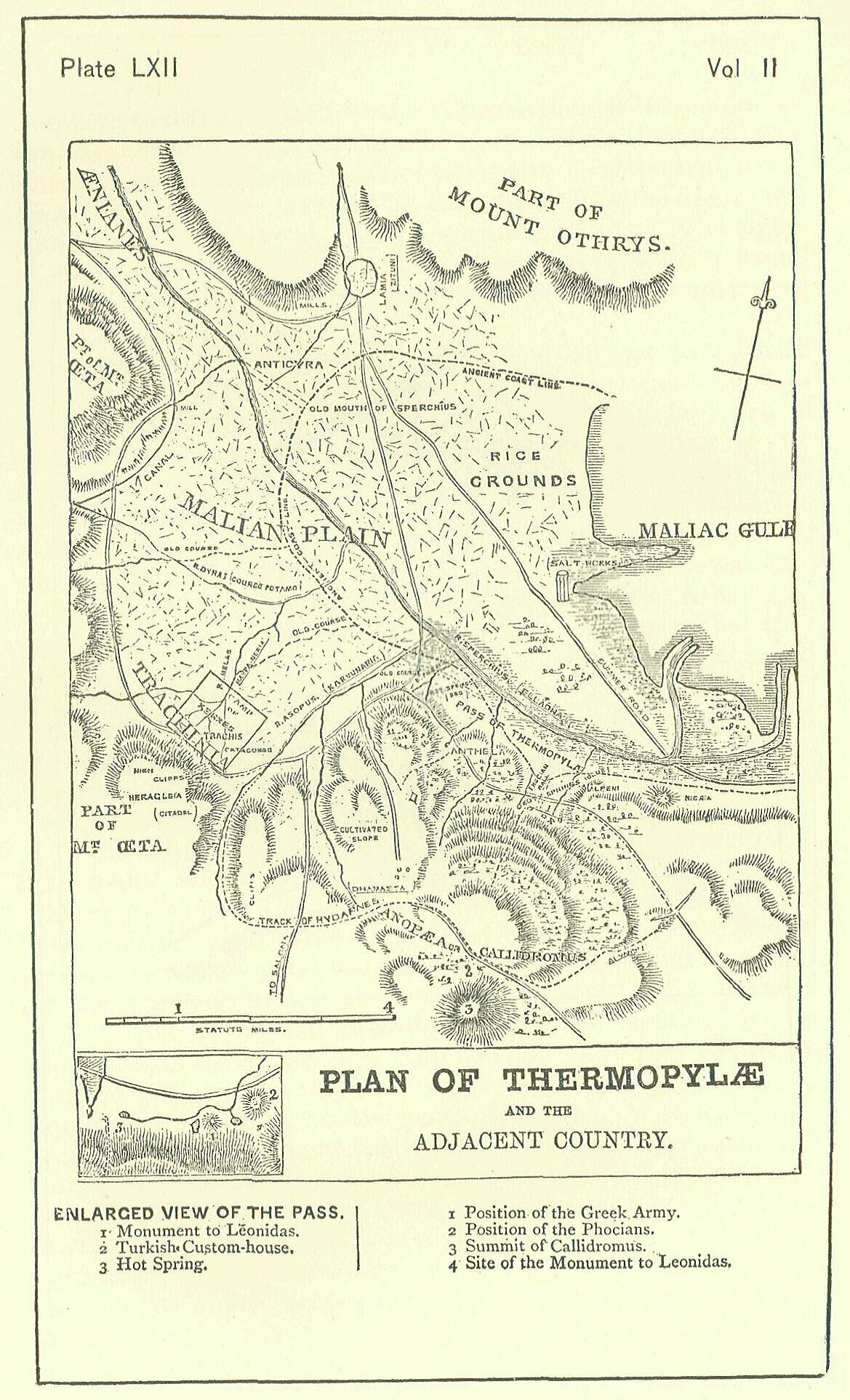
Xerxes, however, confident in his numbers—after waiting four days at Trachis, probably in the hope that his fleet would join him—proceeded on the fifth day to the assault. First the Medes and Cissians, then the famous "Immortals" were sent into the jaws of the pass against the immovable foe; but neither detachment could make any impression. The long spears, large shields, and heavy armor of the Greeks, their skilful tactics, and steady array, were far more than a match for the inferior equipments and discipline of the Asiatics. Though the attack was made with great gallantry, both on this day and the next, it failed to produce the slightest effect. Very few of the Greeks were either slain or wounded; and it seemed as if the further advance of a million of men was to be stopped by a force less than a hundredth part of their number.
But now information reached Xerxes which completely changed the face of affairs. There was a rough mountain-path leading from Trachis up the gorge of the Asopus and across Callidromus to the rear of the Greek position, which had been unknown to the Greeks when they decided on making their first stand at Thermopylae, and which they only discovered when their plans no longer admitted of alteration. It was, perhaps, not much more than a goat-track, and apparently they had regarded it as scarcely practicable, since they had thought its defence might be safely entrusted to a thousand Phocians. Xerxes, however, on learning the existence of the track, resolved at once to make trial of it. His Persian soldiers were excellent mountaineers. He ordered Hydarnes to take the "Immortals," and, guided by a native, to proceed along the path by night, and descend with early dawn into the rear of the Greeks, who would then be placed between two fires. The operation was performed with complete success. The Phocian guard, surprised at the summit, left the path free while they sought a place of safety. The Greeks in the pass below, warned during the night of their danger, in part fled, in part resolved on death. When morning came, Leonidas, at the head of about half his original army, moved forward towards the Malian plain, and there met the advancing Persians. A bloody combat ensued, in which the Persians lost by far the greater number; but the ranks of the Greeks were gradually thinned, and they were beaten back step by step into the narrowest part of the pass, where finally they all perished, except the four hundred Thebans, who submitted and were made prisoners.
So terminated the first struggle on the soil of Greece, between the invaders and the invaded. It seemed to promise that, though at vast cost, Persia would be victorious. If her loss in the three days' combat was 20,000 men, as Herodotus states, yet, as that of her enemy was 4000, the proportionate advantage was on her side.
But, for the conquest of such a country as Greece, it was requisite, not only that the invader should succeed on land, but also that he should be superior at sea. Xerxes had felt this, and had brought with him a fleet, calculated, as he imagined, to sweep the Greek navy from the Egean. As far as the Pagasaean Gulf, opposite the northern extremity of Euboea, his fleet had advanced without meeting an enemy. It had encountered one terrible storm off the coast of Magnesia, and had lost 400 vessels; but this loss was scarcely felt in so vast an armament. When from Aphetse, at the mouth of the gulf, the small Greek fleet, amounting to no more than 271 vessels, was seen at anchor off Artemisium, the only fear which the Persian commanders entertained was lest it should escape them. They at once detached 200 vessels to sail round the Coast coast of Euboea, and cut off the possibility of retreat. When, however, these vessels were all lost in a storm, and when in three engagements on three successive days, the Greek fleet showed itself fully able to contend against the superior numbers of its antagonist, the Persians themselves could not fail to see that their naval supremacy was more than doubtful. The fleet at Artemisium was not the entire Greek naval force; on another occasion it might be augumented, while their own could scarcely expect to receive reinforcements. The fights at Artemisium foreshadowed a day when the rival fleets would no longer meet and part on equal terms, but Persia would have to acknowledge herself inferior.
Meanwhile, however, the balance of advantage rested with the invaders. The key of Northern Greece was won, and Phocis, Locris, Boeotia, Attica, and the Megarid lay open to the Persian army. The Greek fleet could gain nothing by any longer maintaining the position of Artemisium, and fell back towards the south, while its leaders anxiously considered where it should next take up its station. The Persians pressed on both by land and sea. A rapid march through Phocis and Boeotia brought Xerxes to Athens, soon after the Athenians, knowing that resistance would be vain, had evacuated it. The Acropolis, defended by a few fanatics, was taken and burnt. One object of the expedition was thus accomplished. Athens lay in ruins; and the whole of Attica was occupied by the conqueror. The Persian fleet, too, finding the channel of the Euripus clear, sailed down it, and rounding Sunium, came to anchor in the bay of Phalerum.
In the councils of the Greeks all was doubt and irresolution. The army, which ought to have mustered in full force at Thermopylae and Callidromus, and which, after those passes were forced, might have defended Cithseron and Parnes, had never ventured beyond the Isthmus of Corinth, and was there engaged in building a wall across the neck of land from sea to sea. The fleet lay off Salamis, where it was detained by the entreaties of the Athenians, who had placed in that island the greater part of the non-combatant population; but the inclination was strong on the part of many to withdraw westward and fight the next battle, if a battle must be fought, in the vicinity of the land force, which would be a protection in case of defeat. Could Xerxes have had patience for a few days, the combined fleet would have broken up. The Peloponnesian contingents would have withdrawn to the isthmus; and the Athenians, despairing of success, would probably have sailed away to Italy. But the Great King, when he saw the vast disproportion between his own fleet and that of the enemy, could not believe in the possibility of the Greeks offering a successful resistance. Like a modern emperor, who imagined that, if only he could have been with his fleet, all would necessarily have gone well, Xerxes supposed that by having the sea-fight under his own eye he would be sure of victory. Thus again, as at Artemisium, the only fear felt was lest the Greeks should fly, and in that way escape chastisement. Orders were therefore issued to the Persian fleet to close up at once, and blockade the eastern end of the Salaminian strait, while a detachment repeated the attempted manoeuvre at Euboea, and sailed round the island to guard the channel at its western outlet.
These movements were executed late in the day on which the Persian fleet arrived at Phalerum. During the night intelligence reached the commanders that the retreat of the Greeks was about to commence at once; whereupon the Persian right wing was pushed forward into the strait, and carried beyond the Greek position so as to fill the channel where it opens into the bay of Eleusis. The remainder of the night passed in preparations for the battle on both sides. At daybreak both fleets advanced from their respective shores, the Persians being rather the assailants. Their thousand vessels were drawn up in three lines, and charged their antagonists with such spirit that the general inclination on the part of the Greeks was at first to retreat. Some of their ships had almost touched the shore, when the bold example of one of the captains, or a cry of reproach from unknown lips, produced a revulsion of feeling, and the whole line advanced in good order. The battle was for a short time doubtful; but soon the superiority of Greek naval tactics began to tell. The Persian vessels became entangled one with another, and crashing together broke each other's oars. The triple line increased their difficulties. If a vessel, overmatched, sought to retreat, it necessarily came into collision with the ships stationed in its rear. These moreover pressed too eagerly forward, since their captains were anxious to distinguish themselves in order to merit the approval of Xerxes. The Greeks found themselves able to practice with good effect their favorite manoeuvre of the periplus, and thus increased the confusion. It was not long before the greater part of the Persian fleet became a mere helpless mass of shattered or damaged vessels. Five hundred are said to have been sunk—the majority by the enemy, but some even by their own friends. The sea was covered with wrecks, and with wretches who clung to them, till the ruthless enemy slew them or forced them to let go their hold.
This defeat was a death-blow to the hopes of Xerxes, and sealed the fate of the expedition. From the moment that he realized to himself the fact of the entire inability of his fleet to cope with that of the Greeks, Xerxes made up his mind to return with all haste to Asia. From over-confidence he fell into the opposite extreme of despair, and made no effort to retrieve his ill fortune. His fleet was ordered to sail straight for the Hellespont, and to guard the bridges until he reached them with his army. He himself retreated hastily along the same road by which he had advanced, his whole army accompanying him as far as Thessaly, where Marnonius was left with 260,000 picked men, to prevent pursuit, and to renew the attempt against Greece in the ensuing year. Xerxes pressed on to the Hellespont, losing vast numbers of his troops by famine and sickness on the way, and finally returned into Asia, not by his magnificent bridge, which a storm had destroyed, but on board a vessel, which, according to some, narrowly escaped shipwreck during the passage. Even in Asia disaster pursued him. Between Abydos and Sardis his army suffered almost as much from over-indulgence as it had previously suffered from want; and of the mighty host which had gone forth from the Lydian capital in the spring not very many thousands can have re-entered it in the autumn.
Still, however, there was a possibility that the success which his own arms had failed to achieve might reward the exertions of his lieutenants. Mardonius had expressed himself confident that with 300,000 picked soldiers he could overpower all resistance, and make Greece a satrapy of Persia. Xerxes had raised his forces to that amount by sending Artabazus back from Sestos at the head of a corps d'armee numbering 40,000 men. The whole army of 300,000 wintered in Thessaly; and Mardonius, when spring came, having vainly endeavored to detach the Athenians from the Grecian ranks, marched through Boeotia in Attica, and occupied Athens for the second time. Hence he proceeded to menace the Peloponnese, where he formed an alliance with the Argives, who promised him that they would openly embrace the Persian cause. At the same time the Athenians, finding that Sparta took no steps to help them, began to waver in their resistance, and to contemplate accepting the terms which Mardonius was still willing to grant them. The fate of Greece trembled in the balance, and apparently was determined by the accident of a death and a succession, rather than by any wide-spread patriotic feeling or any settled course of policy. Cleombrotus, regent for the young son of Leonidas, died, and his brother Pausanias—a brave, clever, and ambitious man—took his place. We can scarcely be wrong in ascribing—at least in part—to this circumstance the unlooked-for change of policy, which electrified the despondent ambassadors of Athens almost as soon as Pausanias was installed in power. It was suddenly announced that Sparta would take the offensive. Ten thousand hoplites and 400,000 light-armed—the largest army that she ever levied—took the field, and, joined at the isthmus by above 25,000 Peloponnesians, and soon afterwards by almost as many Athenians and Megarians, proceeded to seek the foreigners, first in Attica, and then in the position to which they had retired in Boeotia. On the skirts of Citheeron, near Platsea, a hundred and eight thousand Greeks confronted more than thrice their number of Persians and Persian subjects; and now at length the trial was to be made whether, in fair and open fight on land, Greece or Persia would be superior. A suspicion of what the result would be might have been derived from Marathon. But there the Persians had been taken at a disadvantage, when the cavalry, their most important arm, was absent. Here the error of Datis was not likely to be repeated. Mardonius had a numerous and well-armed cavalry, which he handled with no little skill. It remained to be seen, when the general engagement came, whether, with both arms brought fully into play, the vanquished at Marathon would be the victors.
The battle of Plataea was brought on under circumstances very unfavorable to the Greeks. Want of water and a difficulty about provisions had necessitated a night movement on their part. The cowardice of all the small contingents, and the obstinacy of an individual Spartan, disconcerted the whole plan of the operation, and left the Lacedaemonians and the Athenians at daybreak separated from each other, and deserted by the whole body of their allies. Mardonius attacked at once, and prevented the junction of the two allies, so that two distinct and separate engagements went on at the same time. In both the Greeks were victorious. The Spartans repulsed the Persian horse and foot, slew Mardonius and were the first to assail the Persian camp. The Athenians defeated the medizing Greeks, and effected a breach in the defences of the camp, on which the Spartans had failed to make any impression. A terrible carnage followed. The contingent of 40,000 troops under Artabazus alone drew off in good order.
The remainder were seized with panic, and were either slaughtered like sheep or fled in complete disarray. Seventy thousand Greeks not only defeated but destroyed the army of 300,000 barbarians, which melted away and disappeared making no further stand anywhere. The disaster of Marathon was repeated on a larger scale, and without the resource of an embarkation. Henceforth the immense superiority of Greek troops to Persian was well known on both sides; and nothing but the distance from Greece of her vital parts, and the quarrels of the Greek states among themselves, preserved for nearly a century and a half the doomed empire of Persia.
The immediate result of the defeats of Salamis and Platsea was a contraction of the Persian boundary towards the west. Though a few Persian garrisons maintained themselves for some years on the further side of the straits, soothing thereby the wounded vanity of the Great King, who liked to think that he had still a hold on Europe; yet there can be no doubt that, after the double flight of Xerxes and Artabazus, Macedonia, Pseonia, and Thrace recovered their independence. Persia lost her European provinces, and began the struggle to retain those of Asia. Terminus receded, and having once receded never advanced again in this quarter. The Greeks took the offensive. Sailing to Asia, they not only liberated from their Persian bondage the islands which lay along the coast, but landing their men on the continent, attacked and defeated an army of 60,000 Persians at Mycale, and destroyed the remnant of the ships that had escaped from Salamis. Could they have made up their minds to maintain a powerful fleet permanently on the coast of Asia, they might at once have deprived Persia of her whole sea-hoard on the Propontis and the Egean; but neither of the two great powers of Greece was prepared for such a resolve. Sparta disliked distant expeditions; and Athens did not as yet see her way to undertaking the protection of the continental Greeks. She had much to do at home, and had not yet discovered those weak points in her adversary's harness, which subsequently enabled her to secure by treaty the freedom of the Greek cities upon the mainland. For the present, therefore, Persia only lost the bulk of her European possessions, and the islands of the Propontis and the Egean.
The circumstances which caused a renewal of Greek agressions upon Asia towards the close of the reign of Xerxes are not very clearly narrated by the authors who speak of them. It appears, however, that after twelve years of petty operations, during which Eion was recovered, and Doriscus frequently attacked, but without effect, the Athenians resolved, in B.C. 466, upon a great expedition to the eastward. Collecting a fleet of 300 vessels, which was placed under the command of Cimon, the son of Miltiades, they sailed to the coast of Caria and Lycia, where they drove the Persian garrisons out of the Greek towns, and augmenting their navy by fresh contingents at every step, proceeded along the shores of Pamphylia as far as the mouth of the river Eurymedon, where they found a Phoenician fleet of 340 vessels, and a Persian army, stationed to protect the territory. Engaging first the fleet they defeated it, and drove it ashore, after which they disembarked and gained a victory over the Persian army. As many as two hundred triremes were taken or destroyed. They then sailed on towards Cyprus, where they met and destroyed a squadron of eighty ships, which was on its way to reinforce the fleet at the Eurymedon. Above a hundred vessels, 20,000 captives, and a vast amount of plunder were the prize of this war; which had, however, no further effect on the relations of the two powers.
In the following year the reign of Xerxes came to an end abruptly. With this monarch seems to have begun those internal disorders of the seraglio, which made the Court during more than a hundred and forty years a perpetual scene of intrigues, assassinations, executions, and conspiracies. Xerxes, who appears to have only one wife, Amestris, the daughter (or grand-daughter) of the conspirator, Otanes, permitted himself the free indulgence of illicit passion among the princesses of the Court, the wives of his own near relatives. The most horrible results followed. Amestris vented her jealous spite on those whom she regarded as guilty of stealing from her the affections of her husband; and to prevent her barbarities from producing rebellion, it was necessary to execute the persons whom she had provoked, albeit they were near relations of the monarch. The taint of incontinence spread among the members of the royal family; and a daughter of the king, who was married to one of the most powerful nobles, became notorious for her excesses. Eunuchs rose into power, and fomented the evils which prevailed. The king made himself bitter enemies among those whose position was close to his person. At last, Artabanus, chief of the guard, a courtier of high rank, and Aspamitres, a eunuch, who held the office of chamberlain, conspired against their master, and murdered him in his sleeping apartment, after he had reigned twenty years.
The character of Xerxes falls below that of any preceding monarch. Excepting that he was not wholly devoid of a certain magnanimity, which made him listen patiently to those who opposed his views or gave him unpalatable advice and which prevented him from exacting vengeance on some occasions, he had scarcely a trait whereon the mind can rest with any satisfaction. Weak and easily led, puerile in his gusts of passion and his complete abandonment of himself to them—selfish, fickle, boastful, cruel, superstitious, licentious—he exhibits to us the Oriental despot in the most contemptible of all his aspects—that wherein the moral and the intellectual qualities are equally in defect, and the career is one unvarying course of vice and folly. From Xerxes we have to date at once the decline of the Empire in respect of territorial greatness and military strength, and likewise its deterioration in regard to administrative vigor and national spirit. With him commenced the corruption of the Court—the fatal evil, which almost universally weakens and destroys Oriental dynasties. His expedition against Greece exhausted and depopulated the Empire; and though, by abstaining from further military enterprises, he did what lay in his power to recruit its strength, still the losses which his expedition caused were certainly not repaired in his lifetime.
As a builder, Xerxes showed something of the same grandeur of conception which is observable in his great military enterprise and in the works by which it was accompanied. His Propylaea, and the sculptured staircase in front of the Chebl Minar, which is undoubtedly his work, are among the most magnificent erections upon the Persepolitan platform; and are quite sufficient to place him in the foremost rank of Oriental builders. If we were to ascribe the Chehl Minar itself to him, we should have to give him the palm above all other kings of Persia; but on the whole it is most probable that that edifice and its duplicate at Susa were conceived, and in the main, constructed, by Darius.
Xerxes left behind him three sons—Darius, Hystaspes, and Artaxerxes—and two daughters, Amytis and Rhodogune. Hystaspes was satrap of Bactria, and at the time of their father's death, only Darius and Artaxerxes were at the Court.
Fearing the eldest son most, Artabanus persuaded Artaxerxes that the assassination of Xerxes was the act of his brother, whereupon Artaxerxes caused him to be put to death, and himself ascended the throne (B.C. 465).
Troubles, as usual, accompanied this irregular accession. Artabanus, not content with exercising an influence under Artaxerxes such as has caused some authors to speak of him as king, aimed at removing the young prince, and making himself actual monarch. But his designs being betrayed to Artaxerxes by Megabyzus, and at the same time his former crimes coming to light, he was killed, together with his tool Aspamitres, seven months after the murder of Xerxes. The sons of Artabanus sought to avenge his death, but were defeated by Megabyzus in an engagement, wherein they lost their lives.
Meanwhile, in Bactria, Hystaspes, who had a rightful claim to the throne, raised the standard of revolt. Artaxerxes marched against him in person, and engaged him in two battles, the first of which was indecisive, while in the second the Bactrians suffered defeat, chiefly (according to Ctesias) because the wind blew violently in their faces. So signal was victory, that Bactria at once submitted. Hystaspes' fate is uncertain.
Not long after the reduction of Bactria, Egypt suddenly threw off the Persian yoke (B.C. 460). Inarus, a king of the wild African tribes who bordered the Nile valley on the west, but himself perhaps a descendant of the old monarchs of Egypt, led the insurrection, and, in conjunction with an Egyptian, named Amyrtseus, attacked the Persian troops stationed in the country, who were commanded by Achaemenes, the satrap. A battle was fought near Papremis in the Delta, wherein the Persians were defeated, and Achaemenes fell by the hand of Inarus himself. The Egyptians generally now joined in the revolt; and the remnant of the Persian army was shut up in Memphis. Inarus had asked the aid of Athens; and an Athenian fleet of 200 sail was sent to his assistance. This fleet sailed up the Nile, defeated a Persian squadron, and took part in the capture of Memphis and the siege of its citade (White Castle). When the Persian king first learned what had happened, he endeavored to rid himself of his Athenian enemies by inducing the Spartans to invade their country; but, failing in his attempt, he had recourse to arms, and, levying a vast host, which he placed under the command of Megabyzus, sent that officer to recover the revolted province. Megabyzus marched upon Memphis, defeated the Egyptians and their allies in a great battle, relieved the citadel of Memphis from its siege, and recovered the rest of the town. The Athenians fled to the tract called Prosopitis, which was a a portion of the Delta, completely surrounded by two branch streams of the Nile. Here they were besieged for eighteen months, till Megabyzus contrived to turn the water from one of the two streams, whereby the Athenian ships were stranded, and the Persian troops were able to march across the river bed, and overwhelm the Athenians with their numbers. A few only escaped to Cyrene. The entire fleet fell into the enemy's hands; and a reinforcement of fifty more ships, arriving soon after the defeat, was attacked unawares after it had entered the river, and lost more than half its number. Inarus was betrayed by some of his own men, and, being carried prisoner to Persia, suffered death by crucifixion. Amyrtseus fled to the fens, where for a while he maintained his independence. Egypt, however, was with this exception recovered to the Empire (B.C. 455); and Athens was taught that she could not always invade the dominions of the Great King with impunity.
Six years after this, the Athenians resolved on another effort. A fleet of 200 ships was equipped and placed under the command of the victor of the Eurymedon, Cimon, with orders to proceed into the Eastern Mediterranean, and seek to recover the laurels lost in Egypt. Cimon sailed to Cyprus, where he received a communication from Amyrtseus, which induced him to dispatch sixty ships to Egypt, while with the remaining one hundred and forty he commenced the siege of Citium. Here he died, either of disease or from the effects of a wound; and his armament, pressed for provisions, was forced soon afterwards to raise the siege, and address itself to some other enterprise. Sailing past Salamis, it found there a Cilician and Phoenician fleet, consisting of 300 vessels, which it immediately attacked and defeated, notwithstanding the disparity of number. Besides the ships which were sunk, a hundred triremes were taken; and the sailors then landed and gained a victory over a Persian army upon the shore. Artaxerxes, upon this, fearing lest he should lose Cyprus altogether, and thinking that, if Athens became mistress of this important island, she would always be fomenting insurrection in Egypt, made overtures for peace to the generals who were now in command. His propositions were favorably received. Peace was made on the following terms:—Athens agreed to relinquish Cyprus, and recall her squadron from Egypt; while the king consented to grant freedom to all the Greek cities on the Asiatic continent, and not to menace them either by land or water. The sea was divided between the two powers, Persian ships of war were not to sail to the west of Phaselis in the Levant, or of the Cyanean islands in the Euxine; and Greek war-ships, we may assume, were not to show themselves east of those limits. On these conditions there was to be peace and amity between the Greeks and the Persians, and neither nation was to undertake any expeditions against the territories of the other. Thus terminated the first period of hostility between Greece and Persia, a period of exactly half a century, commencing B.C. 499 and. ending B.C. 449, in the seventeenth year of Artaxerxes.
It was probably not many years after the conclusion of this peace that a rebellion broke out in Syria. Megabyzus, the satrap of that important province, offended at the execution of Inarus, in violation of the promise which he had himself made to him, raised a revolt against his sovereign, defeated repeatedly the armies sent to reduce him to obedience, and finally treated with Artaxerxes as to the terms on which he would consent to be reconciled. Thus was set an example, if not of successful insurrection, yet at any rate of the possibility of rebelling with impunity—an example which could not fail to have a mischievous effect on the future relations of the monarch with his satraps. It would have been better for the Empire had Megabyzus suffered the fate of Oroetes, instead of living to a good old age in high favor with the monarch whose power he had weakened and defied.
Artaxerxes survived the "Peace of Callias" twenty-four years. His relations with the Greeks continued friendly till his demise, though, on the occasion of the revolt of Samos (B.C. 440), Pissuthnes, satrap of Sardis, seems to have transgressed the terms of the treaty, and to have nearly brought about a renewal of hostilities. It was probably in retaliation for the aid given to the revolted Samians, that the Athenians, late in the reign of Artaxerxes, made an expedition against Caunus, which might have had important consequences, if the Caunians had not been firm in their allegiance. A revolt of Lycia and Caria under Zopyrus, the son of Megabyzus, assisted by the Greeks, might have proved even more difficult to subdue than the rebellion of Syria under his father. Persia, however, escaped this danger; and Artaxerxes, no doubt, saw with pleasure a few years later the Greeks turn their arms against each other—Athens, his great enemy, being forced into a contest for existence with the Peloponnesian confederacy under Sparta.
The character of Artaxerxes, though it receives the approval of Plutarch and Diodorus, must be pronounced on the whole poor and contemptible. His ready belief of the charge brought by Artabanus against his brother, Darius, admits perhaps of excuse, owing to his extreme youth; but his surrender of Inarus to Amestris on account of her importunity, his readiness to condone the revolt of Megabyzus, and his subjection throughout almost the whole of his life to the evil influence of Amytis, his sister, and Amestris, his mother—both persons of ill-regulated lives—are indications of weakness and folly quite unpardonable in a monarch. That he was mild in temperament, and even kind and good-natured, is probable. But he had no other quality that deserves the slightest commendation. In the whole course of his long reign he seems never once to have adventured himself in the field against an enemy. He made not a single attempt at conquest in any direction. We have no evidence that he patronized either literature or the arts. His peace with Athens was necessary perhaps, but disgraceful to Persia. The disorders of the Court increased under his reign, from the license (especially) which he allowed the Queen-mother, who sported with the lives of his subjects. The decay of the Empire received a fatal impulse from the impunity which he permitted to Megabyzus.
Like his father, Artaxerxes appears to have had but one legitimate wife. This was a certain Damaspia, of whom nothing is known, except that she died on the same day as her husband, and was the mother of his only legitimate son, Xerxes. Seventeen other sons, who survived him, were the issue of various concubines, chiefly—it would appear—Babylonians. Xerxes II. succeeded to the throne on the death of his father (B.C. 425), but reigned forty-five days only, being murdered after a festival, in which he had indulged too freely, by his half-brother, Secydianus or Sogdianus. Secydianus enjoyed the sovereignty for little more than half a year, when he was in his turn put to death by another, brother, Ochus, who on ascending the throne took the name of Darius, and became known to the Greeks as Darius Nothus.
Darius Nothus had in his father's lifetime been made satrap of Hyrcania, and had married his aunt, Parysatis, a daughter of Xerxes. He had already two children at his accession,—a daughter, Amestris, and a son, Arsaces, who succeeded him as Artaxerxes. His reign, which lasted nineteen years, was a constant scene of insurrections and revolts, some of which were of great importance, since they had permanent and very disastrous consequences. The earliest of all was raised by his full-brother, Arsites, who rebelled in conjunction with a son of Megabyzus, and, obtaining the support of a number of Greek mercenaries, gained two victories over the forces dispatched against him by the king. At last, however, the fortune of war changed. Persian gold was used to corrupt the mercenaries; and the rebels being thus reduced to extremities, were forced to capitulate, yielding themselves on the condition that their lives should be spared. Parysatis induced her husband to disregard the pledges given and execute both Arsites and his fellow-conspirator—thus proclaiming to the world that, unless by the employment of perfidy, the Empire was incapable of dealing with those who rebelled against its authority.
The revolt of Pissuthnes, satrap of Lydia, was the next important outbreak. Its exact date is uncertain; but it seems not to have very long preceded the Athenian disasters in Sicily. Pissuthnes, who had held his satrapy for more than twenty years, was the son of a Hystaspes, and probably a member of the royal family. His wealth—the accumulations of so long a term of office—enabled him to hire the services of a body of Greek mercenaries, who were commanded by an Athenian, called Lycon. On these troops he placed his chief dependence; but they failed him in the hour of need. Tissaphernes, the Persian general sent against him, bribed Lycon and his men, who thereupon quitted Pissuthnes and made common cause with his adversaries. The unfortunate satrap could no longer resist, and therefore surrendered upon terms, and accompanied Tissaphernes to the Court. Darius, accustomed now to disregard the pledged word of his officers, executed him forthwith, and made over his satrapy to Tissaphernes, as a reward for his zeal. Lycon, the Athenian traitor, received likewise a handsome return for his services, the revenues of several towns and districts being assigned him by the Great King.
The rebellion, however, was not wholly crushed by the destruction of its author, Amorges, a bastard son of Pissuthnes, continued to maintain himself in Caria, where he was master of the strong city of Iasus, on the north coast of the Sinus Iasicus, and set the power of Tissaphernes at defiance. Having probably inherited the wealth of his father, he hired a number of Peloponnesian mercenaries, and succeeded in maintaining himself as an independent monarch for some years.
Such was the condition of things in Asia Minor, when intelligence arrived of the fearful disasters which had befallen the Athenians in Sicily—disasters without a parallel since those of Salamis—sudden, unexpected, overwhelming. The news, flying through Asia, awoke everywhere a belief that the power of Athens was broken, and that her hostility need no longer be dreaded. The Persian monarch considered that under the altered circumstances it would be safe to treat the Peace of Callias as a dead letter, and sent down orders to the satraps of Lydia and Bithynia that they were once more to demand and collect the tribute of the Greek cities within their provinces. The satraps began to speculate on the advantages which they might derive from alliance with the enemies of Athens, and looked anxiously to see a Peloponnesian fleet appear off the coast of Asia. Tissaphernes and Pharnabazus vied with each other in the tempting offers which they made to Sparta, and it was not long before a formal treaty was concluded between that state and Persia, by which the two powers bound themselves to carry on war conjointly against Athens.
Thus the contest between Persia and her rival entered upon a new phase. Henceforth until the liberties of Greece were lost, the Great King could always count on having for his ally one of the principal Grecian powers. His gold was found to possess attractions which the Greeks were quite unable to resist. At one time Sparta, at another Athens, at another Thebes yielded to the subtle influence; Greek generals commanded the Persian armies; Greek captains manoeuvered the Persian fleets; the very rank and file of the standing army came to be almost as much Greek as Persian. Acting on the maxim, Divide et impera, Persia prolonged for eighty years her tottering Empire, by the skilful use which she made of the mutual jealousies and divisions of the Hellenic states.
It scarcely belongs to the history of Persia to trace in detail the fortunes of the contending powers during the latter portion of the Peloponnesian war. We need only observe that the real policy of the Court of Susa, well understood, and, on the whole, tolerably well carried out by the satraps, was to preserve the balance of power between Athens and Sparta, to allow neither to obtain too decided a preponderance, to help each in turn, and encourage each to waste the other's strength, but to draw back whenever the moment came for striking a decisive blow against either side. This policy skilfully pursued by Tissaphernes (who had a genius for intrigue and did not require an Alcibiades to give him lessons in state-craft), more clumsily by Pharnabazus, whose character was comparatively sincere and straightforward, prevailed until the younger Cyrus made his appearance upon the scene, when a disturbing force came into play which had disastrous effects both on the fortunes of Greece and on those of Persia. The younger Cyrus had personal views of self-aggrandizement which conflicted with the true interests of his nation, and was so bent on paving the way for his own ascent to sovereign power that he did not greatly care whether he injured his country or no. As the accomplishment of his designs depended mainly on his obtaining a powerful land-force, he regarded a Spartan as preferable to an Athenian alliance; and, having once made his choice, he lent his ally such effectual aid that in two years from the time of his coming down to the coast the war was terminated. Persian gold manned and partly built the fleet which conquered at AEgos-Potami; perhaps it contributed in a still more decisive manner to the victory. Cyrus, by placing his stores at the entire command of Lysander, deserved and acquired the cordial good-will of Sparta and the Peloponnesians generally—an advantage of which we shall find him in the sequel making good use.
The gain to Persia from the dominion which she had reacquired over the Greeks of Asia was more than counter-balanced by a loss of territory in another quarter, which seems to have occurred during the reign of Darius Nothus, though in what exact year is doubtful. The revolt of Egypt is placed by Heeren and Clinton in B.C. 414, by Eusebius in B.C. 411, by Manetho in the last year of Darius Nothus, or B.C. 405. The earlier dates depend on the view that the Amyrtseus of Manetho's twenty-eighth dynasty was the leader of the rebellion, and had a reign of six years at this period—a view which is perhaps unsound. Manetho probably represented Nepherites (Nefaorot) as the leader; and it is quite clear that he placed the re-establishment of the old throne of the Pharaohs in the year that Darius Nothus died. As his authority is the best that we can obtain upon this obscure point, we may regard the last days of the Persian monarch as clouded by news of a rebellion, which had been perhaps for some time contemplated, but which did not break out until he was known to be in a moribund condition.
A few years earlier, B.C. 408 or 409, the Medes had made an unsuccessful attempt to recover their independence. The circumstances of this revolt, which is mentioned by no writer but Xenophon, are wholly unknown, but we may perhaps connect it with the rebellion of Terituchmes, a son-in-law of the king. The story of Terituchmes, which belongs to this period, deserves at any rate to be told, as illustrating, in a very remarkable way, the corruption, cruelty, and dissoluteness of the Persian Court at the time to which we have now come. Terituchmes was the son of Idernes, a Persian noble of high rank, probably a descendant of the conspirator Hydarnes. On the death of his father, he succeeded to his satrapy, as to a hereditary fief, and being high in favor with Darius Nothus, he received in marriage that monarch's daughter, Amestris. Having, however, after his marriage become enamored of his own half-sister, Roxana, and having persuaded her to an incestuous commerce, he grew to detest his wife, and as he could not rid himself of her without making an enemy of the king, he entered into a conspiracy with 300 others, and planned to raise a rebellion. The bond of a common crime, cruel and revolting in its character, was to secure the fidelity of the rebels one to another. Amestris was to be placed in a sack, and each conspirator in turn was to plunge his sword into her body. It is not clear whether this intended murder was executed or no. Hoping to prevent it, Darius commissioned a certain Udiastes, who was in the service of Terituchmes, to save his daughter by any means that might be necessary; and Udiastes, collecting a band, set upon Terituchmes and slew him after a strenuous resistance. After this, his mother, brothers, and sisters were apprehended by the order of Parysatis, the queen, who caused Roxana to be hewn in pieces, and the other unfortunates to be buried alive. It was with great difficulty that Arsaces, the heir-apparent, afterwards Artaxerxes Mnemon, preserved his own wife, Statira, from the massacre. It happened that she was sister to Terituchmes, and, though wholly innocent of his offence, she would have been involved in the common destruction of her family had not her husband with tears and entreaties begged her life of his parents. The son of Terituchmes maintained himself for a while in his father's government; but Parysatis succeeded in having him taken off by poison.
The character of Darius Nothus is seen tolerably clearly in the account of his reign which has been here given. He was at once weak and wicked. Contrary to his sworn word, he murdered his brothers, Secydianus and Arsites. He broke faith with Pissuthnes. He sanctioned the wholesale execution of Terituchmes' relatives. Under him the eunuchs of the palace rose to such power that one of them actually ventured to aspire to the sovereignty. Parysatis, his wife, one of the most cruel and malignant even of Oriental women, was in general his chosen guide and counsellor. His severities cannot, however, in all eases be ascribed to her influence, for he was anxious that she should put the innocent Statira to death, and, when she refused, reproached her with being foolishly lenient. In his administration of the Empire he was unsuccessful; for, if he gained some tracts of Asia Minor, he lost the entire African satrapy. Under him we trace a growing relaxation of the checks by which the great officers of the state were intended to have been held under restraint. Satraps came to be practically uncontrolled in their provinces, and the dangerous custom arose of allowing sons to succeed, almost as a matter of course, to the governments of their fathers. Powers unduly large were lodged in the hands of a single officer, and actions, that should have brought down upon their perpetrators sharp and signal punishment, were timorously or negligently condoned by the supreme authority. Cunning and treachery were made the weapons wherewith Persia contended with her enemies. Manly habits were laid aside, and the nation learned to trust more and more to the swords of mercenaries.
Shortly before the death of Darius there seems to have been a doubt raised as to the succession. Parysatis, who preferred her second son to her first-born, imagined that her influence was sufficient to induce her husband to nominate Cyrus, instead of Arsaces, to succeed him; and Cyrus is said to have himself expected to be preferred above his brother. He had the claim, if claim it can be called, that he was the first son born to his father after he became king; but his main dependence was doubtless on his mother. Darius, however, proved less facile in his dying moments than he had been during most of his life, and declined to set aside the rights of the eldest son on the frivolous pretence suggested to him. His own feelings may have inclined him towards Arsaces, who resembled him far more than Cyrus did in character; and Cyrus, moreover, had recently offended him, and been summoned to court, to answer a very serious charge. Arsaces, therefore, was nominated, and took the name of Artaxerxes—as one of a king who had reigned long, and, on the whole, prosperously.
An incident of ill omen accompanied the commencement of the new reign (B.C. 405). The inauguration of the monarch was a religious ceremony, and took place in a temple at Pasargadae, the old capital, to which a peculiar sanctity was still regarded as attaching. Artaxerxes had proceeded to this place, and was about to engage in the ceremonies, when he was interrupted by Tissaphernes, who informed him that his life was in danger. Cyrus, he said, proposed to hide himself in the temple, and assassinate him as he changed his dress, a necessary part of the formalities. One of the officiating priests—a Magus, as it would seem—confirmed the charge. Cyrus was immediately arrested, and would have been put to death on the spot, had not his mother interfered, and, embracing him in her arms, made it impossible for the executioner to perform his task. With some difficulty she persuaded Artaxerxes to spare his brother's life and allow him to return to his government, assuring him, and perhaps believing, that the charges made against her favorite were without foundation.
Cyrus returned to Asia Minor with the full determination of attacking his brother at the earliest opportunity. He immediately began the collection of a mercenary force, composed wholly of Greeks, on whose arms he was disposed to place far more reliance than on those of Orientals. As Tissaphernes had returned to the coast with him, and was closely watching all his proceedings, it was necessary to exercise great caution, lest his intentions should become known before he was ready to put them into execution. He therefore had recourse to three different devices. Having found a cause of quarrel with Tissaphernes in the ambiguous terms of their respective commissions, he pressed it on to an actual war, which enabled him to hire troops openly, as against this enemy; and in this way he collected from 5000 to 6000 Greeks—chiefly Peloponnesians. He further gave secret commissions to Greek officers, whose acquaintance he had made when he was previously in these parts, to collect men for him, whom they were to employ in their own quarrels until he needed their services. From 3000 to 4000 troops were gathered for him by these persons. Finally, when he found himself nearly ready to commence his march, he discovered a new foe in the Pisidians of the Western Taurus, and proceeded to levy a force against them, which amounted to some thousands more. In all, he had in readiness 11,000 heavy-armed and about 2000 light-armed Greeks before his purpose became so clear that Tissaphernes could no longer mistake it, and therefore started off to carry his somewhat tardy intelligence to the capital.
The aims of Cyrus were different from those of ordinary rebel satraps; and we must go back to the times of Darius Hystaspis in order to find a parallel to them. Instead of seeking to free a province from the Persian yoke, or to carve out for himself an independent sovereignty in some remote corner of the Empire, his intention was to dethrone his brother, and place on his own brows the diadem of his great namesake. It was necessary for him therefore to assume the offensive. Only by a bold advance, and by taking his enemy to some extent unprepared, and so at a disadvantage, could he hope to succeed in his audacious project. It is not easy to see that he could have had any considerable party among the Persians, or any ground for expecting to be supported by any of the subject nations. His following must have been purely personal; and though it may be true that he was of a character to win more admiration and affection than his brother, yet Artaxerxes himself was far from being unpopular with his subjects, whom he pleased by a familiarity and a good-nature to which they were little accustomed. Cyrus knew that his principal dependence must be on himself, on his Greeks, and on the carelessness and dilatoriness of his adversary, who was destitute of military talent and was even thought to be devoid of personal bravery.
Thus it was important to advance as soon as possible. Cyrus therefore quitted Sardis before all his troops were collected (B.C. 401), and marched through Lydia and Phrygia, by the route formally followed in the reverse direction by the army of Xerxes, as far as Celsense, where the remainder of his mercenaries joined him. With his Greek force thus raised to 13,000 men, and with a native army not much short of 100,000, he proceeded on through Phrygia and Lycaonia to the borders of Cilicia, having determined on taking the shortest route to Babylon, through the Cilician and Syrian passes, and then along the course of the Euphrates. At Caystrupedion he was met by Epyaxa, consort of Syennesis, the tributary king of Cilicia, who brought him a welcome supply of money, and probably assured him of the friendly disposition of her husband, who was anxious to stand well with both sides. In Lycaonia, Cyrus divided his forces, and sending a small body of troops under Menon to escort Epyaxa across the mountains and enter Cilicia by the more western of the two practicable passes he proceeded himself with the bulk of his troops to the famous Pylae Cilicias, where he probably knew that Syennesis would only make a feint of resistance. He found the pass occupied; but it was evacuated the next day, on the receipt of intelligence that Menon had already entered the country and that the fleet of Cyrus—composed partly of his own ships, partly of a squadron furnished to him by Sparta—had appeared off the coast and threatened a landing. Cyrus thus crossed the most difficult and dangerous of all the passes that separated him from the heart of the Empire, without the loss of a man.
Thus far it would appear that Cyrus had to a certain extent masked his plans. The Greek captains must have guessed, if they had not actually learnt, his intentions; but to the bulk of the soldiery they had been hitherto absolutely unknown. It was only in Cilicia that the light broke in upon them, and they began to suspect that they were being marched into the interior of Asia, there to engage in a contest with the entire power of the Great King. Something of the horror which is ascribed to Cleomenes, when it was suggested to him a century earlier that he should conduct his Spartans the distance of a three months' journey from the sea, appears to have taken possession of the minds of the mercenaries on their awaking to this conviction. They at once refused to proceed. It was only by the most skilful management on the part of their captains, joined to a judicious liberality on the part of Cyrus, that they were induced to forego their intention of returning home at once, and so breaking up the expedition. A perception of the difficulty of effecting a retreat, together with an increase of pay, extorted a reluctant assent to continue the march, of which the real term and object were even now not distinctly avowed. Cyrus said he proposed to attack the army of Abrocomas, which he believed to be posted on the Euphrates. If he did not find it there, a fresh consultation might be held to consider any further movement.
The march now proceeded rapidly. The gates of Syria—a narrow pass on the east coast of the Gulf of Issus, shut in, like Thermopylae, between the mountains and the sea, and strengthened moreover by fortifications—were left unguarded by Abrocomas; and the army, having traversed them without loss, crossed the Amanus range by the pass of Beilan, and in twenty-nine days from Tarsus reached Thapsacus on the Euphrates. The forces of Artaxerxes had nowhere made their appearance—Abrocomas, though he had 300,000 men at his disposal, had weakly or treacherously abandoned all these strong and easily defensible positions; he does not seem even to have wasted the country; but, having burnt the boats at Thapsacus, he was content to fall back upon Phoenicia, and left the way to Babylon and Susa open. At Thapsacus there was little difficulty in persuading the Greeks, who had no longer the sea before their eyes, to continue the march; they only stipulated for a further increase of pay, which was readily promised them by the sanguine prince, who believed himself on the point of obtaining by their aid the inexhaustible treasures of the Empire. The river, which happened to be unusually low for the time of year, was easily forded. Cyrus entered Mesopotamia, and continued his march down the left bank of the Euphrates at the quickest rate that it was possible to move a hundred thousand Orientals. In thirty-three days he had accomplished above 600 miles, and had approached within 120 miles of Babylon without seeing any traces of an enemy. His only difficulties were from the nature of the country, which, after the Khabour is passed, becomes barren, excepting close along the river. From want of fodder there was a great mortality among the baggage-animals; the price of grain rose; and the Greeks had to subsist almost entirely upon meat. At last, when the Babylonian alluvium was reached, with its abundance of fodder and corn, signs of the enemy began to be observed. Artaxerxes, who after some doubts and misgivings had finally determined to give his enemy battle in the plain, was already on his way from Babylon, with an army reckoned at 900,000 men and had sent forward a body of horse, partly to reconnoitre, partly to destroy the crops, in order to prevent Cyrus and his troops from benefiting by them. Cyrus now advanced slowly and cautiously, at the rate of about fourteen miles a day, expecting each morning to fight a general engagement before evening came. On the third night, believing the battle to be imminent, he distributed the commands and laid down a plan of operations. But morning brought no appearance of the enemy, and the whole day passed tranquilly. In the course of it, he came upon a wide and deep trench cut through the plain for a distance of above forty miles—a recent work, which Artaxerxes had intended as a barrier to stop the progress of his enemy. But the trench was undefended and incomplete, a space of twenty feet being left between its termination and the Euphrates. Cyrus, having passed it, began to be convinced that his brother would not risk a battle in the plain, but would retreat to the mountains and make his stand at Persepolis or Ecbatana. He therefore continued his march negligently. His men piled their arms on the wagons or laid them, across the beasts of burthen; while he himself exchanged the horse which he usually rode for a chariot, and proceeded on his way leisurely, having about his person a small escort, which preserved their ranks, while all the rest of the troops were allowed to advance in complete disarray.
Suddenly, as the army was proceeding in this disorderly manner through the plain, a single horseman was perceived advancing at full gallop from the opposite quarter, his steed all flecked with foam. As he drew near, he shouted aloud to those whom he met, addressing some in Greek, others in Persian, and warning them that the Great King, with his whole force, was close at hand, and rapidly approaching in order of battle. The news took every one by surprise, and at first all was hurry and confusion. The Greeks, however, who were on the right, rapidly marshalled their line, resting it upon the river; while Cyrus put on his armor, mounted his horse, and arranged the ranks of his Asiatics. Ample time was given for completing all the necessary dispositions; since three hours, at the least, must have elapsed from the announcement of the enemy's approach before he actually appeared. Then a white cloud of dust arose towards the verge of the horizon, below which a part of the plain began soon to darken; presently gleams of light were seen to flash out from the dense mass which was advancing, the serried lines of spears came into view, and the component parts of the huge army grew to be discernible. On the extreme left was a body of horsemen with white cuirasses, commanded by Tissaphernes; next came infantry, carrying the long wicker shield, or gerrhum then a solid square of Egyptians, heavily armed, and bearing wooden shields that reached to the feet; then the contingents of many different nations, some on foot, some on horseback, armed with bows and other weapons. The line stretched away to the east further than the Greeks, who were stationed on the right, could see, extending (as it would seem) more than twice the distance which was covered by the army of Cyrus. Artaxerxes was in the centre of his line, on horseback, surrounded by a mounted guard of 6000 Persians. In front of the line, towards the river, were drawn up at wide intervals a hundred and fifty scythed chariots, which were designed to carry terror and confusion into the ranks of the Greeks.
On the other side, Cyrus had upon the extreme right a thousand Paphlagonian cavalry with the more lightly armed of the Greeks; next, the Greek heavy-armed, under Clearchus; and then his Asiatics, stretching in a line to about the middle of his adversary's army, his own special command being in the centre; and his left wing being led by the satrap, Ariaeus. With Ariseus was posted the great mass of the cavalry; but a band of six hundred, clad in complete armor, with their horses also partially armed, waited on Cyrus himself, and accompanied him wherever he went. As the enemy drew near, and Cyrus saw how much he was outflanked upon the left, he made an attempt to remedy the evil by ordering Clearchus to move with his troops from the extreme right to the extreme left of the line, where he would be opposite to Artaxerxes himself. This, no doubt, would have been a hazardous movement to make in the face of a superior enemy; and Clearchus, feeling this, and regarding the execution of the order as left to his discretion, declined to move away from the river. Cyrus, who trusted much to the Greek general's judgment, did not any further press the change, but prepared to fight the battle as he stood.
The combat began upon the right. When the enemy had approached within six or seven hundred yards, the impatience of the Greeks to engage could not be restrained. They sang the paean and started forwards at a pace which in a short time became a run. The Persians did not await their charge. The drivers leaped from their chariots, the line of battle behind them wavered, and then turned and fled without striking a blow. One Greek only was wounded by an arrow. As for the scythed chariots, they damaged their own side more than the Greeks; for the frightened horses in many cases, carried the vehicles into the thick of the fugitives, while the Greeks opened their ranks and gave passage to such as charged in an opposite direction. Moderating their pace so as to preserve their tactical arrangement, but still advancing with great rapidity, the Greeks pressed on the flying enemy, and pursued him a distance of two or three miles, never giving a thought to Cyrus, who, they supposed, would conquer those opposed to him with as much ease as themselves.
But the prince meanwhile was in difficulties. Finding himself outnumbered and outflanked, and fearing that his whole army would be surrounded, and even the victorious Greeks attacked in the rear, he set all upon one desperate cast and charged with his Six Hundred against the six thousand horse who protected his brother. Artagerses, their commander, who met him with a Homeric invective, he slew with his own hand. The six thousand were routed and took to flight; the person of the king was exposed to view; and Cyrus, transported at the sight, rushed forward shouting, "I see the man," and hurling his javelin, struck him straight upon the breast, with such force that the cuirass was pierced and a slight flesh-wound inflicted. The king fell from his horse; but at the same moment Cyrus received a wound beneath the eye from the javelin of a Persian, and in the melee which followed he was slain with eight of his followers. The Six Hundred could lend no effectual aid, because they had rashly dispersed in pursuit of the flying enemy.
As the whole contest was a personal one, the victory was now decided. Fighting, however, continued till nightfall. On learning the death of their leader, the Asiatic troops under Ariseus fled—first to their camp, and then, when Artaxerxes attacked them there, to the last night's station. The Grecian camp was assaulted by Tissaphernes, who at the beginning of the battle had charged through the Greek light-armed, without however, inflicting on them any loss, and had then pressed on, thinking to capture the Grecian baggage. But the guard defended their camp with success, and slew many of the assailants. Tissaphernes and the king drew off after a while, and retraced their steps, in order to complete the victory by routing the troops of Clearchus. Clearchus was at the same time returning from his pursuit, having heard that his camp was in danger, and as the two bodies of troops approached, he found his right threatened by the entire host of the enemy, which might have lapped round it and attacked it in front, in flank, and in rear. To escape this peril he was about to wheel his line and make it rest alone its whole extent upon the river, when the Persians passed him and resumed the position which they had occupied at the beginning of the battle. They were then about to attack, when once more the Greeks anticipated them and charged. The effect was again ludicrous. The Persians would not abide the onset, but fled faster than before. The Greeks pursued them to a village, close by which was a knoll or mound, whither the fugitives had betaken themselves. Again the Greeks made a movement in advance, and immediately the flight recommenced. The last rays of the setting sun fell on scattered masses of Persian horse and foot flying in all directions over the plain from the little band of Greeks.
The battle of Cunaxa was a double blow to the Persian power. By the death of Cyrus there was lost the sole chance that existed of such a re-invigoration of the Empire as might have enabled it to start again on a new lease of life, with ability to held its own, and strength to resume once more the aggressive attitude of former times. The talents of Cyrus have perhaps been overrated, but he was certainly very superior to most Orientals; and there can be no doubt that the Empire would have greatly gained by the substitution of his rule for that of his brother. He was active, energetic, prompt indeed, ready in speech, faithful in the observance of his engagements, brave, liberal—he had more foresight and more self-contro than most Asiatics; he knew how to deal with different classes of men; he had a great power of inspiring affection and retaining it; he was free from the folly of national prejudice, and could appreciate as they deserved both the character and the institutions of foreigners. It is likely that he would have proved a better administrator and ruler than any king of Persia since Darius Hystaspis. He would, therefore, undoubtedly have raised his country to some extent. Whether he could really have arrested its decline, and enabled it to avenge the humiliations of Marathon, Salamis, and the peace of Callias, is, however, exceedingly doubtful. For Cyrus, though he had considerable merits, was not without great and grievous defects. As the Tartar is said always to underlie the Russ, so the true Oriental underlay that coating of Grecian manners and modes of thought and act, with which a real admiration of the Hellenic race induced Cyrus to conceal his native barbarism. When he slew his cousins for an act which he chose to construe as disrespect, and when he executed Orontes for contemplated desertion, secretly and silently, so that no one knew his fate, when transported with jealous rage he rushed madly upon his brother, exposing to hazard the success of all his carefully formed plans, and in fact ruining his cause, the acquired habits of the Phil-Hellene gave way, and the native ferocity of the Asiatic came to the surface. We see Cyrus under favorable circumstances, while conciliation, tact, and self-restraint were necessities of his position, without which he could not possibly gain his ends—we do not know what effect success and the possession of supreme power might have had upon his temper and conduct; but from the acts above-mentioned we may at any rate suspect that the result would have been very injurious.
Again, intellectually, Cyrus is only great for an Asiatic. He has more method, more foresight, more power of combination, more breadth of mind than the other Asiatics of his day, or than the vast mass of Asiatics of any day. But he is not entitled to the praise of a great administrator or of a great general. His three years' administration of Asia Minor was chiefly marked by a barbarous severity towards criminals, and by a lavish expenditure of the resources of his government, which left him in actual want at the moment when he was about to commence his expedition. His generalship failed signally at the battle of Cunaxa, for the loss of which he is far more to be blamed than Clearchus. As he well knew that Artaxerxes was sure to occupy the centre of his line of battle, he should have placed his Greeks in the middle of his own line, not at one extremity. When he saw how much his adversary outflanked him on the left—a contingency which was so probable that it ought to have occurred to him beforehand—he should have deployed his line in that direction, instead of ordering such a movement as Clearchus, not unwisely, declined to execute. He might have trusted the Greeks to fight in line, as they had fought at Marathon; and by expanding their ranks, and moving off his Asiatics to the left, he might, have avoided the danger of being outflanked and surrounded. But his capital error was the wildness and abandon of his charge with the Six Hundred—a charge which it was probably right to make under the circumstances, but which required a combination of coolness and courage that the Persian prince evidently did not possess when his feelings were excited. Had he kept his Six Hundred well in hand, checked their pursuit, and abstained from thrusting his own person into unnecessary danger, he might have joined the Greeks as they returned from their first victory and participated in their final triumph. At the same time, Clearchus cannot but be blamed for pushing his suit too far. If, when the enemy in his front fled, he had at once turned against those who were engaging Cyrus, taking them on their left flank, which must have been completely uncovered, he might have been in time to prevent the fatal results of the rash charge made by his leader.
Thus the death of Cyrus, though a calamity to Persia, was scarcely the great loss which it has been represented. A far worse result of the Cyreian expedition was the revelation which it made of the weakness of Persia, and of the facility with which a Greek force might penetrate to the very midst of the Empire, defeat the largest army that could be brought against it, and remain, or return, as it might think proper. Hitherto Babylon and Susa had been, even to the mind of a Greek statesman, remote localities, which it would be the extreme of rashness to attempt to reach by force of arms, and from which it would be utter folly to suppose that a single man could return alive except by permission of the Great King. Henceforth these towns were looked upon as prizes quite within the legitimate scope of Greek ambition, and their conquest came to be viewed as little more than a question of time. The opinion of inaccessibility, which had been Persia's safeguard hitherto, was gone, and in its stead grew up a conviction that the heart of the Empire might be reached with very little difficulty.
It required, however, for the production of this whole change, not merely that the advance to Cunaxa should have been safely made, and the immeasurable superiority of Greek to Asiatic soldiers there exhibited, but also that the retreat should have been effected, as it was effected, without disaster. Had the Ten Thousand perished under the attacks of the Persian horse, or even under the weapons of the Kurds, or amid the snows of Armenia, the opinion of Persian invulnerability would have been strengthened rather than weakened by the expedition. But the return to Greece of ten thousand men, who had defeated the hosts of the Great King in the centre of his dominions, and fought their way back to the sea without suffering more than the common casualties of war, was an evidence of weakness which could not but become generally known, and of which all could feel the force. Hence the retreat was as important as the battle. If in late autumn and mid-winter a small Greek army, without maps or guides, could make its way for a thousand miles through Asia, and encounter no foe over whom it could not easily triumph, it was clear that the fabric of Persian power was rotten, and would collapse on the first serious attack.
Still, it will not be necessary to trace in detail the steps of the retreat. It was the fact of the return, rather than the mode of its accomplishment, which importantly affected the subsequent history of Persia. We need only note that the retreat was successfully conducted in spite, not merely of the military power of the Empire, but of the most barefaced and cruel treachery—a fact which showed clearly the strong desire that there was to hinder the invaders' escape. Persia did not set much store by her honor at this period; but she would scarcely have pledged her word and broken it, without the slightest shadow of excuse, unless she had regarded the object to be accomplished as one of vast importance, and seen no other way which offered any prospect of the desired result. Her failure, despite the success of her treachery, places her military weakness in the strongest possible light. The Greeks, though deprived of their leaders, deceived, surprised, and hemmed in by superior numbers, amid terrific mountains, precipices, and snows, forced their way by sheer dogged perseverance through all obstacles, and reached Trebizond with the loss of not one fourth of their original number.
There was also another discovery made during the return which partly indicated the weakness of the Persian power, and partly accounted for it. The Greeks had believed that the whole vast space enclosed between the Black Sea, Caucasus, Caspian, and Jaxartes on the one hand, and the Arabian Desert, Persian Gulf, and Indian Ocean on the other, was bound together into one single centralized monarchy, all the resources of which were wielded by a single arm. They now found that even towards the heart of the empire, on the confines of Media and Assyria, there existed independent tribes which set the arms of Persia at defiance; while towards the verge of the old dominion whole provinces, once certainly held in subjection, had fallen away from the declining State, and succeeded in establishing their freedom. The nineteenth satrapy of Herodotus existed no more; in lieu of it was a mass of warlike and autonomous tribes—Chalybes, Taochi, Chaldeans, Macronians, Scythians, Colchians, Mosynoecians, Tibarenians—whose services, if he needed them, the King of Persia had to buy, while ordinarily their attitude towards him was one of distrust and hostility. Judging of the unknown from the known, the Greeks might reasonably conclude that in all parts of the Empire similar defections had occurred, and that thus both the dimensions and the resources of the state had suffered serious diminution, and fell far below the conception which they had been accustomed to form of them.
The immediate consequence of the Cyreian expedition was a rupture between Persia and Sparta. Sparta had given aid to Cyrus, and thus provoked the hostility of the Great King. She was not inclined to apologize or to recede. On the contrary, she saw in the circumstances of the expedition strong grounds for anticipating great advantages to herself from a war with so weak an antagonist. Having, therefore, secured the services of the returned Ten Thousand, she undertook the protection of the Asiatic Greeks against Persia, and carried on a war upon the continent against the satraps of Lydia and Phrygia for the space of six years (B.C. 399 to B.C. 394). The disorganization of the Persian Empire became very manifest during this period. So jealous were the two satraps of each other, that either was willing at any time to make a truce with the Spartans on condition that they proceeded to attack the other; and, on one occasion, as much as thirty silver talents was paid by a satrap on the condition that the war should be transferred from his own government to that, of his rival. At the same time the native tribes were becoming more and more inclined to rebel. The Mysians and Pisidians had for a long time been practically independent. Now the Bithynians showed a disposition to shake off the Persian yoke, while in Paphlagonia the native monarchs boldly renounced their allegiance. Agesilaus, who carried on the war in Asia Minor for three years, knew well how to avail himself of all these advantageous circumstances; and it is not unlikely that he would have effected the separation from Persia of the entire peninsula, had he been able to continue the struggle a few years longer. But the league between Argos, Thebes, and Corinth, which jealousy of Sparta caused and Persian gold promoted, proved so formidable, that Agesilaus had to be summoned home: and after his departure, Conon, in alliance with Pharnabazus, recovered the supremacy of the sea for Athens, and greatly weakened Spartan influence in Asia. Not content with this result, the two friends, in the year B.C. 393, sailed across the Egean, and the portentous spectacle of a Persian fleet in Greek waters was once more seen—this time in alliance with Athens! Descents were made upon the coasts of the Peloponnese, and the island of Cythera was seized and occupied. The long walls of Athens were rebuilt with Persian money, and all the enemies of Sparta were richly subsidized. Sparta was made to feel that if she had been able at one time to make the Great King tremble for his provinces, or even for his throne, the King could at another reach her across the Egean, and approach Sparta as nearly as she had, with the Cyreians, approached Babylon.
The lesson of the year B.C. 393 was not thrown away on the Spartan government. The leading men became convinced that unless they could secure the neutrality of the Persians, Sparta must succumb to the hostility of her Hellenic enemies. Under these circumstances they devised, with much skill, a scheme likely to be acceptable to the Persians, which would weaken their chief rivals in Greece—Athens and Thebes—while it would leave untouched their own power. They proposed a general peace, the conditions of which should be the entire relinquishment of Asia to the Persians, and the complete autonomy of all the Greek States in Europe. The first attempt to procure the acceptance of these terms failed (B.C. 393); but six years later, after Antalcidas had explained them at the Persian Court, Artaxerxes sent down an ultimatum to the disputants, modifying the terms slightly as regarded Athens, extending them as regarded himself so as to include the islands of Clazomenae and Cyprus, and requiring their acceptance by all the belligerents, on pain of their incurring his hostility. To this threat all yielded. A Persian king may be excused if he felt it a proud achievement thus to dictate a peace to the Greeks—a peace, moreover, which annulled the treaty of Callias, and gave back absolutely into his hands a province which had ceased to belong to his Empire more than sixty years previously.
It was the more important to Artaxerxes that his relations with the European Greeks should be put upon a peaceful footing, since all the resources of the Empire were wanted for the repression of disturbances which had some years previously broken out in Cyprus. The exact date of the Cyprian revolt under Evagoras, the Greek tyrant of Salamis, is uncertain; but there is evidence that, at least as early as B.C. 391, he was at open war with the power of Persia, and had made an alliance with the Athenians, who both in that year and in B.C. 388 sent him aid. Assisted also by Achoris, independent monarch of Egypt, and Hecatomnus, vassal king of Caria, he was able to take the offensive, to conquer Tyre, and extend his revolt into Cilicia and Idumaea. An expedition undertaken against him by Autophradates, satrap of Lydia, seems to have failed. It was the first object of the Persians, after concluding the "Peace of Antalcidas," to crush Evagoras. They collected 300 vessels, partly from the Greeks of Asia, and brought together an army of 300,000 men. The fleet of Evagoras numbered 200 triremes, and with these he ventured on an attack, but was completely defeated by Tiribazus, who shut him up in Salamis, and, after a struggle which continued for at least six years, compelled him to submit to terms (B.C. 380 or 379). More fortunate than former rebels, he obtained not merely a promise of pardon, which would probably have been violated, but a recognition of his title, and permission to remain in his government, with the single obligation of furnishing to the Great King a certain annual tribute.
During the continuance of this war, Artaxerxes was personally engaged in military operations in another part of his dominions. The Cadusians, who inhabited the low and fertile tract between the Elburz range and the Caspian, having revolted against his authority, Artaxerxes invaded their territory at the head of an army which is estimated at 300,000 foot and 10,000 horse. The land was little cultivated, rugged, and covered with constant fogs; the men were brave and warlike, and having admitted him into their country, seem to have waylaid and intercepted his convoys. His army was soon reduced to great straits, and forced to subsist on the cavalry horses and the baggage-animals. A most disastrous result must have followed, had not Tiribazus, who had been recalled from Cyprus on charges preferred against him by the commander of the land force, Orontes, contrived very artfully to induce the rebels to make their submission. Artaxerxes was thus enabled to withdraw from the country without serious disaster, having shown in his short campaign that he possessed the qualities of a soldier, but was entirely deficient in those of a general.
A time of comparative tranquillity seems to have followed the Cadusian campaign. Artaxerxes strengthened his hold upon the Asiatic Greeks by razing some of their towns and placing garrisons in others. His satraps even ventured to commence the absorption of the islands off the coast; and there is evidence that Sanaos, at any rate, was reduced and added to the Empire. Cilicia, Phoenicia, and Idumaea were doubtless recovered soon after the great defeat of Evagoras. There remained only one province in this quarter which still maintained its revolt, and enjoyed, under native monarchs, the advantages of independence. This was Egypt, which had now continued free for above thirty years, since it shook off the yoke of Darius Nothus. Artaxerxes, anxious to recover this portion of his ancestral dominions, applied in B.C. 375 to Athens for the services of her great general, Iphicrates. His request was granted, and in the next year a vast armament was assembled at Acre under Iphicrates and Pharnabazus, which effected a successful landing in the Delta at the Mendesian mouth of the Nile, stormed the town commanding this branch of the river, and might have taken Memphis, could the energetic advice of the Athenian have stirred to action the sluggish temper of his Persian colleague. But Pharnabazus declined to be hurried, and preferred to proceed leisurely and according to rule. The result was that the season for hostilities passed and nothing had been done. The Nile rose as the summer drew on, and flooded most of the Delta; the expedition could effect nothing, and had to return. Pharnabazus and Iphicrates parted amid mutual recriminations; and the reduction of Egypt was deferred for above a quarter of a century.
In Greece, however, the Great King still retained that position of supreme arbiter with which he had been invested at the "Peace of Antalcidas." In B.C. 372 Antalcidas was sent by Sparta a second time up to Susa, for the purpose of obtaining an imperial rescript, prescribing the terms on which the then existing hostilities among the Greeks should cease. In B.C. 367 Pelopidas and Ismenias proceeded with the same object from Thebes to the Persian capital. In the following year a rescript, more in their favor than former ones, was obtained by Athens. Thus every one of the leading powers of Greece applied in turn to the Great King for his royal mandate, so erecting him by common consent into a sort of superior, whose decision was to be final in all cases of Greek quarrel.
But this external acknowledgment of the imperial greatness of Persia did not, and could not, check the internal decay and tendency to disintegration, which was gradually gaining head, and threatening the speedy dissolution of the Empire. The long reign of Artaxerxes Mnemon was now verging towards its close. He was advanced in years, and enfeebled in mind and body, suspicious of his sons and of his nobles, especially of such as showed more than common ability. Under these circumstances, revolts on the part of satraps grew frequent. First Ariobarzanes, satrap of Phrygia, renounced his allegiance (B.C. 366), and defended himself with success against Autophradates, satrap of Lydia, and Mausolus, native king of Caria under Persia, to whom the task of reducing him had been entrusted. Then Aspis, who held a part of Cappadocia, revolted and maintained himself by the help of the Pisidians, until he was overpowered by Datames. Next Datames himself, satrap of the rest of Cappadocia, understanding that Artaxerxes' mind was poisoned against him, made a treaty with Ariobarzanes, and assumed an independent attitude in his own province. In this position he resisted all the efforts of Autophradates to reduce him to obedience; and Artaxerxes condescended first to make terms with him and then to remove him by treachery. Finally (B.C. 362), there seems to have been something like a general revolt of the western provinces, in which the satraps of Mysia, Phrygia, and Lydia, Mausolus, prince of Caria, and the people of Lycia, Pamphylia, Cilicia, Syria, and Phoenicia participated. Tachos, king of Egypt, fomented the disturbances, which were also secretly encouraged by the Spartans. A terrible conflict appeared to be imminent; but it was avoided by the ordinary resources of bribery and treachery. Orontes, satrap of Phrygia, and Rheomithras, one of the revolted generals, yielding to the attractions of Persian gold, deserted and betrayed their confederates. The insurrection was in this way quelled, but it had raised hopes in Egypt, which did not at once subside. Tachos, the native king, having secured the services of Agesilaus as general, and of Chabrias, the Athenian, as admiral of his fleet, boldly advanced into Syria, was well received by the Phoenicians, and commenced the siege of some of the Syrian cities. Persia might have suffered considerable loss in this quarter, had not the internal quarrels of the Egyptians among themselves proved a better protection to her than her own armies. Two pretenders to the throne sprang up as soon as Tachos had quitted the country, and he was compelled to return to Egypt in order to resist them. The force intended to strike a vigorous blow against the power of Artaxerxes was dissipated in civil conflicts; and Persia had once more to congratulate herself on the intestine divisions of her adversaries. A few years after this, Artaxerxes died, having reigned forty-six years, and lived, if we may trust Plutarch, ninety-four. Like most of the later Persian kings, he was unfortunate in his domestic relations. To his original queen, Statira, he was indeed fondly attached; and she appears to have merited and returned his love, but in all other respects his private life was unhappy. Its chief curse was Parysatis, the queen-mother. This monster of cruelty held Artaxerxes in a species of bondage during almost the whole of his long reign, and acted as if she were the real sovereign of the country. She encouraged Cyrus in his treason, and brought to most horrible ends all those who had been prominent in frustrating it. She poisoned Statira out of hatred and jealousy, because she had a certain degree of influence over her husband. She encouraged Artaxerxes to contract an incestuous marriage with his daughter Atossa, a marriage which proved a fertile source of further calamities. Artaxerxes had three sons by Statira—Darius, Ariaspes, and Ochus. Of these Darius, as the eldest, was formally declared the heir. But Ochus, ambitious of reigning, intrigued with Atossa, and sought to obtain the succession by her aid. So good seemed to Darius the chances of his brother's success that he took the rash step of conspiring against the life of his father, as the only way of securing the throne. His conspiracy was detected, and he was seized and executed, Ariaspes thereby becoming the eldest son, and so the natural heir. Ochus then persuaded Ariaspes that he had offended his father, and was about to be put to a cruel and ignominious death, whereupon that prince in despair committed suicide. His elder brothers thus removed, there still remained one rival, whom Ochus feared. This was Arsames, one of his half-brothers, an illegitimate son of Artaxerxes, who stood high in his favor. Assassination was the weapon employed to get rid of this rival. It is said that this last blow was too much for the aged and unhappy king, who died of grief on receiving intelligence of the murder.
Artaxerxes was about the weakest of all the Persian monarchs. He was mild in temperament, affable in demeanor, goodnatured, affectionate and well-meaning. But, possessing no strength of will, he allowed the commission of the most atrocious acts, the most horrible cruelties, by those about him, who were bolder and more resolute than himself. The wife and son, whom he fondly loved, were plotted against before his eyes; and he had neither the skill to prevent nor the courage to avenge their fate. Incapable of resisting entreaty and importunity, he granted boons which he ought to have refused, and condoned offences which it would have been proper to punish. He could not maintain long the most just resentment, but remitted punishments even when they were far milder than the crime deserved. He was fairly successful in the management of his relations with foreign countries, and in the suppression of disturbances within his own dominions; but he was quite incapable of anything like a strenuous and prolonged effort to renovate and re-invigorate the Empire. If he held together the territories which he inherited, and bequeathed them to his successor augmented rather than diminished, it is to be attributed more to his good fortune than to his merits, and to the mistakes of his opponents than to his own prudence or sagacity.
Ochus, who obtained the crown in the manner related above, was the most cruel and sanguinary of all the Persian kings. He is indeed the only monarch of the Achaemenian line who appears to have been bloodthirsty by temperament. His first act on finding himself acknowledged king (B.C. 359) was to destroy, so far as he could, all the princes of the blood royal, in order that he might have no rival to fear. He even, if we may believe Justin, involved in this destruction a number of the princesses, whom any but the most ruthless of despots would have spared. Having taken these measures for his own security, he proceeded to show himself more active and enterprising than any monarch since Longimanus. It was now nearly half a century since one of the important provinces of the Empire—Egypt—had successfully asserted its independence and restored the throne of its native kings. General after general had been employed in vain attempts to reduce the rebels to obedience. Ochus determined to attempt the recovery of the revolted province in person. Though a rebellion had broken out in Asia Minor, which being supported by Thebes, threatened to become serious, he declined to be diverted from his enterprise. Levying a vast army, he marched into Egypt, and engaged Noctanebo, the king, in a contest for existence. Nectanebo, however, having obtained the services of two Greek generals, Diophantus, an Athenian, and Lamius, a citizen of Sparta, boldly met his enemy in the field, defeated him, and completely repulsed his expedition. Hereupon the contagion of revolt spread. Phoenicia assumed independence under the leadership of Sidon, expelled or massacred the Persian garrisons, which held her cities, and formed an alliance with Egypt. Her example was followed by Cyprus, where the kings of the nine principal towns assumed each a separate sovereignty.
The chronology of this period is somewhat involved; but it seems probable that the attack and failure of Ochus took place about B.C. 351; that the revolts occurred in the next year, B.C. 350; while it was not till B.C. 346, or four years later, that Ochus undertook his second expedition into these regions. He had, however, in the meanwhile, directed his generals or feudatories, to attack the rebels, and bring them into subjection. The Cyprian war he had committed to Idrieus, prince of Caria, who employed on the service a body of 8000 Greek mercenaries, commanded by Phocion, the Athenian, and Evagoras, son of the former Evagoras, the Cyprian monarch; while he had committed to Belesys, satrap of Syria, and Mezseus, satrap of Cilicia, the task of keeping the Phoenicians in check. Idrieus succeeded in reducing Cyprus; but the two satraps suffered a single defeat at the hands of Tennes, the Sidonian king, who was aided by 40,000 Greek mercenaries, sent him by Nectanebo, and commanded by Mentor the Rhodian. The Persian forces were driven out of Phoenicia; and Sidon had ample time to strengthen its defences and make preparations for a desperate resistance. The approach, however, of Ochus, at the head of an army of 330,000 men, shook the resolution of the Phoenician monarch, who endeavored to purchase his own pardon by treacherously delivering up a hundred of the principal citizens of Sidon into the hands of the Persian king, and then admitting him within the defences of the town. Ochus, with the savage cruelty which was his chief characteristic, caused the hundred citizens to be transfixed with javelins, and when 500 more came out as suppliants to entreat his mercy, relentlessly consigned them to the same fate. Nor did the traitor Tennes derive any advantage from his guilty bargain. Ochus, having obtained from him all he needed, instead of rewarding his desertion, punished his rebellion with death. Hereupon the Sidonians, understanding that they had nothing to hope from submission, formed the dreadful resolution of destroying themselves and their town. They had previously, to prevent the desertion of any of their number, burnt their ships. Now they shut themselves up in their houses, and set fire each to his own dwelling. Forty thousand persons lost their lives in the conflagration; and the city was reduced to a heap of ruins, which Ochus sold for a large sum. Thus ended the Phoenician revolt. Among its most important results was the transfer of his services to the Persian king on the part of Mentor the Rhodian, who appears to have been the ablest of the mercenary leaders of whom Greece at this time produced so many.
The reduction of Sidon was followed closely by the invasion of Egypt. Ochus, besides his 330,000 Asiatics, had now a force of 14,000 Greeks—6000 furnished by the Greek cities of Asia Minor; 4000 under Mentor, consisting of the troops which he had brought to the aid of Tennes from Egypt; 3000 sent by Argos; and 1000 from Thebes. He divided his numerous armament into three bodies, and placed at the head of each two generals—one Persian and one Greek. The Greek commanders were Lacrates of Thebes, Mentor of Rhodes, and Nicostratus of Argos, a man of enormous strength, who regarded himself as a second Hercules, and adopted the traditional costume of that hero—a club and a lion's skin. The Persians were Rhossaces, Aristazanes, and Bagoas, the chief of the eunuchs. Nectanebo was only able to oppose to this vast array an army less than one third of the size. Twenty thousand, however, out of the 100,000 troops at his disposal were Greeks; he occupied the Nile and its various branches with a numerous navy the character of the country, intersected by numerous canals, and full of strongly fortified towns, was in his favor; and he might have been expected to make a prolonged, if not even a successful, resistance. But he was deficient in generals, and over-confident in his own powers of command: the Greek captains out-manoeuvred him; and no sooner did he find one line of his defences forced than his ill-founded confidence was exchanged for an alarm as little reasonable. He hastily fell back upon Memphis, leaving the fortified towns to the defence of their garrisons. These consisted of mixed troops, partly Greek and partly Egyptian; between whom jealousies and suspicions were easily sown by the Persian leaders, who by these means rapidly reduced the secondary cities of Lower Egypt, and were advancing upon Memphis, when Nectanebo in despair quitted the country and fled southwards to Ethiopia. All Egypt submitted to Ochus, who demolished the walls of the cities, plundered the temples, and after amply rewarding his mercenaries, returned to his own capital with an immense booty, and with the glory of having successfully carried through a most difficult and important enterprise.
It has been well observed that "the reconquest of Egypt by Ochus must have been one of the most impressive events of the age," and that it "exalted the Persian Empire in force and credit to a point nearly as high as it had ever occupied before." Ochus not only redeemed by means of it his former failure, but elevated himself in the opinions of men to a pitch of glory such as no previous Persian king had reached, excepting Cyrus, Cambyses, and the first Darius. Henceforth we hear of no more revolts or rebellions. Mentor and Bagoas, the two generals who had most distinguished themselves in the Egyptian campaign, were advanced by the gratitude of Ochus to posts of the highest importance, in which their vigor and energy found ample room to display themselves. Mentor, who was governor of the entire Asiatic sea-board, exerted himself successfully to reduce to subjection the many chiefs who during the recent troubles had assumed an independent authority, and in the course of a few years brought once more the whole coast into complete submission and dependence. Bagoas, carried with him by Ochus to the capital, became the soul of the internal administration, and maintained tranquillity throughout the rest of the Empire. The last six years of the reign of Ochus form an exceptional period of vigorous and successful government, such as occurs nowhere else in the history of the later Persian monarchy. The credit of bringing about such a state of things may be due especially to the king's officers, Bagoas and Mentor; but a portion of it must reflect upon himself, as the person who selected them, assigned them their respective tasks, and permanently maintained them in office.
It was during this period of vigor and renewed life, when the Persian monarchy seemed to have recovered almost its pristine force and strength, that the attention of its rulers was called to a small cloud on the distant horizon, which some were wise enough to see portended storm and tempest. The growing power of Macedon, against which Demosthenes was at this time in vain warning the careless Athenians, attracted the consideration of Ochus or of his counsellors; and orders went forth from the Court that Persian influence was to be used to check and depress the rising kingdom. A force was consequently despatched to assist the Thracian prince, Cersobleptes, to maintain his independence; and such effectual aid was given to the city of Perinthus that the numerous and well-appointed army with which Philip had commenced its siege was completely baffled and compelled to give up the attempt (B.C. 340). The battle of Chseroneia had not yet been fought, and Macedonia was still but one of the many states which disputed for supremacy over Greece; but it is evident that she had already awakened the suspicions of Persia, which saw a rival and a possible assailant in the rapidly growing monarchy.
Greater and more systematic efforts might possibly have been made, and the power of Macedon might perhaps have been kept within bounds, had not the inveterate evil of conspiracy and revolution once more shown itself at the Court, and paralyzed for a time the action of the Empire on communities beyond its borders. Ochus, while he was a vigorous ruler and administrator, was harsh and sanguinary. His violence and cruelty rendered him hateful to his subjects; and it is not unlikely that they caused even those who stood highest in his favor to feel insecure. Bagoas may have feared that sooner or later he would himself be one of the monarch's victims, and have been induced by a genuine alarm to remove the source of his terrors. In the year B.C. 338 he poisoned Ochus, and placed upon the throne his youngest son, Arses, at the same time assassinating all the brothers of the new monarch. It was evidently his aim to exercise the supreme power himself, as counsellor to a prince who owed his position to him, and who was moreover little more than a boy. But Arses, though subservient for a year or two, began, as he grew older, to show that he had a will of his own, and was even heard to utter threats against his benefactor whereupon Bagoas, accustomed now to crime, secured himself by a fresh series of murders. He caused Arses and his infant children to be assassinated, and selected one of his friends, Codomannus, the son of Arsanes, to fill the vacant throne. About the same time (B.C. 336), Philip of Macedon was assassinated by the incensed Pausanias; and the two new monarchs—Codomannus, who took the name of Darius, and Alexander the Great—assumed their respective sceptres almost simultaneously.
Codomannus, the last of the Persian kings, might with some reason have complained, like Plato, that nature had brought him in the world too late. Personally brave, as he proved himself into the Cadusian war, tall and strikingly handsome, amiable in temper, capable of considerable exertion, and not altogether devoid of military capacity, he would have been a fairly good ruler in ordinary times, and might, had he fallen upon such times, have held an honorable place among the Persian monarchs. But he was unequal to the difficulties of such a position as that in which he found himself. Raised to the throne after the victory of Chaeroneia had placed Philip at the head of Greece, and when a portion of the Macedonian forces had already passed into Asia, he was called upon to grapple at once with a danger of the most formidable kind, and had but little time for preparation. It is true that Philip's death soon after his own accession gave him a short breathing-space: but at the same time it threw him off his guard. The military talents of Alexander were untried, and of course unknown; the perils which he had to encounter were patent. Codomannus may be excused if for some months after Alexander's accession he slackened his preparations for defence, uncertain whether the new monarch would maintain himself, whether he would overpower the combinations which were formed against him in Greece, whether he would inherit his father's genius for war, or adopt his ambitious projects. It would have been wiser, no doubt, as the event proved, to have joined heart and soul with Alexander's European enemies, and to have carried the war at once to the other side of the Egean. But no great blame attaches to the Persian monarch for his brief inaction. As soon as the Macedonian prince had shown by his campaigns in Thrace, Illyria, and Boeotia that he was a person to be dreaded, Darius Codomannus renewed the preparations which he had discontinued, and pushed them forward with all the speed that was possible. A fleet was rapidly got ready: the satraps of Asia Minor were reinforced with troops of good quality from the interior of the Empire, and were ordered to raise a strong force of mercenaries; money was sent into Greece to the Lacedaemonians and others in order to induce them to create disturbances in Europe; above all, Memnon the Rhodian, a brother of Mentor, and a commander of approved skill, was sent to the Hellespont, at the head of a body of Greeks in Persian pay, with an authority co-ordinate to that of the satraps.
A certain amount of success at first attended these measures. Memnon was able to act on the offensive in North-Western Asia. He marched upon Cyzicus and was within a little of surprising it, obtaining from the lands and villas without the walls an immense booty. He forced Parmenio to raise the seige of Pitane; and when Callas, one of the Macedonian leaders, endeavored to improve the condition of things by meeting the Persian forces in the open field, he suffered a defeat and was compelled to throw himself into Rhoeteum.
These advantages, however, were detrimental rather than serviceable to the Persian cause; since they encouraged the Persian satraps to regard the Macedonians as an enemy no more formidable than the various tribes of Greeks with whom they had now carried on war in Asia Minor for considerably more than a century. The intended invasion of Alexander seemed to them a matter of no great moment—to be classed with expeditions like those of Thimbron and Agesilaus, not to need, as it really did, to be placed in a category of its own. Accordingly, they made no efforts to dispute the passage of the Hellespont, or to oppose the landing of the expedition on the Asiatic shore. Alexander was allowed to transport a force of 30,000 foot and 4000 or 5000 horse from the Chersonese to Mysia without the slightest interference on the part of the enemy, notwithstanding that his naval power was weak and that of the Persians very considerable. This is one of those pieces of remissness in the Persian conduct of military matters, whereof we have already had to note signal instances, and which constantly caused the failure of very elaborate and judicious preparations to meet a danger. Great efforts had been made to collect and equip a numerous fleet, and a few weeks later it was all-powerful in the Egean. But it was absent exactly at the time when it was wanted. Alexander's passage and landing were unopposed, and the Persians thus admitted within the Empire without a struggle the enemy who was fated to destroy it.
When the Persian commanders heard that Alexander was in Asia, they were anxious to give him battle. One alone, the Rhodian Greek, Memnon, proposed and urged a wholly different plan of operations. Memnon advised that a general engagement should be avoided, that the entire country should be laid waste, and even the cities burnt, while the army should retire, cut off stragglers, and seek to bring the enemy into difficulties. At the same time he recommended that the fleet should be brought up, a strong land force embarked on board it, and an effort made to transfer the war into Europe. But Memnon's colleagues, the satraps and commandants of the north-western portion of Asia Minor, could not bring themselves to see that circumstances required a line of action which they regarded as ignominious. It is not necessary to attribute to them personal or selfish motives. They probably thought honestly that they were a match for Alexander with the troops at their disposal, and viewed retreat before an enemy numerically weaker than themselves as a disgrace not to be endured unless its necessity was palpable. Accordingly they determined to give the invader battle. Supposing that Alexander, having crossed into Asia at Abydos, would proceed to attack Dascyleium, the nearest satrapial capital, they took post on the Granicus, and prepared to dispute the further advance of the Macedonian army. They had collected a force of 20,000 cavalry of the best quality that the Empire afforded, and nearly the same number of infantry, who were chiefly, if not solely, Greek mercenaries. With these they determined to defend the passage of the small stream above mentioned—one of the many which flow from the northern flank of Ida into the Propontis.
The battle thus offered was eagerly accepted by the Macedonian. If he could not defeat with ease a Persian force not greatly exceeding his own, he had miscalculated the relative goodness of the soldiers on either side, and might as well desist from the expedition. Accordingly, he no sooner came to the bank of the river, and saw the enemy drawn up on the other side, than, rejecting the advice of Parmenio to wait till the next day, he gave orders that the whole army should enter the stream and advance across it. The Granicus was in most places fordable; but there were occasional deeper parts, which had to be avoided; and there was thus some difficulty in reaching the opposite bank in line. That bank itself was generally steep and precipitous, but offered also several gentle slopes where a landing was comparatively easy. The Persians had drawn up their cavalry along the line of the river close to the water's edge, and had placed their infantry in the rear. Alexander consequently attacked with his cavalry. The engagement began upon the right. Amytas and Ptolemy, who were the first to reach the opposite bank, met with a strenuous resistance and were driven back into the stream by the forces of Memnon and his sons. The battle, however, on this side was restored by Alexander himself, who gradually forced the Persians back after a long hand-to-hand fight, in which he received a slight wound, and slew with his own hand several noble Persians. Elsewhere the resistance was less determined. Parmenio crossed on the left with comparative ease, by his advance relieving Alexander. The Persians found the long spears of the Macedonians and their intermixture of light-armed foot with heavy-armed cavalry irresistible. The Macedonians seem to have received orders to strike at their adversaries' faces—a style of warfare which was as unpleasant to the Persians as it was to the soldiers of Pompey at Pharsalia. Their line was broken where it was opposed to Alexander and his immediate companions; but the contagion of disorder rapidly spread, and the whole body of the cavalry shortly quitted the field, after having lost a thousand of their number. Only the infantry now remained. Against these the Macedonian phalanx was brought up in front, while the cavalry made repeated charges on either flank with overwhelming effect. Deserted by their horse, vastly outnumbered, and attacked on all sides, the brave mercenaries stood firm, fought with desperation, and were mostly slaughtered where they stood. Two thousand out of the 20,000—probably wounded men—were made prisoners. The rest perished, except a few who lay concealed among the heaps of slain.
The Persians lost by the battle 20,000 of their best footmen, and one or two thousand horse. Among their slain the proportion of men of rank was unusually large. The list included Spithridates, satrap of Lydia, Mithrobarzanes, governor of Cappadocia, Pharnaces, a brother-in-law, and Mithridates, a son-in-law of Darius, Arbupales, a grandson of Artaxerxes Mnemon, Omares, the commander of the mercenaries, Niphates, Petines, and Ehoesaces, generals. The Greek loss is said to have been exceedingly small. Aristobulus made the total number of the slain thirty-four; Arrian gives it as one hundred and fifteen, or a little over. It has been suspected that even the latter estimate is below the truth; but the analogy furnished by the other great victories of the Greeks over the Persians tends rather to confirm Arrian's statement.
The battle of the Granicus threw open to Alexander the whole of Asia Minor. There was no force left in the entire country that could venture to resist him, unless protected by walls. Accordingly, the Macedonian operations for the next twelve months, or during nearly the whole space that intervened between the battles of the Granicus and of Issus, consist of little more than a series of marches and sieges. The reader of Persian history will scarcely wish for an account of these operations in detail. Suffice it to say that Alexander rapidly overran Lydia, Ionia, Caria, Lycia, Pamphylia, Pisidia, and Phrygia, besieged and took Miletus, Halicarnassus, Marmareis, and Sagalassus, and received the submission of Dascyleium, Sardis, Ephesus, Magnesia, Tralles, the Lycian Telmisseis, Pinara, Xanthus, Patara, Phaselis, Side, Aspendus, Celaenee, and Gordium. This last city was the capital of Phrygia; and there the conqueror for the first time since his landing gave himself and his army a few months' rest during the latter part of the winter.
With the first breath of spring his forces were again in motion. Hitherto anxious with respect to the state of things on the coast and in Greece, he had remained in the western half of Asia Minor, within call of his friends in Macedonia, at no time distant more than about 200 miles from the sea. Now intelligence reached him which made him feel at liberty to advance into the interior of Asia. Memnon the Rhodian fell sick and died in the early spring of B.C. 333. It is strange that so much should have depended on a single life; but it certainly seems that there was no one in the Persian service who, on Memnon's death, could replace him—no one fitted for the difficult task of uniting Greeks and Asiatics together, capable of influencing and managing the one while he preserved the confidence of the other. Memnon's death disconcerted all the plans of the Great King, who till it occurred had fully intended to carry the war into his enemy's country. It induced Darius even to give up the notion of maintaining a powerful fleet, and to transfer to the land service the most efficient of his naval forces. At the same time it set Alexander free to march wherever he liked, liberating him from the keen anxiety, which he had previously felt, as to the maintenance of the Macedonian power in Europe.
It now became the object of the Persian king to confront the daring invader of his Western provinces with an army worthy of the Persian name and proportionate to the vastness of the Empire. He had long been collecting troops from many of the most warlike nations, and had got together a force of several hundred thousand men. Forgetting the lessons of his country's previous history, he flattered himself that the host which he had brought together was irresistible, and became anxious to hurry on a general engagement. Starting from Babylon, probably about the time that Alexander left Gordium in Phrygia, he marched up the valley of the Euphrates, and took up a position at Sochi, which was situated in a large open plain, not far from the modern Lake of Antioch. On his arrival there he heard that Alexander was in Cilicia at no great distance; and the Greeks in his service assured him that it would not be long before the Macedonian monarch would seek him out and accept his offer of battle. But a severe attack of illness detained Alexander at Tarsus, and when he was a little recovered, troubles in Western Cilicia, threatening his communications with Greece, required his presence; so that Darius grew impatient, and, believing that his enemy had no intention of advancing further than Cilicia, resolved to seek him in that country. Quitting the open plain of Sochi, he marched northwards, having the range of Amanus on his left, almost as far as the thirty-seventh parallel, when turning sharply to the west, he crossed the chain, and descended upon Issus, in the inner recess of the gulf which bore the same name. Here he came upon Alexander's hospitals, and found himself to his surprise in the rear of his adversary, who, while Darius was proceeding northwards along the eastern flank of Amanus, had been marching southwards between the western flank of the same range and the sea. Alexander had crossed the Pylse, or narrowest portion of the pass, and had reached Myriandrus—a little beyond Iskonderum—when news reached him that Darius had occupied Issus in his rear, and had put to death all the sick and wounded Macedonians whom he had found in the town. At first he could not credit the intelligence; but when it was confirmed by scouts, whom he sent out, he prepared instantly to retrace his steps, and to fight his first great battle with the Persian king under circumstances which he felt to be favorable beyond anything that he could have hoped. The tract of flat land between the base of the mountains and the sea on the borders of the Gulf of Issus was nowhere broader than about a mile and a half. The range of Amanus on the east rose up with rugged and broken hills, so that on this side the operations of cavalry were impracticable. It would be impossible to form a line of battle containing in the front rank more than about 4000 men,1048 and difficult for either party to bring into action as many as 30,000 of their soldiers. Thus the vast superiority of numbers on the Persian side became in such a position absolutely useless, and even Alexander had more troops than he could well employ. No wonder that the Macedonian should exclaim, that "God had declared Himself on the Grecian side by putting it into the heart of Darius to execute such a movement." It may be that Alexander's superior generalship would have made him victorious even on the open plain of Sochi; but in the defile of Issus success was certain, and generalship superfluous.
Darius had started from Issus in pursuit of his adversary, and had reached the banks of the Pinarus, a small stream flowing westward from Amanus into the Mediterranean, when he heard that Alexander had hastened to retrace his stops, and was coming to meet him. Immediately he prepared for battle. Passing a force of horse and foot across the stream in his front, to keep his adversary in check if he advanced too rapidly, he drew up his best troops along the line of the river in a continuous solid mass, the ranks of which must have been at least twenty deep. Thirty thousand Greek mercenaries formed the centre of the line, while on either side of them were an equal number of Asiatic "braves"—picked probably from the mass of the army. Twenty thousand troops of a lighter and inferior class were placed upon the rough hills on the left, the outskirts of the Amanian range, where the nature of the ground allowed them to encircle the Macedonian right, which, to preserve its ranks unbroken, kept the plain. The cavalry, to the number of 30,000, was massed upon the other wing, near the sea.
The battle began by certain movements of Alexander against the flank force which menaced his right. These troops, assailed by the Macedonian light-armed, retreated at once to higher ground, and by their manifest cowardice freed Alexander from all anxiety on their account. Leaving 300 horse to keep the 20,000 in check, he moved on his whole line at a slow pace towards the Pinarus till it came within bow-shot of the enemy, when he gave the order to proceed at a run. The line advanced as commanded; but before it could reach the river, the Persian horse on the extreme right, unable to restrain themselves any longer, dashed across the shallow stream, and assailed Alexander's left, where they engaged in a fierce battle with the Thessalian cavalry, in which neither attained any decided advantage. The infantry, meanwhile, came into conflict along the rest of the line. Alexander himself, with the right and the right-centre, charged the Asiatic troops on Darius's left, who, like their brethren at Cunaxa, instantly broke and fled. Parmenio, with the left-centre, was less successful. The north bank of the Pinarus was in this part steep and defended by stakes in places; the Greek mercenaries were as brave as the Macedonians, and fought valiantly. It was not till the troops which had routed the Persian right began, to act against their centre, assailing it upon the flank, while it was at the same time engaged in front, that the mercenaries were overpowered and gave way. Seeing their defeat, the horse likewise fled, and thus the rout became general.
It is not quite clear what part Darius took in the battle, or how far he was answerable for its untoward result. According to Arrian, he was struck with a sudden panic on beholding the flight of his left wing, and gave orders to his charioteer instantly to quit the field. But Curtius and Diodorus represent him as engaged in a long struggle against Alexander himself, and as only flying when he was in imminent danger of falling into the enemy's hands. Justin goes further, and states that he was actually wounded. The character gained by Darius in his earlier years makes it improbable that he would under any circumstances have exhibited personal cowardice. On the whole it would seem to be most probable that the flight of the Persian monarch occurred, not when the left wing fled, but when the Greek mercenaries among whom he had placed himself began to give way before the irresistible phalanx and the impetuous charges of Alexander. Darius, not unwisely, accepted the defeat of his best troops as the loss of the battle, and hastily retired across Amanus by the pass which had brought him to Issus, whence he hurried on through Sochi to the Euphrates, anxious to place that obstacle between himself and his victorious enemy. His multitudinous host, entangled in the defiles of the mountains, suffered by its own weight and size, the stronger fugitives treading down the weaker, while at the same time it was ruthlessly slaughtered by the pursuing enemy, so long as the waning light allowed. As many as 100,000—90,000 foot and 10,000 horse—are said to have fallen. The ravines were in places choked with the dead bodies, and Ptolemy the son of Lagus related that in one instance he and Alexander crossed a gully on a bridge of this kind. Among the slain were Sabaces, satrap of Egypt, Bubaces, a noble of high rank, and Arsames, Rheomithres, and Atizyes, three of the commanders at the Granicus. Forty thousand prisoners were made. The whole of the Persian camp and camp-equipage fell into the enemy's hands, who found in the royal pavilion the mother, wife, and sister of the king, an infant son, two daughters, and a number of female attendants, wives of noblemen. The treasure captured amounted to 3000 silver talents. Among the trophies of victory were the chariot, bow, shield, and robe of the king, which he had abandoned in his hurried flight.
The loss on the side of the Macedonians was trivial. The highest estimate places it at 450 killed, the lowest at 182. Besides these, 504 were wounded. Thus Alexander had less than 1000 men placed hors de combat. He himself received a slight wound in the thigh from a sword, which, used a little more resolutely, might have changed the fortunes of the world.
The defeat of the Persians at Issus seems to have been due simply to the fact that, practically, the two adversaries engaged with almost equal numbers, and that the troops of Alexander were of vastly superior quality to those of Darhis. The Asiatic infantry—notwithstanding their proud title of "braves"—proved to be worthless; the Greek mercenaries were personally courageous, but their inferior arms and training rendered them incapable of coping with the Macedonian phalanx. The cavalry was the only arm in which the Persians were not greatly at a disadvantage; and cavalry alone cannot gain, or even save a battle. When Darius put himself into a position where he lost all the advantages derivable from superiority of numbers, he made his own defeat and his adversary's triumph certain.
It remained, therefore, before the Empire could be considered as entirely lost, that this error should be corrected, this false step retrieved. All hope for Persia was not gone, so long as her full force had not been met and defeated in a fair and open field. When Darius fled from Issus, it was not simply to preserve for a few months longer his own wretched life; it was to make an effort to redeem the past—to give his country that last chance of maintaining her independence which she had a right to claim at his hands—to try what the award of battle would be under the circumstances which he had fair grounds for regarding as the most favorable possible to his own side and the most disadvantageous to his adversary. Before the heart of the Empire could be reached from the West, the wide Mesopotamian plain had to be traversed—there, in those vast flats, across which the enemy must come, a position might be chosen where there would be room for the largest numbers that even his enormous Empire could furnish—where cavalry and even chariots would be everywhere free to act—where consequently he might engage the puny force of his antagonist to the greatest advantage, outflank it, envelop it, and perhaps destroy it. Darius would have been inexcusable had he given up the contest without trying this last chance—the chance of a battle in the open field with the full collected force of Persia.
His adversary gave him ample time to prepare for this final struggle. The battle of Issus was fought in November, B.C. 333. It was not till the summer of B.C. 331, twenty months later that the Macedonian forces were set in motion towards the interior of the Empire. More than a year and a half was consumed in the reduction of Phoenicia, the siege of Gaza, and the occupation of Egypt. Alexander, apparently, was confident of defeating Darius in a pitched battle, whenever and under whatever circumstances they should again meet; and regarded as the only serious dangers which threatened him, a possible interruption of his communications with Greece, and the employment of Persian gold and Persian naval force in the raising of troubles on the European side of the Egean. He was therefore determined, before he plunged into the depth of the Asiatic continent, to isolate Persia from Greece, to destroy her naval power, and to cripple her pecuniary resources. The event showed that his decision was a wise one. By detaching from Persia and bringing under his own sway the important countries of Syria, Phoenicia, Palestine, Idumsea, and Egypt, he wholly deprived Persia of her navy, and transferred to himself the complete supremacy of the sea, he greatly increased his own resources while he diminished those of the enemy, and he shut out Persia altogether from communication with Greece, excepting through his territories. He could therefore commence his march into the interior with a feeling of entire security as to his communications and his rear. No foe was left on the coast capable of causing him a moment's uneasiness. Athens and Sparta might chafe and even intrigue; but without the Persian "archers," it was impossible that any force should be raised which could in the slightest degree imperil his European dominions.
From Babylon, whither Darius proceeded straight from Issus, he appears to have made two ineffectual attempts at negotiating with his enemy. The first embassy was despatched soon after his arrival, and, according to Arrian, was instructed merely to make proposals for peace, and to request the restitution of the Queen, the Queen-mother, Sisygambis, the infant prince, and the two princesses, captured by Alexander. To this Alexander replied, in haughty and contemptuous terms, that if Darius would acknowledge him as Lord of Asia, and deliver himself into his power, he should receive back his relatives: if he intended still to dispute the sovereignty, he ought to come and fight out the contest, and not run away.
The second embassy was sent six or eight months later, while Alexander was engaged in the siege of Tyre. Darius now offered, as a ransom for the members of his family held in captivity by Alexander, the large sum of ten thousand talents (L240,000.), and was willing to purchase peace by the cession of all the provinces lying west of the Euphrates, several of which were not yet in Alexander's possession. At the same time he proposed that Alexander should marry his daughter, Statira, in order that the cession of territory might be represented as the bestowal of a dowry. The reply of Alexander was, if possible, ruder and haughtier than before. "What did Darius mean by offering money and territory? All his treasure and all his territory were Alexander's already. As for the proposed marriage, if he (Alexander) liked to marry a daughter of Darius, he should of course do so, whether her father consented or not. If Darius wanted merciful treatment, he had better come and deliver himself up at once."
The terms of this reply rendered further negotiation impossible. Darius had probably not hoped much from his pacific overtures, and was therefore not greatly concerned at their rejection. He knew that the members of his family were honorably and even kindly treated by their captor, and that, so far at any rate, Alexander had proved himself a magnanimous conqueror. He can scarcely have thought that a lasting peace was possible between himself and his young antagonist, who had only just fleshed his maiden sword, and was naturally eager to pursue his career of conquest. Indeed, he seems from the moment of his defeat at Issus to have looked forward to another battle as inevitable, and to have been unremitting in his efforts to collect and arm a force which might contend, with a good hope of victory, against the Macedonians. He replaced the panoplies lost at Issus with fresh ones; he armed his forces anew with swords and spears longer than the Persians had been previously accustomed to employ, on account of the great length of the Macedonian weapons; he caused to be constructed 200 scythed chariots; he prepared spiked balls to use against his enemy's cavalry; above all, he laid under contribution for the supply of troops all the provinces, even the most remote, of his extensive Empire, and asked and obtained important aid from allies situated beyond his borders. The forces which he collected for the final struggle comprised—besides Persians, Medes, Babylonians, and Susianians from the centre of the Empire—Syrians from the banks of the Orontes, Armenians from the neighborhood of Ararat, Cappadocians and Albanians from the regions bordering on the Euxine, Cadusians from the Caspian, Bactrians from the Upper Oxus, Sogdians from the Jaxartes, Arachosians from Cabul, Arians from Herat, Indians from Punjab, and even Sacse from the country about Kashgar and Yarkand, on the borders of the Great Desert of Gobi. Twenty-five nations followed the standard of the Great King, and swelled the ranks of his vast army, which amounted (according to the best authorities) to above a million of men. Every available resource that the Empire possessed was brought into play. Besides the three arms of cavalry, infantry, and chariots, elephants were, for perhaps the first time in the history of military science, marshalled in the battle-field, to which they added an unwonted element of grotesqueness and savagery.
The field of battle was likewise selected with great care, and artificially prepared for the encounter. Darius, it would seem, had at last become convinced that his enemy would seek him out wherever he might happen to be, and that consequently the choice of ground rested wholly with himself. Leaving, therefore, the direct road to Babylon by the line of the Euphrates undefended, he selected a position which possessed all the advantages of the Mesopotamian plain, being open, level, fertile, and well supplied with water, while its vicinity to the eastern and northern provinces, made it convenient for a rendezvous. This position was on the left or east bank of the Tigris, in the heart of the ancient Assyria, not more than thirty miles from the site of Nineveh. Here, in the region called by the Greeks Adiabene, extended between the Tigris and the river Zab or Lycus, a vast plain broken by scarcely any elevations, and wholly bare of both shrubs and trees. The few natural inequalities which presented themselves were levelled by order of Darius, who made the entire plain in his front practicable not only for cavalry but for chariots. At the same time he planted, in the places where Alexander's cavalry was likely to charge, spiked balls to damage the feet of the horses.
Meanwhile, Alexander had quitted Egypt, and after delaying some months in Syria while his preparations were being completed, had crossed the Euphrates at Thapsacus and marched through northern Mesopotamia along the southern flank of the Mons Masius, a district in which provisions, water, and forage were abundant, to the Tigris, which he must have reached in about lat. 36° 30', thirty or forty miles above the site of Nineveh. No resistance was made to his advance; even the passage of the great rivers was unopposed. Arrived on the east bank of the Tigris, Alexander found himself in Assyria Proper, with the stream upon his right and the mountains of Gordyene Kurdistan at no great distance upon his left. But the plain widened as he advanced, and became, as he drew near the position of his enemy, a vast level, nowhere less than thirty miles in breadth, between the outlying ranges of hills and the great river. Darius, whose headquarters had been at Arbela, south of the Zab, on learning Alexander's approach, had crossed that stream and taken post on the prepared ground to the north, in the neighborhood of a small town or village called Gaugamela. Here he drew up his forces in the order which he thought best, placing the scythed chariots in front, with supports of horse—Scythian, Bactrian, Armenian, and Cappadocian—near to them; then, the main line of battle, divided into a centre and two wings, and composed of horse and foot intermixed; and finally a reserve of Babylonians. Sitaceni, and others, massed in heavy column in the rear. His own post was, according to invariable Persian custom, in the centre; and about him were grouped the best troops—the Household brigade, the Melophori or Persian foot-guards, the Mardian archers, some Albanians and Carians, the entire body of Greek mercenaries, and the Indians with their elephants.
Alexander, on his side, determined to leave nothing to chance. Advancing leisurely, resting his troops at intervals, carefully feeling his way by means of scouts, and gradually learning from the prisoners whom he took, and the deserters who came over to him, all the dispositions and preparations of the enemy, he arrived opposite the position of Darius on the ninth day after his passage of the Tigris. His officers were eager to attack at once; but with great judgment he restrained them, gave his troops a night's rest, and obtained time to reconnoitre completely the whole position of the enemy and the arrangement which he had made of his forces. He then formed his own dispositions. The army with which he was to attack above a million of men consisted of 40,300 foot and 7000 horse. Alexander drew them up in three lines:
The first consisted of light-armed troops, horse and foot, of good quality, which were especially intended to act against the enemy's chariots. The next was the main line of battle, and contained the phalanx with the rest of the heavy infantry in the centre, the heavy cavalry upon the two wings. The third line consisted of light troops, chiefly horse, and was instructed to act against such of the Persians as should outflank the Macedonian main line and so threaten their rear. As at Issus, Alexander took the command of the right wing himself, and assigned the left to Parmenio.
As the two armies drew near, Alexander, who found himself greatly outflanked on both wings, and saw in front of him smooth ground carefully prepared for the operations of chariots and cavalry, began a diagonal movement towards the right, which tended at once to place him beyond the levelled ground, and to bring him in contact with his enemy's left wing rather than with his direct front. The movement greatly disconcerted his adversary, who sought to prevent it by extending and advancing his own left, which was soon engaged with Alexander's right in a fierce hand-to-hand conflict. Alexander still pressed his slanting movement, and in resisting it Darius's left became separated from his centre, while at the same time he was forced to give the signal for launching the chariots against the foe sooner than he had intended, and under circumstances that were not favorable. The effect of the operation was much the same as at Cunaxa. Received by the Macedonian light-armed, the chariots were mostly disabled before the enemy's main line was reached; the drivers were dragged from the chariot-boards; and the horses were cut to pieces. Such as escaped this fate and charged the Macedonian line, were allowed to pass through the ranks, which opened to receive them, and were then dealt with by grooms and others in the rear of the army.
No sooner had the chariot attack failed, and the space between the two lines of battle become clear, than Alexander, with the quick eye of a true general, saw his opportunity: to resist his flank movement, the Bactrians and Sacae with the greater part of the left wing had broken off from the main Persian line, and in pressing towards the left had made a gap between their ranks and the centre. Into this gap the Macedonian king, at the head of the "Companion" cavalry and a portion of the phalanx, plunged. Here he found himself in the near neighborhood of Darius, whereupon he redoubled the vigor of his assault, knowing the great importance of any success gained in this quarter. The Companions rushed on with loud cries, pressing with all their weight, and thrusting their spears into the faces of their antagonists—the phalanx, bristling with its thick array of lances, bore them down. Alexander found himself sufficiently near Darius to hurl a spear at him, which transfixed his charioteer. The cry arose that the king had fallen, and the ranks at once grew unsteady. The more timid instantly began to break and fly; the contagion of fear spread; and Darius was in a little while almost denuded of protection on one side. Seeing this, and regarding the battle as lost, since his line was broken, his centre and left wing defeated, while only his right wing remained firm, the Persian monarch yielded to his alarm, and hastily quitting the field, made his way to Arbela. The centre and left fled with him. The right, which was under the command of the Syrian satrap, Mazseus, made a firmer stand. On this side the chariots had done some damage, and the horse was more than a match for the Thessalian cavalry. Parmenio found himself in difficulties about the time when the Persian king fled. His messengers detained a part of the phalanx, which was about to engage in the pursuit, and even recalled Alexander, who was hastening upon the track of Darius. The careful prince turned back, but before he could make his way through the crowd of fugitives to the side of his lieutenant, victory had declared in favor of the Macedonians in this part of the field also. Mazseus and his troops, learning that the king was fled, regarded further resistance as useless, and quitted the field. The Persian army hurriedly recrossed the Zab, pursued by the remorseless conquerors, who slew the unresisting fugitives till they were weary of slaughter. Arrian says that 300,000 fell, while a still larger number were taken prisoners. Other writers make the loss considerably less. All, however, agree that the army was completely routed and dispersed, that it made no attempt to rally, and gave no further trouble to the conqueror.
The conduct of Darius in this—the crisis of his fate—cannot be approved; but it admits of palliation, and does not compel us to withdraw from him that respectful compassion which we commonly accord to great misfortunes. After Issus, it was his duty to make at least one more effort against the invader. To this object he addressed himself with earnestness and diligence. The number and quality of the troops collected at Arbela attests at once the zeal and success of his endeavors. His choice and careful preparation of the field of battle are commendable; in his disposition of his forces there is nothing with which to find fault. Every arm of the service had full room to act; all were brought into play; if Alexander conquered, it was because he was a consummate general, while at the same time he commanded the best troops in the world. Arbela was not, like Issus, won by mere fighting. It was the leader's victory, rather than the soldiers. Alexander's diagonal advance, the confusion which it caused, the break in the Persian line, and its prompt occupation by some of the best cavalry and a portion of the phalanx, are the turning-points of the engagement. All the rest followed as a matter of course. Far too much importance has been assigned to Darius's flight, which was the effect rather than the cause of victory. When the centre of an Asiatic army is so deeply penetrated that the person of the monarch is exposed and his near attendants begin to fall, the battle is won. Darius did not—indeed he could not—"set the example of flight." Hemmed in by vast masses of troops, it was not until their falling away from him on his left flank at once exposed him to the enemy and gave him room to escape, that he could extricate himself from the melee.
No doubt it would have been nobler, finer, more heroic, had the Persian monarch, seeing that all was lost, and that the Empire of the Persians was over, resolved not to outlive the independence of his country. Had he died in the thick of the fight, a halo of glory would have surrounded him. But, because he lacked, in common with many other great kings and commanders, the quality of heroism, we are not justified in affixing to his memory the stigma of personal cowardice. Like Pompey, like Napoleon, he yielded in the crisis of his fate to the instinct of self-preservation. He fled from the field where he had lost his crown, not to organize a new army, not to renew the contest, but to prolong for a few weeks a life which had ceased to have any public value.
It is needless to pursue further the dissolution of the Empire. The fatal blow was struck at Arbela—all the rest was but the long death-agony. At Arbela the crown of Cyrua passed to the Macedonian; the Fifth Monarchy came to an end. The HE-GOAT, with the notable horn between his eyes, had come from the west to the ram which had two horns, and had run into him with the fury of his power. He had come close to him, and, moved with choler, had smitten the ram and broken his two horns—there was no power in the ram to stand before him, but he had cast him down to the ground and stamped upon him—and there was none to deliver the ram out of his hand.