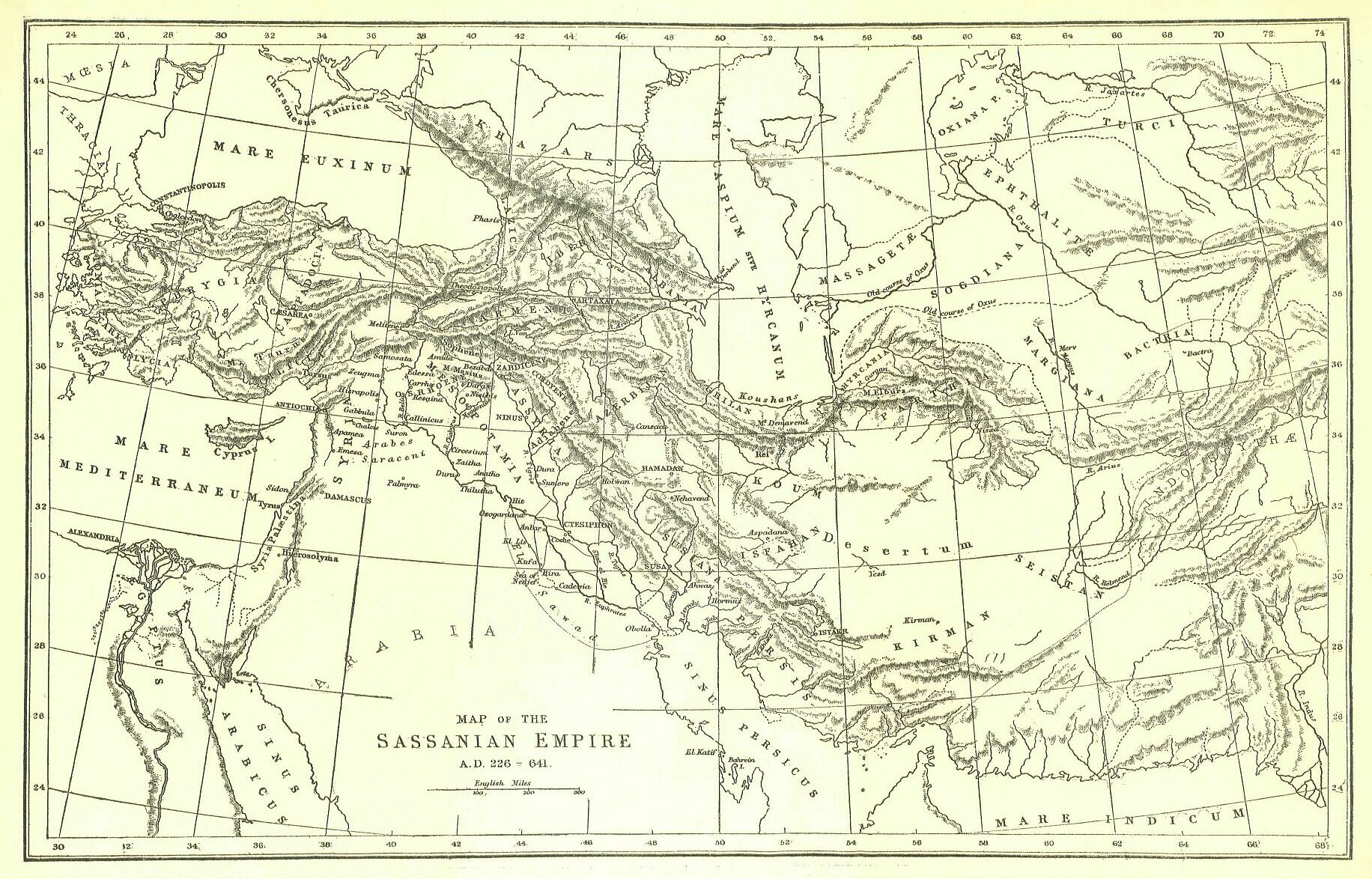
Condition of the Persians under the Successors of Alexander—under the Arsacidce. Favor shown them by the latter—allowed to have Kings of their own. Their Religion at first held in honor. Power of their Priests. Gradual Change of Policy on the part of the Parthian Monarchs, and final Oppression of the Magi. Causes which produced the Insurrection of Artaxerxes.
"The Parthians had been barbarians; they had ruled over a nation far more civilized than themselves, and had oppressed them and their religion."
Niebuhr, Lectures on Roman History, vol. iii. p. 270.
When the great Empire of the Persians, founded by Cyrus, collapsed under the attack of Alexander the Great, the dominant race of Western Asia did not feel itself at the first reduced to an intolerable condition. It was the benevolent design of Alexander to fuse into one the two leading peoples of Europe and Asia, and to establish himself at the head of a Perso-Hellenic State, the capital of which was to have been Babylon. Had this idea been carried out, the Persians would, it is evident, have lost but little by their subjugation. Placed on a par with the Greeks, united with them in marriage bonds, and equally favored by their common ruler, they could scarcely have uttered a murmur, or have been seriously discontented with their position. But when the successors of the great Macedonian, unable to rise to the height of his grand conception, took lower ground, and, giving up the idea of a fusion, fell back upon the ordinary status, and proceeded to enact the ordinary role, of conquerors, the feelings of the late lords of Asia, the countrymen of Cyrus and Darius, must have undergone a complete change. It had been the intention of Alexander to conciliate and elevate the leading Asiatics by uniting them with the Macedonians and the Greeks, by promoting social intercourse between the two classes of his subjects and encouraging them to intermarry, by opening his court to Asiatics, by educating then in Greek ideas and in Greek schools, by promoting them to high employments, and making them feel that they were as much valued and as well cared for as the people of the conquering race: it was the plan of the Seleucidae to govern wholly by means of European officials, Greek or Macedonian, and to regard and treat the entire mass of their Asiatic subjects as mere slaves. Alexander had placed Persian satraps over most of the provinces, attaching to them Greek or Macedonian commandants as checks. Seloucus divided his empire into seventy-two satrapies; but among his satraps not one was an Asiatic—all were either Macedonians or Greeks. Asiatics, indeed, formed the bulk of his standing army, and so far were admitted to employment; they might also, no doubt, be tax-gatherers, couriers, scribes, constables, and officials of that mean stamp; but they were as carefully excluded from all honorable and lucrative offices as the natives of Hindustan under the rule of the East India Company. The standing army of the Seleucidae was wholly officered, just as was that of our own Sepoys, by Europeans; Europeans thronged the court, and filled every important post under the government. There cannot be a doubt that such a high-spirited and indeed arrogant people as the Persians must have fretted and chafed under this treatment, and have detested the nation and dynasty which had thrust them down from their pre-eminence and converted them from masters into slaves. It would scarcely much tend to mitigate the painfulness of their feelings that they could not but confess their conquerors to be a civilized people—as civilized, perhaps more civilized than themselves—since the civilization was of a type and character which did not please them or command their approval. There is an essential antagonism between European and Asiatic ideas and modes of thought, such as seemingly to preclude the possibility of Asiatics appreciating a European civilization. The Persians must have felt towards the Greco-Macedonians much as the Mohammedans of India feel towards ourselves—they may have feared and even respected them—but they must have very bitterly hated them. Nor was the rule of the Seleucidae such as to overcome by its justice or its wisdom the original antipathy of the dispossessed lords of Asia towards those by whom they had been ousted. The satrapial system, which these monarchs lazily adopted from their predecessors, the Achaemenians, is one always open to great abuses, and needs the strictest superintendence and supervision. There is no reason to believe that any sufficient watch was kept over their satraps by the Seleucid kings, or even any system of checks established, such as the Achaemenidae had, at least in theory, set up and maintained. The Greco-Macedonian governors of provinces seem to have been left to themselves almost entirely, and to have been only controlled in the exercise of their authority by their own notions of what was right or expedient. Under these circumstances, abuses were sure to creep in; and it is not improbable that gross outrages were sometimes perpetrated by those in power—outrages calculated to make the blood of a nation boil, and to produce a keen longing for vengeance. We have no direct evidence that the Persians of the time did actually suffer from such a misuse of satrapial authority; but it is unlikely that they entirely escaped the miseries which are incidental to the system in question. Public opinion ascribed the grossest acts of tyranny and oppression to some of the Seleucid satraps; probably the Persians were not exempt from the common lot of the subject races.
Moreover, the Seleucid monarchs themselves were occasionally guilty of acts of tyranny, which must have intensified the dislike wherewith they were regarded by their Asiatic subjects. The reckless conduct of Antiochus Epiphanes towards the Jews is well known; but it is not perhaps generally recognized that intolerance and impious cupidity formed a portion of the system on which he governed. There seems, however, to be good reason to believe that, having exhausted his treasury by his wars and his extravagances, Epiphanes formed a general design of recruiting it by means of the plunder of his subjects. The temples of the Asiatics had hitherto been for the most part respected by their European conquerors, and large stores of the precious metals were accumulated in them. Epiphanes saw in these hoards the means of relieving his own necessities, and determined to seize and confiscate them. Besides plundering the Temple of Jehovah at Jerusalem, he made a journey into the southeastern portion of his empire, about B.C. 165, for the express purpose of conducting in person the collection of the sacred treasures. It was while he was engaged in this unpopular work that a spirit of disaffection showed itself; the East took arms no less than the West; and in Persia, or upon its borders, the avaricious monarch was forced to retire before the opposition which his ill-judged measures had provoked, and to allow one of the doomed temples to escape him. When he soon afterwards sickened and died, the natives of this part of Asia saw in his death a judgment upon him for his attempted sacrilege.
It was within twenty years of this unfortunate attempt that the dominion of the Seleucidae over Persia and the adjacent countries came to an end. The Parthian Empire had for nearly a century been gradually growing in power and extending itself at the expense of the Syro-Macedonian; and, about B.C. 163, an energetic prince, Mithridates I., commenced a series of conquests towards the West, which terminated (about B.C. 150) in the transference from the Syro-Macedonian to the Parthian rule of Media Magna, Susiana, Persia, Babylonia, and Assyria Proper. It would seem that the Persians offered no resistance to the progress of the new conqueror. The Seleucidae had not tried to conciliate their attachment, and it was impossible that they should dislike the rupture of ties which had only galled hitherto. Perhaps their feeling, in prospect of the change, was one of simple indifference. Perhaps it was not without some stir of satisfaction and complacency that they saw the pride of the hated Europeans abased, and a race, which, however much it might differ from their own, was at least Asiatic, installed in power. The Parthia system, moreover, was one which allowed greater liberty to the subject races than the Macedonian, as it had been understood and carried out by the Seleucidae; and so far some real gain was to be expected from the change. Religious motives must also have conspired to make the Persians sympathize with the new power, rather than with that which for centuries had despised their faith and had recently insulted it.
The treatment of the Persians by their Parthian lords seems, on the whole, to have been marked by moderation. Mithridates indeed, the original conqueror, is accused of having alienated his new subjects by the harshness of his rule; and in the struggle which occurred between him and the Seleucid king, Demetrius II., Persians, as well as Elymseans and Bactrians, are said to have fought on the side of the Syro-Macedonian. But this is the only occasion in Parthian history, between the submission of Persia and the great revolt under Artaxerxes, where there is any appearance of the Persians regarding their masters with hostile feelings. In general they show themselves submissive and contented with their position, which was certainly, on the whole, a less irksome one than they had occupied under the Seleucidae.
It was a principle of the Parthian governmental system to allow the subject peoples, to a large extent, to govern themselves. These peoples generally, and notably the Persians, were ruled by native kings, who succeeded to the throne by hereditary right, had the full power of life and death, and ruled very much as they pleased, so long as they paid regularly the tribute imposed upon them by the "King of Kings," and sent him a respectable contingent when he was about to engage in a military expedition. Such a system implies that the conquered peoples have the enjoyment of their own laws and institutions, are exempt from troublesome interference, and possess a sort of semi-independence. Oriental nations, having once assumed this position, are usually contented with it, and rarely make any effort to better themselves. It would seem that, thus far at any rate, the Persians could not complain of the Parthian rule, but must have been fairly satisfied with their condition.
Again, the Greco-Macedonians had tolerated, but they had not viewed with much respect, the religion which they had found established in Persia. Alexander, indeed, with the enlightened curiosity which characterised him, had made inquiries concerning, the tenets of the Magi, and endeavored to collect in one the writings of Zoroaster. But the later monarchs, and still more their subjects, had held the system in contempt, and, as we have seen, Epiphanes had openly insulted the religious feelings of his Asiatic subjects. The Parthians, on the other hand, began at any rate with a treatment of the Persian religion which was respectful and gratifying. Though perhaps at no time very sincere Zoroastrians, they had conformed to the State religion under the Achaemenian kings; and when the period came that they had themselves to establish a system of government, they gave to the Magian hierarchy a distinct and important place in their governmental machinery. The council, which advised the monarch, and which helped to elect and (if need were) depose him, was composed of two elements—-the Sophi, or wise men, who were civilians; and the Magi, or priests of the Zoroastrian religion. The Magi had thus an important political status in Parthia, during the early period of the Empire; but they seem gradually to have declined in favor, and ultimately to have fallen into disrepute. The Zoroastrian creed was, little by little, superseded among the Parthians by a complex idolatry, which, beginning with an image-worship of the Sun and Moon, proceeded to an association with those deities of the deceased kings of the nation, and finally added to both a worship of ancestral idols, which formed the most cherished possession of each family, and practically monopolized the religious sentiment. All the old Zoroastrian practices were by degrees laid aside. In Armenia the Arsacid monarchs allowed the sacred fire of Ormazd to become extinguished; and in their own territories the Parthian Arsacidae introduced the practice, hateful to Zoroastrians, of burning the dead. The ultimate religion of these monarchs seems in fact to have been a syncretism wherein Sabaism, Confucianism, Greco-Macedonian notions, and an inveterate primitive idolatry were mixed together. It is not impossible that the very names of Ormazd and Ahriman had ceased to be known at the Parthian Court, or were regarded as those of exploded deities, whose dominion over men's minds had passed away.
On the other hand, in Persia itself, and to some extent doubtless among the neighboring countries, Zoroastrianism (or what went by the name) had a firm hold on the religious sentiments of the multitude, who viewed with disfavor the tolerant and eclectic spirit which animated the Court of Ctesiphon. The perpetual fire, kindled, as it was, from heaven, was carefully tended and preserved on the fire-altars of the Persian holy places; the Magian hierarchy was held in the highest repute, the kings themselves (as it would seem) not disdaining to be Magi; the ideas—even perhaps the forms—of Ormazd and Ahriman were familiar to all; image-worship was abhorred the sacred writings in the Zend or most ancient Iranian language were diligently preserved and multiplied; a pompous ritual was kept up; the old national religion, the religion of the Achaemenians, of the glorious period of Persian ascendency in Asia, was with the utmost strictness maintained, probably the more zealously as it fell more and more into disfavor with the Parthians.
The consequence of this divergence of religious opinion between the Persians and their feudal lords must undoubtedly have been a certain amount of alienation and discontent. The Persian Magi must have been especially dissatisfied with the position of their brethren at Court; and they would doubtless use their influence to arouse the indignation of their countrymen generally. But it is scarcely probable that this cause alone would have produced any striking result. Religious sympathy rarely leads men to engage in important wars, unless it has the support of other concurrent motives. To account for the revolt of the Persians against their Parthian lords under Artaxerxes, something more is needed than the consideration of the religious differences which separated the two peoples.
First, then, it should be borne in mind that the Parthian rule must have been from the beginning distasteful to the Persians, owing to the rude and coarse character of the people. At the moment of Mithridates's successes, the Persians might experience a sentiment of satisfaction that the European invader was at last thrust back, and that Asia had re-asserted herself; but a very little experience of Parthian rule was sufficient to call forth different feelings. There can be no doubt that the Parthians, whether they were actually Turanians or no, were, in comparison with the Persians, unpolished and uncivilized. They showed their own sense of this inferiority by an affectation of Persian manners. But this affectation was not very successful. It is evident that in art, in architecture, in manners, in habits of life, the Parthian race reached only a low standard; they stood to their Hellenic and Iranian subjects in much the same relation that the Turks of the present day stand to the modern Greeks; they made themselves respected by their strength and their talent for organization; but in all that adorns and beautifies life they were deficient. The Persians must, during the whole time of their subjection to Parthia, have been sensible of a feeling of shame at the want of refinement and of a high type of civilization in their masters.
Again, the later sovereigns of the Arsacid dynasty were for the most part of weak and contemptible character. From the time of Volagases I. to that of Artabanus IV., the last king, the military reputation of Parthia had declined. Foreign enemies ravaged the territories of Parthian vassal kings, and retired when they chose, unpunished. Provinces revolted and established their independence. Rome was entreated to lend assistance to her distressed and afflicted rival, and met the entreaties with a refusal. In the wars which still from time to time were waged between the two empires Parthia was almost uniformly worsted. Three times her capital was occupied, and once her monarch's summer palace was burned. Province after province had to be ceded to Rome. The golden throne which symbolized her glory and magnificence was carried off. Meanwhile feuds raged between the different branches of the Arsacid family; civil wars were frequent; two or three monarchs at a time claimed the throne, or actually ruled in different portions of the Empire. It is not surprising that under these circumstances the bonds were loosened between Parthia and her vassal kingdoms, or that the Persian tributary monarchs began to despise their suzerains, and to contemplate without alarm the prospect of a rebellion which should place them in an independent position.
While the general weakness of the Arsacid monarchs was thus a cause naturally leading to a renunciation of their allegiance on the part of the Persians, a special influence upon the decision taken by Artaxerxes is probably to be assigned to one, in particular, of the results of that weakness. When provinces long subject to Parthian rule revolted, and revolted successfully, as seems to have been the case with Hyrcania, and partially with Bactria, Persia could scarcely for very shame continue submissive. Of all the races subject to Parthia, the Persians were the one which had held the most brilliant position in the past, and which retained the liveliest remembrance of its ancient glories. This is evidenced not only by the grand claims which Artaxorxes put forward in his early negotiations with the Romans, but by the whole course of Persian literature, which has fundamentally an historic character, and exhibits the people as attached, almost more than any other Oriental nation, to the memory of its great men and of their noble achievements. The countrymen of Cyrus, of Darius, of Xerxes, of Ochus, of the conquerors of Media, Bactria, Babylon, Syria, Asia Minor, Egypt, of the invaders of Scythia and Greece, aware that they had once borne sway over the whole region between Tunis and the Indian Desert, between the Caucasus and the Cataracts, when they saw a petty mountain clan, like the Hyrcanians, establish and maintain their independence despite the efforts of Parthia to coerce them, could not very well remain quiet. If so weak and small a race could defy the power of the Arsacid monarchs, much more might the far more numerous and at least equally courageous Persians expect to succeed, if they made a resolute attempt to recover their freedom.
It is probable that Artaxerxes, in his capacity of vassal, served personally in the army with which the Parthian monarch Artabanus carried on the struggle against Rome, and thus acquired the power of estimating correctly the military strength still possessed by the Arsacidae, and of measuring it against that which he knew to belong to his nation. It is not unlikely that he formed his plans during the earlier period of Artabanus's reign, when that monarch allowed himself to be imposed upon by Caracallus, and suffered calamities and indignities in consequence of his folly. When the Parthian monarch atoned for his indiscretion and wiped out the memory of his disgraces by the brilliant victory of Nisibis and the glorious peace which he made with Macrinus, Artaxerxes may have found that he had gone too far to recede; or, undazzled by the splendor of these successes, he may still have judged that he might with prudence persevere in his enterprise. Artabanus had suffered great losses in his two campaigns against Rome, and especially in the three days' battle of Nisibis. He was at variance with several princes of his family, one of whom certainly maintained himself during his whole reign with the State and title of "King of Parthia." Though he had fought well at Nisibis, he had not given any indications of remarkable military talent. Artaxerxes, having taken the measure of his antagonist during the course of the Roman war, having estimated his resources and formed a decided opinion on the relative strength of Persia and Parthia, deliberately resolved, a few years after the Roman war had come to an end, to revolt and accept the consequences. He was no doubt convinced that his nation would throw itself enthusiastically into the struggle, and he believed that he could conduct it to a successful issue. He felt himself the champion of a depressed, if not an oppressed, nationality, and had faith in his power to raise it into a lofty position. Iran, at any rate, should no longer, he resolved, submit patiently to be the slave of Turan; the keen, intelligent, art-loving Aryan people should no longer bear submissively the yoke of the rude, coarse, clumsy Scyths. An effort after freedom should be made. He had little doubt of the result. The Persians, by the strength of their own right arms and the blessing of Ahuramazda, the "All-bounteous," would triumph over their impious masters, and become once more a great and independent people. At the worst, if he had miscalculated, there would be the alternative of a glorious death upon the battle-field in one of the noblest of all causes, the assertion of a nation's freedom.
Situation and Size of Persia. General Character of the Country and Climate. Chief Products. Characteristics of the Persian People, physical and moral. Differences observable in the Race at different periods.
Persia Proper was a tract of country lying on the Gulf to which it has given name, and extending about 450 miles from north-west to south-east, with an average breadth of about 250 miles. Its entire area may be estimated at about a hundred thousand square miles. It was thus larger than Great Britain, about the size of Italy, and rather less than half the size of France. The boundaries were, on the west, Elymais or Susiana (which, however, was sometimes reckoned a part of Persia); on the north, Media; on the east, Carmania; and on the south, the sea. It is nearly represented in modern times by the two Persian provinces of Farsistan and Laristan, the former of which retains, but slightly changed, the ancient appellation. The Hindyan or Tab (ancient Oroatis) seems towards its mouth to have formed the western limit. Eastward, Persia extended to about the site of the modern Bunder Kongo. Inland, the northern boundary ran probably a little south of the thirty-second parallel, from long. 50° to 55°. The line dividing Persia Proper from Carmania (now Kerman) was somewhat uncertain.
The character of the tract is extremely diversified. Ancient writers divided the country into three strongly contrasted regions. The first, or coast tract, was (they said) a sandy desert, producing nothing but a few dates, owing to the intensity of the heat. Above this was a fertile region, grassy, with well-watered meadows and numerous vineyards, enjoying a delicious climate, producing almost every fruit but the olive, containing pleasant parks or "paradises," watered by a number of limpid streams and clear lakes, well wooded in places, affording an excellent pasture for horses and for all sorts of cattle, abounding in water-fowl and game of every kind, and altogether a most delightful abode. Beyond this fertile region, towards the north, was a rugged mountain tract, cold and mostly covered with snow, of which they did not profess to know much.
In this description there is no doubt a certain amount of truth; but it is mixed probably with a good deal of exaggeration. There is no reason to believe that the climate or character of the country has undergone any important alteration between the time of Nearchus or Strabo and the present day. At present it is certain that the tract in question answers but very incompletely to the description which those writers give of it. Three regions may indeed be distinguished, though the natives seem now to speak of only two; but none of them corresponds at all exactly to the accounts of the Greeks. The coast tract is represented with the nearest approach to correctness. This is, in fact, a region of arid plain, often impregnated with salt, ill-watered, with a poor soil, consisting either of sand or clay, and productive of little besides dates and a few other fruits. A modern historian says of it that "it bears a greater resemblance in soil and climate to Arabia than to the rest of Persia." It is very hot and unhealthy, and can at no time have supported more than a sparse and scanty population. Above this, towards the north, is the best and most fertile portion of the territory. A mountain tract, the continuation of Zagros, succeeds to the flat and sandy coast region, occupying the greater portion of Persia Proper. It is about two hundred miles in width, and consists of an alternation of mountain, plain, and narrow valley, curiously intermixed, and hitherto mapped very imperfectly. In places this district answers fully to the description of Nearchus, being, "richly fertile, picturesque, and romantic almost beyond imagination, with lovely wooded dells, green mountain sides, and broad plains, suited for the production of almost any crops." But it is only to the smaller moiety of the region that such a character attaches; more than half the mountain tract is sterile and barren; the supply of water is almost everywhere scanty; the rivers are few, and have not much volume; many of them, after short courses, end in the sand, or in small salt lakes, from which the superfluous water is evaporated. Much of the country is absolutely without streams, and would be uninhabitable were it not for the kanats or kareezes—subterranean channels made by art for the conveyance of spring water to be used in irrigation. The most desolate portion of the mountain tract is towards the north and north-east, where it adjoins upon the third region, which is the worst of the three. This is a portion of the high tableland of Iran, the great desert which stretches from the eastern skirts of Zagros to the Hamoon, the Helmend, and the river of Subzawur. It is a dry and hard plain, intersected at intervals by ranges of rocky hills, with a climate extremely hot in summer and extremely cold in winter, incapable of cultivation, excepting so far as water can be conveyed by kanats, which is, of course, only a short distance. The fox, the jackal, the antelope, and the wild ass possess this sterile and desolate tract, where "all is dry and cheerless," and verdure is almost unknown.
Perhaps the two most peculiar districts of. Persia are the lake basins of Neyriz and Deriah-i-Nemek. The rivers given off from the northern side of the great mountain chain between the twenty-ninth and thirty-first parallels, being unable to penetrate the mountains, flow eastward towards the desert; and their waters gradually collect into two streams, which end in two lakes, the Deriah-i-Nemek and that of Neyriz, or Lake Bakhtigan. The basin of Lake Neyriz lies towards the north. Here the famous Bendamir, and the Pulwar or Kur-ab, flowing respectively from the north-east and the north, unite in one near the ruins of the ancient Persepolis, and, after fertilizing the plain of Merdasht, run eastward down a rich vale for a distance of some forty miles into the salt lake which swallows them up. This lake, when full, has a length of fifty or sixty miles, with a breadth of from three to six. In summer, however, it is often quite dry, the water of the Bendamir being expended in irrigation before reaching its natural terminus. The valley and plain of the Bendamir, and its tributaries, are among the most fertile portions of Persia, as well as among those of most historic interest.
The basin of the Deriah-i-Nemek is smaller than that of the Neyriz, but it is even more productive. Numerous brooks and streams, rising not far from Shiraz, run on all sides into the Nemek lake, which has a length of about fifteen and a breadth of three or three and a half miles. Among the streams is the celebrated brook of Hafiz, the Rocknabad, which still retains "its singular transparency and softness to the taste." Other rills and fountains of extreme clearness abound, and a verdure is the result, very unusual in Persia. The vines grown in the basin produce the famous Shiraz wine, the only good wine which is manufactured in the East. The orchards are magnificent. In the autumn "the earth is covered with the gathered harvest, flowers, and fruits; melons, peaches, pears, nectarines, cherries, grapes, pomegranates; all is a garden, abundant in sweets and refreshment."
But, notwithstanding the exceptional fertility of the Shiraz plain and of a few other places, Persia Proper seems to have been rightly characterized in ancient times as "a scant land and a rugged." Its area was less than a fifth of the area of modern Persia; and of this space nearly one half was uninhabitable, consisting either of barren stony mountain or of scorching sandy plain, ill supplied with water and often impregnated with salt. Its products, consequently, can have been at no time either very abundant or very varied. Anciently, the low coast tract seems to have been cultivated to a small extent in corn, and to have produced good dates and a few other fruits. The mountain region was, as we have seen, celebrated for its excellent pastures, for its abundant fruits, and especially for its grapes. Within the mountains, on the high plateau, assafoetida (silphium) was found, and probably some other medicinal herbs. Corn, no doubt, could be grown largely in the plains and valleys of the mountain tract, as well as on the plateau, so far as the kanats carried the water. There must have been, on the whole, a deficiency of timber, though the palms of the low tract, and the oaks, planes, chenars or sycamores, poplars, and willows of the mountain regions sufficed for the wants of the natives. Not much fuel was required, and stone was the general material used for building. Among the fruits for which Persia was famous are especially noted the peach, the walnut, and the citron. The walnut bore among the Romans the appellation of "royal."
Persia, like Media, was a good nursery for horses. Fine grazing grounds existed in many parts of the mountain region, and for horses of the Arab breed even the Deshtistan was not unsuited. Camels were reared in some places, and sheep and goats were numerous. Horned cattle were probably not so abundant, as the character of the country is not favorable for them. Game existed in large quantities, the lakes abounding with water-fowl, such as ducks, teal, heron, snipe, etc.; and the wooded portions of the mountain tract giving shelter to the stag, the wild goat, the wild boar, the hare, the pheasant, and the heathcock, fish were also plentiful. Whales visited the Persian Gulf, and were sometimes stranded upon the shores, where their carcases furnished a mine of wealth to the inhabitants. Dolphins abounded, as well as many smaller kinds; and shell-fish, particularly oysters, could always be obtained without difficulty. The rivers, too, were capable of furnishing fresh-water fish in good quantity, though we cannot say if this source of supply was utilized in antiquity.
The mineral treasures of Persia were fairly numerous. Good salt was yielded by the lakes of the middle region, and was also obtainable upon the plateau. Bitumen and naphtha were produced by sources in the low country. The mountains contained most of the important metals and a certain number of valuable gems. The pearls of the Gulf acquired early a great reputation, and a regular fishery was established for them before the time of Alexander.
But the most celebrated of all the products of Persia were its men. The "scant and rugged country" gave birth, as Cyrus the Great is said to have observed, to a race brave, hardy, and enduring, calculated not only to hold its own against aggressors, but to extend its sway and exercise dominion over the Western Asiatics generally. The Aryan family is the one which, of all the races of mankind, is the most self-asserting, and has the greatest strength, physical, moral, and intellectual. The Iranian branch of it, whereto the Persians belonged, is not perhaps so gifted as some others; but it has qualities which place it above most of those by which Western Asia was anciently peopled. In the primitive times, from Cyrus the Great to Darius Hystaspis, the Persians seem to have been rude mountaineers, probably not very unlike the modern Kurds and Lurs, who inhabit portions of the same chain which forms the heart of the Persian country. Their physiognomy was handsome. A high straight forehead, a long slightly aquiline nose, a short and curved upper lip, a well-rounded chin, characterized the Persian. The expression of his face was grave and noble. He had abundant hair, which he wore very artificially arranged. Above and round the brow it was made to stand away from the face in short crisp curls; on the top of the head it was worn smooth; at the back of the head it was again trained into curls, which followed each other in several rows from the level of the forehead to the nape of the neck. The moustache was always cultivated, and curved in a gentle sweep. A beard and whiskers were worn, the former sometimes long and pendent, like the Assyrian, but more often clustering around the chin in short close curls. The figure was well-formed, but somewhat stout; the carriage was dignified and simple. [PLATE XI, Fig. 1.]
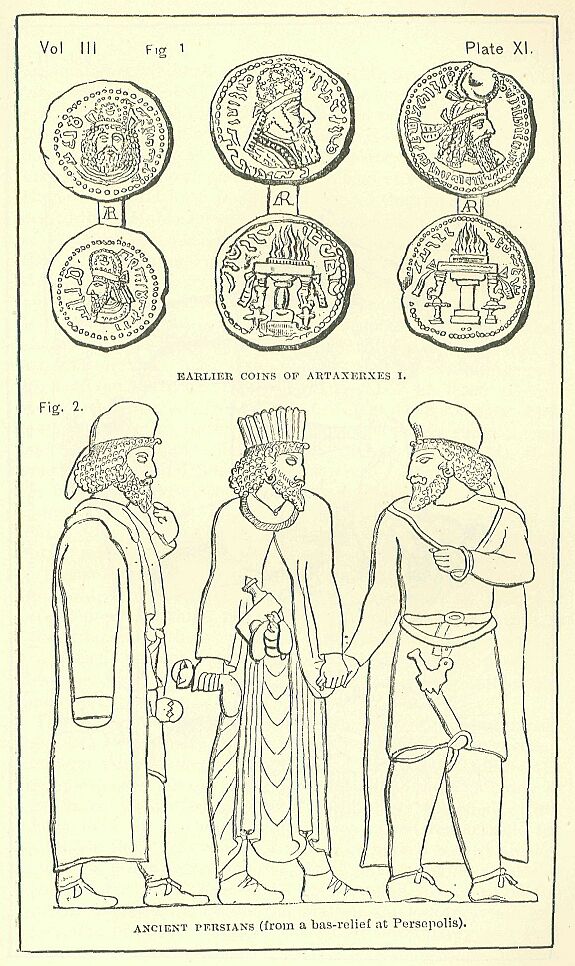
Simplicity of manners prevailed during this period. At the court there was some luxury; but the bulk of the nation, living in their mountain territory, and attached to agriculture and hunting, maintained the habits of their ancestors, and were a somewhat rude though not a coarse people. The dress commonly worn was a close-fitting shirt or tunic of leather, descending to the knee, and with sleeves that reached down to the wrist. Round the tunic was worn a belt or sash, which was tied in front. The head was protected by a loose felt cap and the feet by a sort of high shoe or low boot. The ordinary diet was bread and cress-seed, while the sole beverage was water. In the higher ranks, of course, a different style of living prevailed; the elegant and flowing "Median robe" was worn; flesh of various kinds was eaten; much wine was consumed; and meals were extended to a great length; The Persians, however, maintained during this period a general hardihood and bravery which made them the most dreaded adversaries of the Greeks, and enabled them to maintain an unquestioned dominion over the other native races of Western Asia.
As time went on, and their monarchs became less warlike, and wealth accumulated, and national spirit decayed, the Persian character by degrees deteriorated, and sank, even under the Achaemenian kings, to a level not much superior to that of the ordinary Asiatic. The Persian antagonists of Alexander were pretty nearly upon a par with the races which in Hindustan have yielded to the British power; they occasionally fought with gallantry, but they were deficient in resolution, in endurance, in all the elements of solid strength; and they were quite unable to stand their ground against the vigor and dash of the Macedonians and the Greeks. Whether physically they were very different from the soldiers of Cyrus may be doubted, but morally they had fallen far below the ancient standard; their self-respect their love of country, their attachment to their monarch had diminished; no one showed any great devotion to the cause for which he fought; after two defeats the empire wholly collapsed; and the Persians submitted, apparently without much reluctance, to the Helleno-Macedonian yoke.
Five centuries and a half of servitude could not much improve or elevate the character of the people. Their fall from power, their loss of wealth and of dominion did indeed advantage them in one way: it but an end to that continually advancing sloth and luxury which had sapped the virtue of the nation, depriving it of energy, endurance, and almost every manly excellence. It dashed the Persians back upon the ground whence they had sprung, and whence, Antseus-like, they proceeded to derive fresh vigor and vital force. In their "scant and rugged" fatherland, the people of Cyrus once more recovered to a great extent their ancient prowess and hardihood—their habits became simplified, their old patriotism revived, their self-respect grew greater. But while adversity thus in some respects proved its "sweet uses" upon them, there were other respects in which submission to the yoke of the Greeks, and still more to that of the Parthians, seems to have altered them for the worse rather than for the better. There is a coarseness and rudeness about the Sassanian Persians which we do not observe in Achaemenian times. The physique of the nation is not indeed much altered. Nearly the same countenance meets us in the sculptures of Artaxerxes, the son of Babek, of Sapor, and of their successors, with which we are familiar from the bas-reliefs of Darius Hystapis and Xerxes. There is the same straight forehead, the same aquiline nose, the same well-shaped mouth, the same abundant hair. The form is, however, coarser and clumsier; the expression is less refined; and the general effect produced is that the people have, even physically, deteriorated. The mental and aesthetic standard seems still more to have sunk. There is no evidence that the Persians of Sassanian times possessed the governmental and administrative ability of Darius Hystapis or Artaxerxes Ochus. Their art, though remarkable, considering the almost entire disappearance of art from Western Asia under the Parthians, is, compared with that of Achaemenian times, rude and grotesque. In architecture, indeed, they are not without merit though even here the extent to which they were indebted to the Parthians, which cannot be exactly determined, must lessen our estimation of them; but their mimetic art, while not wanting in spirit, is remarkably coarse and unrefined. As a later chapter will be devoted to this subject, no more need be said upon it here. It is sufficient for our present purpose to note that the impression which we obtain from the monumental remains of the Sassanian Persians accords with what is to be gathered of them from the accounts of the Romans and the Greeks. The great Asiatic revolution of the year A.D. 226 marks a revival of the Iranic nationality from the depressed state into which it had sunk for more than five hundred years; but the revival is not full or complete. The Persians of the Sassanian kingdom are not equal to those of the time between Cyrus the Great and Darius Codomannus; they have ruder manners, a grosser taste, less capacity for government and organization; they have, in fact, been coarsened by centuries of Tartar rule; they are vigorous, active, energetic, proud, brave; but in civilization and refinement they do not rank much above their Parthian predecessors. Western Asia gained, perhaps, something, but it did not gain much, from the substitution of the Persians for the Parthians as the dominant power. The change is the least marked among the revolutions which the East underwent between the accession of Cyrus and the conquests of Timour. But it is a change, on the whole, for the better. It is accompanied by a revival of art, by improvements in architecture; it inaugurates a religious revolution which has advantages. Above all, it saves the East from stagnation. It is one among many of those salutary shocks which, in the political as in the natural world, are needed from time to time to stimulate action and prevent torpor and apathy.
Reign of Artaxerxes I. Stories told of him. Most probable account of his Descent, Rank, and Parentage. His Contest with Artabanus. First War with Chosroes of Armenia. Contest with Alexander Severus. Second War with Chosroes and conquest of Armenia. Religious Reforms. Internal Administration and Government. Art. Coinage. Inscriptions.
Around the cradle of an Oriental sovereign who founds a dynasty there cluster commonly a number of traditions, which have, more or less, a mythical character. The tales told of the Great, which even Herodotus set aside as incredible, have their parallels in narratives that were current within one or two centuries with respect to the founder of the Second Persian Empire, which would not have disgraced the mythologers of Achaemenian times. Artaxerxes, according to some, was the son of a common soldier who had an illicit connection with the wife of a Persian cobbler and astrologer, a certain Babek or Papak, an inhabitant of the Cadusian country and a man of the lowest class. Papak, knowing by his art that the soldier's son would attain a lofty position, voluntarily ceded his rights as husband to the favorite of fortune, and bred up as his own the issue of this illegitimate commerce, who, when he attained to manhood, justified Papak's foresight by successfully revolting from Artabanus and establishing the new Persian monarchy. Others said that the founder of the new kingdom was a Parthian satrap, the son of a noble, and that, having long meditated revolt, he took the final plunge in consequence of a prophecy uttered by Artabanus, who was well skilled in magical arts, and saw in the stars that the Parthian empire was threatened with destruction. Artabanus, on a certain occasion, when he communicated this prophetic knowledge to his wife, was overheard by one of her attendants, a noble damsel named Artaducta, already affianced to Artaxerxes and a sharer in his secret counsels. At her instigation he hastened his plans, raised the standard of revolt, and upon the successful issue of his enterprise made her his queen. Miraculous circumstances were freely interwoven with these narratives, and a result was produced which staggered the faith even of such a writer as Moses of Chorene, who, desiring to confine himself to what was strictly true and certain, could find no more to say of Artaxerxes's birth and origin than that he was the son of a certain Sasan, and a native of Istakr, or Persepolis.
Even, however, the two facts thus selected as beyond criticism by Moses are far from being entitled to implicit credence. Artaxerxes, the son of Sasan according to Agathangelus and Moses, is the same as Papak (or Babek) in his own and his son's inscriptions. The Persian writers generally take the same view, and declare that Sasan was a remoter ancestor of Artaxerxes, the acknowledged founder of the family, and not Artaxerxes' father. In the extant records of the new Persian Kingdom, the coins and the inscriptions, neither Sasan nor the gentilitial term derived from it, Sasanidae, has any place; and though it would perhaps be rash to question on this account the employment of the term Sasanidae by the dynasty, yet we may regard it as really "certain" that the father of Artaxerxes was named, not Sasan, but Papak; and that, if the term Sasanian was in reality a patronymic, it was derived, like the term "Achaemenian," from some remote progenitor whom the royal family of the new empire believed to have been their founder.
The native country of Artaxerxes is also variously stated by the authorities. Agathangelus calls him an Assyrian, and makes the Assyrians play an important part in his rebellion. Agathias says that he was born in the Cadusian country, or the low tract south-west of the Caspian, which belonged to Media rather than to Assyria or Persia. Dio Cassius, and Herodian, the contemporaries of Artaxerxes, call him a Persian; and there can be no reasonable doubt that they are correct in so doing. Agathangelus allows the predominantly Persian character of his revolt, and Agathias is apparently unaware that the Cadusian country was no part of Persia. The statement that he was a native of Persepolis (Istakr) is first found in Moses of Chorene. It may be true, but it is uncertain; for it may have grown out of the earlier statement of Agathangelus, that he held the government of the province of Istakr. We can only affirm with confidence that the founder of the new Persian monarchy was a genuine Persian, without attempting to determine positively what Persian city or province had the honor of producing him.
A more interesting question, and one which will be found perhaps to admit of a more definite answer, is that of the rank and station in which Artaxerxes was born. We have seen that Agathias (writing ab. A.D. 580) called him the supposititious son of a cobbler. Others spoke of him as the child of a shepherd; while some said that his father was "an inferior officer in the service of the government." But on the other hand, in the inscriptions which Artaxerxes himself setup in the neighborhood of Persepolis, he gives his father, Papak, the title of "King." Agathangelus calls him a "noble" and "satrap of Persepolitan government;" while Herodian seems to speak of him as "king of the Persians," before his victories over Artabanus. On the whole, it is perhaps most probable that, like Cyrus, he was the hereditary monarch of the subject kingdom of Persia, which had always its own princes under the Parthians, and that thus he naturally and without effort took the leadership of the revolt when circumstances induced his nation to rebel and seek to establish its independence. The stories told of his humble origin, which are contradictory and improbable, are to be paralleled with those which made Cyrus the son of a Persian of moderate rank, and the foster-child of a herdsman. There is always in the East a tendency towards romance and exaggeration; and when a great monarch emerges from a comparatively humble position, the humility and obscurity of his first condition are intensified, to make the contrast more striking between his original low estate and his ultimate splendor and dignity.
The circumstances of the struggle between Artaxerxes and. Artabanus are briefly sketched by Dio Cassius and Agathangelus, while they are related more at large by the Persian writers. It is probable that the contest occupied a space of four or five years. At first, we are told, Artabanus neglected to arouse himself, and took no steps towards crushing the rebellion, which was limited to an assertion of the independence of Persia Proper, or the province of Fars. After a time the revolted vassal, finding himself unmolested, was induced to raise his thoughts higher, and commenced a career of conquest. Turning his arms eastward, he attacked Kerman (Carmania), and easily succeeded in reducing that scantily-peopled tract under his dominion. He then proceeded to menace the north, and, making war in that quarter, overran and attached to his kingdom some of the outlying provinces of Media. Roused by these aggressions, the Parthian monarch at length took the field, collected an army consisting in part of Parthians, in part of the Persians who continued faithful to him, against his vassal, and, invading Persia, soon brought his adversary to a battle. A long and bloody contest followed, both sides suffering great losses; but victory finally declared itself in favor of Artaxerxes, through the desertion to him, during the engagement, of a portion of his enemy's forces. A second conflict ensued within a short period, in which the insurgents were even more completely successful; the carnage on the side of the Parthians was great, the loss of the Persians small; and the great king fled precipitately from the field. Still the resources of Parthia were equal to a third trial of arms. After a brief pause, Artabanus made a final effort to reduce his revolted vassal; and a last engagement took place in the plain of Hormuz, which was a portion of the Jerahi valley, in the beautiful country between Bebahan and Shuster. Here, after a desperate conflict, the Parthian monarch suffered a third and signal defeat; his army was scattered; and he himself lost his life in the combat. According to some, his death was the result of a hand-to-hand conflict with his great antagonist, who, pretending to fly, drew him on, and then pierced his heart with an arrow.
The victory of Hormuz gave to Artaxerxes the dominion of the East; but it did not secure him this result at once, or without further struggle. Artabanus had left sons; and both in Bactria and Armenia there were powerful branches of the Arsacid family, which could not see unmoved the downfall of their kindred in Parthia. Chosroes, the Armenian monarch, was a prince of considerable ability, and is said to have been set upon his throne by Artabanus, whose brother he was, according to some writers. At any rate he was an Arsacid; and he felt keenly the diminution of his own influence involved in the transfer to an alien race of the sovereignty wielded for five centuries by the descendants of the first Arsaces. He had set his forces in motion, while the contest between Artabanus and Artaxerxes was still in progress, in the hope of affording substantial help to his relative. But the march of events was too rapid for him; and, ere he could strike a blow, he found that the time for effectual action had gone by, that Artabanus was no more, and that the dominion of Artaxerxes was established over most of the countries which had previously formed portions of the Parthian Empire. Still, he resolved to continue the struggle; he was on friendly terms with Rome, and might count on an imperial contingent; he had some hope that the Bactrian Arsacidae would join him; at the worst, he regarded his own power as firmly fixed and as sufficient to enable him to maintain an equal contest with the new monarchy. Accordingly he took the Parthian Arsacids under his protection, and gave them a refuge in the Armenian territory. At the same time he negotiated with both Balkh and Rome, made arrangements with the barbarians upon his northern frontier to lend him aid, and, having collected a large army, invaded the new kingdom on the north-west, and gained certain not unimportant successes. According to the Armenian historians, Artaxerxes lost Assyria and the adjacent regions; Bactria wavered; and, after the struggle had continued for a year or two, the founder of the second Persian empire was obliged to fly ignominiously to India! But this entire narrative seems to be deeply tinged with the vitiating stain of intense national vanity, a fault which markedly characterizes the Armenian writers, and renders them, when unconfirmed by other authorities, almost worthless. The general course of events, and the position which Artaxerxes takes in his dealings with Rome (A.D. 229-230), sufficiently indicate that any reverses which he sustained at this time in his struggle with Chosroes and the unsubmitted Arsacidae must have been trivial, and that they certainly had no greater result than to establish the independence of Armenia, which, by dint of leaning upon Rome, was able to maintain itself against the Persian monarch and to check the advance of the Persians in North-Western Asia.
Artaxerxes, however, resisted in this quarter, and unable to overcome the resistance, which he may have regarded as deriving its effectiveness (in part at least) from the support lent it by Rome, determined (ab. A.D. 229) to challenge the empire to an encounter. Aware that Artabanus, his late rival, against whom he had measured himself, and whose power he had completely overthrown, had been successful in his war with Macrinus, had gained the great battle of Nisibis, and forced the Imperial State to purchase an ignominious peace by a payment equal to nearly two millions of our money, he may naturally have thought that a facile triumph was open to his arms in this direction. Alexander Severus, the occupant of the imperial throne, was a young man of a weak character, controlled in a great measure by his mother, Julia Mamaea, and as yet quite undistinguished as a general. The Roman forces in the East were known to be licentious and insubordinate; corrupted by the softness of the climate and the seductions of Oriental manners, they disregarded the restraints of discipline, indulged in the vices which at once enervate the frame and lower the moral character, had scant respect for their leaders, and seemed a defence which it would be easy to overpower and sweep away. Artaxerxes, like other founders of great empires, entertained lofty views of his abilities and his destinies; the monarchy which he had built up in the space of some five or six years was far from contenting him; well read in the ancient history of his nation, he sighed after the glorious days of Cyrus the Great and Darius Hystaspis, when all Western Asia from the shores of the AEgean to the Indian desert, and portions of Europe and Africa, had acknowledged the sway of the Persian king. The territories which these princes had ruled he regarded as his own by right of inheritance; and we are told that he not only entertained, but boldly published, these views. His emissaries everywhere declared that their master claimed the dominion of Asia as far as the AEgean Sea and the Propontis. It was his duty and his mission to recover to the Persians their pristine empire. What Cyrus had conquered, what the Persian kings had held from that time until the defeat of Codomannus by Alexander, was his by indefeasible right, and he was about to take possession of it.
Nor were these brave words a mere brutum fulmen. Simultaneously with the putting forth of such lofty pretensions the troops of the Persian monarch crossed the Tigris and spread themselves over the entire Roman province of Mesopotamia, which was rapidly overrun and offered scarcely any resistance. Severus learned at the same moment the demands of his adversary and the loss of one of his best provinces. He heard that his strong posts upon the Euphrates, the old defences of the empire in this quarter, were being attacked, and that Syria daily expected the passage of the invaders. The crisis was one requiring prompt action; but the weak and inexperienced youth was content to meet it with diplomacy, and, instead of sending an army to the East, despatched ambassadors to his rival with a letter. "Artaxerxes," he said, "ought to confine himself to his own territories and not seek to revolutionize Asia; it was unsafe, on the strength of mere unsubstantial hopes, to commence a great war. Every one should be content with keeping what belonged to him. Artaxerxes would find war with Rome a very different thing from the contests in which he had been hitherto engaged with barbarous races like his own. He should call to mind the successes of Augustus and Trajan, and the trophies carried off from the East by Lucius Verus and by Septimius Severus."
The counsels of moderation have rarely much effect in restraining princely ambition. Artaxerxes replied by an embassy in which he ostentatiously displayed the wealth and magnificence of Persia; but, so far from making any deduction from his original demands, he now distinctly formulated them, and required their immediate acceptance. "Artaxerxes, the Great King," he said, "ordered the Romans and their ruler to take their departure forthwith from Syria and the rest of Western Asia, and to allow the Persians to exercise dominion over Ionia and Caria and the other countries within the AEgean and the Euxine, since these countries belonged to Persia by right of inheritance." A Roman emperor had seldom received such a message; and Alexander, mild and gentle as he was by nature, seems to have had his equanimity disturbed by the insolence of the mandate. Disregarding the sacredness of the ambassadorial character, he stripped the envoys of their splendid apparel, treated them as prisoners of war, and settled them as agricultural colonists in Phrygia. If we may believe Herodian, he even took credit to himself for sparing their lives, which he regarded as justly forfeit to the offended majesty of the empire.
Meantime the angry prince, convinced at last against his will that negotiations with such an enemy were futile, collected an army and began his march towards the East. Taking troops from the various provinces through which he passed, he conducted to Antioch, in the autumn of A.D. 231, a considerable force, which was there augmented by the legions of the East and by troops drawn from Egypt and other quarters. Artaxerxes, on his part, was not idle. According to Soverus himself, the army brought into the field by the Persian monarch consisted of one hundred and twenty thousand mailed horsemen, of eighteen hundred scythed chariots, and of seven hundred trained elephants, bearing on their backs towers filled with archers; and though this pretended host has been truly characterized as one "the like of which is not to be found in Eastern history, and has scarcely been imagined in Eastern romance," yet, allowing much for exaggeration, we may still safely conclude that great exertions had been made on the Persian side, that their forces consisted of the three arms mentioned, and that the numbers of each were large beyond ordinary precedent. The two adversaries were thus not ill-matched; each brought the flower of his troops to the conflict; each commanded the army, on which his dependence was placed, in person; each looked to obtain from the contest not only an increase of military glory, but substantial fruits of victory in the shape of plunder or territory.
It might have been expected that the Persian monarch, after the high tone which he had taken, would have maintained an aggressive attitude, have crossed the Euphrates, and spread the hordes at his disposal over Syria, Cappadocia, and Asia Minor. But it seems to be certain that he did not do so, and that the initiative was taken by the other side. Probably the Persian arms, as inefficient in sieges as the Parthian, were unable to overcome the resistance offered by the Roman forts upon the great river; and Artaxerxes was too good a general to throw his forces into the heart of an enemy's country without having first secured a safe retreat. The Euphrates was therefore crossed by his adversary in the spring of A.D. 232; the Roman province of Mesopotamia was easily recovered; and arrangements were made by which it was hoped to deal the new monarchy a heavy blow, if not actually to crush and conquer it.
Alexander divided his troops into three bodies. One division was to act towards the north, to take advantage of the friendly disposition of Chosroes, king of Armenia, and, traversing his strong mountain territory, to direct its attack upon Media, into which Armenia gave a ready entrance. Another was to take a southern line, and to threaten Persia Proper from the marshy tract about the junction of the Euphrates with the Tigris, a portion of the Babylonian territory. The third and main division, which was to be commanded by the emperor in person, was to act on a line intermediate between the other two, which would conduct it to the very heart of the enemy's territory, and at the same time allow of its giving effective support to either of the two other divisions if they should need it.
The plan of operations appears to have been judiciously constructed, and should perhaps be ascribed rather to the friends whom the youthful emperor consulted than to his own unassisted wisdom. But the best designed plans may be frustrated by unskilfulness or timidity in the execution; and it was here, if we may trust the author who alone gives us any detailed account of the campaign, that the weakness of Alexander's character showed itself. The northern army successfully traversed Armenia, and, invading Media, proved itself in numerous small actions superior to the Persian force opposed to it, and was able to plunder and ravage the entire country at its pleasure. The southern division crossed Mesopotamia in safety, and threatened to invade Persia Proper. Had Alexander with the third and main division kept faith with the two secondary armies, had he marched briskly and combined his movements with theirs, the triumph of the Roman arms would have been assured. But, either from personal timidity or from an amiable regard for the anxieties of his mother Mamsea, he hung back while his right and left wings made their advance, and so allowed the enemy to concentrate their efforts on these two isolated bodies. The army in Media, favored by the rugged character of the country, was able to maintain its ground without much difficulty; but that which had advanced by the line of the Euphrates and Tigris, and which was still marching through the boundless plains of the great alluvium, found itself suddenly beset by a countless host, commanded by Artaxerxes in person, and, though it struggled gallantly, was overwhelmed and utterly destroyed by the arrows of the terrible Persian bowmen. Herodian says, no doubt with some exaggeration, that this was the greatest calamity which had ever befallen the Romans. It certainly cannot compare with Cannae, with the disaster of Varus, or even with the similar defeat of Crassus in a not very distant region. But it was (if rightly represented by Herodian) a terrible blow. It absolutely determined the campaign. A Caesar or a Trajan might have retrieved such a loss. An Alexander Severus was not likely even to make an attempt to do so. Already weakened in body by the heat of the climate and the unwonted fatigues of war, he was utterly prostrated in spirit by the intelligence when it reached him. The signal was at once given for retreat. Orders were sent to the corps d' armee which occupied Media to evacuate its conquests and to retire forthwith upon the Euphrates. These orders were executed, but with difficulty. Winter had already set in throughout the high regions; and in its retreat the army of Media suffered great losses through the inclemency of the climate, so that those who reached Syria were but a small proportion of the original force. Alexander himself, and the army which he led, experienced less difficulty; but disease dogged the steps of this division, and when its columns reached Antioch it was found to be greatly reduced in numbers by sickness, though it had never confronted an enemy. The three armies of Severus suffered not indeed equally, but still in every case considerably, from three distinct causes—sickness, severe weather, and marked inferiority to the enemy. The last-named cause had annihilated the southern division; the northern had succumbed to climate; the main army, led by Severus himself, was (comparatively speaking) intact, but even this had been decimated by sickness, and was not in a condition to carry on the war with vigor. The result of the campaign had thus been altogether favorable to the Persians, but yet it had convinced Artaxerxes that Rome was more powerful than he had thought. It had shown him that in imagining the time had arrived when they might be easily driven out of Asia—he had made a mistake. The imperial power had proved itself strong enough to penetrate deeply within his territory, to ravage some of his best provinces, and to threaten his capital. The grand ideas with which he had entered upon the contest had consequently to be abandoned; and it had to be recognized that the struggle with Rome was one in which the two parties were very evenly matched, one in which it was not to be supposed that either side would very soon obtain any decided preponderance. Under these circumstances the grand ideas were quietly dropped; the army which had been gathered together to enforce them was allowed to disperse, and was not required within any given time to reassemble; it is not unlikely that (as Niebuhr conjectures) a peace was made, though whether Rome ceded any of her territory by its terms is exceedingly doubtful. Probably the general principle of the arrangement was a return to the status quo ante bellum, or, in other words, the acceptance by either side, as the true territorial limits between Rome and Persia, of those boundaries which had been previously held to divide the imperial possessions from the dominions of the Arsacidse.
The issue of the struggle was no doubt disappointing to Artaxerxes; but if, on the one hand, it dispelled some illusions and proved to him that the Roman State, though verging to its decline, nevertheless still possessed a vigor and a life which he had been far from anticipating, on the other hand it left him free to concentrate his efforts on the reduction of Armenia, which was really of more importance to him, from Armenia being the great stronghold of the Arsacid power, than the nominal attachment to the empire of half-a-dozen Roman provinces. So long as Arsacidae maintained themselves in a position of independence and substantial power so near the Persian borders, and in a country of such extent and such vast natural strength as Armenia, there could not but be a danger of reaction, of the nations again reverting to the yoke whereto they had by long use become accustomed, and of the star of the Sasanidae paling before that of the former masters of Asia. It was essential to the consolidation of the new Persian Empire that Armenia should be subjugated, or at any rate that Arsacidae should cease to govern it; and the fact that the peace which appears to have been made between Rome and Persia, A.D. 232, set Artaxerxes at liberty to direct all his endeavors to the establishment of such relations between his own state and Armenia as he deemed required by public policy and necessary for the security of his own power, must be regarded as one of paramount importance, and as probably one of the causes mainly actuating him in the negotiations and inclining him to consent to peace on any fair and equitable terms. Consequently, the immediate result of hostilities ceasing between Persia and Rome was their renewal between Persia and Armenia. The war had indeed, in one sense, never ceased; for Chosroes had been an ally of the Romans during the campaign of Severus, and had no doubt played a part in the invasion and devastation of Media which have been described above. But, the Romans having withdrawn, he was left wholly dependent on his own resources; and the entire strength of Persia was now doubtless brought into the field against him. Still he defended himself with such success, and caused Artaxerxes so much alarm, that after a time that monarch began to despair of ever conquering his adversary by fair means, and cast about for some other mode of accomplishing his purpose. Summoning an assembly of all the vassal kings, the governors, and the commandants throughout the empire, he besought them to find some cure for the existing distress, at the same time promising a rich reward to the man who should contrive an effectual remedy. The second place in the kingdom should be his; he should have dominion over one half of the Arians; nay, he should share the Persian throne with Artaxerxes himself, and hold a rank and dignity only slightly inferior. We are told that these offers prevailed with a noble of the empire, named Anak, a man who had Arsacid blood in his veins, and belonged to that one of the three branches of the old royal stock which had long been settled at Bactria (Balkh), and that he was induced thereby to come forward and undertake the assassination of Chosroes, who was his near relative and would not be likely to suspect him of an ill intent. Artaxerxes warmly encouraged him in his design, and in a little time it was successfully carried out. Anak, with his wife, his children, his brother, and a train of attendants, pretended to take refuge in Armenia from the threatened vengeance of his sovereign, who caused his troops to pursue him, as a rebel and deserter, to the very borders of Armenia. Unsuspicious of any evil design, Ohosroes received the exiles with favor, discussed with them his plans for the subjugation of Persia, and, having sheltered them during the whole of the autumn and winter, proposed to them in the spring that they should accompany him and take part in the year's campaign. Anak, forced by this proposal to precipitate his designs, contrived a meeting between himself, his brother, and Chosroes, without attendants, on the pretext of discussing plans of attack, and, having thus got the Armenian monarch at a disadvantage, drew sword upon him, together with his brother, and easily put him to death. The crime which he had undertaken was thus accomplished; but he did not live to receive the reward promised him for it. Armenia rose in arms on learning the foul deed wrought upon its king; the bridges and the few practicable outlets by which the capital could be quitted were occupied by armed men; and the murderers, driven to desperation, lost their lives in an attempt to make their escape by swimming the river Araxes. Thus Artaxerxes obtained his object without having to pay the price that he had agreed upon; his dreaded rival was removed; Armenia lay at his mercy; and he had not to weaken his power at home by sharing it with an Arsacid partner.
The Persian monarch allowed the Armenians no time to recover from the blow which he had treacherously dealt them. His armies at once entered their territory and carried everything before them. Chosroes seems to have had no son of sufficient age to succeed him, and the defence of the country fell upon the satraps, or governors of the several provinces. These chiefs implored the aid of the Roman emperor, and received a contingent; but neither were their own exertions nor was the valor of their allies of any avail. Artaxerxes easily defeated the confederate army, and forced the satraps to take refuge in Roman territory. Armenia submitted to his arms, and became an integral portion of his empire. It probably did not greatly trouble him that Artavasdes, one of the satraps, succeeded in carrying off one of the sons of Chosroes, a boy named Tiridates, whom he conveyed to Rome, and placed under the protection of the reigning emperor.
Such were the chief military successes of Artaxerxes. The greatest of our historians, Gibbon, ventures indeed to assign to him, in addition, "some easy victories over the wild Scythians and the effeminate Indians." But there is no good authority for this statement; and on the whole it is unlikely that he came into contact with either nation. His coins are not found in Afghanistan; and it may be doubted whether he ever made any eastern expedition. His reign was not long; and it was sufficiently occupied by the Roman and Armenian wars, and by the greatest of all his works, the reformation of religion.
The religious aspect of the insurrection which transferred the headship of Western Asia from the Parthians to the Persians, from Artabanus to Artaxerxes, has been already noticed; but we have now to trace, so far as we can, the steps by which the religious revolution was accomplished, and the faith of Zoroaster, or what was believed to be such, established as the religion of the State throughout the new empire. Artaxerxes, himself (if we may believe Agathias) a Magus, was resolved from the first that, if his efforts to shake off the Parthian yoke succeeded, he would use his best endeavors to overthrow the Parthian idolatry and install in its stead the ancestral religion of the Persians. This religion consisted of a combination of Dualism with a qualified creature-worship, and a special reverence for the elements, earth, air, water, and fire. Zoroastrianism, in the earliest form which is historically known to us, postulated two independent and contending principles—a principle of good, Ahura-Mazda, and a principle of evil, Angro-Mainyus. These beings, who were coeternal and coequal, were engaged in a perpetual struggle for supremacy; and the world was the battle-field wherein the strife was carried on. Each had called into existence numerous inferior beings, through whose agency they waged their interminable conflict. Ahura-Mazda (Oromazdos, Ormazd) had created thousands of angelic beings to perform his will and fight on his side against the Evil One; and Alngro-Mainyus (Arimanius, Ahriman) had equally on his part called into being thousands of malignant spirits to be his emissaries in the world, to do his work, and fight his battles. The greater of the powers called into being by Ahura-Mazda were proper objects of the worship of man, though, of course, his main worship was to be given to Ahura-Mazda. Angro-Mainyus was not to be worshipped, but to be hated and feared. With this dualistic belief had been combined, at a time not much later than that of Darius Hystaspis, an entirely separate system, the worship of the elements. Fire, air, earth, and water were regarded as essentially holy, and to pollute any of them was a crime. Fire was especially to be held in honor; and it became an essential part of the Persian religion to maintain perpetually upon the fire-altars the sacred flame, supposed to have been originally kindled from heaven, and to see that it never went out. Together with this elemental worship was introduced into the religion a profound regard for an order of priests called Magians, who interposed themselves between the deity and the worshipper, and claimed to possess prophetic powers. This Magian order was a priest-caste, and exercised vast influence, being internally organized into a hierarchy containing many ranks, and claiming a sanctity far above that of the best laymen.
Artaxerxes found the Magian order depressed by the systematic action of the later Parthian princes, who had practically fallen away from the Zoroastrian faith and become mere idolaters. He found the fire-altars in ruins, the sacred flame extinguished, the most essential of the Magian ceremonies and practices disregarded. Everywhere, except perhaps in his own province of Persia Proper, he found idolatry established. Temples of the sun abounded, where images of Mithra were the object of worship, and the Mithraic cult was carried out with a variety of imposing ceremonies. Similar temples to the moon existed in many places; and the images of the Arsacidae were associated with those of the sun and moon gods, in the sanctuaries dedicated to them. The precepts of Zoroaster were forgotten. The sacred compositions which bore that sage's name, and had been handed down from a remote antiquity, were still indeed preserved, if not in a written form, yet in the memory of the faithful few who clung to the old creed; but they had ceased to be regarded as binding upon their consciences by the great mass of the Western Asiatics. Western Asia was a seething-pot, in which were mixed up a score of contradictory creeds, old and new, rational and irrational, Sabaism, Magism, Zoroastrianism, Grecian polytheism, teraphim-worship, Judaism, Chaldae mysticism, Christianity. Artaxerxes conceived it to be his mission to evoke order out of this confusion, to establish in lieu of this extreme diversity an absolute uniformity of religion.
The steps which he took to effect his purpose seem to have been the following. He put down idolatry by a general destruction of the images, which he overthrew and broke to pieces. He raised the Magian hierarchy to a position of honor and dignity such as they had scarcely enjoyed even under the later Achaemenian princes, securing them in a condition of pecuniary independence by assignments of lands, and also by allowing their title to claim from the faithful the tithe of all their possessions. He caused the sacred fire to be rekindled on the altars where it was extinguished, and assigned to certain bodies of priests the charge of maintaining the fire in each locality. He then proceeded to collect the supposed precepts of Zoroaster into a volume, in order to establish a standard of orthodoxy whereto he might require all to conform. He found the Zoroastrians themselves divided into a number of sects. Among these he established uniformity by means of a "general council," which was attended by Magi from all parts of the empire, and which settled what was to be regarded as the true Zoroastrian faith. According to the Oriental writers, this was effected in the following way: Forty thousand, or, according to others, eighty thousand Magi having assembled, they were successively reduced by their own act to four thousand, to four hundred, to forty, and finally to seven, the most highly respected for their piety and learning. Of these seven there was one, a young but holy priest, whom the universal consent of his brethren recognized as pre-eminent. His name was Arda-Viraf. "Having passed through the strictest ablutions, and drunk a powerful opiate, he was covered with a white linen and laid to sleep. Watched by seven of the nobles, including the king, he slept for seven days and nights; and, on his reawaking, the whole nation listened with believing wonder to his exposition of the faith of Ormazd, which was carefully written down by an attendant scribe for the benefit of posterity."
The result, however brought about, which must always remain doubtful, was the authoritative issue of a volume which the learned of Europe have now possessed for some quarter of a century, and which has recently been made accessible to the general reader by the labors of Spiegel. This work, the Zendavesta, while it may contain fragments of a very ancient literature, took its present shape in the time of Artaxerxes, and was probably then first collected from the mouths of the Zoroastrian priests and published by Arda-Viraf. Certain additions may since have been made to it; but we are assured that "their number is small," and that we "have no reason to doubt" that the text of the Avesta, in the days of Arda-Viraf, was on the whole exactly the same as at present. The religious system of the new Persian monarchy is thus completely known to us, and will be described minutely in a later chapter. At present we have to consider, not what the exact tenets of the Zoroastrians were, but only the mode in which Artaxerxes imposed them upon his subjects.
The next step, after settling the true text of the sacred volume, was to agree upon its interpretation. The language of the Avesta, though pure Persian, was of so archaic a type that none but the most learned of the Magi understood it; to the common people, even to the ordinary priest, it was a dead letter. Artaxerxes seems to have recognized the necessity of accompanying the Zend text with a translation and a commentary in the language of his own time, the Pehlevi or Huzvaresh. Such a translation and commentary exist; and though in part belonging to later Sassanian times, they reach back probably in their earlier portions to the era of Artaxerxes, who may fairly be credited with the desire to make the sacred book "understanded of the people."
Further, it was necessary, in order to secure permanent uniformity of belief, to give to the Magian priesthood, the keepers and interpreters of the sacred book, very extensive powers. The Magian hierarchy was therefore associated with the monarch in the government and administration of the State. It was declared that the altar and the throne were inseparable, and must always sustain each other. The Magi were made to form the great council of the nation. While they lent their support to the crown, the crown upheld them against all impugners, and enforced by pains and penalties their decisions. Persecution was adopted and asserted as a principle of action without any disguise. By an edict of Artaxerxes, all places of worship were closed except the temples of the fire-worshippers. If no violent outbreak of fanaticism followed, it was because the various sectaries and schismatics succumbed to the decree without resistance. Christian, and Jew, and Greek, and Parthian, and Arab allowed their sanctuaries to be closed without striking a blow to prevent it; and the non-Zoroastrians of the empire, the votaries of foreign religions, were shortly reckoned at the insignificant number of 80,000.
Of the internal administration and government of his extensive empire by Artaxerxes, but little is known. That little seems, however, to show that while in general type and character it conformed to the usual Oriental model, in its practical working it was such as to obtain the approval of the bulk of his subjects. Artaxerxes governed his provinces either through native kings, or else through Persian satraps. At the same time, like the Achaemenian monarchs, he kept the armed force under his own control by the appointment of "generals" or "commandants" distinct from the satraps. Discarding the Parthian plan of intrusting the military defence of the empire and the preservation of domestic order to a mere militia, he maintained on a war footing a considerable force, regularly paid and drilled. "There can be no power," he remarked, "without an army, no army without money, no money without agriculture, and no agriculture without justice." To administer strict justice was therefore among his chief endeavors. Daily reports were made to him of all that passed not only in his capital, but in every province of his vast empire; and his knowledge extended even to the private actions of his subjects. It was his earnest desire that all well-deposed persons should feel an absolute assurance of security with respect to their lives, their property, and their honor. At the same time he punished crimes with severity, and even visited upon entire families the transgression of one of their members. It is said to have been one of his maxims, that "kings should never use the sword where the cane would answer;" but, if the Armenian historians are to be trusted, in practice he certainly did not err on the side of clemency.
Artaxerxes was, of course, an absolute monarch, having the entire power of life or death, and entitled, if he chose, to decide all matters at his own mere will and pleasure. But, in practice, he, like most Oriental despots, was wont to summon and take the advice of counsellors. It is perhaps doubtful whether any regular "Council of State" existed under him. Such an institution had prevailed under the Parthians, where the monarchs were elected and might be deposed by the Megistanes; but there is no evidence that Artaxerxes continued it, or did more than call on each occasion for the advice of such persons among his subjects as he thought most capable. In matters affecting his relations towards foreign powers he consulted with the subject kings, the satraps, and the generals; in religious affairs he no doubt took counsel with the chief Magi. The general principles which guided his conduct both in religious and other matters may perhaps be best gathered from the words of that "testament," or "dying speech," which he is said to have addressed to his son Sapor. "Never forget," he said, "that, as a king, you are at once the protector of religion and of your country. Consider the altar and the throne as inseparable; they must always sustain each other. A sovereign without religion is a tyrant; and a people who have none may be deemed the most monstrous of all societies. Religion may exist without a state; but a state cannot exist without religion; and it is by holy laws that a political association can alone be bound. You should be to your people an example of piety and of virtue, but without pride or ostentation.... Remember, my son, that it is the prosperity or adversity of the ruler which forms the happiness or misery of his subjects, and that the fate of the nation depends on the conduct of the individual who fills the throne. The world is exposed to constant vicissitudes; learn, therefore, to meet the frowns of fortune with courage and fortitude, and to receive her smiles with moderation and wisdom. To sum up all—may your administration be such as to bring, at a future day, the blessings of those whom God has confided to our parental care upon both your memory and mine!"
There is reason to believe that Artaxerxes, some short time before his death, invested Sapor with the emblems of sovereignty, and either associated him in the empire, or wholly ceded to him his own place. The Arabian writer, Macoudi, declares that, sated with glory and with power, he withdrew altogether from the government, and, making over the administration of affairs to his favorite son, devoted himself to religious contemplation. Tabari knows nothing of the religious motive, but relates that towards the close of his life Artaxerxes "made Sapor regent, appointed him formally to be his successor, and with his own hands placed the .crown on his head." [PLATE XII.] These notices would, by themselves, have been of small importance; but force is lent to them by the facts that Artaxerxes is found to have placed the effigy of Sapor on his later coins, and that in one of his bas-reliefs he seems to be represented as investing Sapor with the diadem. This tablet, which is at Takht-i-Bostan, has been variously explained, and, as it is unaccompanied by any inscription, no certain account can be given of it; but, on the whole the opinion of those most competent to judge seems to be that the intention of the artist was to represent Artaxerxes (who wears the cap and inflated ball) as handing the diadem to Sapor—distinguished by the mural crown of his own tablets and coins—while Ormazd, marked by his customary baton, and further indicated by a halo of glory around his head, looks on, sanctioning and approving the transaction. A prostrate figure under the feet of the two Sassanian kings represents either Artabanus or the extinct Parthian monarchy, probably the former; while the sunflower upon which Ormazd stands, together with the rays that stream from his head, denote an intention to present him under a Mithraitic aspect, suggestive to the beholder of a real latent identity between the two great objects of Persian worship.
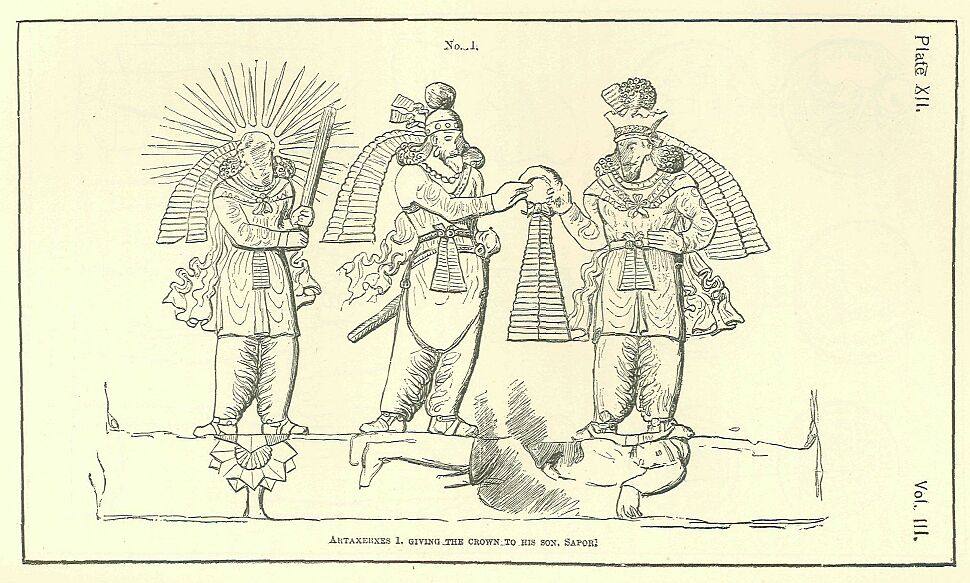
The coins of Artaxerxes present five different types. [PLATE XI., Fig. 1.] In the earliest his effigy appears on the obverse, front-faced, with the simple legend AETaHsnaTE (Artaxerxes), or sometimes with the longer one, BaGi ARTaiiSHaTR MaLKA, "Divine Artaxerxes, King;" while the reverse bears the profile of his father, Papak, looking to the left, with the legend BaGi PAPaKi MaLKA, "Divine Papak, King;" or BaBl BaGi PAPaKi MaLKA, "Son of Divine Papak, King." Both heads wear the ordinary Parthian diadem and tiara; and the head of Artaxerxes much resembles that of Volagases V., one of the later Parthian kings. The coins of the next period have a head on one side only. This is in profile, looking to the right, and bears a highly ornamental tiara, exactly like that of Mithridates I. of Parthia, the great conqueror. It is usually accompanied by the legend MaZDiSN BaGi ARTaHSHaTR MaLKA (or MaLKAN MaLKA) aiean, i.e. "The Ormazd-worshipping Divine Artaxerxes, King of Iran," or "King of the Kings of Iran." The reverse of these coins bears a fire-altar, with the legend ARTaHSHaTR nuvazi, a phrase of doubtful import. In the third period, while the reverse remains unchanged, on the obverse the Parthian costume is entirely given up; and the king takes, instead of the Parthian tiara, a low cap surmounted by the inflated ball, which thenceforth becomes the almost universal badge of a Sassanian monarch. The legend is now longer, being commonly MaZDiSN BaGi ARTaiisi-iaTR MaLKAN MaLKA airanMiNUCHiTRi iniN YazDAN, or "The Ormazd-worshipping Divine Artaxerxes, King of the Kings of Iran, heaven-descended of (the race of) the Gods." The fourth period is marked by the assumption of the mural crown, which in the sculptures of Artaxerxes is given only to Ormazd, but which was afterwards adopted by Sapor I. and many later kings, in combination with the ball, as their usual head-dress. The legend on these coins remains as in the third period, and the reverse is likewise unchanged. Finally, there are a few coins of Artaxerxes, belonging to the very close of his reign, where he is represented with the tiara of the third period, looking to the right; while in front of him, and looking towards him, is another profile, that of a boy, in whom numismatists recognize his eldest son and successor, Sapor. [PLATE XV., Fig. 1].
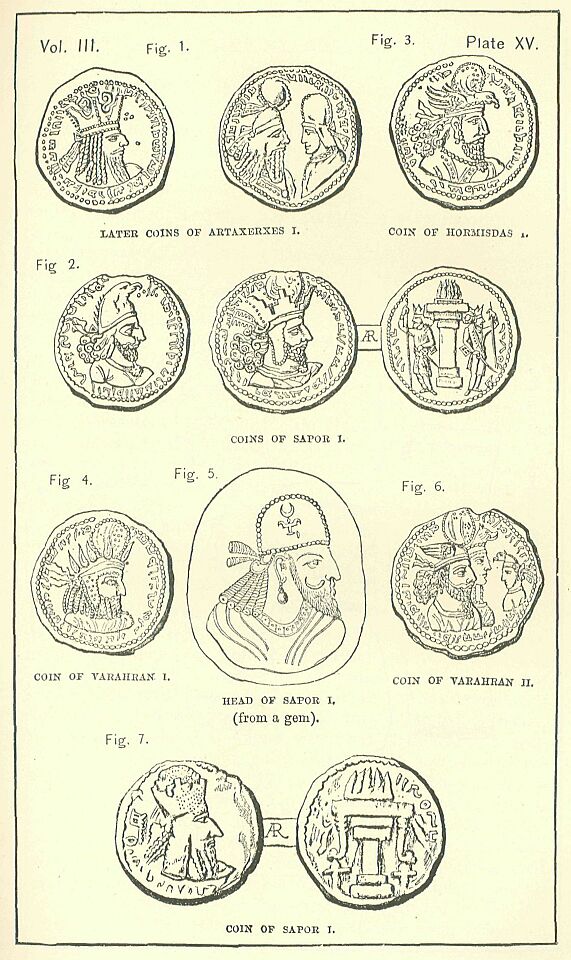
It is remarkable that with the accession of Artaxerxes there is at once a revival of art. Art had sunk under the Parthians, despite their Grecian leanings, to the lowest ebb which it had known in Western Asia since the accession of Asshur-izir-pal to the throne of Assyria (B.C. 886). Parthian attempts at art were few and far between, and when made were unhappy, not to say ridiculous. The coins of Artaxerxes, compared with those of the later Parthian monarchs, show at once a renaissance. The head is well cut; the features have individuality and expression; the epigraph is sufficiently legible. Still more is his sculpture calculated to surprise us. Artaxerxes represents himself as receiving the Persian diadem from the hands of Ormazd; both he and the god are mounted upon chargers of a stout breed, which are spiritedly portrayed; Artabanus lies prostrate under the feet of the king's steed, while under those of the deity's we observe the form of Ahriman, also prostrate, and indeed seemingly dead. Though the tablet has not really any great artistic merit, it is far better than anything that remains to us of the Parthians; it has energy and vigor; the physiognomies are carefully rendered; and the only flagrant fault is a certain over-robustness in the figures, which has an effect that is not altogether pleasing. Still, we cannot but see in the new Persian art—even at its very beginning—a movement towards life after a long period of stagnation; an evidence of that general stir of mind which the downfall of Tartar oppression rendered possible; a token that Aryan intelligence was beginning to recover and reassert itself in all the various fields in which it had formerly won its triumphs.
The coinage of Artaxerxes, and of the other Sassanian monarchs, is based, in part upon Roman, in part upon Parthian, models. The Roman aureus furnishes the type which is reproduced in the Sassanian gold coins, while the silver coins follow the standard long established in Western Asia, first under the Seleucid, and then under the Arsacid princes. This standard is based upon the Attic drachm, which was adopted by Alexander as the basis of his monetary system. The curious occurrence of a completely different standard for gold and silver in Persia during this period is accounted for by the circumstances of the time at which the coinage took its rise. The Arsacidae had employed no gold coins, but had been content with a silver currency; any gold coin that may have been in use among their subjects for purposes of trade during the continuance of their empire must have been foreign money—Roman, Bactrian, or Indian; but the quantity had probably for the most part been very small. But, about ten years before the accession of Artaxerxes there had been a sudden influx into Western Asia of Roman gold, in consequence of the terms of the treaty concluded between Artabanus and Macrinus (A.D. 217), whereby Rome undertook to pay to Parthia an indemnity of above a million and a half of our money. It is probable that the payment was mostly made in aurei. Artaxerxes thus found current in the countries, which he overran and formed into an empire, two coinages—a gold and a silver—coming from different sources and possessing no common measure. It was simpler and easier to retain what existed, and what had sufficiently adjusted itself through the working of commercial needs, than to invent something new; and hence the anomalous character of the New Persian monetary system.
The remarkable bas-relief of Artaxerxes described above and figured below in the chapter on the Art of the Sassanians, is accompanied by a bilingual inscription, or perhaps we should say by two bilingual inscriptions, which possess much antiquarian and some historic interest. The longer of the two runs as follows:—"Pathkar zani mazdisn bagi Artahshatr, malkan malka Airan, minuchitri min Ydztan, bari bagi Pap-aki malka;" while the Greek version of it is—
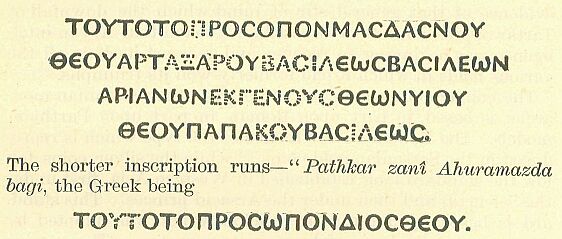
The inscriptions are interesting, first, as proving the continued use of the Greek character and language by a dynasty that was intensely national and that wished to drive the Greeks out of Asia. Secondly, they are interesting as showing the character of the native language, and letters, employed by the Persians, when they came suddenly into notice as the ruling people of Western Asia. Thirdly, they have an historic interest in what they tell us of the relationship of Artaxerxes to Babek (Papak), of the rank of Babek, and of the religious sympathies of the Sassanians. In this last respect they do indeed, in themselves, little but confirm the evidence of the coins and the general voice of antiquity on the subject. Coupled, however, with the reliefs to which they are appended, they do more. They prove to us that the Persians of the earliest Sassanian times were not averse to exhibiting the great personages of their theology in sculptured forms; nay, they reveal to us the actual forms then considered appropriate to Ahura-Mazda (Ormazd) and Angro-Mainyus (Ahriman); for we can scarcely be mistaken in regarding the prostrate figure under the hoofs of Ahura-Mazda's steed as the antagonist Spirit of Evil. Finally, the inscriptions show that, from the commencement of their sovereignty, the Sassanian princes claimed for themselves a qualified divinity, assuming the title of BAG and ALHA, "god," and taking, in the Greek version of their legends, the correspondent epithet of OEOE
Death of Artaxerxes I. and Accession of Sapor I. War of Sapor with Manizen. His first War with Rome. Invasion of Mesopotamia, A.D. 241. Occupation of Antioch. Expedition of Gordian to the East. Recovery by Rome of her lost Territory. Peace made between Rome and Persia. Obscure Interval. Second War with Rome. Mesopotamia again invaded, A.D. 258. Valerian takes the Command in the East. Struggle between him and Sapor. Defeat and Capture of Valerian, A.D. 260. Sapor invests Miriades with the Purple. He takes Syria and Southern Cappadocia, but is shortly afterwards attacked by Odenathus. Successes of Odenathus. Treatment of Valerian. Further successes of Odenathus. Period of Tranquillity. Great Works of Sapor. His Scriptures. His Dyke. His Inscriptions. His Coins. His Religion. Religious Condition of the East in his Time. Rise into Notice of Mani. His Rejection by Sapor. Sapor's Death. His Character.

Artaxerxes appears to have died in A.D. 240. He was succeeded by his son, Shahpuhri, or Sapor, the first Sassanian prince of that name. According to the Persian historians, the mother of Sapor was a daughter of the last Parthian king, Artabanus, whom Artaxerxes had taken to wife after his conquest of her father. But the facts known of Sapor throw doubt on this story, which has too many parallels in Oriental romance to claim implicit credence. Nothing authentic has come down to us respecting Sapor during his father's lifetime; but from the moment that he mounted the throne, we find him engaged in a series of wars, which show him to have been of a most active and energetic character. Armenia, which Artaxerxes had subjected, attempted (it would seem) to regain its independence at the commencement of the new reign; but Sapor easily crushed the nascent insurrection, and the Armenians made no further effort to free themselves till several years after his death. Contemporaneously with this revolt in the mountain region of the north, a danger showed itself in the plain country of the south, where Manizen, king of Hatra, or El Hadhr, not only declared himself independent, but assumed dominion over the entire tract between the Euphrates and the Tigris, the Jezireh of the Arabian geographers. The strength of Hatra was great, as had been proved by Trajan and Severus; its thick walls and valiant inhabitants would probably have defied every attempt of the Persian prince to make himself master of it by force. He therefore condescended to stratagem. Manizen had a daughter who cherished ambitious views. On obtaining a promise from Sapor that if she gave Hatra into his power he would make her his queen, this unnatural child turned against her father, betrayed him into Sapor's hands, and thus brought the war to an end. Sapor recovered his lost territory; but he did not fulfil his bargain. Instead of marrying the traitress, he handed her over to an executioner, to receive the death that she had deserved, though scarcely at his hands. Encouraged by his success in these two lesser contests, Sapor resolved (apparently in A.D. 241) to resume the bold projects of his father, and engage in a great war with Rome. The confusion and troubles which afflicted the Roman Empire at this time were such as might well give him hopes of obtaining a decided advantage. Alexander, his father's adversary, had been murdered in A.D. 235 by Maximin, who from the condition of a Thracian peasant had risen into the higher ranks of the army. The upstart had ruled like the savage that he was; and, after three years of misery, the whole Roman world had risen against him. Two emperors had been proclaimed in Africa; on their fall, two others had been elected by the Senate; a third, a mere boy, had been added at the demand of the Roman populace. All the pretenders except the last had met with violent deaths; and, after the shocks of a year unparalleled since A.D. 69, the administration of the greatest kingdom in the world was in the hands of a youth of fifteen. Sapor, no doubt, thought he saw in this condition of things an opportunity that he ought not to miss, and rapidly matured his plans lest the favorable moment should pass away.
Crossing the middle Tigris into Mesopotamia, the bands of Sapor first attacked the important city of Nisibis. Nisibis, at this time a Roman colony, was strongly situated on the outskirts of the mountain range which traverses Northern Mesopotamia between the 37th and 38th parallels. The place was well fortified and well defended; it offered a prolonged resistance; but at last the Avails were breached, and it was forced to yield itself. The advance was then made along the southern flank of the mountains, by Carrhae (Harran) and Edessa to the Euphrates, which was probably reached in the neighborhood of Birehjik, The hordes then poured into Syria, and, spreading themselves over that fertile region, surprised and took the metropolis of the Roman East, the rich and luxurious city of Antioch. But meantime the Romans had shown a spirit which had not been expected from them. Gordian, young as he was, had quitted Rome and marched through Mossia and Thrace into Asia, accompanied by a formidable army, and by at least one good general. Timesitheus, whose daughter Gordian had recently married, though his life had hitherto been that of a civilian, exhibited, on his elevation to the dignity of Praetorian prefect, considerable military ability. The army, nominally commanded by Gordian, really acted under his orders. With it Timesitheus attacked and beat the bands of Sapor in a number of engagements, recovered Antioch, crossed the Euphrates, retook Carrhae, defeated the Persian monarch in a pitched battle near Resaina (Ras-el-Ain), recovered Nisibis, and once more planted the Roman standards on the banks of the Tigris. Sapor hastily evacuated most of his conquests, and retired first across the Euphrates and then across the more eastern river; while the Romans advanced as he retreated, placed garrisons in the various Mesopotamian towns, and even threatened the great city of Ctesiphon. Gordian was confident that his general would gain further triumphs, and wrote to the Senate to that effect; but either disease or the arts of a rival cut short the career of the victor, and from the time of his death the Romans ceased to be successful. The legions had, it would seem, invaded Southern Mesopotamia when the Praetorian prefect who had succeeded Timesitheus brought them intentionally into difficulties by his mismanagement of the commissariat; and at last retreat was determined on. The young emperor was approaching the Khabour, and had almost reached his own frontier, when the discontent of the army, fomented by the prefect, Philip, came to a head. Gordian was murdered at a place called Zaitha, about twenty miles south of Circesium, and was buried where he fell, the soldiers raising a tumulus in his honor. His successor, Philip, was glad to make peace on any tolerable terms with the Persians; he felt himself insecure upon his throne, and was anxious to obtain the Senate's sanction of his usurpation. He therefore quitted the East in A.D. 244, having concluded a treaty with Sapor, by which Armenia seems to have been left to the Persians, while Mesopotamia returned to its old condition of a Roman province.
The peace made between Philip and Sapor was followed by an interval of fourteen years, during which scarcely anything is known of the condition of Persia. We may suspect that troubles in the north-east of his empire occupied Sapor during this period, for at the end of it we find Bactria, which was certainly subject to Persia during the earlier years of the monarchy, occupying an independent position, and even assuming an attitude of hostility towards the Persian monarch. Bactria had, from a remote antiquity, claims to pre-eminence among the Aryan nations. She was more than once inclined to revolt from the Achaemenidae; and during the later Parthian period she had enjoyed a sort of semi-independence. It would seem that she now succeeded in detaching herself altogether from her southern neighbor, and becoming a distinct and separate power. To strengthen her position she entered into relations with Rome, which gladly welcomed any adhesions to her cause in this remote region.
Sapor's second war with Rome was, like his first, provoked by himself. After concluding his peace with Philip, he had seen the Roman world governed successively by six weak emperors, of whom four had died violent deaths, while at the same time there had been a continued series of attacks upon the northern frontiers of the empire by Alemanni, Goths, and Franks, who had ravaged at their will a number of the finest provinces, and threatened the absolute destruction of the great monarchy of the West. It was natural that the chief kingdom of Western Asia should note these events, and should seek to promote its own interests by taking advantage of the circumstances of the time. Sapor, in A.D. 258, determined on a fresh invasion of the Roman provinces, and, once more entering Mesopotamia, carried all before him, became master of Nisibis, Carrhae, and Edessa, and, crossing the Euphrates, surprised Antioch, which was wrapped in the enjoyment of theatrical and other representations, and only knew its fate on the exclamation of a couple of actors "that the Persians were in possession of the town." The aged emperor, Valerian, hastened to the protection of his more eastern territories, and at first gained some successes, retaking Antioch, and making that city his headquarters during his stay in the East. But, after this, the tide turned. Valerian entrusted the whole conduct of the war to Macrianus, his Praetorian prefect, whose talents he admired, and of whose fidelity he did not entertain a suspicion. Macrianus, however, aspired to the empire, and intentionally brought Valerian into difficulties, in the hope of disgracing or removing him. His tactics were successful. The Roman army in Mesopotamia was betrayed into a situation whence escape was impossible, and where its capitulation was only a question of time. A bold attempt' made to force a way through the enemy's lines failed utterly, after which famine and pestilence began to do their work. In vain did the aged emperor send envoys to propose a peace, and offer to purchase escape by the payment of an immense sum in gold. Sapor, confident of victory, refused the overture, and, waiting patiently till his adversary was at the last gasp, invited him to a conference, and then treacherously seized his person. The army surrendered or dispersed. Macrianus, the Praetorian prefect, shortly assumed the title of emperor, and marched against Gallienus, the son and colleague of Valerian, who had been left to direct affairs in the West. But another rival started up in the East. Sapor conceived the idea of complicating the Roman affairs by himself putting forward a pretender; and an obscure citizen of Antioch, a certain Miriades or Cyriades, a refugee in his camp, was invested with the purple, and assumed the title of Caesar. [PLATE. XIII.]
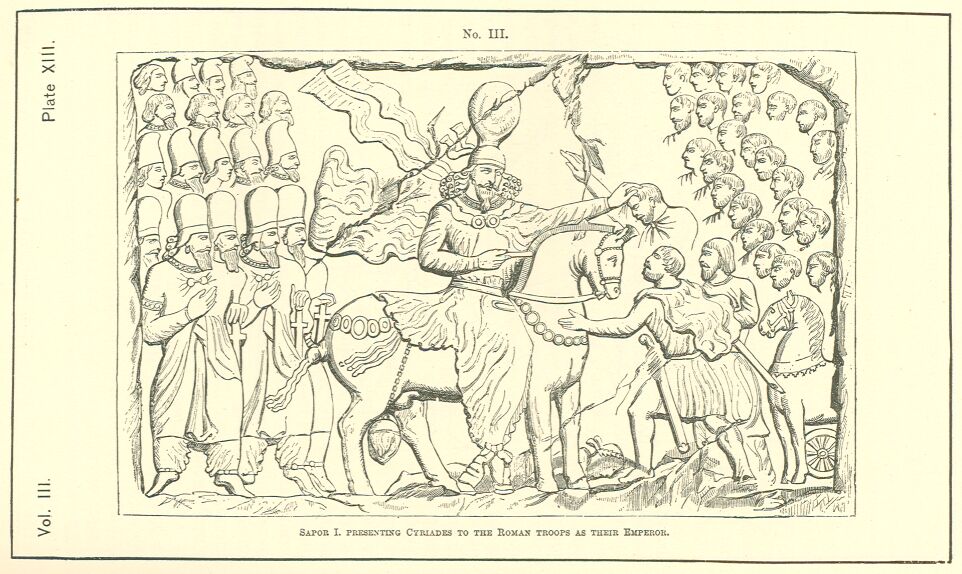
The blow struck at Edessa laid the whole of Roman Asia open to attack, and the Persian monarch was not slow to seize the occasion. His troops crossed the Euphrates in force, and, marching on Antioch, once more captured that unfortunate town, from which the more prudent citizens had withdrawn, but where the bulk of the people, not displeased at the turn of affairs, remained and welcomed the conqueror. Miriades was installed in power, while Sapor himself, at the head of his irresistible squadrons, pressed forward, bursting "like a mountain torrent" into Cilicia and thence into Cappadocia. Tarsus, the birthplace of St. Paul, at once a famous seat of learning and a great emporium of commerce, fell; Cilicia Campestris was overrun; and the passes of Taurus, deserted or weakly defended by the Romans, came into Sapor's hands. Penetrating through them and entering the champaign country beyond, his bands soon formed the siege of Caesarea Mazaca, the greatest city of these parts, estimated, at this time to have contained a population of four hundred thousand souls. Demosthenes, the governor of Caesarea, defended it bravely, and, had force only been used against him, might have prevailed; but Sapor found friends within the walls, and by their help made himself master of the place, while its bold defender was obliged to content himself with escaping by cutting his way through the victorious host. All Asia Minor now seemed open to the conqueror; and it is difficult to understand why he did not at any rate attempt a permanent occupation of the territory which he had so easily overrun. But it seems certain that he entertained no such idea. Devastation and plunder, revenge and gain, not permanent conquest, were his objects; and hence his course was everywhere marked by ruin and carnage, by smoking towns, ravaged fields, and heaps of slain. His cruelties have no doubt been exaggerated; but when we hear that he filled the ravines and valleys of Cappadocia with dead bodies, and so led his cavalry across them; that he depopulated Antioch, killing or carrying off into slavery almost the whole population; that he suffered his prisoners in many cases to perish of hunger, and that he drove them to water once a day like beasts, we may be sure that the guise in which he showed himself to the Romans was that of a merciless scourge—an avenger bent on spreading the terror of his name—not of one who really sought to enlarge the limits of his empire.
During the whole course of this plundering expedition, until the retreat began, we hear but of one check that the bands of Sapor received. It had been determined to attack Emesa (now Hems), one of the most important of the Syrian towns, where the temple of Venus was known to contain a vast treasure. The invaders approached, scarcely expecting to be resisted; but the high priest of the temple, having collected a large body of peasants, appeared, in his sacerdotal robes, at the head of a fanatic multitude armed with slings, and succeeded in beating off the assailants. Emesa, its temple, and its treasure, escaped the rapacity of the Persians; and an example of resistance was set, which was not perhaps without important consequences.
For it seems certain that the return of Sapor across the Euphrates was not effected without considerable loss and difficulty. On his advance into Syria he had received an embassy from a certain Odenathus, a Syrian or Arab chief, who occupied a position of semi-independence at Palmyra, which, through the advantages of its situation, had lately become a flourishing commercial town. Odenathus sent a long train of camels laden with gifts, consisting in part of rare and precious merchandise, to the Persian monarch, begging him to accept them, and claiming his favorable regard on the ground that he had hitherto refrained from all acts of hostility against the Persians. It appears that Sapor took offence at the tone of the communication, which was not sufficiently humble to please him. Tearing the letter to fragments and trampling it beneath his feet, he exclaimed—"Who is this Odenathus, and of what country, that he ventures thus to address his lord? Let him now, if he would lighten his punishment, come here and fall prostrate before me with his hands tied behind his back. Should he refuse, let him be well assured that I will destroy himself, his race, and his land." At the same time he ordered his servants to cast the costly presents of the Palmyrene prince into the Euphrates.
This arrogant and offensive behavior naturally turned the willing friend into an enemy. Odenathus, finding himself forced into a hostile position, took arms and watched his opportunity. So long as Sapor continued to advance, he kept aloof. As soon, however, as the retreat commenced, and the Persian army, encumbered with its spoil and captives, proceeded to make its way back slowly and painfully to the Euphrates, Odenathus, who had collected a large force, in part from the Syrian villages, in part from the wild tribes of Arabia, made his appearance in the field. His light and agile horsemen hovered about the Persian host, cut off their stragglers, made prize of much of their spoil, and even captured a portion of the seraglio of the Great King. The harassed troops were glad when they had placed the Euphrates between themselves and their pursuer, and congratulated each other on their escape. So much had they suffered, and so little did they feel equal to further conflicts, that on their march through Mesopotamia they consented to purchase the neutrality of the people of Edessa by making over to them all the coined money that they had carried off in their Syrian raid. After this it would seem that the retreat was unmolested, and Sapor succeeded in conveying the greater part of his army, together with his illustrious prisoner, to his own country.
With regard to the treatment that Valerian received at the hands of his conqueror, it is difficult to form a decided opinion. The writers nearest to the time speak vaguely and moderately, merely telling us that he grew old in his captivity, and was kept in the condition of a slave. It is reserved for authors of the next generation to inform us that he was exposed to the constant gaze of the multitude, fettered, but clad in the imperial purple; and that Sapor, whenever he mounted on horseback, placed his foot upon his prisoner's neck. Some add that, when the unhappy captive died, about the year A.D. 265 or 266, his body was flayed, and the skin inflated and hung up to view in one of the most frequented temples of Persia, where it was seen by Roman envoys on their visits to the Great King's court.
It is impossible to deny that Oriental barbarism may conceivably have gone to these lengths; and it is in favor of the truth of the details that Roman vanity would naturally have been opposed to their invention. But, on the other hand, we have to remember that in the East the person of a king is generally regarded as sacred, and that self-interest restrains the conquering monarch from dishonoring one of his own class. We have also to give due weight to the fact that the earlier authorities are silent with respect to any such atrocities and that they are first related half a century after the time when they are said to have occurred. Under these circumstances the scepticism of Gibbon with respect to them is perhaps more worthy of commendation than the ready faith of a recent French writer.
It may be added that Oriental monarchs, when they are cruel, do not show themselves ashamed of their cruelties, but usually relate them openly in their inscriptions, or represent them in their bas-reliefs. The remains ascribed on good grounds to Sapor do not, however, contain anything confirmatory of the stories which we are considering. Valerian is represented on them in a humble attitude, but not fettered, and never in the posture of extreme degradation commonly associated with his name. He bends his knee, as no doubt he would be required to do, on being brought into the Great King's presence; but otherwise he does not appear to be subjected to any indignity. It seems thus to be on the whole most probable that the Roman emperor was not more severely treated than the generalty of captive princes, and that Sapor has been unjustly taxed with abusing the rights of conquest.
The hostile feeling of Odenathus against Sapor did not cease with the retreat of the latter across the Euphrates. The Palmyrene prince was bent on taking advantage of the general confusion of the times to carve out for himself a considerable kingdom, of which Palmyra should be the capital. Syria and Palestine on the one hand, Mesopotamia on the other, were the provinces that lay most conveniently near to him, and that he especially coveted. But Mesopotamia had remained in the possession of the Persians as the prize of their victory over Valerian, and could only be obtained by wresting it from the hands into which it had fallen. Odenathus did not shrink from this contest. It had been with some reason conjectured that Sapor must have been at this time occupied with troubles which had broken out on the eastern side of his empire. At any rate, it appears that Odenathus, after a short contest with Macriarius and his son, Quietus, turned his arms once more, about A.D. 263, against the Persians, crossed the Euphrates into Mesopotamia, took Oarrhee and Nisibis, defeated Sapor and some of his sons in a battle, and drove the entire Persian host in confusion to the gates of Ctesiphon. He even ventured to form the siege of that city; but it was not long before effectual relief arrived; from all the provinces flocked in contingents for the defence of the Western capital; several engagements were fought, in some of which Odenathus was defeated; and at last he found himself involved in difficulties through his ignorance of the localities, and so thought it best to retire. Apparently his retreat was undisturbed; he succeeded in carrying off his booty and his prisoners, among whom were several satraps, and he retained possession of Mesopotamia, which continued to form a part of the Palmyrene kingdom until the capture of Zenobia by Aurelian (A.D. 273).
The successes of Odenathus in A.D. 263 were followed by a period of comparative tranquillity. That ambitious prince seems to have been content with ruling from the Tigris to the Mediterranean, and with the titles of "Augustus," which he received from the Roman emperor, Gallienus, and "king of kings," which he assumed upon his coins. He did not press further upon Sapor; nor did the Roman emperor make any serious attempt to recover his father's person or revenge his defeat upon the Persians. An expedition which he sent out to the East, professedly with this object, in the year A.D. 267, failed utterly, its commander, Heraclianus, being completely defeated by Zenobia, the widow and successor of Odenathus. Odenathus himself was murdered by a kinsman three or four years after his great successes; and, though Zenobia ruled his kingdom almost with a man's vigor, the removal of his powerful adversary must have been felt as a relief by the Persian monarch. It is evident, too, that from the time of the accession of Zenobia, the relations between Rome and Palmyra had become unfriendly; the old empire grew jealous of the new kingdom which had sprung up upon its borders; and the effect of this jealousy, while it lasted, was to secure Persia from any attack on the part of either.
It appears that Sapor, relieved from any further necessity of defending his empire in arms, employed the remaining years of his life in the construction of great works, and especially in the erection and ornamentation of a new capital. The ruins of Shahpur, which still exist near Kazerun, in the province of Fars, commemorate the name, and afford some indication of the grandeur, of the second Persian monarch. Besides remains of buildings, they comprise a number of bas-reliefs and rock inscriptions, some of which were beyond a doubt set up by Sapor I. In one of the most remarkable the Persian monarch is represented on horseback, wearing the crown usual upon his coins, and holding by the hand a tunicked figure, probably Miriades, whom he is presenting to the captured Romans as their sovereign. Foremost to do him homage is the kneeling figure of a chieftain, probably Valerian, behind whom are arranged in a double line seventeen persons, representing apparently the different corps of the Roman army. [PLATE XIV.] All these persons are on foot, while in contrast with them are arranged behind Sapor ten guards on horseback, who represent his irresistible cavalry. Another bas-relief at the same place gives us a general view of the triumph of Sapor on his return to Persia with his illustrious prisoner. Here fifty-seven guards are ranged behind him, while in front are thirty-three tribute-bearers, having with them an elephant and a chariot. In the centre is a group of seven figures, comprising Sapor, who is on horseback in his usual costume; Valerian, who is under the horse's feet; Miriades, who stands by Sapor's side; three principal tribute-bearers in front of the main figure; and a Victory which floats in the sky.
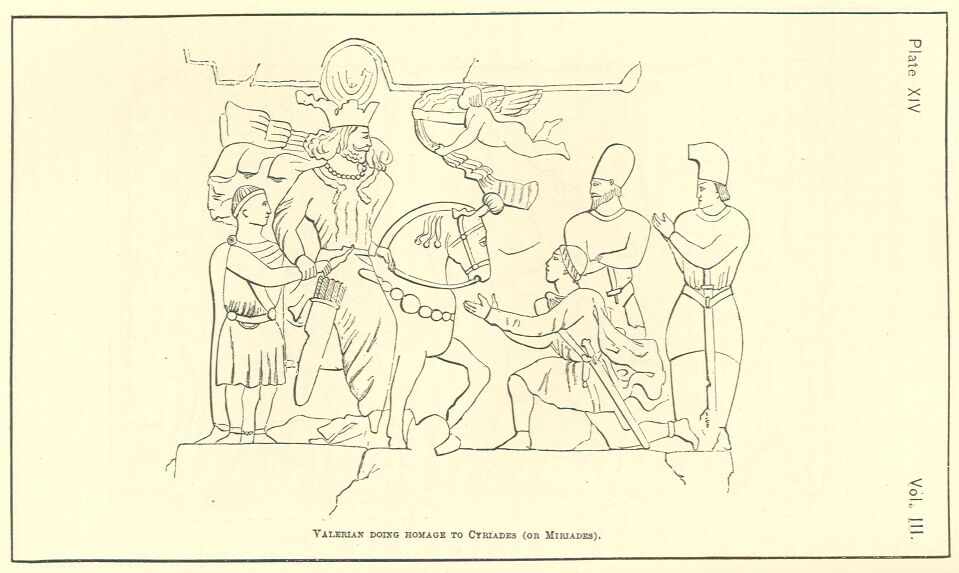
Another important work, assigned by tradition to Sapor I., is the great dyke at Shuster. This is a dam across the river Karun, formed of cut stones, cemented by lime, and fastened together by clamps of iron; it is twenty feet broad, and no less than twelve hundred feet in length. The whole is a solid mass excepting in the centre, where two small arches have been constructed for the purpose of allowing a part of the stream to flow in its natural bed. The greater portion of the water is directed eastward into a canal cut for it; and the town of Shuster is thus defended on both sides by a water barrier, whereby the position becomes one of great strength. Tradition says that Sapor used his power over Valerian to obtain Roman engineers for this work; and the great dam is still known as the Bund-i-Kaisar, or "dam of Caesar," to the inhabitants of the neighboring country.
Besides his works at Shahpur and Shuster, Sapor set up memorials of himself at Haji-abad, Nakhsh-i-Rajab, and Nakhsh-i-Rustam, near Persepolis, at Darabgerd in South-eastern Persia, and elsewhere; most of which still exist and have been described by various travellers. At Nakhsh-i-Rustam Valerian is seen making his submission in one tablet, while another exhibits the glories of Sapor's court. The sculptures are in some instances accompanied by inscriptions. One of these is, like those of Artaxerxes, bilingual, Greek and Persian. The Greek inscription runs as follows:

In the main, Sapor, it will be seen, follows the phrases of his father Artaxerxes; but he claims a wider dominion. Artaxerxes is content to rule over Ariana (or Iran) only; his son calls himself lord both of the Arians and the non-Arians, or of Iran and Turan. We may conclude from this as probable that he held some Scythic tribes under his sway, probably in Segestan, or Seistan, the country south and east of the Hamoon, or lake in which the Helmend is swallowed up. Scythians had been settled in these parts, and in portions of Afghanistan and India, since the great invasion of the Yue-chi, about B.C. 200; and it is not unlikely that some of them may have passed under the Persian rule during the reign of Sapor, but we have no particulars of these conquests.
Sapor's coins resemble those of Artaxerxes in general type, but may be distinguished from them, first, by the head-dress, which is either a cap terminating in the head of an eagle, or else a mural crown surmounted by an inflated ball; and, secondly, by the emblem on the reverse, which is almost always a fire-altar between two supporters [PLATE XV., Fig. 2.] The ordinary legend on the coins is "Mazdisn bag Shahpuhri, malkan malka Airan, minuchitri minyazdan," on the obverse; and on the reverse "Shahpuhri nuvazi."
It appears from these legends, and from the inscription above given, that Sapor was, like his father, a zealous Zoroastrian. His faith was exposed to considerable trial. Never was there a time of greater religious ferment in the East, or a crisis which more shook men's belief in ancestral creeds. The absurd idolatry which had generally prevailed through Western Asia for two thousand years—a nature-worship which gave the sanction of religion to the gratification of men's lowest propensities—was shaken to its foundation; and everywhere men were striving after something higher, nobler, and truer than had satisfied previous generations for twenty centuries. The sudden revivification of Zoroastrianism, after it had been depressed and almost forgotten for five hundred years, was one result of this stir of men's minds. Another result was the rapid progress of Christianity, which in the course of the third century overspread large portions of the East, rooting itself with great firmness in Armenia, and obtaining a hold to some extent on Babylonia, Bactria, and perhaps even on India. Judaism, also, which had long had a footing in Mesopotamia, and which after the time of Hadrian may be regarded as having its headquarters at Babylon—Judaism itself, usually so immovable, at this time showed signs of life and change, taking something like a new form in the schools wherein was compiled the vast and strange work known as "the Babylonian Talmud."
Amid the strife and jar of so many conflicting systems, each having a root in the past, and each able to appeal with more or less of force to noble examples of virtue and constancy among its professors in the present, we cannot be surprised that in some minds the idea grew up that, while all the systems possessed some truth, no one of them was perfect or indeed much superior to its fellows. Eclectic or syncretic views are always congenial to some intellects; and in times when religious thought is deeply stirred, and antagonistic creeds are brought into direct collision, the amiable feeling of a desire for peace comes in to strengthen the inclination for reconciling opponents by means of a fusion, and producing harmony by a happy combination of discords. It was in Persia, and in the reign of Sapor, that one of the most remarkable of these well-meaning attempts at fusion and reconciliation that the whole of history can show was made, and with results which ought to be a lasting warning to the apostles of comprehension. A certain Mani (or Manes, as the ecclesiastical writers call him), born in Persia about A.D. 240, grew to manhood under Sapor, exposed to the various religious influences of which we have spoken. With a mind free from prejudice and open to conviction, he studied the various systems of belief which he found established in Western Asia—the Cabalism of the Babylonian Jews, the Dualism of the Magi, the mysterious doctrines of the Christians, and even the Buddhism of India. At first he inclined to Christianity, and is said to have been admitted to priest's orders and to have ministered to a congregation; but after a time he thought that he saw his way to the formation of a new creed, which should combine all that was best in the religious systems which he was acquainted with, and omit what was superfluous or objectionable. He adopted the Dualism of the Zoroastrians, the metempsychosis of India, the angelism and demonism of the Talmud, and the Trinitarianism of the Gospel of Christ. Christ himself he identified with Mithra, and gave Him his dwelling in the sun. He assumed to be the Paraclete promised by Christ, who should guide men into all truth, and claimed that his "Ertang," a sacred book illustrated by pictures of his own painting, should supersede the New Testament. Such pretensions were not likely to be tolerated by the Christian community; and Manes had not put them forward very long when he was expelled from the church and forced to carry his teaching elsewhere. Under these circumstances he is said to have addressed himself to Sapor, who was at first inclined to show him some favor; but when he found out what the doctrines of the new teacher actually were, his feelings underwent a change, and Manes, proscribed, or at any rate threatened with penalties, had to retire into a foreign country.
The Zoroastrian faith was thus maintained in its purity by the Persian monarch, who did not allow himself to be imposed upon by the specious eloquence of the new teacher, but ultimately rejected the strange amalgamation that was offered to his acceptance. It is scarcely to be regretted that he so determined. Though the morality of the Manichees was pure, and though their religion is regarded by some as a sort of Christianity, there were but few points in which it was an improvement on Zoroastrianism. Its Dualism was pronounced and decided; its Trinitarianism was questionable; its teaching with respect to Christ destroyed the doctrines of the incarnation and atonement; its "Ertang " was a poor substitute for Holy Scripture. Even its morality, being deeply penetrated with asceticism, was of a wrong type and inferior to that preached by Zoroaster. Had the creed of Manes been accepted by the Persian monarch, the progress of real Christianity in the East would, it is probable, have been impeded rather than forwarded—the general currency of the debased amalgam would have checked the introduction of the pure metal.
It must have been shortly after his rejection of the teaching of Manes that Sapor died, having reigned thirty-one years, from A.D. 240 to A.D. 271. He was undoubtedly one of the most remarkable princes of the Sassanian series. In military talent, indeed, he may not have equalled his father; for though he defeated Valerian, he had to confess himself inferior to Odenathus. But in general governmental ability he is among the foremost of the Neo-Persian monarchs, and may compare favorably with almost any prince of the series. He baffled Odenathus, when he was not able to defeat him, by placing himself behind walls, and by bringing into play those advantages which naturally belonged to the position of a monarch attacked in his own country. He maintained, if he did not permanently advance, the power of Persia in the west; while in the east it is probable that he considerably extended the bounds of his dominion. In the internal administration of his empire he united works of usefulness with the construction of memorial which had only a sentimental and aesthetic value. He was a liberal patron of art, and is thought not to have confined his patronage to the encouragement of native talent. On the subject of religion he did not suffer himself to be permanently led away by the enthusiasm of a young and bold freethinker. He decided to maintain the religious system that had descended to him from his ancestors, and turned a deaf ear to persuasions that would have led him to revolutionize the religious opinion of the East without placing it upon a satisfactory footing. The Orientals add to these commendable features of character, that he was a man of remarkable beauty, of great personal courage, and of a noble and princely liberality. According to them, "he only desired wealth that he might use it for good and great purposes."
Short Reign of Hormisdas I. His dealings with Manes. Accession of Varahran I. He puts Manes to Death. Persecutes the Manichaeans and the Christians. His Relations with Zenobia. He is threatened by Aurelian. His Death. Reign of Varahran II. His Tyrannical Conduct. His Conquest of Seistan, and War with India. His war with the Roman Emperors Cams and Diocletian. His Loss of Armenia. His Death. Short Reign of Varahran III.

The first and second kings of the Neo-Persian Empire were men of mark and renown. Their successors for several generations were, comparatively speaking, feeble and insignificant. The first burst of vigor and freshness which commonly attends the advent to power of a new race in the East, or the recovery of its former position by an old one, had passed away, and was succeeded, as so often happens, by reaction and exhaustion, the monarchs becoming luxurious and inert, while the people willingly acquiesced in a policy of which the principle was "Rest and be thankful." It helped to keep matters in this quiescent state, that the kings who ruled during this period had, in almost every instance, short reigns, four monarchs coming to the throne and dying within the space of a little more than twenty-one years. The first of these four was Hormisdates, Hormisdas, or Hormuz, the son of Sapor, who succeeded his father in A.D. 271. His reign lasted no more than a year and ten days, and was distinguished by only a single event of any importance. Mani, who had fled from Sapor, ventured to return to Persia on the accession of his son, and was received with respect and favor. Whether Hormisdas was inclined to accept his religious teaching or no, we are not told; but at any rate he treated him kindly, allowed him to propagate his doctrines, and even assigned him as his residence a castle named Arabion. From this place Mani proceeded to spread his views among the Christians of Mesopotamia, and in a short time succeeded in founding the sect which, under the name of Manichaeans or Manichaes, gave so much trouble to the Church for several centuries. Hormisdas, who, according to some founded the city of Ram-Hormuz in Eastern Persia, died in A.D.272, and was succeeded by his son or brother, Vararanes or Varahran. He left no inscriptions, and it is doubted whether we possess any of his coins.
Varahran I., whose reign lasted three years only, from A.D. 272 to 275, is declared by the native historians to have been a mild and amiable prince; but the little that is positively known of him does not bear out this testimony. It seems certain that he put Mani to death, and probable that he enticed him to leave the shelter of his castle by artifice, thus showing himself not only harsh but treacherous towards the unfortunate heresiarch. If it be true that he caused him to be flayed alive, we can scarcely exonerate him from the charge of actual cruelty, unless indeed we regard the punishment as an ordinary mode of execution in Persia. Perhaps, however, in this case, as in other similar ones, there is no sufficient evidence that the process of flaying took place until the culprit was dead, the real object of the excoriation being, not the infliction of pain, but the preservation of a memorial which could be used as a warning and a terror to others. The skin of Mani, stuffed with straw, was no doubt suspended for some time after his execution over one of the gates of the great city of Shahpur; and it is possible that this fact may have been the sole ground of the belief (which, it is to be remembered, was not universal) that he actually suffered death by flaying.
The death of the leader was followed by the persecution of his disciples. Mani had organized a hierarchy, consisting of twelve apostles, seventy-two bishops, and a numerous priesthood; and his sect was widely established at the time of his execution. Varahran handed over these unfortunates, or at any rate such of them as he was able to seize, to the tender mercies of the Magians, who put to death great numbers of Manichseans. Many Christians at the same time perished, either because they were confounded with the followers of Mani, or because the spirit of persecution, once let loose, could not be restrained, but passed on from victims of one class to those of another, the Magian priesthood seizing the opportunity of devoting all heretics to a common destruction.
Thus unhappy in his domestic administration, Varahran was not much more fortunate in his wars. Zenobia, the queen of the East, held for some time to the policy of her illustrious husband, maintaining a position inimical alike to Rome and Persia from the death of Odenathus in A.D. 267 to Aurelian's expedition against her in A.D. 272. When, however, in this year, Aurelian marched to attack her with the full forces of the empire, she recognized the necessity of calling to her aid other troops besides her own. It was at this time that she made overtures to the Persians, which were favorably received; and, in the year A.D. 273, Persian troops are mentioned among those with whom Aurelian contended in the vicinity of Palmyra. But the succors sent were inconsiderable, and were easily overpowered by the arts or arms of the emperor. The young king had not the courage to throw himself boldly into the war. He allowed Zenobia to be defeated and reduced to extremities without making anything like an earnest or determined effort to save her. He continued her ally, indeed, to the end, and probably offered her an asylum at his court, if she were compelled to quit her capital; but even this poor boon he was prevented from conferring by the capture of the unfortunate princess just as she reached the banks of the Euphrates.
In the aid which he lent Zenobia, Varahran, while he had done too little to affect in any degree the issue of the struggle, had done quite enough to provoke Rome and draw down upon him the vengeance of the Empire, It seems that he quite realized the position in which circumstances had placed him. Feeling that he had thrown out a challenge to Rome, and yet shrinking from the impending conflict, he sent an embassy to the conqueror, deprecating his anger and seeking to propitiate him by rare and costly gifts. Among these were a purple robe from Cashmere, or some other remote province of India, of so brilliant a hue that the ordinary purple of the imperial robes could not compare with it, and a chariot like to those in which the Persian monarch was himself wont to be carried. Aurelian accepted these gifts; and it would seem to follow that he condoned Varahran's conduct, and granted him terms of peace. Hence, in the triumph which Aurelian celebrated at Rome in the year A.D. 274, no Persian captives appeared in the procession, but Persian envoys were exhibited instead, who bore with them the presents wherewith their master had appeased the anger of the emperor.
A full year, however, had not elapsed from the time of the triumph when the master of the Roman world thought fit to change his policy, and, suddenly declaring war against the Persians, commenced his march towards the East. We are not told that he discovered, or even sought to discover, any fresh ground of complaint. His talents were best suited for employment in the field, and he regarded it as expedient to "exercise the restless temper of the legions in some foreign war." Thus it was desirable to find or make an enemy; and the Persians presented themselves as the foe which could be attacked most conveniently. There was no doubt a general desire to efface the memory of Valerian's disaster by some considerable success; and war with Persia was therefore likely to be popular at once with the Senate, with the army, and with the mixed multitude which was dignified with the title of "the Roman people."
Aurelian, therefore, set out for Persia at the head of a numerous, but still a manageable, force. He proceeded through Illyricum and Macedonia towards Byzantium, and had almost reached the straits, when a conspiracy, fomented by one of his secretaries, cut short his career, and saved the Persian empire from invasion. Aurelian was murdered in the spring of A.D. 275, at Coenophrurium, a small station between Heraclea (Perinthus) and Byzantium. The adversary with whom he had hoped to contend, Varahran, cannot have survived him long, since he died (of disease as it would seem) in the course of the year, leaving his crown to a young son who bore the same name with himself, and is known in history as Varahran the Second.
Varahran II. is said to have ruled at first tyrannically, and to have greatly disgusted all his principal nobles, who went so far as to form a conspiracy against him, and intended to put him to death. The chief of the Magians, however, interposed, and, having effectually alarmed the king, brought him to acknowledge himself wrong and to promise an entire change of conduct. The nobles upon this returned to their allegiance; and Varahran, during the remainder of his reign, is said to have been distinguished for wisdom and moderation, and to have rendered himself popular with every class of his subjects.
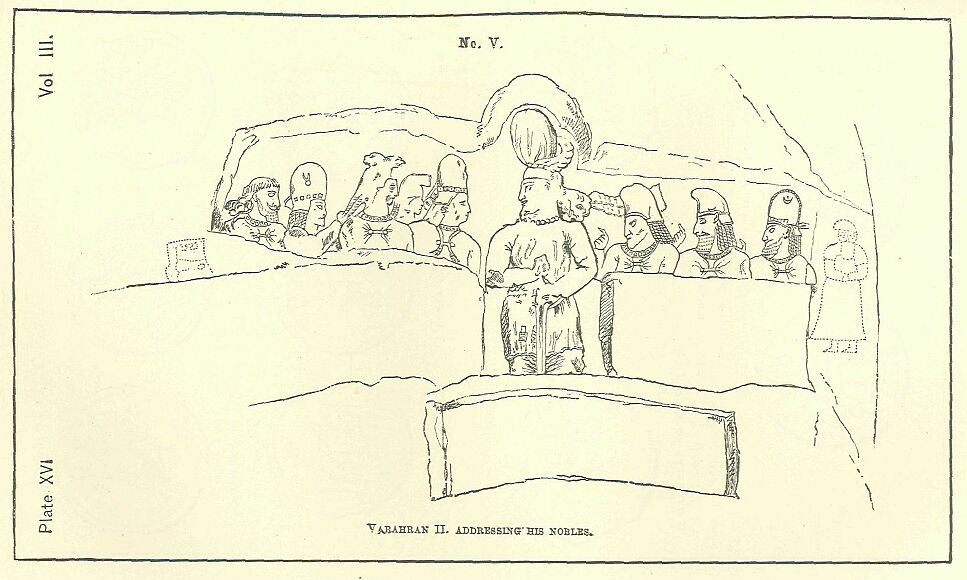
It appears that this prince was not without military ambition. He engaged in a war with the Segestani (or Sacastani), the inhabitants of Segestan or Seistan, a people of Scythic origin, and after a time reduced them to subjection [PLATE XVII]. He then became involved in a quarrel with some of the natives of Afghanistan, who were at this time regarded as "Indians." A long and desultory contest followed without definite result, which was not concluded by the year A.D. 283, when he found himself suddenly engaged in hostilities on the opposite side of the empire.
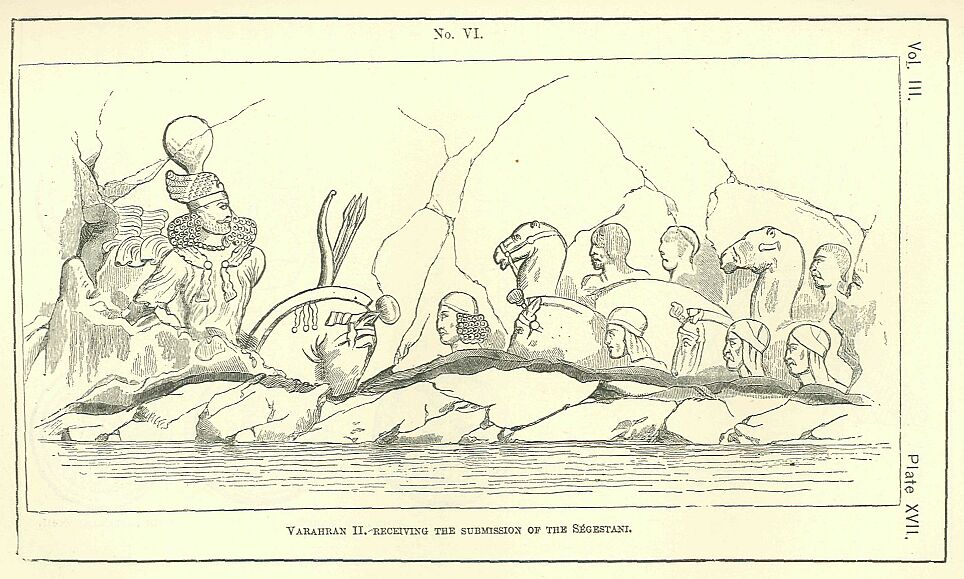
Rome, in the latter part of the third century, had experienced one of those reactions which mark her later history, and which alone enabled her to complete her predestined term of twelve centuries. Between the years A.D. 274 and 282, under Aurelian, Tacitus, Probus, and Carus, she showed herself once more very decidedly the first military power in the world, drove back the barbarians on all sides, and even ventured to indulge in an aggressive policy. Aurelian, as we have seen, was on the point of invading Persia when a domestic conspiracy brought his reign and life to an end. Tacitus, his successor, scarcely obtained such a firm hold upon the throne as to feel that he could with any prudence provoke a war. But Probus, the next emperor, revived the project of a Persian expedition, and would probably have led the Roman armies into Mesopotamia, had not his career been cut short by the revolt of the legions in Illyria (A.D. 282). Carus, who had been his praetorian prefect, and who became emperor at his death, adhered steadily to his policy. It was the first act of his reign to march the forces of the empire to the extreme east, and to commence in earnest the war which had so long been threatened. Led by the Emperor in person, the legions once more crossed the Euphrates.
Mesopotamia was rapidly overrun, since the Persians (we are told) were at variance among themselves, and a civil war was raging. The bulk of their forces, moreover, were engaged on the opposite side of the empire in a struggle with the Indians, probably those of Afghanistan. Under these circumstances, no effectual resistance was possible; and, if we may believe the Roman writers, not only was the Roman province of Mesopotamia recovered, but the entire tract between the rivers as far south as the latitude of Bagdad was ravaged, and even the two great cities of Seleucia and Ctesiphon were taken without the slightest difficulty. Persia Proper seemed to lie open to the invader, and Carus was preparing to penetrate still further to the east, when again an opportune death checked the progress of the Roman arms, and perhaps saved the Persian monarchy from destruction. Carus had announced his intention of continuing his march; some discontent had shown itself; and an oracle had been quoted which declared that a Roman emperor would never proceed victoriously beyond Ctesiphon, Carus was not convinced, but he fell sick, and his projects were delayed; he was still in his camp near Ctesiphon, when a terrible thunderstorm broke over the ground occupied by the Roman army. A weird darkness was spread around, amid which flash followed flash at brief intervals, and peal upon peal terrified the superstitious soldiery. Suddenly, after the most violent clap of all, the cry arose that the Emperor was dead. Some said that his tent had been struck by lightning, and that his death was owing to this cause; others believed that he had simply happened to succumb to his malady at the exact moment of the last thunder-clap; a third theory was that his attendants had taken advantage of the general confusion to assassinate him, and that he merely added another to the long list of Roman emperors murdered by those who hoped to profit by their removal. It is not likely that the problem of what really caused the death of Carus will ever be solved. That he died very late in A.D. 283, or within the first fortnight of A.D. 284, is certain; and it is no less certain that his death was most fortunate for Persia, since it brought the war to an end when it had reached a point at which any further reverses would have been disastrous, and gave the Persians a breathing-space during which they might, at least partially, recover from their prostration.
Upon the death of Carus, the Romans at once determined on retreat. It was generally believed that the imperial tent had been struck by lightning; and it was concluded that the decision of the gods against the further advance of the invading army had been thereby unmistakably declared. The army considered that it had done enough, and was anxious to return home; the feeble successor of Carus, his son Numerian, if he possessed the will, was at any rate without the power to resist the wishes of the troops; and the result was that the legions quitted the East without further fighting, and without securing, by the conclusion of formal terms of peace, any permanent advantage from their victories.
A pause of two years now occurred, during which Varahran had the opportunity of strengthening his position while Rome was occupied by civil wars and distracted between the claims of pretenders. No great use seems, however, to have been made of this interval. When, in A.D. 286, the celebrated Diocletian determined to resume the war with Persia, and, embracing the cause of Tiridates, son of Chosroes, directed his efforts to the establishment of that prince, as a Roman feudatory, on his father's throne. Varahran found himself once more overmatched, and could offer no effectual resistance. Armenia had now been a province of Persia for the space of twenty-six (or perhaps forty-six) years; but it had in no degree been conciliated or united with the rest of the empire. The people had been distrusted and oppressed; the nobles had been deprived of employment; a heavy tribute had been laid on the land; and a religious revolution had been violently effected. It is not surprising that when Tiridates, supported by a Roman corps d'armee, appeared upon the frontiers, the whole population received him with transports of loyalty and joy. All the nobles flocked to his standard, and at once acknowledged him for their king. The people everywhere welcomed him with acclamations. A native prince of the Arsacid dynasty united the suffrages of all; and the nation threw itself with enthusiastic zeal into a struggle which was viewed as a war of independence. It was forgotten that Tiridates was in fact only a puppet in the hand of the Roman emperor, and that, whatever the result of the contest, Armenia would remain at its close, as she had been at its commencement, a dependant upon a foreign power.
The success of Tiridates at the first was such as might have been expected from the forces arrayed in his favor. He defeated two Persian armies in the open field, drove out the garrisons which held the more important of the fortified towns, and became undisputed master of Armenia. He even crossed the border which separated Armenia from Persia, and gained signal victories on admitted Persian ground. According to the native writers, his personal exploits were extraordinary; he defeated singly a corps of giants, and routed on foot a large detachment mounted on elephants! The narrative is here, no doubt, tinged with exaggeration; but the general result is correctly stated. Tiridates, within a year of his invasion, was complete master of the entire Armenian highland, and was in a position to carry his arms beyond his own frontiers.
Such seems to have been the position of things, when Varahran II. suddenly died, after a reign of seventeen years,52 A.D. 292. He is generally said to have left behind him two sons, Varahran and Narsehi, or Narses, of whom the elder, Varahran, was proclaimed king. This prince was of an amiable temper, but apparently of a weakly constitution. He was with difficulty persuaded to accept the throne, and anticipated from the first an early demise. No events are assigned to his short reign, which (according to the best authorities) did not exceed the length of four months. It is evident that he must have been powerless to offer any effectual opposition to Tiridates, whose forces continued to ravage, year after year, the north-western provinces of the Persian empire. Had Tiridates been a prince of real military talent, it could scarcely have been difficult for him to obtain still greater advantages. But he was content with annual raids, which left the substantial power of Persia untouched. He allowed the occasion of the throne's being occupied by a weak and invalid prince to slip by. The consequences of this negligence will appear in the next chapter. Persia, permitted to escape serious attack in her time of weakness, was able shortly to take the offensive and to make the Armenian prince regret his indolence or want of ambition. The son of Chosroes became a second time a fugitive; and once more the Romans were called in to settle the affairs of the East. We have now to trace the circumstances of this struggle, and to show how Rome under able leaders succeeded in revenging the defeat and captivity of Valerian, and in inflicting, in her turn, a grievous humiliation upon her adversary.
Civil War of Narses and his Brother Hormisdas. Narses victorious. He attacks and expels Tiridates. War declared against him by Diocletian. First Campaign of Galerius, A.D. 297. Second Campaign, A.D. 298. Defeat suffered by Narses. Negotiations. Conditions of Peace. Abdication and Death of Narses.
It appears that on the death of Varahran III., probably without issue, there was a contention for the crown between two brothers, Narses and Hormisdas. We are not informed which of them was the elder, nor on what grounds they respectively rested their claims; but it seems that Narses was from the first preferred by the Persians, and that his rival relied mainly for success on the arms of foreign barbarians. Worsted in encounters wherein none but Persians fought on either side, Hormisdas summoned to his aid the hordes of the north—Gelli from the shores of the Caspian, Scyths from the Oxus or the regions beyond, and Russians, now first mentioned by a classical writer. But the perilous attempt to settle a domestic struggle by the swords of foreigners was not destined on this occasion to prosper. Hormisdas failed in his endeavor to obtain the throne; and, as we hear no more of him, we may regard it as probable that he was defeated and slain. At any rate Narses was, within a year or two of his accession, so firmly settled in his kingdom that he was able to turn his thoughts to the external affairs of the empire, and to engage in a great war. All danger from internal disorder must have been pretty certainly removed before Narses could venture to affront, as he did, the strongest of existing military powers. [PLATE XVIII.]
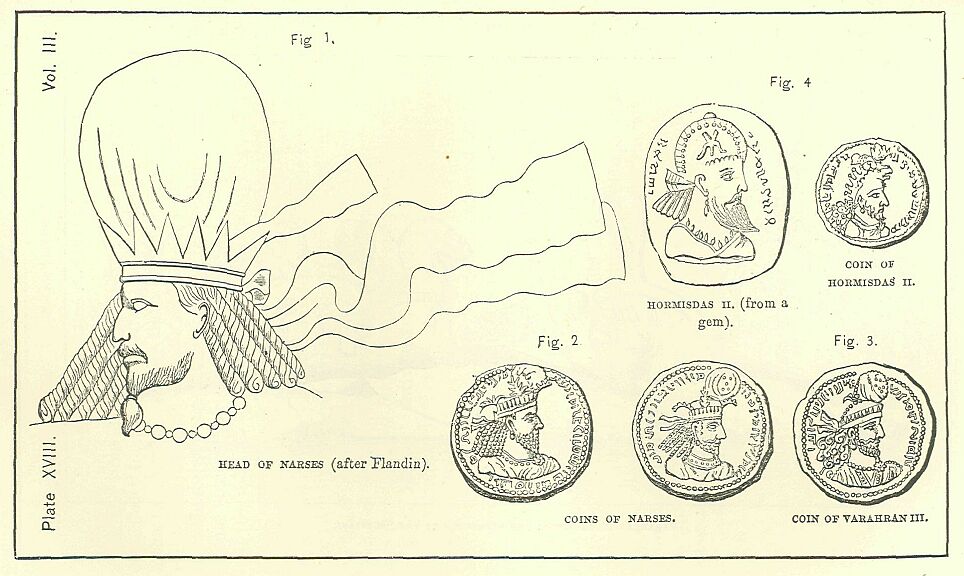
Narses ascended the throne in A.D. 292 or 293. It was at least as early as A.D. 296 that he challenged Rome to an encounter by attacking in force the vassal monarch whom her arms had established in Armenia. Tiridates had, it is evident, done much to provoke the attack by his constant raids into Persian territory, which were sometimes carried even to the south of Ctesiphon. He was probably surprised by the sudden march and vigorous assault of an enemy whom he had learned to despise; and, feeling himself unable to organize an effectual resistance, he had recourse to flight, gave up Armenia to the Persians, and for a second time placed himself under the protection of the Roman emperor. The monarch who held this proud position was still Diocletian, the greatest emperor that had occupied the Roman throne since Trajan, and the prince to whom Tiridates was indebted for his restoration to his kingdom. It was impossible that Diocletian should submit to the affront put upon him without an earnest effort to avenge it. His own power rested, in a great measure, on his military prestige; and the unpunished insolence of a foreign king would have seriously endangered an authority not very firmly established. The position of Diocletian compelled him to declare war against Narses in the year A.D. 296, and to address himself to a struggle of which he is not likely to have misconceived the importance. It might have been expected that he would have undertaken the conduct of the war in person; but the internal condition of the empire was far from satisfactory, and the chief of the State seems to have felt that he could not conveniently quit his dominions to engage in war beyond his borders. He therefore committed the task of reinstating Tiridates and punishing Narses to his favorite and son-in-law, Galerius, while he himself took up a position within the limits of the empire, which at once enabled him to overawe his domestic adversaries and to support and countenance his lieutenant.
The first attempts of Galerius were unfortunate. Summoned suddenly from the Danube to the Euphrates, and placed at the head of an army composed chiefly of the levies of Asia, ill-disciplined, and unacquainted with their commander, he had to meet an adversary of whom he knew little or nothing, in a region the character of which was adverse to his own troops and favorable to those of the enemy. Narses had invaded the Roman province of Mesopotamia, had penetrated to the Khabour, and was threatening to cross the Euphrates into Syria. Galerius had no choice but to encounter him on the ground which he had chosen. Now, though Western Mesopotamia is ill-described as a smooth and barren surface of sandy desert, without a hillock, without a tree, and without a spring of fresh water, it is undoubtedly an open country, possessing numerous plains, where, in a battle, the advantage of numbers is likely to be felt, and where there is abundant room for the evolutions of cavalry. The Persians, like their predecessors the Parthians, were especially strong in horse; and the host which Narses had brought into the field greatly outnumbered the troops which Diocletian had placed at the disposal of Galerius. Yet Galerius took the offensive. Fighting under the eye of a somewhat stern master, he was scarcely free to choose his plan of campaign. Diocletian expected him to drive the Persians from Mesopotamia, and he was therefore bound to make the attempt. He accordingly sought out his adversary in this region, and engaged him in three great battles. The first and second appear to have been indecisive; but in the third the Roman general suffered a complete defeat. The catastrophe of Crassus was repeated almost upon the same battle-field, and probably almost by the same means. But, personally, Galerius was more fortunate than his predecessor. He escaped from the carnage, and, recrossing the Euphrates, rejoined his father-in-law in Syria. A conjecture, not altogether destitute of probability, makes Tiridates share both the calamity and the good fortune of the Roman Caesar. Like Galerius, he escaped from the battle-field, and reached the banks of the Euphrates. But his horse, which had received a wound, could not be trusted to pass the river. In this emergency the Armenian prince dismounted, and, armed as he was, plunged into the stream. The river was both wide and deep; the current was rapid; but the hardy adventurer, inured to danger and accustomed to every athletic exercise, swam across and reached the opposite bank in safety.
Thus, while the rank and file perished ignominiously, the two personages of most importance on the Roman side were saved. Galerius hastened towards Antioch, to rejoin his colleague and sovereign. The latter came out to meet him, but, instead of congratulating him on his escape, assumed the air of an offended master, and, declining to speak to him or to stop his chariot, forced the Caesar to follow him on foot for nearly a mile before he would condescend to receive his explanations and apologies for defeat. The disgrace was keenly felt, and was ultimately revenged upon the prince who had contrived it. But, at the time, its main effect doubtless was to awake in the young Caesar the strongest desire of retrieving his honor, and wiping out the memory of his great reverse by a yet more signal victory. Galerius did not cease through the winter of A.D. 297 to importune his father-in-law for an opportunity of redeeming the past and recovering his lost laurels.
The emperor, having sufficiently indulged his resentment, acceded to the wishes of his favorite. Galerius was continued in his command. A new army was collected during the winter, to replace that which had been lost; and the greatest care was taken that its material should be of good quality, and that it should be employed where it had the best chance of success. The veterans of Illyria and Moesia constituted the flower of the force now enrolled; and it was further strengthened by the addition of a body of Gothic auxiliaries. It was determined, moreover, that the attack should this time be made on the side of Armenia, where it was felt that the Romans would have the double advantage of a friendly country, and of one far more favorable for the movements of infantry than for those of an army whose strength lay in its horse. The number of the troops employed was still small. Galerius entered Armenia at the head of only 25,000 men; but they were a picked force, and they might be augmented, almost to any extent, by the national militia of the Armenians. He was now, moreover, as cautious as he had previously been rash; he advanced slowly, feeling his way; he even personally made reconnaissances, accompanied by only one or two horsemen, and, under the shelter of a flag of truce, explored the position of his adversary. Narses found himself overmatched alike in art and in force. He allowed himself to be surprised in his camp by his active enemy, and suffered a defeat by which he more than lost all the fruits of his former victory. Most of his army was destroyed; he himself received a wound, and with difficulty escaped by a hasty flight. Galerius pursued, and, though he did not succeed in taking the monarch himself, made prize of his wives, his sisters, and a number of his children, besides capturing his military chest. He also took many of the most illustrious Persians prisoners. How far he followed his flying adversary is uncertain; but it is scarcely probable that he proceeded much southward of the Armenian frontier. He had to reinstate Tiridates in his dominions, to recover Eastern Mesopotamia, and to lay his laurels at the feet of his colleague and master. It seems probable that having driven Narses from Armenia, and left Tiridates there to administer the government, he hastened to rejoin Diocletian before attempting any further conquests.
The Persian monarch, on his side, having recovered from his wound, which could have been but slight, set himself to collect another army, but at the same time sent an ambassador to to the camp of Galerius, requesting to know the terms on which Rome would consent to make peace. A writer of good authority has left us an account of the interview which followed between the envoy of the Persian monarch and the victorious Roman. Apharban (so was the envoy named) opened the negotiations with the following speech:
"The whole human race knows," he said, "that the Roman and Persian kingdoms resemble two great luminaries, and that, like a man's two eyes, they ought mutually to adorn and illustrate each other, and not in the extremity of their wrath to seek rather each other's destruction. So to act is not to act manfully, but is indicative rather of levity and weakness; for it is to suppose that our inferiors can never be of any service to us, and that therefore we had bettor get rid of them. Narses, moreover, ought not to be accounted a weaker prince than other Persian kings; thou hast indeed conquered him, but then thou surpassest all other monarchs; and thus Narses has of course been worsted by thee, though he is no whit inferior in merit to the best of his ancestors. The orders which my master has given me are to entrust all the rights of Persia to the clemency of Rome; and I therefore do not even bring with me any conditions of peace, since it is for the emperor to determine everything. I have only to pray, on my master's behalf, for the restoration of his wives and male children; if he receives them at your hands, he will be forever beholden to you, and will be better pleased than if he recovered them by force of arms. Even now my master cannot sufficiently thank you for the kind treatment which he hears you have vouchsafed them, in that you have offered them no insult, but have behaved towards them as though on the point of giving them back to their kith and kin. He sees herein that you bear in mind the changes of fortune and the instability of all human affairs."
At this point Galerius, who had listened with impatience to the long harangue, burst in with a movement of anger that shook his whole frame—"What? Do the Persians dare to remind us of the vicissitudes of fortune, as though we could forget how they behave when victory inclines to them? Is it not their wont to push their advantage to the uttermost and press as heavily as may be on the unfortunate? How charmingly they showed the moderation that becomes a victor in Valerian's time! They vanquished him by fraud; they kept him a prisoner to advanced old age; they let him die in dishonor; and then when he was dead they stripped off his skin, and with diabolical ingenuity made of a perishable human body an imperishable monument of our shame. Verily, if we follow this envoy's advice, and look to the changes of human affairs, we shall not be moved to clemency, but to anger, when we consider the past conduct of the Persians. If pity be shown them, if their requests be granted, it will not be for what they have urged, but because it is a principle of action with us—a principle handed down to us from our ancestors—to spare the humble and chastise the proud." Apharban, therefore, was dismissed with no definite answer to his question, what terms of peace Rome would require; but he was told to assure his master that Rome's clemency equalled her valor, and that it would not be long before he would receive a Roman envoy authorized to signify the Imperial pleasure, and to conclude a treaty with him.
Having held this interview with Apharban, Galerius hastened to meet and consult his colleague. Diocletian had remained in Syria, at the head of an army of observation, while Galerius penetrated into Armenia and engaged the forces of Persia. When he heard of his son-in-law's great victory he crossed the Euphrates, and advancing through Western Mesopotamia, from which the Persians probably retired, took up his residence at Nisibis, now the chief town of these parts. It is perhaps true that his object was "to moderate, by his presence and counsels, the pride of Galarius." That prince was bold to rashness, and nourished an excessive ambition. He is said to have at this time entertained a design of grasping at the conquest of the East, and to have even proposed to himself to reduce the Persian Empire into the form of a Roman province. But the views of Diocletian were humbler and more prudent. He held to the opinion of Augustus and Hadrian, that Rome did not need any enlargement of her territory, and that the absorption of the East was especially undesirable. When he and his son-in-law met and interchanged ideas at Nisibis, the views of the elder ruler naturally prevailed; and it was resolved to offer to the Persians tolerable terms of peace. A civilian of importance, Sicorius Probus, was selected for the delicate office of envoy, and was sent, with a train of attendants, into Media, where Narses had fixed his headquarters. We are told that the Persian monarch received him with all honor, but, under pretence of allowing him to rest and refresh himself after his long journey, deferred his audience from day to day; while he employed the time thus gained in collecting from various quarters such a number of detachments and garrisons as might constitute a respectable army. He had no intention of renewing the war, but he knew the weight which military preparation ever lends to the representations of diplomacy. Accordingly it was not until he had brought under the notice of Sicorius a force of no inconsiderable size that he at last admitted him to an interview. The Roman ambassador was introduced into an inner chamber of the royal palace in Media, where he found only the king and three others—Apharban, the envoy sent to Galerius, Archapetes, the captain of the guard, and Barsaborsus, the governor of a province on the Armenian frontier. He was asked to unfold the particulars of his message, and say what were the terms on which Rome would make peace. Sicorius complied. The emperors, he said, required five things:—(i.) The cession to Rome of five provinces beyond the river Tigris, which are given by one writer as Intilene, Sophene, Arzanene, Carduene, and Zabdicene; by another as Arzanene, Moxoene, Zabdicene, Rehimene, and Corduene; (ii.) the recognition of the Tigris, as the general boundary between the two empires; (iii.) the extension of Armenia to the fortress of Zintha, in Media; (iv.) the relinquishment by Persia to Rome of her protectorate over Iberia, including the right of giving investiture to the Iberian kings; and (v.) the recognition of Nisibis as the place at which alone commercial dealings could take place between the two nations.
It would seem that the Persians were surprised at the moderation of these demands. Their exact value and force will require some discussion; but at any rate it is clear that, under the circumstances, they were not felt to be excessive. Narses did not dispute any of them except the last: and it seems to have been rather because he did not wish it to be said that he had yielded everything, than because the condition was really very onerous, that he made objection in this instance. Sicorius was fortunately at liberty to yield the point. He at once withdrew the fifth article of the treaty, and, the other four being accepted, a formal peace was concluded between the two nations.
To understand the real character of the peace now made, and to appreciate properly the relations thereby established between Rome and Persia, it will be necessary to examine at some length the several conditions of the treaty, and to see exactly what was imported by each of them. There is scarcely one out of the whole number that carries its meaning plainly upon its face; and on the more important very various interpretations have been put, so that a discussion and settlement of some rather intricate points is here necessary.
(i.) There is a considerable difference of opinion as to the five provinces ceded to Rome by the first article of the treaty, as to their position and extent, and consequently as to their importance. By some they are put on the right, by others on the left, bank of the Tigris; while of those who assign them this latter position some place them in a cluster about the sources of the river, while others extend them very much further to the southward. Of the five provinces three only can be certainly named, since the authorities differ as to the two others. These three are Arzanene, Cordyene, and Zabdicene, which occur in that order in Patricius. If we can determine the position of these three, that of the others will follow, at least within certain limits.
Now Arzanene was certainly on the left bank of the Tigris. It adjoined Armenia, and is reasonably identified with the modern district of Kherzan, which lies between Lake Van and the Tigris, to the west of the Bitlis river. All the notices of Arzanene suit this locality; and the name "Kherzan" may be regarded as representing the ancient appellation.
Zabdicene was a little south and a little east of this position. It was the tract about a town known as Bezabda (perhaps a corruption of Beit-Zabda), which had been anciently called Phoenica. This town is almost certainly represented by the modern Fynyk, on the left bank of the Tigris, a little above Jezireh. The province whereof it was the capital may perhaps have adjoined Arzanene, reaching as far north as the Bitlis river.
If these two tracts are rightly placed, Cordyene must also be sought on the left bank of the Tigris. The word is no doubt the ancient representative of the modern Kurdistan, and means a country in which Kurds dwelt. Now Kurds seem to have been at one time the chief inhabitants of the Mons Masius, the modern Jebel Kara j ah Dagh and Jebel Tur, which was thence called Oordyene, Gordyene, or the Gordisean mountain chain. But there was another and a more important Cordyene on the opposite side of the river. The tract to this day known as Kurdistan, the high mountain region south and south-east of Lake Van between Persia and Mesopotamia, was in the possession of Kurds from before the time of Xenophon, and was known as the country of the Carduchi, as Cardyene, and as Cordyene. This tract, which was contiguous to Arzanene and Zabdicene, if we have rightly placed those regions, must almost certainly have been the Cordyene of the treaty, which, if it corresponded at all nearly in extent with the modern Kurdistan, must have been by far the largest and most important of the five provinces.
The two remaining tracts, whatever their names, must undoubtedly have lain on the same side of the Tigris with these three. As they are otherwise unknown to us (for Sophene, which had long been Roman, cannot have been one of them), it is impossible that they should have been of much importance. No doubt they helped to round off the Roman dominion in this quarter; but the great value of the entire cession lay in the acquisition of the large and fruitful province of Cordyene, inhabited by a brave and hardy population, and afterwards the seat of fifteen fortresses which brought the Roman dominion to the very edge of Adiabene, made them masters of the passes into Media, and laid the whole of Southern Mesopotamia open to their incursions. It is probable that the hold of Persia on the territory had never been strong; and in relinquishing it she may have imagined that she gave up no very great advantage; but in the hands of Rome Kurdistan became a standing menace to the Persian power, and we shall find that on the first opportunity the false step now taken was retrieved, Cordyene with its adjoining districts was pertinaciously demanded of the Romans, was grudgingly surrendered, and was then firmly re-attached to the Sassanian dominions.
(ii.) The Tigris is said by Patricius and Festus to have been made the boundary of the two empires. Gibbon here boldly substitutes the Western Khabour and maintains that "the Roman frontier traversed, but never followed, the course of the Tigris." He appears not to be able to understand how the Tigris could be the frontier, when five provinces across the Tigris were Roman. But the intention of the article probably was, first, to mark the complete cession to Rome of Eastern as well as Western Mesopotamia, and, secondly, to establish the Tigris as the line separating the empires below the point down to which the Romans held both banks. Cordyene may not have touch the Tigris at all, or may have touched it only about the 37th parallel. From this point southwards, as far as Mosul, or Nimrud, or possibly Kileh Sherghat, the Tigris was probably now recognized as the dividing line between the empires. By the letter of the treaty the whole Euphrates valley might indeed have been claimed by Rome; but practically she did not push her occupation of Mesopotamia below Circeshim. The real frontier from this point was the Mesopotamian desert, which extends from Kerkesiyeh to Nimrud, a distance of 150 miles. Above this it was the Tigris, as far probably as Feshapoor; after which it followed the line, whatever it was, which divided Oordyene from Assyria and Media.
(iii.) The extension of Armenia to the fortress of Zintha, in Media, seems to have imported much more than would at first sight appear from the words. Gibbon interprets it as implying the cession of all Media Atropatene, which certainly appears a little later to be in the possession of the Armenian monarch, Tiridates. A large addition to the Armenian territory out of the Median is doubtless intended; but it is quite impossible to determine definitely the extent or exact character of the cession.
(iv.) The fourth article of the treaty is sufficiently intelligible. So long as Armenia had been a fief of the Persian empire, it naturally belonged to Persia to exercise influence over the neighboring Iberia, which corresponded closely to the modern Georgia, intervening between Armenia and the Caucasus. Now, when Armenia had become a dependency of Rome, the protectorate hitherto exercised by the Sassanian princes passed naturally to the Caesars; and with the protectorate was bound up the right of granting investiture to the kingdom, whereby the protecting power was secured against the establishment on the throne of an unfriendly person. Iberia was not herself a state of much strength; but her power of opening or shutting the passes of the Caucasus gave her considerable importance, since by the admission of the Tatar hordes, which were always ready to pour in from the plains of the North, she could suddenly change the whole face of affairs in North-Western Asia, and inflict a terrible revenge on any enemy that had provoked her. It is true that she might also bring suffering on her friends, or even on herself, for the hordes, once admitted, were apt to make little distinction between friend and foe; but prudential considerations did not always prevail over the promptings of passion, and there had been occasions when, in spite of them, the gates had been thrown open and the barbarians invited to enter. It was well for Rome to have it in her power to check this peril. Her own strength and the tranquillity of her eastern provinces were confirmed and secured by the right which she (practically) obtained of nominating the Iberian monarchs.
(v.) The fifth article of the treaty, having been rejected by Narses and then withdrawn by Sicorius, need not detain us long. By limiting the commercial intercourse of the two nations to a single city, and that a city within their own dominions, the Romans would have obtained enormous commercial advantages. While their own merchants remained quietly at home, the foreign merchants would have had the trouble and expense of bringing their commodities to market a distance of sixty miles from the Persian frontier and of above a hundred from any considerable town; they would of course have been liable to market dues, which would have fallen wholly into Roman hands; and they would further have been chargeable with any duty, protective or even prohibitive, which Rome chose to impose. It is not surprising that Narses here made a stand, and insisted on commerce being left to flow in the broader channels which it had formed for itself in the course of ages.
Rome thus terminated her first period of struggle with the newly revived monarchy of Persia by a great victory and a great diplomatic success. If Narses regarded the terms—and by his conduct he would seem to have done so—as moderate under the circumstances, our conclusion must be that the disaster which he had suffered was extreme, and that he knew the strength of Persia to be, for the time, exhausted. Forced to relinquish his suzerainty over Armenia and Iberia, he saw those countries not merely wrested from himself, but placed under the protectorate, and so made to minister to the strength, of his rival. Nor was this all. Rome had gradually been advancing across Mesopotamia and working her way from the Euphrates to the Tigris. Narses had to acknowledge, in so many words, that the Tigris, and not the Euphrates, was to be regarded as her true boundary, and that nothing consequently was to be considered as Persian beyond the more eastern of the two rivers. Even this concession was not the last or the worst. Narses had finally to submit to see his empire dismembered, a portion of Media attached to Armenia, and five provinces, never hitherto in dispute, torn from Persia and added to the dominion of Rome. He had to allow Rome to establish herself in force on the left bank of the Tigris, and so to lay open to her assaults a great portion of his northern besides all his western frontier. He had to see her brought to the very edge of the Iranic plateau, and within a fortnight's march of Persia Proper. The ambition to rival his ancestor Sapor, if really entertained, was severely punished; and the defeated prince must have felt that he had been most ill-advised in making the venture.
Narses did not long continue on the throne after the conclusion of this disgraceful, though, it may be, necessary, treaty. It was made in A.D. 297. He abdicated in A.D. 301. It may have been disgust at his ill-success, it may have been mere weariness of absolute power, which caused him to descend from his high position and retire into private life. He was so fortunate as to have a son of full age in whose favor he could resign, so that there was no difficulty about the succession. His ministers seem to have thought it necessary to offer some opposition to his project; but their resistance was feeble, perhaps because they hoped that a young prince would be more entirely guided by their counsels. Narses was allowed to complete his act of self-renunciation, and, after crowning his son Hormisdas with his own hand, to spend the remainder of his days in retirement. According to the native writers, his main object was to contemplate death and prepare himself for it. In his youth he had evinced some levity of character, and had been noted for his devotion to games and to the chase; in his middle age he laid aside these pursuits, and, applying himself actively to business, was a good administrator, as well as a brave soldier. But at last it seemed to him that the only life worth living was the contemplative, and that the happiness of the hunter and the statesman must yield to that of the philosopher. It is doubtful how long he survived his resignation of the throne, but tolerably certain that he did not outlive his son and successor, who reigned less than eight years.
Reign of Hormisdas II. His Disposition. General Character of his Reign. His Taste for Building. His new Court of Justice. His Marriage with a Princess of Cabul. Story of his Son Hormisdas. Death of Hormisdas II., and Imprisonment of his Son Hormisdas. Interregnum. Crown assigned to Sapor II. before his Birth. Long Reign of Sapor. First Period of his Reign, from A.D. 309 to A.D. 337. Persia plundered by the Arabs and the Turks. Victories of Sapor over the Arabs. Persecution of the Christians. Escape of Hormisdas. Feelings and Conduct of Sapor.
Hormisdas II., who became king on the abdication of his father, Narses, had, like his father, a short reign. He ascended the throne A.D. 301; he died A.D. 309, not quite eight years later. To this period historians assign scarcely any events. The personal appearance of Hormisdas, if we may judge by a gem, was pleasing; [PLATE XVIII., Fig. 4.] he is said, however, to have been of a harsh temper by nature, but to have controlled his evil inclinations after he became king, and in fact to have then neglected nothing that could contribute to the welfare of his subjects. He engaged in no wars; and his reign was thus one of those quiet and uneventful intervals which, furnishing no materials for history, indicate thereby the happiness of a nation. We are told that he had a strong taste for building, and could never see a crumbling edifice without instantly setting to work to restore it. Ruined towns and villages, so common throughout the East in all ages, ceased to be seen in Persia while he filled the throne. An army of masons always followed him in his frequent journeys throughout his empire, and repaired dilapidated homesteads and cottages with as much care and diligence as edifices of a public character. According to some writers he founded several entirely new towns in Khuzistan or Susiana, while, according to others, he built the important city of Hormuz, or (as it is sometimes called) Ram-Aormuz, in the province of Kerman, which is still a flourishing place. Other authorities ascribe this city, however, to the first Hormisdas, the son of Sapor I. and grandson of Artaxerxes.
Among the means devised by Hormisdas II. for bettering the condition of his people the most remarkable was his establishment of a new Court of Justice. In the East the oppression of the weak by the powerful is the most inveterate and universal of all evils, and the one that well-intentioned monarchs have to be most careful in checking and repressing. Hormisdas, in his anxiety to root out this evil, is said to have set up a court expressly for the hearing of causes where complaint was made by the poor of wrongs done to them by the rich. The duty of the judges was at once to punish the oppressors, and to see that ample reparation was made to those whom they had wronged. To increase the authority of the court, and to secure the impartiality of its sentences, the monarch made a point of often presiding over it himself, of hearing the causes, and pronouncing the judgments in person. The most powerful nobles were thus made to feel that, if they offended, they would be likely to receive adequate punishment; and the weakest and poorest of the people were encouraged to come forward and make complaint if they had suffered injury.
Among his other wives, Hormisdas, we are told, married a daughter of the king of Cabul. It was natural that, after the conquest of Seistan by Varahran II., about A.D. 280, the Persian monarchs should establish relations with the chieftains ruling in Afghanistan. That country seems, from the first to the fourth century of our era, to have been under the government of princes of Scythian descent and of considerable wealth and power. Kadphises, Kanerki, Kenorano. Ooerki, Baraoro, had the main seat of their empire in the region about Cabul and Jellalabad; but from this centre they exercised an extensive sway, which at times probably reached Candahar on the one hand, and the Punjab region on the other. Their large gold coinage proves them to have been monarchs of great wealth, while their use of the Greek letters and language indicates a certain amount of civilization. The marriage of Hormisdas with a princess of Cabul implies that the hostile relations existing under Varahran II. had been superseded by friendly ones. Persian aggression had ceased to be feared. The reigning Indo-Scythic monarch felt no reluctance to give his daughter in marriage to his Western neighbor, and sent her to his court (we are told) with a wardrobe and ornaments of the utmost magnificence and costliness.
Hormisdas II. appears to have had a son, of the same name with himself, who attained to manhood while his father was still reigning. This prince, who was generally regarded, and who, of course, viewed himself, as the heir-apparent, was no favorite with the Persian nobles, whom he had perhaps offended by an inclination towards the literature and civilization of the Greeks. It must have been upon previous consultation and agreement that the entire body of the chief men resolved to vent their spite by insulting the prince in the most open and public way at the table of his father. The king was keeping his birthday, which was always, in Persia, the greatest festival of the year, and so the most public occasion possible. All the nobles of the realm were invited to the banquet; and all came and took their several places. The prince was absent at the first, but shortly arrived, bringing with him, as the excuse for his late appearance, a quantity of game, the produce of the morning's chase. Such an entrance must have created some disturbance and have drawn general attention; but the nobles, who were bound by etiquette to rise from their seats, remained firmly fixed in them, and took not the slightest notice of the prince's arrival. This behavior was an indignity which naturally aroused his resentment. In the heat of the moment he exclaimed aloud that "those who had insulted him should one day suffer for it—their fate should be the fate of Marsyas." At first the threat was not understood; but one chieftain, more learned than his fellows, explained to the rest that, according to the Greek myth, Marsyas was flayed alive. Now, flaying alive was a punishment not unknown to the Persian law; and the nobles, fearing that the prince really entertained the intention which he had expressed, became thoroughly alienated from him, and made up their minds that they would not allow him to reign. During his father's lifetime, they could, of course, do nothing; but they laid up the dread threat in their memory, and patiently waited for the moment when the throne would become vacant, and their enemy would assert his right to it.
Apparently, their patience was not very severely taxed. Hormisdas II. died within a few years; and Prince Hormisdas, as the only son whom he had left behind him, thought to succeed as a matter of course. But the nobles rose in insurrection, seized his person, and threw him into a dungeon, intending that he should remain there for the rest of his life. They themselves took the direction of affairs, and finding that, though King Hormisdas had left behind him no other son, yet one of his wives was pregnant, they proclaimed the unborn infant king, and even with the utmost ceremony proceeded to crown the embryo by suspending the royal diadem over the womb of the mother. A real interregnum must have followed; but it did not extend beyond a few months. The pregnant widow of Hormisdas fortunately gave birth to a boy, and the difficulties of the succession were thereby ended. All classes acquiesced in the rule of the infant monarch, who received the name of Sapor—whether simply to mark the fact that he was believed to be the late king's son, or in the hope that he would rival the glories of the first Sapor, is uncertain.
The reign of Sapor II. is estimated variously, at 69, 70, 71, and 72 years; but the balance of authority is in favor of seventy. He was born in the course of the year A.D. 309, and he seems to have died in the year after the Roman emperor Valens, or A.D. 379. He thus reigned nearly three-quarters of a century, being contemporary with the Roman emperors, Galerius, Constantine, Constantius and Constans, Julian, Jovian, Valentinian I., Valens, Gratian, and Valentinian II.
This long reign is best divided into periods. The first period of it extended from A.D. 309 to A.D. 337, or a space of twenty-eight years. This was the time anterior to Sapor's wars with the Romans. It included the sixteen years of his minority and a space of twelve years during which he waged successful wars with the Arabs. The minority of Sapor was a period of severe trial to Persia. On every side the bordering nations endeavored to take advantage of the weakness incident to the rule of a minor, and attacked and ravaged the empire at their pleasure. The Arabs were especially aggressive, and made continual raids into Babylonia, Khuzistan, and the adjoining regions, which desolated these provinces and carried the horrors of war into the very heart of the empire. The tribes of Beni-Ayar and Abdul-Kais, which dwelt on the southern shores of the Persian Gulf, took the lead in these incursions, and though not attempting any permanent conquests, inflicted terrible sufferings on the inhabitants of the tracts which they invaded. At the same time a Mesopotamian. chieftain, called Tayer or Thair, made an attack upon Otesiphon, took the city by storm, and captured a sister or aunt of the Persian monarch. The nobles, who, during Sapor's minority, guided the helm of the State, were quite incompetent to make head against these numerous enemies. For sixteen years the marauding bands had the advantage, and Persia found herself continually weaker, more impoverished, and less able to recover herself. The young prince is said to have shown extraordinary discretion and intelligence. He diligently trained himself in all manly exercises, and prepared both his mind and body for the important duties of his station. But his tender years forbade him as yet taking the field; and it is not unlikely that his ministers prolonged the period of his tutelage in order to retain, to the latest possible moment, the power whereto they had become accustomed. At any rate, it was not till he was sixteen, a later age than Oriental ideas require, that Sapor's minority ceased—that he asserted his manhood, and, placing himself at the head of his army, took the entire direction of affairs, civil and military, into his own hands.
From this moment the fortunes of Persia began to rise. Content at first to meet and chastise the marauding bands on his own territory, Sapor, after a time, grew bolder, and ventured to take the offensive. Having collected a fleet of considerable size, he placed his troops on board, and conveyed them to the city of El-Katif, an important place on the south coast of the Persian Gulf, where he disembarked and proceeded to carry fire and sword through the adjacent region. Either on this occasion, or more probably in a long series of expeditions, he ravaged the whole district of the Hejer, gaining numerous victories over the tribes of the Temanites, the Beni-Wa'iel, the Abdul-Kais, and others, which had taken a leading part in the invasion of Persia. His military genius and his valor were everywhere conspicuous; but unfortunately these excellent qualities were unaccompanied by the humanity which has been the crowning virtue o£ many a conqueror. Sapor, exasperated by the sufferings of his countrymen during so many years, thought that he could not too severely punish those who had inflicted them. He put to the sword the greater part of every tribe that he conquered; and, when his soldiers were weary of slaying, he made them pierce the shoulders of their prisoners, and insert in the wound a string or thong by which to drag them into captivity. The barbarity of the age and nation approved these atrocities; and the monarch who had commanded them was, in consequence, saluted as Dhoulacta, or "Lord of the Shoulders," by an admiring people. Cruelties almost as great, but of a different character, were at the same time sanctioned by Sapor in regard to one class of his own subjects—viz., those who had made profession of Christianity. The Zoroastrian zeal of this king was great, and he regarded it as incumbent on him to check the advance which Christianity was now making in his territories. He issued severe edicts against the Christians soon after attaining his majority; and when they sought the protection of the Roman emperor, he punished their disloyalty by imposing upon them a fresh tax, the weight of which was oppressive. When Symeon, Archbishop of Seleucia, complained of this additional burden in an offensive manner, Sapor retaliated by closing the Christian churches, confiscating the ecclesiastical property, and putting the complainant to death. Accounts of these severities reached Constantine, the Roman emperor, who had recently embraced the new religion (which, in spite of constant persecution, had gradually overspread the empire), and had assumed the character of a sort of general protector of the Christians throughout the world. He remonstrated with Sapor, but to no purpose. Sapor had formed the resolution to renew the contest terminated so unfavorably forty years earlier by his grandfather. He made the emperor's interference with Persian affairs, and encouragement of his Christian subjects in their perversity, a ground of complaint, and began to threaten hostilities. Some negotiations, which are not very clearly narrated, followed. Both sides, apparently, had determined on war, but both wished to gain time. It is uncertain what would have been the result had Constantine lived. But the death of that monarch in the early summer of A.D. 337, on his way to the eastern frontier, dispelled the last chance of peace by relieving Sapor from the wholesome fear which had hitherto restrained his ambition. The military fame of Constantine was great, and naturally inspired respect; his power was firmly fixed, and he was without competitor or rival. By his removal the whole face of affairs was changed; and Sapor, who had almost brought himself to venture on a rupture with Rome during Constantine's life, no longer hesitated on receiving news of his death, but at once commenced hostilities.
It is probable that among the motives which determined the somewhat wavering conduct of Sapor at this juncture was a reasonable fear of the internal troubles which it seemed to be in the power of the Romans to excite among the Persians, if from friends they became enemies. Having tested his own military capacity in his Arab wars, and formed an army on whose courage, endurance, and attachment he could rely, he was not afraid of measuring his strength with that of Rome in the open field; but he may well have dreaded the arts which the Imperial State was in the habit of employing, to supplement her military shortcomings, in wars with her neighbors. There was now at the court of Constantinople a Persian refugee of such rank and importance that Constantine had, as it were, a pretender ready made to his hand, and could reckon on creating dissension among the Persians whenever he pleased, by simply proclaiming himself this person's ally and patron. Prince Hormisdas, the elder brother of Sapor, and rightful king of Persia, had, after a long imprisonment, contrived, by the help of his wife, to escape from his dungeon, and had fled to the court of Constantine as early as A.D. 323. He had been received by the emperor with every mark of honor and distinction, had been given a maintenance suited to his rank, and had enjoyed other favors. Sapor must have felt himself deeply aggrieved by the undue attention paid to his rival; and though he pretended to make light of the matter, and even generously sent Hormisdas the wife to whom his escape was due, he cannot but have been uneasy at the possession, by the Roman emperor, of his brother's person. In weighing the reasons for and against war he cannot but have assigned considerable importance to this circumstance. It did not ultimately prevent him from challenging Rome to the combat; but it may help to account for the hesitation, the delay, and the fluctuations of purpose, which we remark in his conduct during the four or five years which immediately preceded the death of Constantine.
Position of Affairs on the Death of Constantine. First War of Sapor with Rome, A.D. 337-350. First Siege of Nisibis. Obscure Interval. Troubles in Armenia, and Recovery of Armenia by the Persians. Sapor's Second Siege of Nisibis. Its Failure. Great Battle of Singara. Sapor's Son made Prisoner and murdered in cold blood. Third Siege of Nisibis. Sapor called away by an Invasion of the Massagatae.

"Constantius adversus Persas et Saporem, qui Mesopotamiam vastaverant, novem prasliis parum prospere decertavit."—Orosius, Hist. vii. 39.
The death of Constantine was followed by the division of the Roman world among his sons. The vast empire with which Sapor had almost made up his mind to contend was partitioned out into three moderate-sized kingdoms. In place of the late brave and experienced emperor, a raw youth, who had given no signs of superior ability, had the government of the Roman provinces of the East, of Thrace, Asia Minor, Syria, Mesopotamia, and Egypt. Master of one third of the empire only, and of the least warlike portion, Constantius was a foe whom the Persian monarch might well despise, and whom he might expect to defeat without much difficulty. Moreover, there was much in the circumstances of the time that seemed to promise success to the Persian arms in a struggle with Rome. The removal of Constantme had been followed by an outburst of licentiousness and violence among the Roman soldiery in the capital; and throughout the East the army had cast off the restraints of discipline, and given indications of a turbulent and seditious spirit. The condition of Armenia was also such as to encourage Sapor in his ambitious projects. Tiridates, though a persecutor of the Christians in the early part of his reign, had been converted by Gregory the Illuminator, and had then enforced Christianity on his subjects by fire and sword. A sanguinary conflict had followed. A large portion of the Armenians, firmly attached to the old national idolatry, had resisted determinedly. Nobles, priests, and people had fought desperately in defence of their temples, images, and altars; and, though the persistent will of the king overbore all opposition, yet the result was the formation of a discontented faction, which rose up from time to time against its rulers, and was constantly tempted to ally itself with any foreign power from which it could hope the re-establishment of the old religion. Armenia had also, after the death of Tiridates (in A.D. 314), fallen under the government of weak princes. Persia had recovered from it the portion of Media Atropatene ceded by the treaty between Galerius and Narses. Sapor, therefore, had nothing to fear on this side; and he might reasonably expect to find friends among the Armenians themselves, should the general position of his affairs allow him to make an effort to extend Persian influence once more over the Armenian highland.
The bands of Sapor crossed the Roman frontier soon after, if not even before, the death of Constantine; and after an interval of forty years the two great powers of the world were once more engaged in a bloody conflict. Constantius, having paid the last honors to his father's remains, hastened to the eastern frontier, where he found the Roman army weak in numbers, badly armed and badly provided, ill-disposed towards himself, and almost ready to mutiny. It was necessary, before anything could be done to resist the advance of Sapor, that the insubordination of the troops should be checked, their wants supplied, and their good-will conciliated. Constantius applied himself to effect these changes. Meanwhile Sapor set the Arabs and Armenians in motion, inducing the Pagan party among the latter to rise in insurrection, deliver their king, Tiranus, into his power, and make incursions into the Roman territory, while the latter infested with their armed bands the provinces of Mesopotamia and Syria. He himself was content, during the first year of the war, A.D. 337, with moderate successes, and appeared to the Romans to avoid rather than seek a pitched battle. Constantius was able, under these circumstances, not only to maintain his ground, but to gain certain advantages. He restored the direction of affairs in Armenia to the Roman party, detached some of the Mesopotamian Arabs from the side of his adversary, and attached them to his own, and even built forts in the Persian territory on the further side of the Tigris. But the gains made were slight; and in the ensuing year (A.D. 338) Sapor took the field in greater force than before, and addressed himself to an important enterprise. He aimed, it is evident, from the first, at the recovery of Mesopotamia, and at thrusting back the Romans from the Tigris to the Euphrates. He found it easy to overrun the open country, to ravage the crops, drive off the cattle, and burn the villages and homesteads. But the region could not be regarded as conquered, it could not be permanently held, unless the strongly fortified posts which commanded it, and which were in the hands of Rome, could be captured. Of all these the most important was Nisibis. This ancient town, known to the Assyrians as Nazibina, was, at any rate from the time of Lucullus, the most important city of Mesopotamia. It was situated at the distance of about sixty miles from the Tigris, at the edge of the Mons Masius, in a broad and fertile plain, watered by one of the affluents of the river Khabour, or Aborrhas. The Romans, after their occupation of Mesopotamia, had raised it to the rank of a colony; and its defences, which were of great strength, had always been maintained by the emperors in a state of efficiency. Sapor regarded it as the key of the Roman position in the tract between the rivers, and, as early as A.D. 338, sought to make himself master of it.
The first siege of Nisibis by Sapor lasted, we are told, sixty-three days. Few particulars of it have come down to us. Sapor had attacked the city, apparently, in the absence of Constantius, who had been called off to Pannonia to hold a conference with his brothers. It was defended, not only by its garrison and inhabitants, but by the prayers and exhortations of its bishop, St. James, who, if he did not work miracles for the deliverance of his countrymen, at any rate sustained and animated their resistance. The result was that the bands of Sapor were repelled with loss, and he was forced, after wasting two months before the walls, to raise the siege and own himself baffled.
After this, for some years the Persian war with Rome languished. It is difficult to extract from the brief statements of epitomizers, and the loose invectives or panegyrics of orators, the real circumstances of the struggle; but apparently the general condition of things was this. The Persians were constantly victorious in the open field; Constantius was again and again defeated; but no permanent gain was effected by these successes. A weakness inherited by the Persians from the Parthians—an inability to conduct sieges to a prosperous issue—showed itself; and their failures against the fortified posts which Rome had taken care to establish in the disputed regions were continual. Up to the close of A.D. 340 Sapor had made no important gain, had struck no decisive blow, but stood nearly in the same position which he had occupied at the commencement of the conflict.
But the year A.D. 341 saw a change. Sapor, after obtaining possession of the person of Tiranus, had sought to make himself master of Armenia, and had even attempted to set up one of his own relatives as king. But the indomitable spirit of the inhabitants, and their firm attachment to their Arsacid princes, caused his attempts to fail of any good result, and tended on the whole to throw Armenia into the arms of Rome. Sapor, after a while, became convinced of the folly of his proceedings, and resolved on the adoption of a wholly new policy. He would relinquish the idea of conquering, and would endeavor instead to conciliate the Armenians, in the hope of obtaining from their gratitude what he had been unable to extort from their fears. Tiranus was still living; and Sapor, we are told, offered to replace him upon the Armenian throne; but, as he had been blinded by his captors, and as Oriental notions did not allow a person thus mutilated to exercise royal power, Tiranus declined the offer made him, and suggested the substitution of his son, Arsaces, who was, like himself, a prisoner in Persia. Sapor readily consented; and the young prince, released from captivity, returned to his country, and was installed as king by the Persians, with the good-will of the natives, who were satisfied so long as they could feel that they had at their head a monarch of the ancient stock. The arrangement, of course, placed Armenia on the Persian side, and gave Sapor for many years a powerful ally in his struggle with Rome.
Thus Sapor had, by the, year A.D. 341, made a very considerable gain. He had placed a friendly sovereign on the Armenian throne, had bound him to his cause by oaths, and had thereby established his influence, not only over Armenia itself, but over the whole tract which lay between Armenia and the Caucasus. But he was far from content with these successes. It was still his great object to drive the Romans from Mesopotamia; and with that object in view it continued to be his first wish to obtain possession of Nisibis. Accordingly, having settled Armenian affairs to his liking, he made, in A.D. 346, a second attack on the great city of Northern Mesopotamia, again investing it with a large body of troops, and this time pressing the siege during the space of nearly three months. Again, however, the strength of the walls and the endurance of the garrison baffled him. Sapor was once more obliged to withdraw from, before the place, having suffered greater loss than those whom he had assailed, and forfeited much of the prestige which he had acquired by his many victories.
It was, perhaps, on account of the repulse from Nisibis, and in the hope of recovering his lost laurels, that Sapor, in the next year but one, A.D. 348, made an unusual effort. Calling out the entire military force of the empire, and augmenting it by large bodies of allies and mercenaries, the Persian king, towards the middle of summer, crossed the Tigris by three bridges, and with a numerous and well-appointed army invaded Central Mesopotamia, probably from Adiabene, or the region near and a little south of Nineveh. Constantius, with the Roman army, was posted on and about the Sinjax range of hills, in the vicinity of the town of Singara, which is represented by the modern village of Sinjar. The Roman emperor did not venture to dispute the passage of the river, or to meet his adversary in the broad plain which, intervenes between the Tigris and the mountain range, but clung to the skirts of the hills, and commanded his troops to remain wholly on the defensive. Sapor was thus enabled to choose his position, to establish a fortified camp at a convenient distance from the enemy, and to occupy the hills in its vicinity—some portion of the Sinjar range—with his archers. It is uncertain whether, in making these dispositions, he was merely providing for his own safety, or whether he was laying a trap into which he hoped to entice the Roman army. Perhaps his mind was wide enough to embrace both contingencies. At any rate, having thus established a point d'appui in his rear, he advanced boldly and challenged the legions to an encounter. The challenge was at once accepted, and the battle commenced about midday; but now the Persians, having just crossed swords with the enemy, almost immediately began to give ground, and retreating hastily drew their adversaries along, across the thirsty plain, to the vicinity of their fortified camp, where a strong body of horse and the flower of the Persian archers were posted. The horse charged, but the legionaries easily defeated them, and elated with their success burst into the camp, despite the warnings of their leader, who strove vainly to check their ardor and to induce them to put off the completion of their victory till the next day. A small detachment found within the ramparts was put to the sword; and the soldiers scattered themselves among the tents, some in quest of booty, others only anxious for some means of quenching their raging thirst. Meantime the sun had gone down, and the shades of night fell rapidly. Regarding the battle as over, and the victory as assured, the Romans gave themselves up to sleep or feasting. But now Sapor saw his opportunity—the opportunity for which he had perhaps planned and waited. His light troops on the adjacent hills commanded the camp, and, advancing on every side, surrounded it. They were fresh and eager for the fray; they fought in the security afforded by the darkness; while the fires of the camp showed them their enemies, worn out with fatigue, sleepy, or drunken. The result, as might have been expected, was a terrible carnage. The Persians overwhelmed the legionaries with showers of darts and arrows; flight, under the circumstances, was impossible; and the Roman soldiers mostly perished where they stood. They took, however, ere they died, an atrocious revenge. Sapor's son had been made prisoner in the course of the day; in their desperation the legionaries turned their fury against this innocent youth; they beat him with whips, wounded him with the points of their weapons, and finally rushed upon him and killed him with a hundred blows.
The battle of Singara, though thus disastrous to the Romans, had not any great effect in determining the course or issue of the war. Sapor did not take advantage of his victory to attack the rest of the Roman forces in Mesopotamia, or even to attempt the siege of any large town. Perhaps he had really suffered large losses in the earlier part of the day; perhaps he was too much affected by the miserable death of his son to care, till time had dulled the edge of his grief, for military glory. At any rate, we hear of his undertaking no further enterprise till the second year after the battle, A.D. 350, when he made his third and most desperate attempt to capture Nisibis.
The rise of a civil war in the West, and the departure of Constantius for Europe with the flower of his troops early in the year no doubt encouraged the Persian monarch to make one more effort against the place which had twice repulsed him with ignominy. He collected a numerous native army, and strengthened it by the addition of a body of Indian allies, who brought a large troop of elephants into the field. With this force he crossed the Tigris in the early summer, and, after taking several fortified posts, march northwards and invested Nisibis. The Roman commander in the place was the Count Lucilianus, afterwards the father-in-law of Jovian, a man of resource and determination. He is said to have taken the best advantage of every favorable turn of fortune in the course of the siege, and to have prolonged the resistance by various subtle stratagems. But the real animating spirit of the defence was once more the bishop, St. James, who raised the enthusiasm of the inhabitants to the highest pitch by his exhortations, guided them by his counsels, and was thought to work miracles for them by his prayers. Sapor tried at first the ordinary methods of attack; he battered the walls with his rams, and sapped them with mines. But finding that by these means he made no satisfactory progress, he had recourse shortly to wholly novel proceedings. The river Mygdonius (now the Jerujer), swollen by the melting of the snows in the Mons Masius, had overflowed its banks and covered with an inundation the plain in which Nisibis stands. Sapor saw that the forces of nature might be employed to advance his ends, and so embanked the lower part of the plain that the water could not run off, but formed a deep lake round the town, gradually creeping up the walls till it had almost reached the battlements. Having thus created an artificial sea, the energetic monarch rapidly collected, or constructed, a fleet of vessels, and, placing his military engines on board, launched the ships upon the waters, and so attacked the walls of the city at great advantage. But the defenders resisted stoutly, setting the engines on fire with torches, and either lifting the ships from the water by means of cranes, or else shattering them with the huge stones which they could discharge from their balistics. Still, therefore, no impression was made; but at last an unforeseen circumstance brought the besieged into the greatest peril, and almost gave Nisibis into the enemy's hands. The inundation, confined by the mounds of the Persians, which prevented it from running off, pressed with continually increasing force against the defences of the city, till at last the wall, in one part, proved too weak to withstand the tremendous weight which bore upon it, and gave way suddenly for the space of a hundred and fifty feet. What further damage was done to the town we know not; but a breach was opened through which the Persians at once made ready to pour into the place, regarding it as impossible that so huge a gap should be either repaired or effectually defended. Sapor took up his position on an artificial eminence, while his troops rushed to the assault. First of all marched the heavy cavalry, accompanied by the horse-archers; next came the elephants, bearing iron towers upon their backs, and in each tower a number of bowmen; intermixed with the elephants were a certain amount of heavy-armed foot. It was a strange column with which to attack a breach; and its composition does not say much for Persian siege tactics, which were always poor and ineffective, and which now, as usually, resulted in failure. The horses became quickly entangled in the ooze and mud which the waters had left behind them as they subsided; the elephants were even less able to overcome these difficulties, and as soon as they received a wound sank down—never to rise again—in the swamp. Sapor hastily gave orders for the assailing column to retreat and seek the friendly shelter of the Persian camp, while he essayed to maintain his advantage in a different way. His light archers were ordered to the front, and, being formed into divisions which were to act as reliefs, received orders to prevent the restoration of the ruined wall by directing an incessant storm of arrows into the gap made by the waters. But the firmness and activity of the garrison and inhabitants defeated this well-imagined proceeding. While the heavy-armed troops stood in the gap receiving the flights of arrows and defending themselves as they best could, the unarmed multitude raised a new wall in their rear, which, by the morning of the next day, was six feet in height. This last proof of his enemies' resolution and resource seems to have finally convinced Sapor of the hopelessness of his enterprise. Though he still continued the siege for a while, he made no other grand attack, and at length drew off his forces, having lost twenty thousand men before the walls, and wasted a hundred days, or more than three months.
Perhaps he would not have departed so soon, but would have turned the siege into a blockade, and endeavored to starve the garrison into submission, had not alarming tidings reached him from his north-eastern frontier. Then, as now, the low flat sandy region east of the Caspian was in the possession of nomadic hordes, whose whole life was spent in war and plunder. The Oxus might be nominally the boundary of the empire in this quarter; but the nomads were really dominant over the entire desert to the foot of the Hyrcanian and Parthian hills. Petty plundering forays into the fertile region south and east of the desert were no doubt constant, and were not greatly regarded; but from time to time some tribe or chieftain bolder than the rest made a deeper inroad and a more sustained attack than usual, spreading consternation around, and terrifying the court for its safety. Such an attack seems to have occurred towards the autumn of A.D. 350. The invading horde is said to have consisted of Massagatae; but we can hardly be mistaken in regarding them as, in the main, of Tatar, or Turkoman blood, akin to the Usbegs and other Turanian tribes which still inhabit the sandy steppe. Sapor considered the crisis such as to require his own presence; and thus, while civil war summoned one of the two rivals from Mesopotamia to the far West, where he had to contend with the self-styled emperors, Magnentius and Vetranio, the other was called away to the extreme East to repel a Tatar invasion. A tacit truce was thus established between the great belligerents—a truce which lasted for seven or eight years. The unfortunate Mesopotamians, harassed by constant war for above twenty years, had now a breathing-space during which to recover from the ruin and desolation that had overwhelmed them. Rome and Persia for a time suspended their conflict. Rivalry, indeed, did not cease; but it was transferred from the battlefield to the cabinet, and the Roman emperor sought and found in diplomatic triumphs a compensation for the ill-success which had attended his efforts in the field.
Revolt of Armenia and Acceptance by Arsaces of the Position of a Roman Feudatory. Character and Issue of Sapor's Eastern Wars. His negotiations with Constantius. His Extreme Demands. Circumstances under which he determines to renew the War. His Preparations. Desertion to him of Antoninus. Great Invasion of Sapor. Siege of Amida. Sapor's Severities. Siege and Capture of Singara; of Bezabde. Attack on Virtu fails. Aggressive Movement of Constantius. He attacks Bezabde, but fails Campaign of A.D. 361. Death of Constantius.
Evenerat . . . quasi fatali constellatione . . . ut Constantium dimicantem cum Persis fortuna semper sequeretur afflictior.—Amm. Marc. xx. 9, ad fin.
It seems to have been soon after the close of Sapor's first war with Constantius that events took place in Armenia which once more replaced that country under Roman influence. Arsaces, the son of Tiranus, had been, as we have seen, established as monarch, by Sapor, in the year A.D. 341, under the notion that, in return for the favor shown him, he would administer Armenia in the Persian interest. But gratitude is an unsafe basis for the friendships of monarchs. Arsaces, after a time, began to chafe against the obligations under which Sapor had laid him, and to wish, by taking independent action, to show himself a real king, and not a mere feudatory. He was also, perhaps, tired of aiding Sapor in his Roman war, and may have found that he suffered more than he gained by having Rome for an enemy. At any rate, in the interval between A.D. 351 and 359, probably while Sapor was engaged in the far East, Arsaces sent envoys to Constantinople with a request to Constantius that he would give him in marriage a member of the Imperial house. Constantius was charmed with the application made to him, and at once accepted the proposal. He selected for the proffered honor a certain Olympias, the daughter of Ablabius, a Praetorian prefect, and lately the betrothed bride of his own brother, Constans; and sent her to Armenia, where Arsaces welcomed her, and made her (as it would seem) his chief wife, provoking thereby the jealousy and aversion of his previous sultana, a native Armenian, named Pharandzem. The engagement thus entered into led on, naturally, to the conclusion of a formal alliance between Rome and Armenia—an alliance which Sapor made fruitless efforts to disturb, and which continued unimpaired down to the time A.D. 359 when hostilities once more broke out between Rome and Persia.
Of Sapor's Eastern wars we have no detailed account. They seem to have occupied him from A.D. 350 to A.D. 357, and to have been, on the whole, successful. They were certainly terminated by a peace in the last-named year—a peace of which it must have been a condition that his late enemies should lend him aid in the struggle which he was about to renew with Rome. Who these enemies exactly were, and what exact region they inhabited, is doubtful. They comprised certainly the Chionites and Gelani, probably the Euseni and the Vertse. The Chionites are thought to have been Hiongnu or Huns; and the Euseni are probably the Usiun, who, as early as B.C. 200, are found among the nomadic hordes pressing towards the Oxus. The Vertse are wholly unknown. The Gelani should, by their name, be the inhabitants of Ghilan, or the coast tract south-west of the Caspian; but this locality seems too remote from the probable seats of the Chionites and Euseni to be the one intended. The general scene of the wars was undoubtedly east of the Caspian, either in the Oxus region, or still further eastward, on the confines of India and Scythia. The result of the wars, though not a conquest, was an extension of Persian influence and power. Troublesome enemies were converted into friends and allies. The loss of a predominating influence over Armenia was thus compensated, or more than compensated, within a few years, by a gain of a similar kind in another quarter.
While Sapor was thus engaged in the far East, he received letters from the officer whom he had left in charge of his western frontier, informing him that the Romans were anxious to exchange the precarious truce which Mesopotamia had been allowed to enjoy during the last five or six years for a more settled and formal peace. Two great Roman officials, Cassianus, duke of Mesopotamia, and Musonianus, Praetorian prefect, understanding that Sapor was entangled in a bloody and difficult war at the eastern extremity of his empire, and knowing that Constantius was fully occupied with the troubles caused by the inroads of the barbarians into the more western of the Roman provinces, had thought that the time was favorable for terminating the provisional state of affairs in the Mesopotamian region by an actual treaty. They had accordingly opened negotiations with Tamsapor, satrap of Adiabene, and suggested to him that he should sound his master on the subject of making peace with Rome. Tamsapor appears to have misunderstood the character of these overtures, or to have misrepresented them to Sapor; in his despatch he made Constantius himself the mover in the matter, and spoke of him as humbly supplicating the great king to grant him conditions. It happened that the message reached Sapor just as he had come to terms with his eastern enemies, and had succeeded in inducing them to become his allies. He was naturally elated at his success, and regarded the Roman overture as a simple acknowledgment of weakness. Accordingly he answered in the most haughty style. His letter, which was conveyed to the Roman emperor at Sirmium by an ambassador named Narses, was conceived in the following terms:
"Sapor, king of kings, brother of the sun and moon, and companion of the stars, sends salutation to his brother, Constantius Caesar. It glads me to see that thou art at last returned to the right way, and art ready to do what is just and fair, having learned by experience that inordinate greed is oft-times punished by defeat and disaster. As then the voice of truth ought to speak with all openness, and the more illustrious of mankind should make their words mirror their thoughts, I will briefly declare to thee what I propose, not forgetting that I have often said the same things before. Your own authors are witness that the entire tract within the river Strymon and the borders of Macedon was once held by my ancestors; if I required you to restore all this, it would not ill become me (excuse the boast), inasmuch as I excel in virtue and in the splendor of my achievements the whole line of our ancient monarchs. But as moderation delights me, and has always been the rule of my conduct—wherefore from my youth up I have had no occasion to repent of any action—I will be content to receive Mesopotamia and Armenia, which was fraudulently extorted from my grandfather. We Persians have never admitted the principle, which you proclaim with such effrontery, that success in war is always glorious, whether it be the fruit of courage or trickery. In conclusion, if you will take the advice of one who speaks for your good, sacrifice a small tract of territory, one always in dispute and causing continual bloodshed, in order that you may rule the remainder securely. Physicians, remember, often cut and burn, and even amputate portions of the body, that the patient may have the healthy use of what is left to him; and there are animals which, understanding why the hunters chase them, deprive themselves of the thing coveted, to live thenceforth without fear. I warn you, that, if my ambassador returns in vain, I will take the field against you, so soon as the winter is past, with all my forces, confiding in my good fortune and in the fairness of the conditions which I have now offered."
It must have been a severe blow to Imperial pride to receive such a letter: and the sense of insult can scarcely have been much mitigated by the fact that the missive was enveloped in a silken covering, or by the circumstance that the bearer, Narses, endeavored by his conciliating manners to atone for his master's rudeness. Constantius replied, however, in a dignified and calm tone. "The Roman emperor," he said, "victorious by land and sea, saluted his brother, King Sapor. His lieutenant in Mesopotamia had meant well in opening a negotiation with a Persian governor; but he had acted without orders, and could not bind his master. Nevertheless, he (Constantius) would not disclaim what had been done, since he did not object to a peace, provided it were fair and honorable. But to ask the master of the whole Roman world to surrender territories which he had successfully defended when he ruled only over the provinces of the East was plainly indecent and absurd. He must add that the employment of threats was futile, and too common an artifice; more especially as the Persians themselves must know that Rome always defended herself when attacked, and that, if occasionally she was vanquished in a battle, yet she never failed to have the advantage in the event of every war." Three envoys were entrusted with the delivery of this reply—Prosper, a count of the empire; Spectatus, a tribune and notary; and Eustathius, an orator and philosopher, a pupil of the celebrated Neo-Platonist, Jamblichus, and a friend of St. Basil. Constantius was most anxious for peace, as a dangerous war threatened with the Alemanni, one of the most powerful tribes of Germany. He seems to have hoped that, if the unadorned language of the two statesmen failed to move Sapor, he might be won over by the persuasive eloquence of the professor of rhetoric.
But Sapor was bent on war. He had concluded arrangements with the natives so long his adversaries in the East, by which they had pledged themselves to join his standard with all their forces in the ensuing spring. He was well aware of the position of Constantius in the West, of the internal corruption of his court, and of the perils constantly threatening him from external enemies. A Roman official of importance, bearing the once honored name of Antoninus, had recently taken refuge with him from the claims of pretended creditors, and had been received into high favor on account of the information which he was able to communicate with respect to the disposition of the Roman forces and the condition of their magazines. This individual, ennobled by the royal authority, and given a place at the royal table, gained great influence over his new master, whom he stimulated by alternately reproaching him with his backwardness in the past, and putting before him the prospect of easy triumphs over Rome in the future. He pointed out that the emperor, with the bulk of his troops and treasures, was detained in the regions adjoining the Danube, and that the East was left almost undefended; he magnified the services which he was himself competent to render; he exhorted Sapor to bestir himself, and to put confidence in his good fortune. He recommended that the old plan of sitting down before walled towns should be given up, and that the Persian monarch, leaving the strongholds of Mesopotamia in his rear, should press forward to the Euphrates, pour his troops across it, and overrun the rich province of Syria, which he would find unguarded, and which had not been invaded by an enemy for nearly a century. The views of Antoninus were adopted; but, in practice, they were overruled by the exigencies of the situation. A Roman army occupied Mesopotamia, and advanced to the banks of the Tigris. When the Persians in full force crossed the river, accompanied by Chionite and Albanian allies, they found a considerable body of troops prepared to resist them. Their opponents did not, indeed offer battle, but they laid waste the country as the Persians took possession of it; they destroyed the forage, evacuated the indefensible towns (which fell, of course, into the enemy's hands), and fortified the line of the Euphrates with castles, military engines, and palisades. Still the programme of Antoninus would probably have been carried out, had not the swell of the Euphrates exceeded the average, and rendered it impossible for the Persian troops to ford the river at the usual point of passage into Syria. On discovering this obstacle, Antoninus suggested that, by a march to the north-east through a fertile country, the "Upper Euphrates" might be reached, and easily crossed, before its waters had attained any considerable volume. Sapor agreed to adopt this suggestion. He marched from Zeugma across the Mons Masius towards the Upper Euphrates, defeated the Romans in an important battle near Arnida, took, by a sudden assault, two castles which defended the town, and then somewhat hastily resolved that he would attack the place, which he did not imagine capable of making much resistance.
Amida, now Diarbekr, was situated on the right bank of the Upper Tigris, in a fertile plain, and was washed along the whole of its western side by a semi-circular bend of the river. It had been a place of considerable importance from a very ancient date, and had recently been much strengthened by Constantius, who had made it an arsenal for military engines, and had repaired its towers and walls. The town contained within it a copious fountain of water, which was liable, however, to acquire a disagreeable odor in the summer time. Seven legions, of the moderate strength to which legions had been reduced by Constantine, defended it; and the garrison included also a body of horse-archers, composed chiefly or entirely of noble foreigners. Sapor hoped in the first instance to terrify it into submission by his mere appearance, and boldly rode up to the gates with a small body of his followers, expecting that they would be opened to him. But the defenders were more courageous than he had imagined. They received him with a shower of darts and arrows that were directed specially against his person, which was conspicuous from its ornaments; and they aimed their weapons so well that one of them passed through a portion of his dress and was nearly wounding him. Persuaded by his followers, Sapor upon this withdrew, and committed the further prosecution of the attack to Grumbates, the king of the Chionites, who assaulted the walls on the next day with a body of picked troops, but was repulsed with great loss, his only son, a youth of great promise, being killed at his side by a dart from a balista. The death of this prince spread dismay through the camp, and was followed by a general mourning; but it now became a point of honor to take the town which had so injured one of the great king's royal allies; and Grumbates was promised that Amida should become the funeral pile of his lost darling.
The town was now regularly invested. Each nation was assigned its place. The Chionites, burning with the desire to avenge their late defeat, were on the east; the Vertse on the south; the Albanians, warriors from the Caspian region, on the north; the Segestans, who were reckoned the bravest soldiers of all, and who brought into the field a large body of elephants, held the west. A continuous line of Persians, five ranks deep, surrounded the entire city, and supported the auxiliary detachments. The entire besieging army was estimated at a hundred thousand men; the besieged, including the unarmed multitude, were under 30,000. After the pause of an entire day, the first general attack was made. Grumbates gave the signal for the assault by hurling a bloody spear into the space before the walls, after the fashion of a Roman fetialis. A cloud of darts and arrows from every side followed the flight of this weapon, and did severe damage to the besieged, who were at the same time galled with discharges from Roman military engines, taken by the Persians in some capture of Singara, and now employed against their former owners. Still a vigorous resistance continued to be made, and the besiegers, in their exposed positions, suffered even more than the garrison; so that after two days the attempt to carry the city by general assault was abandoned, and the slow process of a regular siege was adopted. Trenches were opened at the usual distance from the walls, along which the troops advanced under the cover of hurdles towards the ditch, which they proceeded to fill up in places. Mounds were then thrown up against the walls; and movable towers were constructed and brought into play, guarded externally with iron, and each mounting a balista. It was impossible long to withstand these various weapons of attack. The hopes of the besieged lay, primarily, in their receiving relief from without by the advance of an army capable of engaging their assailants and harassing them or driving them off; secondarily, in successful sallies, by means of which they might destroy the enemy's works and induce him to retire from before the place.
There existed, in the neighborhood of Amida, the elements of a relieving army, under the command of the new prefect of the East, Sabinianus. Had this officer possessed an energetic and enterprising character, he might, without much difficulty, have collected a force of light and active soldiers, which might have hung upon the rear of the Persians, intercepted their convoys, cut off their stragglers, and have even made an occasional dash upon their lines. Such was the course of conduct recommended by Ursicinus, the second in command, whom Sabinianus had recently superseded; but the latter was jealous of his subordinate, and had orders from the Byzantine court to keep him unemployed. He was himself old and rich, alike disinclined to and unfit for military enterprise; he therefore absolutely rejected the advice of Ursicinus, and determined on making no effort. He had positive orders, he said, from the court to keep on the defensive and not endanger his troops by engaging them in hazardous adventures. Amida must protect itself, or at any rate not look to him for succor. Ursicinus chafed terribly, it is said, against this decision, but was forced to submit to it. His messengers conveyed the dispiriting intelligence to the devoted city, which learned thereby that it must rely wholly upon its own exertions.
Nothing now remained but to organize sallies on a large scale and attack the besieger's works. Such attempts were made from time to time with some success; and on one occasion two Gaulish legions, banished to the East for their adherence to the cause of Magnentius, penetrated, by night, into the heart of the besieging camp, and brought the person of the monarch into danger. This peril was, however, escaped; the legions were repulsed with the loss of a sixth of their number; and nothing was gained by the audacious enterprise beyond a truce of three days, during which each side mourned its dead, and sought to repair its losses.
The fate of the doomed city drew on. Pestilence was added to the calamities which the besieged had to endure. Desertion and treachery were arrayed against them. One of the natives of Amida, going over to the Persians, informed them that on the southern side of the city a neglected staircase led up from the margin of the Tigris through underground corridors to one of the principal bastions; and under his guidance seventy archers of the Persian guard, picked men, ascended the dark passage at dead of night, occupied the tower, and when morning broke displayed from it a scarlet flag, as a sign to their countrymen that a portion of the wall was taken. The Persians were upon the alert, and an instant assault was made. But the garrison, by extraordinary efforts, succeeded in recapturing the tower before any support reached its occupants; and then, directing their artillery and missiles against the assailing columns, inflicted on them tremendous losses, and soon compelled them to return hastily to the shelter of their camp. The Verte, who maintained the siege on the south side of the city, were the chief sufferers in this abortive attempt.
Sapor had now spent seventy days before the place, and had made no perceptible impression. Autumn was already far advanced, and the season for military operations would, soon be over. It was necessary, therefore, either to take the city speedily or to give up the siege and retire. Under these circumstances Sapor resolved on a last effort. He had constructed towers of such a height that they overtopped the wall, and poured their discharges on the defenders from a superior elevation. He had brought his mounds in places to a level with the ramparts, and had compelled the garrison to raise countermounds within the walls for their protection. He now determined on pressing the assault day after day, until he either carried the town or found all his resources exhausted. His artillery, his foot, and his elephants were all employed in turn or together; he allowed the garrison no rest. Not content with directing the operations, he himself took part in the supreme struggle, exposing his own person freely to the enemy's weapons, and losing many of his attendants. After the contest had lasted three continuous days from morn to night, fortune at last favored him. One of the inner mounds, raised by the besieged behind their wall, suddenly gave way, involving its defenders in its fall, and at the same time filling up the entire space between the wall and the mound raised outside by the Persians. A way into the town was thus laid open, and the besiegers instantly occupied it. It was in vain that the flower of the garrison threw itself across the path of the entering columns—nothing could withstand the ardor of the Persian troops. In a little time all resistance was at an end; those who could quitted the city and fled—the remainder, whatever their sex, age, or calling, whether armed or unarmed, were slaughtered like sheep by the conquerors.
Thus fell Amida after a siege of seventy-three days. Sapor, who on other occasions showed himself not deficient in clemency, was exasperated by the prolonged resistance and the losses which he had sustained in the course of it. Thirty thousand of his best soldiers had fallen; the son of his chief ally had perished; he himself had been brought into imminent danger. Such audacity on the part of a petty town seemed no doubt to him to deserve a severe retribution. The place was therefore given over to the infuriated soldiery, who were allowed to slay and plunder at their pleasure. Of the captives taken, all belonging to the five provinces across the Tigris, claimed as his own by Sapor, though ceded to Rome by his grandfather, were massacred in cold blood. The Count Elian, and the commanders of the legions who had conducted the gallant defence, were barbarously crucified. Many other Romans of high rank were subjected to the indignity of being manacled, and were dragged into Persia as slaves rather than as prisoners.
The campaign of A.D. 359 terminated with this dearly bought victory. The season was too far advanced for any fresh enterprise of importance; and Sapor was probably glad to give his army a rest after the toils and perils of the last three months. Accordingly he retired across the Tigris, without leaving (so far as appears) any garrisons in Mesopotamia, and began preparations for the campaign of A.D. 360. Stores of all kinds were accumulated during the winter; and, when the spring came, the indefatigable monarch once more invaded the enemy's country, pouring into Mesopotamia an army even more numerous and better appointed than that which he had led against Amida in the preceding year. His first object now was to capture Singara, a town of some consequence, which was, however, defended by only two Roman legions and a certain number of native soldiers. After a vain attempt to persuade the garrison to a surrender, the attack was made in the usual way, chiefly by scaling parties with ladders, and by battering parties which shook the walls with the ram. The defenders kept the sealers at bay by a constant discharge of stones and darts from their artillery, arrows from their bows, and leaden bullets from their slings. They met the assaults of the ram by attempts to fire the wooden covering which protected it and those who worked it. For some days these efforts sufficed; but after a while the besiegers found a weak point in the defences of the place—a tower so recently built that the mortar in which the stones were laid was still moist, and which consequently crumbled rapidly before the blows of a strong and heavy battering-ram, and in a short time fell to the ground. The Persians poured in through the gap, and were at once masters of the entire town, which ceased to resist after the catastrophe. This easy victory allowed Sapor to exhibit the better side of his character; he forbade the further shedding of blood, and ordered that as many as possible of the garrisons and citizens should be taken alive. Reviving a favorite policy of Oriental rulers from very remote times, he transported these captives to the extreme eastern parts of his empire, where they might be of the greatest service to him in defending his frontier against the Scythians and Indians.
It is not really surprising, though the historian of the war regards it as needing explanation, that no attempt was made to relieve Singara by the Romans. The siege was short; the place was considered strong; the nearest point held by a powerful Roman force was Nisibis, which was at least sixty miles distant from Singara. The neighborhood of Singara was, moreover, ill supplied with water; and a relieving army would probably have soon found itself in difficulties. Singara, on the verge of the desert, was always perilously situated. Rome valued it as an outpost from which her enemy might be watched, and which might advertise her of a sudden danger, but could not venture to undertake its defence in case of an attack in force, and was prepared to hear of its capture with equanimity.
From Singara Sapor directed his march almost due northwards, and, leaving Nisibis unassailed upon his left, proceeded to attack the strong fort known indifferently as Phoenica or Bezabde. This was a position on the east bank of the Tigris, near the point where that river quits the mountains and debouches upon the plain; though not on the site, it may be considered the representative of the modern Jezireh, which commands the passes from the low country into the Kurdish mountains. Bezabde was the chief city of the province, called after it Zabdicene, one of the five ceded by Narses and greatly coveted by his grandson. It was much valued by Rome, was fortified in places with a double wall, and was guarded by three legions and a large body of Kurdish archers. Sapor, having reconnoitred the place, and, with his usual hardihood, exposed himself to danger in doing so, sent a flag of truce to demand a surrender, joining with the messengers some prisoners of high rank taken at Singara, lest the enemy should open fire upon his envoys. The device was successful; but the garrison proved stanch, and determined on resisting to the last. Once more all the known resources of attack and defence were brought into play; and after a long siege, of which the most important incident was an attempt made by the bishop of the place to induce Sapor to withdraw, the wall was at last breached, the city taken, and its defenders indiscriminately massacred. Regarding the position as one of first-rate importance, Sapor, who had destroyed Singara, carefully repaired the defences of Bezabde, provisioned it abundantly, and garrisoned it with some of his best troops. He was well aware that the Romans would feel keenly the loss of so important a post, and expected that it would not be long before they made an effort to recover possession of it.
The winter was now approaching, but the Persian monarch still kept the field. The capture of Bezabde was followed by that of many other less important strongholds, which offered little resistance. At last, towards the close of the year, an attack was made upon a place called Virta, said to have been a fortress of great strength, and by some moderns identified with Tekrit, an important city upon the Tigris between Mosul and Bagdad. Here the career of the conqueror was at last arrested. Persuasion and force proved alike unavailing to induce or compel a surrender; and, after wasting the small remainder of the year, and suffering considerable loss, the Persian monarch reluctantly gave up the siege, and returned to his own country.
Meanwhile the movements of the Roman emperor had been slow and uncertain. Distracted between a jealous fear of his cousin Julian's proceedings in the West, and a desire of checking the advance of his rival Sapor in the East, he had left Constantinople in the early spring, but had journeyed leisurely through Cappadocia and Armenia Minor to Samosata, whence, after crossing the Euphrates, he had proceeded to Edessa, and there fixed himself. While in Cappadocia he had summoned to his presence Arsaces, the tributary king of Armenia, had reminded him of his engagements, and had endeavored to quicken his gratitude by bestowing on him liberal presents. At Edessa he employed himself during the whole of the summer in collecting troops and stores; nor was it till the autumnal equinox was past that he took the field, and, after weeping over the smoking ruins of Amida, marched to Bezabde, and, when the defenders rejected his overtures of peace, formed the siege of the place. Sapor was, we must suppose, now engaged before Virta, and it is probable that he thought Bezabde strong enough to defend itself. At any rate, he made no effort to afford it any relief; and the Roman emperor was allowed to employ all the resources at his disposal in reiterated assaults upon the walls. The defence, however, proved stronger than the attack. Time after time the bold sallies of the besieged destroyed the Roman works. At last the rainy season set in, and the low ground outside the town became a glutinous and adhesive marsh. It was no longer possible to continue the siege; and the disappointed emperor reluctantly drew off his troops, recrossed the Euphrates, and retired into winter quarters at Antioch.
The successes of Sapor in the campaigns of A.D. 359 and 360, his captures of Amida, Singara, and Bezabde, together with the unfortunate issue of the expedition made by Constantius against the last-named place, had a tendency to shake the fidelity of the Roman vassal-kings, Arsaces of Armenia, and Meribanes of Iberia. Constantius, therefore, during the winter of A.D. 360-1, which he passed at Antioch, sent emissaries to the courts of these monarchs, and endeavored to secure their fidelity by loading them with costly presents. His policy seems to have been so far successful that no revolt of these kingdoms took place; they did not as yet desert the Romans or make their submission to Sapor. Their monarchs seem to have simply watched events, prepared to declare themselves distinctly on the winning side so soon as fortune should incline unmistakably to one or the other combatant. Meanwhile they maintained the fiction of a nominal dependence upon Rome.
It might have been expected that the year A.D. 361 would have been a turning-point in the war, and that, if Rome did not by a great effort assert herself and recover her prestige, the advance of Persia would have been marked and rapid. But the actual course of events was far different. Hesitation and diffidence characterize the movements of both parties to the contest, and the year is signalized by no important enterprise on the part of either monarch. Constantius reoccupied Edessa, and had (we are told) some thoughts of renewing the siege of Bezabde; actually, however, he did not advance further, but contented himself with sending a part of his army to watch Sapor, giving them strict orders not to risk an engagement. Sapor, on his side, began the year with demonstrations which were taken to mean that he was about to pass the Euphrates; but in reality he never even brought his troops across the Tigris, or once set foot in Mesopotamia. After wasting weeks or months in a futile display of his armed strength upon the eastern bank of the river, and violently alarming the officers sent by Constantius to observe his movements, he suddenly, towards autumn, withdrew his troops, having attempted nothing, and quietly returned to his capital! It is by no means difficult to understand the motives which actuated Constantius. He was, month after month, receiving intelligence from the West of steps taken by Julian which amounted to open rebellion, and challenged him to engage in civil war. So long as Sapor threatened invasion he did not like to quit Mesopotamia, lest he might appear to have sacrificed the interests of his country to his own private quarrels; but he must have been anxious to return to the seat of empire from the first moment that intelligence reached him of Julian's assumption of the imperial name and dignity; and when Sapor's retreat was announced he naturally made all haste to reach his capital. Meanwhile the desire of keeping his army intact caused him to refrain from any movement which involved the slightest risk of bringing on a battle, and, in fact, reduced him to inaction. So much is readily intelligible. But what at this time withheld Sapor, when he had so grand an opportunity of making an impression upon Rome—what paralyzed his arm when it might have struck with such effect it is far from easy to understand, though perhaps not impossible to conjecture. The historian of the war ascribes his abstinence to a religious motive, telling us that the auguries were not favorable for the Persians crossing the Tigris. But there is no other evidence that the Persians of this period were the slaves of any such superstition as that noted by Ammianus, nor any probability that a monarch of Sapor's force of character would have suffered his military policy to be affected by omens. We must therefore ascribe the conduct of the Persian king to some cause not recorded by the historian—same failure of health, or some peril from internal or external enemies which called him away from the scene of his recent exploits, just at the time when his continued presence there was most important. Once before in his lifetime, an invasion of his eastern provinces had required his immediate presence, and allowed his adversary to quit Mesopotamia and march against Magnentius. It is not improbable that a fresh attack of the same or some other barbarians now again happened opportunely for the Romans, calling Sapor away, and thus enabling Constantius to turn his hack upon the East, and set out for Europe in order to meet Julian.
The meeting, however, was not destined to take place. On his way from Antioch to Constantinople the unfortunate Constantius, anxious and perhaps over-fatigued, fell sick at Mopsucrene, in Cilicia, and died there, after a short illness, towards the close of A.D. 361. Julian the Apostate succeeded peacefully to the empire whereto he was about to assert his right by force of arms; and Sapor found that the war which he had provoked with Rome, in reliance upon his adversary's weakness and incapacity, had to be carried on with a prince of far greater natural powers and of much superior military training.
Julian becomes Emperor of Rome. His Resolution to invade Persia. His Views and Motives. His Proceedings. Proposals of Sapor rejected. Other Embassies. Relations of Julian with Armenia. Strength of his Army. His invasion of Mesopotamia. His Line of March. Siege of Perisabor; of Maogamalcha. Battle of the Tigris. Further Progress of Julian checked by his Inability to invest Ctesiphon. His Retreat. His Death. Retreat continued by Jovian. Sapor offers Terms of Peace. Peace made by Jovian. Its Conditions. Reflections on the Peace and on the Termination of the Second Period of Struggle between Rome and Persia.
"Julianus, redacta ad unum se orbis Romani curatione, glorise nimis cupidus, in Persas proficiscitur."—Aurel. Viet. Epit. §43.
The prince on whom the government of the Roman empire, and consequently the direction of the Persian war, devolved by the death of Constantius, was in the flower of his age, proud, self-confident, and full of energy. He had been engaged for a period of four years in a struggle with the rude and warlike tribes of Germany, had freed the whole country west of the Rhine from the presence of those terrible warriors, and had even carried fire and sword far into the wild and savage districts on the right bank of the river, and compelled the Alemanni and other powerful German tribes to make their submission to the majesty of Rome. Personally brave, by temperament restless, and inspired with an ardent desire to rival or eclipse the glorious deeds of those heroes of former times who had made themselves a name in history, he viewed the disturbed condition of the East at the time of his accession not as a trouble, not as a drawback upon the delights of empire, but as a happy circumstance, a fortunate opportunity for distinguishing himself by some great achievement. Of all the Greeks, Alexander appeared to him the most illustrious; of all his predecessors on the imperial throne, Trajan and Marcus Aurelius were those whom he most wished to emulate. But all these princes had either led or sent expeditions into the far East, and had aimed at uniting in one the fairest provinces of Europe and Asia. Julian appears, from the first moment that he found himself peaceably established upon the throne, to have resolved on undertaking in person a great expedition against Sapor, with the object of avenging upon Persia the ravages and defeats of the last sixty years, or at any rate of obtaining such successes as might justify his assuming the title of "Persicus." Whether he really entertained any hope of rivalling Alexander, or supposed it possible that he should effect "the final conquest of Persia," may be doubted. Acquainted, as he must have been, with the entire course of Roman warfare in these parts from the attack of Crassus to the last defeat of his own immediate predecessor, he can scarcely have regarded the subjugation of Persia as an easy matter, or have expected to do much more than strike terror into the "barbarians" of the East, or perhaps obtain from them the cession of another province. The sensible officer, who, after accompanying him in his expedition, wrote the history of the campaign, regarded his actuating motives as the delight that he took in war, and the desire of a new title. Confident in his own military talent, in his training, and in his power to inspire enthusiasm in an army, he no doubt looked to reap laurels sufficient to justify him in making his attack; but the wild schemes ascribed to him, the conquest of the Sassanian kingdom, and the subjugation of Hyrcania and India, are figments (probably) of the imagination of his historians.
Julian entered Constantinople on the 11th of December, A.D. 361; he quitted it towards the end of May,12 A.D. 362, after residing there less than six months. During this period, notwithstanding the various important matters in which he was engaged, the purifying of the court, the depression of the Christians, the restoration and revivification of Paganism, he found time to form plans and make preparations for his intended eastern expedition, in which he was anxious to engage as soon as possible. Having designated for the war such troops as could be spared from the West, he committed them and their officers to the charge of two generals, carefully chosen, Victor, a Roman of distinction, and the Persian refugee, Prince Hormisdas, who conducted the legions without difficulty to Antioch. There Julian himself arrived in June or July 14 after having made a stately progress through Asia Minor; and it would seem that he would at once have marched against the enemy, had not his counsellors strongly urged the necessity of a short delay, during which the European troops might be rested, and adequate preparations made for the intended invasion. It was especially necessary to provide stores and ships, since the new emperor had resolved not to content himself with an ordinary campaign upon the frontier, but rather to imitate the examples of Trajan and Severus, who had carried the Roman eagles to the extreme south of Mesopotamia. Ships, accordingly, were collected, and probably built during the winter of A.D. 362-3; provisions were laid in; warlike stores, military engines, and the like accumulated; while the impatient monarch, galled by the wit and raillery of the gay Antiochenes, chafed at his compelled inaction, and longed to exchange the war of words in which he was engaged with his subjects for the ruder contests of arms wherewith use had made him more familiar.
It must have been during the emperor's stay at Antioch that he received an embassy from the court of Persia, commissioned to sound his inclinations with regard to the conclusion of a peace. Sapor had seen, with some disquiet, the sceptre of the Roman world assumed by an enterprising and courageous youth, inured to warfare and ambitious of military glory. He was probably very well informed as to the general condition of the Roman State and the personal character of its administrator; and the tidings which he received concerning the intentions and preparations, of the new prince were such as caused him some apprehension, if not actual alarm. Under these circumstance she sent an embassy with overtures, the exact nature of which is not known, but which, it is probable, took for their basis the existing territorial limits of the two countries. At least, we hear of no offer of surrender or submission on Sapor's part; and we can scarcely suppose that, had such offers been made, the Roman writers would have passed them over in silence. It is not surprising that Julian lent no favorable ear to the envoys, if these were their instructions; but it would have been better for his reputation had he replied to them with less of haughtiness and rudeness. According to one authority, he tore up before their faces the autograph letter of their master; while, according to another, he responded, with a contemptuous smile, that "there was no occasion for an exchange of thought between him and the Persian king by messengers, since he intended very shortly to treat with him in person." Having received this rebuff, the envoys of Sapor took their departure, and conveyed to their sovereign the intelligence that he must prepare himself to resist a serious invasion.
About the same time various offers of assistance reached the Roman emperor from the independent or semi-independent princes and chieftains of the regions adjacent to Mesopotamia. Such overtures were sure to be made by the heads of the plundering desert tribes to any powerful invader, since it would be hoped that a share in the booty might be obtained without much participation in the danger. We are told that Julian promptly rejected these offers, grandly saying that it was for Rome rather to give aid to her allies than to receive assistance from them. It appears, however, that at least two exceptions were made to the general principle thus magniloquently asserted. Julian had taken into his service, ere he quitted Europe, a strong body of Gothic auxiliaries; and, while at Antioch, he sent to the Saracens, reminding them of their promise to lend him troops, and calling upon them to fulfil it. If the advance on Persia was to be made by the line of the Euphrates, an alliance with these agile sons of the desert was of first-rate importance, since the assistance which they could render as friends was considerable, and the injury which they could inflict as enemies was almost beyond calculation. It is among the faults of Julian in this campaign that he did not set more store by the Saracen alliance, and make greater efforts to maintain it; we shall find that after a while he allowed the brave nomads to become disaffected, and to exchange their friendship with him for hostility. Had he taken more care to attach them cordially to the side of Rome, it is quite possible that his expedition might have had a prosperous issue.
There was another ally, whose services Julian regarded himself as entitled not to request, but to command. Arsaces, king of Armenia, though placed on his throne by Sapor, had (as we have seen) transferred his allegiance to Constantius, and voluntarily taken up the position of a Roman feudatory. Constantius had of late suspected his fidelity; but Arsaces had not as yet, by any overt act, justified these suspicions, and Julian seems to have regarded him as an assured friend and ally. Early in A.D. 363 he addressed a letter to the Armenian monarch, requiring him to levy a considerable force, and hold himself in readiness to execute such orders as he would receive within a short time. The style, address, and purport of this letter were equally distasteful to Arsaces, whose pride was outraged, and whose indolence was disturbed, by the call thus suddenly made upon him. His own desire was probably to remain neutral; he felt no interest in the standing quarrel between his two powerful neighbors; he was under obligations to both of them; and it was for his advantage that they should remain evenly balanced. We cannot ascribe to him any earnest religious feeling; but, as one who kept up the profession of Christianity, he could not but regard with aversion the Apostate, who had given no obscure intimation of his intention to use his power to the utmost in order to sweep the Christian religion from the face of the earth. The disinclination of their monarch to observe the designs of Julian was shared, or rather surpassed, by his people, the more educated portion of whom were strongly attached to the new faith and worship. If the great historian of Armenia is right in stating that Julian at this time offered an open insult to the Armenian religion, we must pronounce him strangely imprudent. The alliance of Armenia was always of the utmost importance to Rome in any attack upon the East. Julian seems to have gone out of his way to create offence in this quarter, where his interests required that he should exercise all his powers of conciliation.
The forces which the emperor regarded as at his disposal, and with which he expected to take the field, were the following. His own troops amounted to 83,000 or (according to another account) to 95,000 men. They consisted chiefly of Roman legionaries, horse and foot, but included a strong body of Gothic auxiliaries. Armenia was expected to furnish a considerable force, probably not less than 20,000 men; and the light horse of the Saracens would, it was thought, be tolerably numerous. Altogether, an army of above a hundred thousand men was about to be launched on the devoted Persia, which was believed unlikely to offer any effectual, if even any serious, resistance.
The impatience of Julian scarcely allowed him to await the conclusion of the winter. With the first breath of spring he put his forces in motion, and, quitting Antioch, marched with all speed to the Euphrates. Passing Litarbi, and then Hiapolis, he crossed the river by a bridge of boats in the vicinity that place, and proceeded by Batnee to the important city of Carrhae, once the home of Abraham. Here he halted for a few days and finally fixed his plans. It was by this time well known to the Romans that there were two, and two only, convenient roads whereby Southern Mesopotamia was to be reached, one along the line of the Mons Masius to the Tigris, and then along the banks of that stream, the other down the valley of the Euphrates to the great alluvial plain on the lower course of the rivers. Julian had, perhaps, hitherto doubted which line he should follow in person. The first had been preferred by Alexander and by Trajan, the second by the younger Cyrus, by Avidius Cassius, and by Severus. Both lines were fairly practicable; but that of the Tigris was circuitous, and its free employment was only possible under the condition of Armenia being certainly friendly. If Julian had cause to suspect, as it is probable that he had, the fidelity o£ the Armenians, he may have felt that there was one line only which he could with prudence pursue. He might send a subsidiary force by the doubtful route which could advance to his aid if matters went favorably, or remain on the defensive if they assumed a threatening aspect; but his own grand attack must be by the other. Accordingly he divided his forces. Committing a body of troops, which is variously estimated at from 18,000 to 30,000, into the hands of Procopius, a connection of his own, and Sebastian, Duke of Egypt, with orders that they should proceed by way of the Mons Masius to Armenia, and, uniting themselves with the forces of Arsaces, invade Northern Media, ravage it, and then join him before Ctesiphon by the line of the Tigris, he reserved for himself and for his main army the shorter and more open route down the valley of the Euphrates. Leaving Carrhae on the 26th of March, after about a week's stay, he marched southward, at the head of 65,000 men, by Davana and along the course of the Belik, to Callinicus or Nicophorium, near the junction of the Belik with the Euphrates. Here the Saracen chiefs came and made their submission, and were graciously received by the emperor, to whom they presented a crown of gold. At the same time the fleet made its appearance, numbering at least 1100 vessels, of which fifty were ships of war, fifty prepared to serve as pontoons, and the remaining thousand, transports laden with provisions, weapons, and military engines.
From Callinicus the emperor marched along the course of the Euphrates to Circusium, or Circesium, at the junction of the Khabour with the Euphrates, arriving at this place early in April. Thus far he had been marching through his own dominions, and had had no hostility to dread. Being now about to enter the enemy's country, he made arrangements for the march which seem to have been extremely judicious. The cavalry was placed under the command of Arinthseus and Prince Hormisdas, and was stationed at the extreme left, with orders to advance on a line parallel with the general course of the river. Some picked legions under the command of Nevitta formed the right wing, and, resting on the Euphrates, maintained communication with the fleet. Julian, with the main part of his troops, occupied the space intermediate between these two extremes, marching in a loose column which from front to rear covered a distance of above nine miles. A flying corps of fifteen hundred men acted as an avant-guard under Count Lucilianus, and explored the country in advance, feeling on all sides for the enemy. The rear was covered by a detachment under Secundinus, Duke of Osrhoene, Dagalaiphus, and Victor.
Having made his dispositions, and crossed the broad stream of the Khabour, on the 7th of April, by a bridge of boats, which he immediately broke up, Julian continued his advance along the course of the Euphrates, supported by his fleet, which was not allowed either to outstrip or to lag behind the army. The first halt was at Zaitha, famous as the scene of the murder of Gordian, whose tomb was in its vicinity. Here Julian encouraged his soldiers by an eloquent speech, in which he recounted the past successes of the Roman arms, and promised them an easy victory over their present adversary. He then, in a two days' march, reached Dura, a ruined city, destitute of inhabitants, on the banks of the river; from which a march of four days more brought him to Anathan, the modern Anah, a strong fortress on an island in the mid-stream, which was held by a Persian garrison. An attempt to surprise the place by a night attack having failed, Julian had recourse to persuasion, and by the representations of Prince Hormisdas induced its defenders to surrender the fort and place themselves at his mercy. It was, perhaps, to gall the Antiochenes with an indication of his victorious progress that he sent his prisoners under escort into Syria, and settled them in the territory of Chalcis, at no great distance from the city of his aversion. Unwilling further to weaken his army by detaching a garrison to hold his conquest, he committed Anathan to the flames before proceeding further down the river.
About eight miles below Anathan, another island and another fortress were held by the enemy. Thilutha is described as stronger than Anathan, and indeed as almost impregnable. Julian felt that he could not attack it with any hope of success, and therefore once more submitted to use persuasion. But the garrison, feeling themselves secure, rejected his overtures; they would wait, they said, and see which party was superior in the approaching conflict, and would then attach themselves to the victors. Meanwhile, if unmolested by the invader, they would not interfere with his advance, but would maintain a neutral attitude. Julian had to determine whether he would act in the spirit of an Alexander, and, rejecting with disdain all compromise, compel by force of arms an entire submission, or whether he would take lower ground, accept the offer made to him, and be content to leave in his rear a certain number of unconquered fortresses. He decided that prudence required him to take the latter course, and left Thilutha unassailed. It is not surprising that, having admitted the assumption of a neutral position by one town, he was forced to extend the permission to others, and so to allow the Euphrates route to remain, practically, in the hands of the Persians.
A. five days' march from Thilutha brought the army to a point opposite Diacira, or Hit, a town of ancient repute, and one which happened to be well provided with stores and provisions. Though the place lay on the right bank of the river, it was still exposed to attack, as the fleet could convey any number of troops from one shore to the other. Being considered untenable, it was deserted by the male inhabitants, who, however, left some of their women behind them. We obtain an unpleasant idea of the state of discipline which the philosophic emperor allowed to prevail, when we find that his soldiers, "without remorse and without punishment, massacred these defenceless persons." The historian of the war records this act without any appearance of shame, as if it were a usual occurrence, and no more important than the burning of the plundered city which followed.
From Hit the army pursued its march, through Sitha and Megia, to Zaragardia or Ozogardana, where the memory of Trajan's expedition still lingered, a certain pedestal or pulpit of stone being known to the natives as "Trajan's tribunal." Up to this time nothing had been seen or heard of any Persian opposing army; one man only on the Roman side, so far as we hear, had been killed. No systematic method of checking the advance had been adopted; the corn was everywhere found standing; forage was plentiful; and there were magazines of grain in the towns. No difficulties had delayed the invaders but such as Nature had interposed to thwart them, as when a violent storm on one occasion shattered the tents, and on another a sudden swell of the Euphrates wrecked some of the corn transports, and interrupted the right wing's line of march. But this pleasant condition of things was not to continue. At Hit the rolling Assyrian plain had come to an end, and the invading army had entered upon the low alluvium of Babylonia, a region of great fertility, intersected by numerous canals, which in some places were carried the entire distance from the one river to the other. The change in the character of the country encouraged the Persians to make a change in their tactics. Hitherto they had been absolutely passive; now at last they showed themselves, and commenced the active system of perpetual harassing warfare in which they were adepts. A surena, or general of the first rank, appeared in the field, at the head of a strong body of Persian horse, and accompanied by a sheikh of the Saracenic Arabs, known as Malik (or "King") Rodoseces. Retreating as Julian advanced, but continually delaying his progress, hanging on the skirts of his army, cutting off his stragglers, and threatening every unsupported detachment, this active force changed all the conditions of the march, rendering it slow and painful, and sometimes stopping it altogether. We are told that on one occasion Prince Hormisdas narrowly escaped falling into the surena's hands. On another, the Persian force, having allowed the Roman vanguard to proceed unmolested, suddenly showed itself on the southern bank of one of the great canals connecting the Euphrates with the Tigris, and forbade the passage of Julian's main army. It was only after a day and a night's delay that the emperor, by detaching troops under Victor to make a long circuit, cross the canal far to the east, recall Lucilianus with the vanguard, and then attack the surena's troops in the rear, was able to overcome the resistance in his front, and carry his army across the cutting.
Having in this way effected the passage, Julian continued his march along the Euphrates, and in a short time came to the city of Perisabor (Mruz Shapur), the most important that he had yet reached, and reckoned not much inferior to Otesiphon. As the inhabitants steadily refused all accommodation, and insulted Hormisdas, who was sent to treat with them, by the reproach that he was a deserter and a traitor, the emperor determined to form the siege of the place and see if he could not compel it to a surrender. Situated between the Euphrates and one of the numerous canals derived from it, and further protected by a trench drawn across from the canal to the river, Perisabor occupied a sort of island, while at the same time it was completely surrounded with a double wall. The citadel, which lay towards the north, and overhung the Euphrates, was especially strong; and the garrison was brave, numerous, and full of confidence. The walls, however, composed in part of brick laid in bitumen, were not of much strength; and the Roman soldiers found little difficulty in shattering with the ram one of the corner towers, and so making an entrance into the place. But the real struggle now began. The brave defenders retreated into the citadel, which was of imposing height, and from this vantage-ground galled the Romans in the town with an incessant shower of arrows, darts, and stones. The ordinary catapults and balistae of the Romans were no match for such a storm descending from such a height; and it was plainly necessary, if the place was to be taken, to have recourse to some other device. Julian, therefore, who was never sparing of his own person, took the resolution, on the second day of the siege, of attempting to burst open one of the gates. Accompanied by a small band, who formed a roof over his head with their shields, and by a few sappers with their tools, he approached the gate-tower, and made his men commence their operations. The doors, however, were found to be protected with iron, and the fastenings to be so strong that no immediate impression could be made; while the alarmed garrison, concentrating its attention on the threatened spot, kept up a furious discharge of missiles on their daring assailants. Prudence counselled retreat from the dangerous position which had been taken up; and the emperor, though he felt acutely the shame of having failed, retired. But his mind, fertile in resource, soon formed a new plan. He remembered that Demetrius Poliorcetes had acquired his surname by the invention and use of the "Helepolis," a movable tower of vast height, which placed the assailants on a level with the defenders even of the loftiest ramparts. He at once ordered the construction of such a machine; and, the ability of his engineers being equal to the task, it rapidly grew before his eyes. The garrison saw its growth with feelings very opposite to those of their assailant; they felt that they could not resist the new creation, and anticipated its employment by a surrender, Julian agreed to spare their lives, and allowed them to withdraw and join their countrymen, each man taking with him a spare garment and a certain sum of money. The other stores contained within the walls fell to the conquerors, who found them to comprise a vast quantity of corn, arms, and other valuables. Julian distributed among his troops whatever was likely to be serviceable; the remainder, of which he could make no use, was either burned or thrown into the Euphrates.
The latitude of Ctesiphon was now nearly reached, but Julian still continued to descend the Euphrates, while the Persian cavalry made occasional dashes upon his extended line, and sometimes caused him a sensible loss. At length he came to the point where the Nahr-Malcha, or "Royal river," the chief of the canals connecting the Euphrates with the Tigris, branched off from the more western stream, and ran nearly due east to the vicinity of the capital. The canal was navigable by his ships, and he therefore at this point quitted the Euphrates, and directed his march eastward along the course of the cutting, following in the footsteps of Severus, and no doubt expecting, like him, to capture easily the great metropolitan city. But his advance across the neck of land which here separates the Tigris from the Euphrates was painful and difficult, since the enemy laid the country under water, and at every favorable point disputed his progress. Julian, however, still pressed forward, and advanced, though slowly. By felling the palms which grew abundantly in this region, and forming with them rafts supported by inflated skins, he was able to pass the inundated district, and to approach within about eleven miles of Ctesiphon. Here his further march was obstructed by a fortress, built (as it would seem) to defend the capital, and fortified with especial care. Ammianus calls this place Maoga-malcha, while Zosimus gives it the name of Besuchis; but both agree that it was a large town, commanded by a strong citadel, and held by a brave and numerous garrison. Julian might perhaps have left it unassailed, as he had left already several towns upon his line of march; but a daring attempt made against himself by a portion of the garrison caused him to feel his honor concerned in taking the place; and the result was that he once more arrested his steps, and, sitting down before the walls, commenced a formal siege. All the usual arts of attack and defence were employed on either side for several days, the chief novel feature in the warfare being the use by the besieged of blazing balls of bitumen, which they shot from their lofty towers against the besiegers' works and persons. Julian, however, met this novelty by a device on his side which was uncommon; he continued openly to assault the walls and gates with his battering rams, but he secretly gave orders that the chief efforts of his men should be directed to the formation of a mine, which should be carried under both the walls that defended the place, and enable him to introduce suddenly a body of troops into the very heart of the city. His orders were successfully executed; and while a general attack upon the defences occupied the attention of the besieged, three corps introduced through the mine suddenly showed themselves in the town itself, and rendered further resistance hopeless. Maogamalcha, which a little before had boasted of being impregnable, and had laughed to scorn the vain efforts of the emperor, suddenly found itself taken by assault and undergoing the extremities of sack and pillage. Julian made no efforts to prevent a general massacre, and the entire population, without distinction of age or sex, seems to have been put to the sword. The commandant of the fortress, though he was at first spared, suffered death shortly after on a frivolous charge. Even a miserable remnant, which had concealed itself in caves and cellars, was hunted out, smoke and fire being used to force the fugitives from their hiding-places, or else cause them to perish in the darksome dens by suffocation. Thus there was no extremity of savage warfare which was not used, the fourth century anticipating some of the horrors which have most disgraced the nineteenth.
Nothing now but the river Tigris intervened between Julian and the great city of Ctesiphon, which was plainly the special object of the expedition. Ctesiphon, indeed, was not to Persia what it had been to Parthia; but still it might fairly be looked upon as a prize of considerable importance. Of Parthia it had been the main, in later times perhaps the sole, capital; to Persia it was a secondary rather than a primary city, the ordinary residence of the court being Istakr, or Persepolis. Still the Persian kings seem occasionally to have resided at Ctesiphon; and among the secondary cities of the empire it undoubtedly held a high rank. In the neighborhood were various royal hunting-seats, surrounded by shady gardens, and adorned with paintings or bas-reliefs; while near them were parks or "paradises," containing the game kept for the prince's sport, which included lions, wild boars, and bears of remarkable fierceness. As Julian advanced, these pleasaunces fell, one after another, into his hands, and were delivered over to the rude soldiery, who trampled the flowers and shrubs under foot, destroyed the wild beasts, and burned the residences. No serious resistance was as yet made by any Persian force to the progress of the Romans, who pressed steadily forward, occasionally losing a few men or a few baggage animals, but drawing daily nearer to the great city, and on their way spreading ruin and desolation over a most fertile district, from which they drew abundant supplies as they passed through it, while they left it behind them blackened, wasted, and almost without inhabitant. The Persians seem to have had orders not to make, as yet, any firm stand. One of the sons of Sapor was now at their head, but no change of tactics occurred. As Julian drew near, this prince indeed quitted the shelter of Ctesiphon, and made a reconnaissance in force; but when he fell in with the Roman advanced guard under Victor, and saw its strength, he declined an engagement, and retired without coming to blows.
Julian had now reached the western suburb of Ctesiphon, which had lost its old name of Seleucia and was known as Coche. The capture of this place would, perhaps, not have been difficult; but, as the broad and deep stream of the Tigris flowed between it and the main town, little would have been gained by the occupation. Julian felt that, to attack Ctesiphon with success, he must, like Trajan and Severus, transport his army to the left bank of the Tigris, and deliver his assault upon the defences that lay beyond that river. For the safe transport of his army he trusted to his fleet, which he had therefore caused to enter the Nahr-Malcha, and to accompany his troops thus far. But at Coche he found that the Nahr-Malcha, instead of joining the Tigris, as he had expected, above Ctesiphon, ran into it at some distance below. To have pursued this line with both fleet and army would have carried him too far into the enemy's country, have endangered his communications, and especially have cut him off from the Armenian army under Procopius and Sebastian, with which he was at this time looking to effect a junction. To have sent the fleet into the Tigris below Coche, while the army occupied the right bank of the river above it, would, in the first place, have separated the two, and would further have been useless, unless the fleet could force its way against the strong current through the whole length of the hostile city. In this difficulty Julian's book-knowledge was found of service. He had studied with care the campaigns of his predecessors in these regions, and recollected that one of them at any rate had made a cutting from the Nahr-Malcha, by which he had brought his fleet into the Tigris above Ctesiphon. If this work could be discovered, it might, he thought, in all probability be restored. Some of the country people were therefore seized, and, inquiry being made of them, the line of the canal was pointed out, and the place shown at which it had been derived from the Nahr-Malcha. Here the Persians had erected a strong dam, with sluices, by means of which a portion of the water could occasionally be turned into the Roman cutting. Julian had the cutting cleared out, and the dam torn down; whereupon the main portion of the stream rushed at once into the old channel, which rapidly filled, and was found to be navigable by the Roman vessels. The fleet was thus brought into the Tigris above Coche; and the army advancing with it encamped upon the right bank of the river.
The Persians now for the first time appeared in force. As Julian drew near the great stream, he perceived that his passage of it would not be unopposed. Along the left bank, which was at this point naturally higher than the right, and which was further crowned by a wall built originally to fence in one of the royal parks, could be seen the dense masses of the enemy's-horse and foot, stretching away to right and left, the former encased in glittering armor, the latter protected by huge wattled shields. Behind these troops were discernible the vast forms of elephants, looking (says the historian) like moving mountains, and regarded by the legionaries with extreme dread. Julian felt that he could not ask his army to cross the stream openly in the face of a foe thus advantageously posted. He therefore waited the approach of night. When darkness had closed in, he made his dispositions; divided his fleet into portions; embarked a number of his troops; and, despite the dissuasions of his officers, gave the signal for the passage to commence. Five ships, each of them conveying eighty soldiers, led the way, and reached the opposite shore without accident. Here, however, the enemy received them with a sharp fire of burning darts, and the two foremost were soon in flames. At the ominous sight the rest of the fleet wavered, and might have refused to proceed further, had not Julian, with admirable presence of mind, exclaimed aloud—"Our men have crossed and are masters of the bank—that fire is the signal which I bade them make if they were victorious." Thus encouraged, the crews plied their oars with vigor, and impelled the remaining vessels rapidly across the stream. At the same time, some of the soldiers who had not been put on board, impatient to assist their comrades, plunged into the stream, and swam across supported by their shields. Though a stout resistance was offered by the Persians, it was found impossible to withstand the impetuosity of the Roman attack. Not only were the half-burned vessels saved, the flames extinguished, and the men on board rescued from their perilous position, but everywhere the Roman troops made good their landing, fought their way up the bank against a storm of missile weapons, and drew up in good order upon its summit. A pause probably now occurred, as the armies could not see each other in the darkness; but, at dawn of day, Julian, having made a fresh arrangement of his troops, led them against the dense array of the enemy, and engaged in a hand-to-hand combat, which lasted from morning to midday, when it was terminated by the flight of the Persians. Their leaders, Tigranes, Narseus, and the Surena, are said to have been the first to quit the field and take refuge within the defences of Ctesiphon. The example thus set was universally followed; and the entire Persian army, abandoning its camp and baggage, rushed in the wildest confusion across the plain to the nearest of the city gates, closely pursued by its active foe up to the very foot of the walls. The Roman writers assert that Ctesiphon might have been entered and taken, had not the general, Victor, who was wounded by a dart from a catapult, recalled his men as they were about to rush in through the open gateway. It is perhaps doubtful whether success would really have crowned such audacity. At any rate the opportunity passed—the runaways entered the town—the gate closed upon them; and Ctesiphon was safe unless it were reduced by the operations of a regular siege.
But the fruits of the victory were still considerable. The entire Persian army collected hitherto for the defence of Ctesiphon had been defeated by one-third of the Roman force under Julian. The vanquished had left 2,500 men dead upon the field, while the victors had lost no more than seventy-five. A rich spoil had fallen into the hands of the Romans, who found in the abandoned camp couches and tables of massive silver, and on the bodies of the slain, both men and horses, a profusion of gold and silver ornaments, besides trappings and apparel of great magnificence. A welcome supply of provisions was also furnished by the lands and houses in the neighborhood of Ctesiphon; and the troops passed from a state of privation to one of extreme abundance, so that it was feared lest they might suffer from excess.
Affairs had now reached a point when it was necessary to form a definite resolution as to what should be the further aim and course of the expedition. Hitherto all had indicated an intention on the part of Julian to occupy Ctesiphon, and thence dictate a peace. His long march, his toilsome canal-cutting, his orders to his second army, his crossing of the Tigris, his engagement with the Persians in the plain before Ctesiphon, were the natural steps conducting to such a result, and are explicable on one hypothesis and one hypothesis only. He must up to this time have designed to make himself master of the great city, which had been the goal of so many previous invasions, and had always fallen whenever Rome attacked it. But, having overcome all the obstacles in his path, and having it in his power at once to commence the siege, a sudden doubt appears to have assailed him as to the practicability of the undertaking. It can scarcely be supposed that the city was really stronger now than it had been under the Parthians; much less can it be argued that Julian's army was insufficient for the investment of such a place. It was probably the most powerful army with which the Romans had as yet invaded Southern Mesopotamia; and it was amply provided with all the appurtenances of war. If Julian did not venture to attempt what Trajan and Avidius Cassius and Septimius Severus had achieved without difficulty, it must have been because the circumstances under which he would have had to make the attack were different from those under which they had ventured and succeeded. And the difference—a most momentous one—was this. They besieged and captured the place after defeating the greatest force that Parthia could bring into the field against them. Julian found himself in front of Ctesiphon before he had crossed swords with the Persian king, or so much as set eyes on the grand army which Sapor was known to have collected. To have sat down before Ctesiphon under such circumstances would have been to expose himself to great peril; while he was intent upon the siege, he might at any time have been attacked by a relieving army under the Great King, have been placed between two fires, and compelled to engage at extreme disadvantage. It was a consideration of this danger that impelled the council of war, whereto he submitted the question, to pronounce the siege of Ctesiphon too hazardous an operation, and to dissuade the emperor from attempting it.
But, if the city were not to be besieged, what course could with any prudence be adopted? It would have been madness to leave Ctesiphon unassailed, and to press forward against Susa and Persepolis. It would have been futile to remain encamped before the walls without commencing a siege. The heats of summer had arrived, and the malaria of autumn was not far off. The stores brought by the fleet were exhausted; and there was a great risk in the army's depending wholly for its subsistence on the supplies that it might be able to obtain from the enemy's country. Julian and his advisers must have seen at a glance that if the Romans were not to attack Ctesiphon, they must retreat. And accordingly retreat seems to have been at once determined on. As a first step, the whole fleet, except some dozen vessels, was burned, since twelve was a sufficient number to serve as pontoons, and it was not worth the army's while to encumber itself with the remainder. They could only have been tracked up the strong stream of the Tigris by devoting to the work some 20,000 men; thus greatly weakening the strength of the armed force, and at the same time hampering its movements. Julian, in sacrificing his ships, suffered simply a pecuniary loss—they could not possibly have been of any further service to him in the campaign.
Retreat being resolved upon, it only remained to determine what route should be followed, and on what portion of the Roman territory the march should be directed. The soldiers clamored for a return by the way whereby they had come; but many valid objections to this course presented themselves to their commanders. The country along the line of the Euphrates had been exhausted of its stores by the troops in their advance; the forage had been consumed, the towns and villages desolated. There would be neither food nor shelter for the men along this route; the season was also unsuitable for it, since the Euphrates was in full flood, and the moist atmosphere would be sure to breed swarms of flies and mosquitoes. Julian saw that by far the best line of retreat was along the Tigris, which had higher banks than the Euphrates, which was no longer in flood, and which ran through a tract that was highly productive and that had for many years not been visited by an enemy. The army, therefore, was ordered to commence its retreat through the country lying on the left bank of the Tigris, and to spread itself over the fertile region, in the hope of obtaining ample supplies. The march was understood to be directed on Cordyene (Kurdistan), a province now in the possession of Rome, a rich tract, and not more than about 250 miles distant from Ctesiphon.
Before, however, the retreat commenced, while Julian and his victorious army were still encamped in sight of Ctesiphon, the Persian king, according to some writers, sent an embassy proposing terms of peace. Julian's successes are represented as having driven Sapor to despair—"the pride of his royalty was humbled in the dust; he took his repasts on the ground; and the grief and anxiety of his mind were expressed by the disorder of his hair." He would, it is suggested, have been willing "to purchase, with one half of his kingdom, the safety of the remainder, and would have gladly subscribed himself, in a treaty of peace, the faithful and dependent ally of the Roman conqueror." Such are the pleasing fictions wherewith the rhetorician of Antioch, faithful to the memory of his friend and master, consoled himself and his readers after Julian's death. It is difficult to decide whether there underlies them any substratum of truth. Neither Ammianus nor Zosimus makes the slightest allusion to any negotiations at all at this period; and it is thus open to doubt whether the entire story told by Libanius is not the product of his imagination. But at any rate it is quite impossible that the Persian king can have made any abject offers of submission, or have been in a state of mind at all akin to despair. His great army, collected from all quarters, was intact; he had not yet condescended to take the field in person; he had lost no important town, and his adversary had tacitly confessed his inability to form the siege of a city which was far from being the greatest in the empire. If Sapor, therefore, really made at this time overtures of peace, it must have been either with the intention of amusing Julian, and increasing his difficulties by delaying his retreat, or because he thought that Julian's consciousness of his difficulties would induce him to offer terms which he might accept.
The retreat commenced on June 16. Scarcely were the troops set in motion, when an ominous cloud of dust appeared on the southern horizon, which grew larger as the day advanced; and, though some suggested that the appearance was produced by a herd of wild asses, and others ventured the conjecture that it was caused by the approach of a body of Julian's Saracenic allies, the emperor himself was not deceived, but, understanding that the Persians had set out in pursuit, he called in his stragglers, massed his troops, and pitched his camp in a strong position. Day-dawn showed that he had judged aright, for the earliest rays of the sun were reflected from the polished breastplates and cuirasses of the Persians, who had drawn up at no great distance during the night. A combat followed in which the Persian and Saracenic horse attacked the Romans vigorously, and especially threatened the baggage, but were repulsed by the firmness and valor of the Roman foot. Julian was able to continue his retreat after a while, but found himself surrounded by enemies, some of whom, keeping in advance of his troops, or hanging upon his flanks, destroyed the corn and forage that his men so much needed; while others, pressing upon his rear, retarded his march, and caused him from time to time no inconsiderable losses. The retreat under these circumstances was slow; the army had to be rested and recruited when it fell in with any accumulation of provisions; and the average progress made seems to have been not much more than ten miles a day. This tardy advance allowed the more slow-moving portion of the Persian army to close in upon the retiring Romans; and Julian soon found himself closely followed by dense masses of the enemy's troops, by the heavy cavalry clad in steel panoplies, and armed with long spears, by large bodies of archers, and even by a powerful corps of elephants. This grand army was under the command of a general whom the Roman writers call Meranes, and of two sons of Sapor. It pressed heavily upon the Roman rearguard; and Julian, after a little while, found it necessary to stop his march, confront his pursuers, and offer them battle. The offer was accepted, and an engagement took place in a tract called Maranga. The enemy advanced in two lines—the first composed of the mailed horsemen and the archers intermixed, the second of the elephants. Julian prepared his army to receive the attack by disposing it in the form of a crescent, with the centre drawn back considerably; but as the Persians advanced into the hollow space, he suddenly led his troops forward at speed, allowing the archers scarcely time to discharge their arrows before he engaged them and the horse in close combat. A long and bloody struggle followed; but the Persians were unaccustomed to hand-to-hand fighting and disliked it; they gradually gave ground, and at last broke up and fled, covering their retreat, however, with the clouds of arrows which they knew well how to discharge as they retired. The weight of their arms, and the fiery heat of the summer sun, prevented the Romans from carrying the pursuit very far. Julian recalled them quickly to the protection of the camp, and suspended his march for some days while the wounded had their hurts attended to.
The Persian troops, having suffered heavily in the battle, made no attempt to storm the Roman camp. They were content to spread themselves on all sides, to destroy or carry off all the forage and provisions, and to make the country, through which the Roman army must retire, a desert. Julian's forces were already suffering severely from scarcity of food, and the general want was but very slightly relieved by a distribution of the stores set apart for the officers and for the members of the imperial household. Under these circumstances it is not surprising that Julian's firmness deserted him, and that he began to give way to melancholy forebodings, and to see visions and omens which portended disaster and death. In the silence of his tent, as he studied a favorite philosopher during the dead of night, he thought he saw the Genius of the State, with veiled head and cornucopia, stealing away through the hangings slowly and sadly. Soon afterwards, when he had just gone forth into the open air to perform averting sacrifices, the fall of a shooting star seemed to him a direct threat from Mars, with whom he had recently quarrelled. The soothsayers were consulted, and counselled abstinence from all military movement; but the exigencies of the situation caused their advice to be for once contemned. It was only by change of place that there was any chance of obtaining supplies of food; and ultimate extrication from the perils that surrounded the army depended on a steady persistence in retreat.
At dawn of day, therefore, on the memorable 26th of June, A.D. 363, the tents were struck, and the Roman army continued its march across the wasted plain, having the Tigris at some little distance on its left, and some low hills upon its right. The enemy did not anywhere appear; and the troops advanced for a time without encountering opposition. But, as they drew near the skirts of the hills, not far from Samarah, suddenly an attack was made upon them. The rearguard found itself violently assailed; and when Julian hastened to its relief, news came that the van was also engaged with the enemy, and was already in difficulties. The active commander now hurried towards the front, and had accomplished half the distance, when the main Persian attack was delivered upon his right centre, and to his dismay he found himself entangled amid the masses of heavy horse and elephants, which had thrown his columns into confusion. The suddenness of the enemy's appearance had prevented him from donning his complete armor; and as he fought without a breastplate, and with the aid of his light-armed troops restored the day, falling on the foe from behind and striking the backs and houghs of the horses and elephants, the javelin of a horseman, after grazing the flesh of his arm, fixed itself in his right side, penetrating-through the ribs to the liver. Julian, grasping the head of the weapon, attempted to draw it forth, but in vain—the sharp steel cut his fingers, and the pain and loss of blood caused him to fall fainting from his steed. His guards, who had closed around him, carefully raised him up, and conveyed him to the camp, where the surgeons at once declared the wound mortal. The sad news spread rapidly among the soldiery, and nerved them to desperate efforts—if they must lose their general, he should, they determined, be avenged. Striking their shields with their spears, they everywhere rushed upon the enemy with incredible ardor, careless whether they lived or died, and only seeking to inflict the greatest possible loss on those opposed to them. But the Persians, who had regarded the day as theirs, resisted strenuously, and maintained the fight with obstinacy till evening closed in and darkness put a stop to the engagement. The losses were large on both sides; the Roman right wing had suffered greatly; its commander, Anatolius, master of the offices, was among the slain, and the prefect Sallust was with difficulty saved by an attendant. The Persians, too, lost their generals Meranes and Nohodares; and with them no fewer than fifty satraps and great nobles are said to have perished. The rank and file no doubt suffered in proportion; and the Romans were perhaps justified in claiming that the balance of advantage upon the day rested with them. But such advantage as they could reasonably assert was far more than counterbalanced by the loss of their commander, who died in his tent towards midnight on the day of the battle. Whatever we may think of the general character of Julian, or of the degree of his intellectual capacity, there can be no question as to his excellence as a soldier, or his ability as a commander in the field. If the expedition which he had led into Persia was to some extent rash—if his preparations for it had been insufficient, and his conduct of it not wholly faultless; if consequently he had brought the army of the East into a situation of great peril and difficulty—yet candor requires us to acknowledge that of all the men collected in the Roman camp he was the fittest to have extricated the army from its embarrassments, and have conducted it, without serious disaster or loss of honor, into a position of safety. No one, like Julian, possessed the confidence of the troops; no one so combined experience in command with the personal activity and vigor that was needed under the circumstances. When the leaders met to consult about the appointment of a successor to the dead prince, it was at once apparent how irreparable was their loss. The prefect Sallust, whose superior rank and length of service pointed him out for promotion to the vacant post, excused himself on account of his age and infirmities. The generals of the second grade—Arinthseus, Victor, Nevitta, Dagalaiphus—had each their party among the soldiers, but were unacceptable to the army generally. None could claim any superior merit which might clearly place him above the rest; and a discord that might have led to open strife seemed impending, when a casual voice pronounced the name of Jovian, and, some applause following the suggestion, the rival generals acquiesced in the choice; and this hitherto insignificant officer was suddenly invested with the purple and saluted as "Augustus" and "Emperor." Had there been any one really fit to take the command, such an appointment could not have been made; but, in the evident dearth of warlike genius, it was thought best that one whose rank was civil rather than military should be preferred, for the avoidance of jealousies and contentions. A deserter carried the news to Sapor, who was not now very far distant, and described the new emperor to him as effeminate and slothful. A fresh impulse was given to the pursuit by the intelligence thus conveyed; the army engaged in disputing the Roman retreat was reinforced by a strong body of cavalry; and Sapor himself pressed forward with all haste, resolved to hurl his main force on the rear of the retreating columns.
It was with reluctance that Jovian, on the day of his elevation to the supreme power (June 27, A.D. 363), quitted the protection of the camp, and proceeded to conduct his army over the open plain, where the Persians were now collected in great force, prepared to dispute the ground with him inch by inch. Their horse and elephants again fell upon the right wing of the Romans, where the Jovians and Herculians were now posted, and, throwing those renowned corps into disorder, pressed on, driving them across the plain in headlong flight and slaying vast numbers of them. The corps would probably have been annihilated, had they not in their flight reached a hill occupied by the baggage train, which gallantly came to their aid, and, attacking the horse and elephants from higher ground, gained a signal success. The elephants, wounded by the javelins hurled down upon them from above, and maddened with the pain, turned upon their own side, and, roaring frightfully, carried confusion among the ranks of the horse, which broke up and fled. Many of the frantic animals were killed by their own riders or by the Persians on whom they were trampling, while others succumbed to the blows dealt them by the enemy. There was a frightful carnage, ending in the repulse of the Persians and the resumption of the Roman march. Shortly before night fell, Jovian and his army reached Samarah, then a fort of no great size upon the Tigris, and, encamping in its vicinity, passed the hours of rest unmolested. The retreat now continued for four days along the left bank of the Tigris, the progress made each day being small, since the enemy incessantly obstructed the march, pressing on the columns as they retired, but when they stopped drawing off, and declining an engagement at close quarters. On one occasion they even attacked the Roman camp, and, after insulting the legions with their cries, forced their way through the preatorian gate, and had nearly penetrated to the royal tent, when they were met and defeated by the legionaries. The Saracenic Arabs were especially troublesome. Offended by the refusal of Julian to continue their subsidies, they had transferred their services wholly to the other side, and pursued the Romans with a hostility that was sharpened by indignation and resentment. It was with difficulty that the Roman army, at the close of the fourth day, reached Dura, a small place upon the Tigris, about eighteen miles north of Samarah. Here a new idea seized the soldiers. As the Persian forces were massed chiefly on the left bank of the Tigris, and might find it difficult to transfer themselves to the other side, it seemed to the legionaries that they would escape half their difficulties if they could themselves cross the river, and place it between them and their foes. They had also a notion that on the west side of the stream the Roman frontier was not far distent, but might be reached by forced marches in a few days. They therefore begged Jovian to allow them to swim the stream. It was in vain that he and his officers opposed the project; mutinous cries arose; and, to avoid worse evils, he was compelled to consent that five hundred Gauls and Sarmatians, known to be expert swimmers, should make the attempt. It succeeded beyond his hopes. The corps crossed at night, surprised the Persians who held the opposite bank, and established themselves in a safe position before the dawn of day. By this bold exploit the passage of the other troops, many of whom could not swim, was rendered feasible, and Jovian proceeded to collect timber, brushwood, and skins for the formation of large rafts on which he might transport the rest of his army.
These movements were seen with no small disquietude by the Persian king. The army which he had regarded as almost a certain prey seemed about to escape him. He knew that his troops could not pass the Tigris by swimming; he had, it is probable, brought with him no boats, and the country about Dura could not supply many; to follow the Romans, if they crossed the stream, he must construct a bridge, and the construction of a bridge was, to such unskilful engineers as the Persians, a work of time. Before it was finished the legions might be beyond his reach, and so the campaign would end, and he would have gained no advantage from it. Under these circumstances he determined to open negotiations with the Romans, and to see if he could not extract from their fears some important concessions. They were still in a position of great peril, since they could not expect to embark and cross the stream without suffering tremendous loss from the enemy before whom they would be flying. And it was uncertain what perils they might not encounter beyond the river in traversing the two hundred miles that still separated them from Roman territory. The Saracenic allies of Persia were in force on the further side of the stream; and a portion of Sapor's army might be conveyed across in time to hang on the rear of the legions and add largely to their difficulties. At any rate, it was worth while to make overtures and see what answer would be returned. If the idea of negotiating were entertained at all, something would be gained; for each additional day of suffering and privation diminished the Roman strength, and brought nearer the moment of absolute and complete exhaustion. Moreover, a bridge might be at once commenced at some little distance, and might be pushed forward, so that, if the negotiations failed, there should be no great delay in following the Romans across the river.
Such were probably the considerations which led Sapor to send as envoys to the Roman camp at Dura the Surena and another great noble, who announced that they came to offer terms of peace. The great king, they said, having respect to the mutability of human affairs, was desirous of dealing mercifully with the Romans, and would allow the escape of the remnant which was left of their army, if the Caesar and his advisers accepted the conditions that he required. These conditions would be explained to any envoys whom Jovian might empower to discuss them with the Persian plenipotentiaries. The Roman emperor and his council gladly caught at the offer; and two officers of high rank, the general Arinthseus and the prefect Sallust, were at once appointed to confer with Sapor's envoys, and ascertain the terms on which peace would be granted. They proved to be such as Roman pride felt to be almost intolerable; and great efforts were made to induce Sapor to be content with less. The negotiations lasted for four days; but the Persian monarch was inexorable; each day diminished his adversary's strength and bettered his own position; there was no reason why he should make any concession at all; and he seems, in fact, to have yielded nothing of his original demands, except points of such exceedingly slight moment that to insist on them would have been folly.
The following were the terms of peace to which Jovian consented. First, the five provinces east of the Tigris, which had been ceded to Rome by Narses, the grandfather of Sapor, after his defeat by Galerius, were to be given back to Persia, with their fortifications, their inhabitants, and all that they contained of value. The Romans in the territory were, however, to be allowed to withdraw and join their countrymen. Secondly, three places in Eastern Mesopotamia, Nisibis, Singara, and a fort called "the Camp of the Moors," were to be surrendered, but with the condition that not only the Romans, but the inhabitants generally, might retire ere the Persians took possession, and carry with them such of their effects as were movable. The surrender of these places necessarily involved that of the country which they commanded, and can scarcely imply less than the withdrawal of Rome from any claim to dominion over the region between the Tigris and the Khabour. Thirdly, all connection between Armenia and Rome was to be broken off; Arsaces was to be left to his own resources; and in any quarrel between him and Persia Rome was precluded from lending him aid. On these conditions a peace was concluded for thirty years; oaths to observe it faithfully were interchanged; and hostages were given and received on either side, to be retained until the stipulations of the treaty were executed.
The Roman historian who exclaims that it would have been better to have fought ten battles than to have conceded a single one of these shameful terms, commands the sympathy of every reader, who cannot fail to recognize in his utterance the natural feeling of a patriot. And it is possible that Julian, had he lived, would have rejected so inglorious a peace, and have preferred to run all risks rather than sign it. But in that case there is every reason to believe that the army would have been absolutely destroyed, and a few stragglers only have returned to tell the tale of disaster. The alternative which Ammianus suggests—that Jovian, instead of negotiating, should have pushed on to Cordyene, which he might have reached in four days—is absurd; for Cordyeno was at least a hundred and fifty miles distant from Dura, and, at the rate of retreat which Jovian had found possible (four and a half miles a day), would have been reached in three days over a month! The judgment of Eutropius, who, like Ammianus, shared in the expedition, is probably correct—that the peace, though disgraceful, was necessary. Unless Jovian was prepared to risk not only his own life, but the lives of all his soldiers, it was essential that he should come to terms; and the best terms that he could obtain were those which he has been blamed for accepting.
It is creditable to both parties that the peace, once made, was faithfully observed, all its stipulations being honestly and speedily executed. The Romans were allowed to pass the river without molestation from Sapor's army, and, though they suffered somewhat from the Saracens when landing on the other side, were unpursued in their retreat, and were perhaps even, at first, supplied to some extent with provisions. Afterwards, no doubt, they endured for some days great privations; but a convoy with stores was allowed to advance from Roman Mesopotamia into Persian territory, which met the famished soldiers at a Persian military post, called Ur or Adur, and relieved their most pressing necessities. On the Roman side, the ceded provinces and towns were quietly surrendered; offers on the part of the inhabitants to hold their own against the Persians without Roman aid were refused; the Roman troops were withdrawn from the fortresses; and the Armenians were told that they must henceforth rely upon themselves, and not look to Rome for help or protection. Thus Jovian, though strongly urged to follow ancient precedent, and refuse to fulfil the engagements contracted under the pressure of imminent peril, stood firm, and honorably performed all the conditions of the treaty. The second period of struggle between Rome and Persia had thus a termination exactly the reverse of the first. Rome ended the first period by a great victory and a great diplomatic success. At the close of the second she had to relinquish all her gains, and to draw back even behind the line which she occupied when hostilities first broke out. Nisibis, the great stronghold of Eastern Mesopotamia, had been in her possession ever since the time of Verus. Repeatedly attacked by Parthia and Persia, it had never fallen; but once, after which it had been soon recovered; and now for many years it had come to be regarded as the bulwark of the Roman power in the East, and as carrying with it the dominion of Western Asia.102 A fatal blow was dealt to Roman prestige when a city held for near two hundred years, and one honored with the name of "colony," was wrested from the empire and occupied by the most powerful of its adversaries. Not only Amida and Carrhae, but Antioch itself, trembled at a loss which was felt to lay open the whole eastern frontier to attack, and which seemed ominous of further retrogression. Although the fear generally felt proved to be groundless, and the Roman possessions in the East were not, for 200 years, further curtailed by the Persians, yet Roman influence in Western Asia from this time steadily declined, and Persia came to be regarded as the first power in these regions. Much credit is due to Sapor II. for his entire conduct of the war with Constantius, Julian, and Jovian. He knew when to attack and when to remain upon the defensive, when to press on the enemy and when to hold himself in reserve and let the enemy follow his own devices. He rightly conceived from the first the importance of Nisibis, and resolutely persisted in his determination to acquire possession of it, until at last he succeeded. When, in A.D. 337, he challenged Rome to a trial of strength, he might have seemed rash and presumptuous. But the event justified him. In a war which lasted twenty-seven years, he fought numerous pitched battles with the Romans, and was never once defeated. He proved himself greatly superior as a general to Constantius and Jovian, and not unequal to Julian. By a combination of courage, perseverance, and promptness, he brought the entire contest to a favorable issue, and restored Persia, in A.D. 363, to a higher position than that from which she had descended two generations earlier. If he had done nothing more than has already come under our notice, he would still have amply deserved that epithet of "Great" which, by the general consent of historians, has been assigned to him. He was undoubtedly among the greatest of the Sassanian monarchs, and may properly be placed above all his predecessors, and above all but one of those who succeeded him.
Attitude of Armenia during the War between Sapor and Julian. Sapor's Treachery towards Arsaces. Sapor conquers Armenia. He attacks Iberia, deposes Sauromaces, and sets up a new King. Resistance and Capture of Artogerassa. Difficulties of Sapor. Division of Iberia between the Roman and Persian Pretenders. Renewal of Hostilities between Rome and Persia. Peace made with Valens. Death of Sapor. His Coins.
"Rex Persidis, longaevus ille Sapor, post imperatoris Juliani excessum et pudendse pacis icta foedera . . . irqectabat Armeniae manum."—Amm. Marc, xxvii. 18.
The successful issue of Sapor's war with Julian and Jovian resulted in no small degree from the attitude which was assumed by Armenia soon after Julian commenced his invasion. We have seen that the emperor, when he set out upon his expedition, regarded Armenia as an ally, and in forming his plans placed considerable dependence on the contingent which he expected from Arsaces, the Armenian monarch. It was his intention to attack Ctesiphon with two separate armies, acting upon two converging lines. While he himself advanced with his main force by way of the Euphrates valley and the Nahr-Malcha, he had arranged that his two generals, Procopius and Sebastian, should unite their troops with those of the Armenian king, and, after ravaging a fertile district of Media, make their way towards the great city, through Assyria and Adiabene, along the left bank of the Tigris. It was a bitter disappointment to him when, on nearing Ctesiphon, he could see no signs and hear no tidings of the northern army, from which he had looked for effectual aid at this crisis of the campaign. We have now to consider how this failure came about, what circumstances induced that hesitation and delay on the part of Sebastian and Procopius which had at any rate a large share in frustrating Julian's plans and causing the ill-success of his expedition.
It appears that the Roman generals, in pursuance of the orders given them, marched across Northern Mesopotamia to the Armenian borders, and were there joined by an Armenian contingent which Arsaces sent to their assistance. The allies marched together into Media, and carried fire and sword through the fruitful district known as Chiliacomus, or "the district of the Thousand Villages." They might easily have advanced further; but the Armenians suddenly and without warning drew off and fell back towards their own country. According to Moses of Chorene, their general, Zurseus, was actuated by a religious motive; it seemed to him monstrous that Armenia, a Christian country, should embrace the cause of an apostate, and he was prepared to risk offending his own sovereign rather than lend help to one whom he regarded as the enemy of his faith. The Roman generals, thus deserted by their allies, differed as to the proper course to pursue. While one was still desirous of descending the course of the Tigris, and making at least an attempt to effect a junction with Julian, the other forbade his soldiers to join in the march, and insisted on falling back and re-entering Mesopotamia. As usual in such cases, the difference of opinion resulted in a policy of inaction. The attempt to join Julian was given up; and the second army, from which he had hoped so much, played no further part in the campaign of A.D. 363.
We are told that Julian heard of the defection of the Armenians while he was still on his way to Ctesiphon, and immediately sent a letter to Arsacos, complaining of his general's conduct, and threatening to exact a heavy retribution on his return from the Persian war, if the offence of Zurseus were not visited at once with condign punishment. Arsaces was greatly alarmed at the message; and, though he made no effort to supply the shortcomings of his officer by leading or sending fresh troops to Julian's assistance, yet he hastened to acquit himself of complicity in the misconduct of Zurseus by executing him, together with his whole family. Having thus, as he supposed, secured himself against Julian's anger, he took no further steps, but indulged his love of ease and his distaste for the Roman alliance by remaining wholly passive during the rest of the year.
But though the attitude taken by Armenia was thus, on the whole, favorable to the Persians,and undoubtedly contributed to Sapor's success, he was himself so far from satisfied with the conduct of Arsaces that he resolved at once to invade his country and endeavor to strip him of his crown. As Rome had by the recent treaty relinquished her protectorate over Armenia, and bound herself not to interfere in any quarrel between the Armenians and the Persians, an opportunity was afforded for bringing Armenia into subjection which an ambitious monarch like Sapor was not likely to let slip. He had only to consider whether he would employ art or violence, or whether he would rather prefer a judicious admixture of the two. Adopting the last-named course as the most prudent, he proceeded to intrigue with a portion of the Armenian satraps, while he made armed incursions on the territories of others, and so harassed the country that after a while the satraps generally went over to his side, and represented to Arsaces that no course was open to him but to make his submission. Having brought matters to this point, Sapor had only further to persuade Arsaces to surrender himself, in order to obtain the province which he coveted, almost without striking a blow. He therefore addressed Arsaces a letter which, according to the only writer who professes to give its terms, was expressed as follows:
"Sapor, the offspring of Ormazd, comrade of the sun, king of kings, sends greeting to his dear brother, Arsaces, king of Armenia, whom he holds in affectionate remembrance. It has come to our knowledge that thou hast approved thyself our faithful friend, since not only didst thou decline to invade Persia with Caesar, but when he took a contingent from thee thou didst send messengers and withdraw it. Moreover, we have not forgotten how thou actedst at the first, when thou didst prevent him from passing through thy territories, as he wished. Our soldiers, indeed, who quitted their post, sought to cast on thee the blame due to their own cowardice. But we have not listened to them: their leader we punished with death, and to thy realm, I swear by Mithra, we have done no hurt. Arrange matters then so that thou mayest come to us with all speed, and consult with us concerning our common advantage. Then thou canst return home."
Arsaces, on receiving this missive, whatever suspicions he may have felt, saw no course open to him but to accept the invitation. He accordingly quitted Armenia and made his way to the court of Sapor, where he was immediately seized and blinded. He was then fettered with chains of silver, according to a common practice of the Persians with prisoners of distinction, and was placed in strict confinement in a place called "the Castle of Oblivion."
But the removal of their head did not at once produce the submission of the people. A national party declared itself under, Pharandzem, the wife, and Bab (or Para), the son of Arsaces, who threw themselves into the strong fortress of Artogerassa (Ardakers), and there offered to Sapor a determined resistance. Sapor committed the siege of this place to two renegade Armenians, Cylaces and Artabannes, while at the same time he proceeded to extend his influence beyond the limits of Armenia into the neighboring country of Iberia, which was closely connected with Armenia, and for the most part followed its fortunes.
Iberia was at this time under the government of a king bearing the name of Sauromaces, who had received his investiture from Rome, and was consequently likely to uphold Roman interests. Sapor invaded Iberia, drove Sauromaces from his kingdom, and set up a new monarch in the person of a certain Aspacures, on whose brow he placed the coveted diadem. He then withdrew to his own country, leaving the complete subjection of Armenia to be accomplished by his officers, Cylaces and Artabannes, or, as the Armenian historians call them, Zig and Garen.
Cylaces and Artabannes commenced the siege of Artogerassa, and for a time pressed it with vigor, while they strongly urged the garrison to make their submission. But, having entered within the walls to negotiate, they were won over by the opposite side, and joined in planning a treacherous attack on the besieging force, which was surprised at night and compelled to retire. Para took advantage of their retreat to quit the town and throw himself on the protection of Valens, the Roman emperor, who permitted him to reside in regal state at Neocaesarea. Shortly afterwards, however, by the advice of Cylaces and Artabannes, he returned into Armenia, and was accepted by the patriotic party as their king, Rome secretly countenancing his proceedings. Under these circumstances the Persian monarch once more took the field, and, entering Armenia at the head of a large army, drove Para, with his counsellors Cylaces and Artabannes, to the mountains, renewed the siege of Artogerassa, and forced it to submit, captured the queen Pharandzem, together with the treasure of Arsaces, and finally induced Para to come to terms, and to send him the heads of the two arch-traitors. The resistance of Armenia would probably now have ceased, had Rome been content to see her old enemy so aggrandized, or felt her hands absolutely tied by the terms of the treaty of Dura.
But the success of Sapor thus far only brought him into greater difficulties. The Armenians and Iberians, who desired above all things liberty and independence, were always especially hostile to the power from which they felt that they had for the time being most to fear. As Christian nations, they had also at this period an additional ground of sympathy with Rome, and of aversion from the Persians, who were at once heathens and intolerant. The patriotic party in both countries was thus violently opposed to the establishment of Sapor's authority over them, and cared little for the artifices by which he sought to make it appear that they still enjoyed freedom and autonomy. Above all, Rome, being ruled by monarchs who had had no hand in making the disgraceful peace of A.D. 363, and who had no strong feeling of honor or religious obligation in the matter of treaties with barbarians, was preparing herself to fly in the face of her engagements, and, regarding her own interest as her highest law, to interfere effectually in order to check the progress of Persia in North-Western Asia.
Rome's first open interference was in Ibera. Iberia had perhaps not been expressly named in the treaty, and support might consequently be given to the expelled Sauromaces without any clear infraction of its conditions. The duke Terentius was ordered, therefore, towards the close of A.D. 370, to enter Iberia with twelve legions and replace upon his throne the old Roman feudatory. Accordingly he invaded the country from Lazica, which bordered it upon the north, and found no difficulty in conquering it as far as the river Cyrus. On the Cyrus, however, he was met by Aspacures, the king of Sapor's choice, who made proposals for an accommodation. Representing himself as really well-inclined to Rome, and only prevented from declaring himself by the fact that Sapor held his son as a hostage, he asked Terentius' consent to a division of Iberia between himself and his rival, the tract north of the Cyrus being assigned to the Roman claimant, and that south of the river remaining under his own government. Terentius, to escape further trouble, consented to the arrangement; and the double kingdom was established. The northern and western portions of Iberia were made over to Sauromaces; the southern and eastern continued to be ruled by Aspacures.
When the Persian king received intelligence of these transactions he was greatly excited. To him it appeared clear that by the spirit, if not by the letter, of the treaty of Dura, Rome had relinquished Iberia equally with Armenia; and he complained bitterly of the division which had been made of the Iberian territory, not only without his consent, but without his knowledge. He was no doubt aware that Rome had not really confined her interference to the region with which she had some excuse for intermeddling, but had already secretly intervened in Armenia, and was intending further intervention. The count Arinthseus had been sent with an army to the Armenian frontier about the same time that Terentius had invaded Iberia, and had received positive instructions to help the Armenians if Sapor molested them. It was in vain that the Persian monarch appealed to the terms of the treaty of Dura—Rome dismissed his ambassadors with contempt, and made no change in her line of procedure. Upon this Sapor saw that war was unavoidable; and accordingly he wasted no more time in embassies, but employed himself during the winter, which had now begun, in collecting as large a force as he could, in part from his allies, in part from his own subjects, resolving to take the field in the spring, and to do his best to punish Rome for her faithlessness.
Rome on her part made ready to resist the invasion which she knew to be impending. A powerful army was sent to guard the East under count Trajan, and Vadomair, ex-king of the Alemanni; but so much regard for the terms of the recent treaty was still felt, or pretended, that the generals received orders to be careful not to commence hostilities, but to wait till an attack was made on them. They were not kept long in expectation. As soon as winter was over, Sapor crossed the frontier (A.D. 371) with a large force of native cavalry and archers, supported by numerous auxiliaries, and attacked the Romans near a place called Vagabanta. The Roman commander gave his troops the order to retire; and accordingly they fell back under a shower of Persian arrows, until, several having been wounded, they felt that they could with a good face declare that the rupture of the peace was the act of the Persians. The retreat was then exchanged for an advance, and after a brief engagement the Romans were victorious, and inflicted a severe loss upon their adversaries. But the success was not followed by results of any importance. Neither side seems to have been anxious for another general encounter; and the season for hostilities was occupied by a sort of guerilla warfare, in which the advantage rested alternately with the Persians and the Romans. At length, when the summer was ended, the commanders on either side entered into negotiations; and a truce was made which allowed Sapor to retire to Ctesiphon, and the Roman emperor, who was now personally directing the war, to go into winter quarters at Antioch.
After this the war languished for two or three years. Valens was wholly deficient in military genius, and was quite content if he could maintain a certain amount of Roman influence in Armenia and Iberia, while at the same time he protected the Roman frontier against Persian invasion. Sapor was advanced in years, and might naturally desire repose, having been almost constantly engaged in military expeditions since he reached the age of sixteen. Negotiations seem to have alternated with hostilities during the interval between A.D. 371 and 376; but they resulted in nothing, until, in this last-named year, a peace was made, which gave tranquillity to the East during the remainder of the reign of Sapor.
The terms upon which this peace was concluded are obscure. It is perhaps most probable that the two contracting powers agreed to abstain from further interference with Iberia and Armenia, and to leave those countries to follow their own inclinations. Armenia seems by the native accounts to have gravitated towards Rome under these circumstances, and Iberia is likely to have followed her example. The tie of Christianity attached these countries to the great power of the West; and, except under compulsion, they were not likely at this time to tolerate the yoke of Persia for a day. When Jovian withdrew the Roman protection from them, they were forced for a while to submit to the power which they disliked; but no sooner did his successors reverse his policy, and show themselves ready to uphold the Armenians and Iberians against Persia, than they naturally reverted to the Roman side, and formed an important support to the empire against its Eastern rival.
The death of Sapor followed the peace of A.D. 376 within a few years. He died A.D. 379 or 380, after having reigned seventy years. It is curious that, although possessing the crown for so long a term, and enjoying a more brilliant reign than any preceding monarch, he neither left behind him any inscriptions, nor any sculptured memorials. The only material evidences that we possess of his reign are his coins, which are exceedingly numerous. According to Mordtmann, they may be divided into three classes, corresponding to three periods in his life. The earliest have on the reverse the fire-altar, with two priests, or guards, looking towards the altar, and with the flame rising from the altar in the usual way. The head on the obverse is archaic in type, and very much resembles that of Sapor I. The crown has attached to it, in many cases, that "cheek-piece" which is otherwise confined to the first three monarchs of the line. These coins are the best from an artistic point of view; they greatly resemble those of the first Sapor, but are distinguishable from them, first, by the guards looking towards the altar instead of away from it; and, secondly, by a greater profusion of pearls about the king's person. The coins of the second period lack the "cheek-piece," and have on the reverse the fire-altar without supporters; they are inferior as works of art to those of the first period, but much superior to those of the third. These last, which exhibit a marked degeneracy, are especially distinguished by having a human head in the middle of the flames that rise from the altar. Otherwise they much resemble in their emblems the early coins, only differing from them in being artistically inferior. The ordinary legends upon the coins are in no respect remarkable; but occasionally we find the monarch taking the new and expressive epithet of Toham, "the Strong." [PLATE XIX., Fig. 1.]
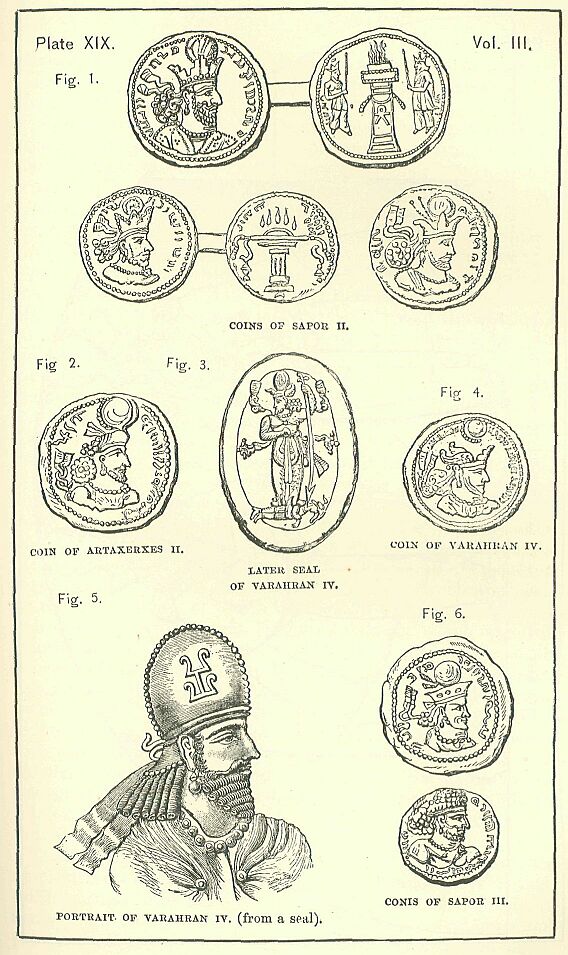
Short Reigns of Artaxerxes II. and Sapor III. Obscurity of their History. Their Relations with Armenia. Monument of Sapor III. at Tdkht-i-Bostan. Coins of Artaxerxes II. and Sapor III. Reign of Varahran IV. His Signets. His Dealings with Armenia. His Death.
The glorious reign of Sapor II., which carried the New Persian Empire to the highest point whereto it had yet attained, is followed by a time which offers to that remarkable reign a most complete contrast. Sapor had occupied the Persian throne for a space approaching nearly to three-quarters of a century; the reigns of his next three successors amounted to no more than twenty years in the aggregate. Sapor had been engaged in perpetual wars, had spread the terror of the Persian arms on all sides, and ruled more gloriously than any of his predecessors. The kings who followed him were pacific and unenterprising; they were almost unknown to their neighbors, and are among the least distinguished of the Sassanian monarchs. More especially does this character attach to the two immediate successors of Sapor II., viz. Artaxerxes II. and Sapor III. They reigned respectively four and five years; and their annals during this period are almost a blank. Artaxerxes II., who is called by some the brother of Sapor II., was more probably his son. He succeeded his father in A.D. 379, and died at Ctesiphon in A.D. 383. He left a character for kindness and amiability behind him, and is known to the Persians as Nihoukar, or "the Beneficent," and to the Arabs as Al Djemil, "the Virtuous." According to the "Modjmel-al-Tewarikh," he took no taxes from his subjects during the four years of his reign, and thereby secured to himself their affection and gratitude. He seems to have received overtures from the Armenians soon after his accession, and for a time to have been acknowledged by the turbulent mountaineers as their sovereign. After the murder of Bab, or Para, the Romans had set up, as king over Armenia, a certain Varaztad (Pharasdates), a member of the Arsacid family, but no near relation of the recent monarchs, assigning at the same time the real direction of affairs to an Armenian noble named Moushegh, who belonged to the illustrious family of the Mamigonians. Moushegh ruled Armenia with vigor, but was suspected of maintaining over-friendly relations with the Roman emperor, Valens, and of designing to undermine and supplant his master. Varaztad, after a while, having been worked on by his counsellors, grew suspicious of him, and caused him to be executed at a banquet. This treachery roused the indignation of Moushegh's brother Manuel, who raised a rebellion against Varaztad, defeated him in open fight, and drove him from his kingdom. Manuel then brought forward the princess Zermandueht, widow of the late king Para, together with her two young sons, Arsaces and Valarsaces, and, surrounding all three with royal pomp, gave to the two princes the name of king, while he took care to retain in his own hands the real government of the country. Under these circumstances he naturally dreaded the hostility of the Roman emperor, who was not likely to see with patience a monarch, whom he had set upon the throne, deprived of his kingdom by a subject. To maintain the position which he had assumed, it was necessary that he should contract some important alliance; and the alliance always open to Armenia when she had quarrelled with Rome was with the Persians. It seems to have been soon after Artaxerxes II. succeeded his father, that Manuel sent an embassy to him, with letters and rich gifts, offering, in return for his protection, to acknowledge him as lord-paramount of Armenia, and promising him unshakable fidelity. The offer was, of course, received with extreme satisfaction; and terms were speedily arranged. Armenia was to pay a fixed tribute, to receive a garrison of ten thousand Persians and to provide adequately for their support, to allow a Persian satrap to divide with Manuel the actual government of the country, and to furnish him with all that was necessary for his court and table. On the other hand, Arsacos and Valarsaces, together (apparently) with their mother, Zermandueht, were to be allowed the royal title and,honors; Armenia was to be protected in case of invasion; and Manuel was to be maintained in his office of Sparapet or generalissimo of the Armenian forces. We cannot say with certainty how long this arrangement remained undisturbed; most probably, however, it did not continue in force more than a few years. It was most likely while Artaxerxes still ruled Persia, that the rupture described by Faustus occurred. A certain Meroujan, an Armenian, noble, jealous of the power and prosperity of Manuel, persuaded him that the Persian commandant in Armenia was about to seize his person, and either to send him a prisoner to Artaxerxes, or else to put him to death. Manuel, who was so credulous as to believe the information, thought it necessary for his own safety to anticipate the designs of his enemies, and, falling upon the ten thousand Persians with the whole of the Armenian army, succeeded in putting them all to the sword, except their commander, whom he allowed to escape. War followed between Persia and Armenia with varied success, but on the whole Manuel had the advantage; he repulsed several Persian invasions, and maintained the independence and integrity of Armenia till his death, without calling in the aid of Rome. When, however, Manuel died, about A.D. 383, Armenian affairs fell into confusion; the Romans were summoned to give help to one party, the Persians to render assistance to the other; Armenia became once more the battle-ground between the two great powers, and it seemed as if the old contest, fraught with so many calamities, was to be at once renewed. But the circumstances of the time were such that neither Rome nor Persia now desired to reopen the contest. Persia was in the hands of weak and unwarlike sovereigns, and was perhaps already threatened by Scythic hordes upon the east. Rome was in the agonies of a struggle with the ever-increasing power of the Goths; and though, in the course of the years A.D. 379-382, the Great Theodosius had established peace in the tract under his rule, and delivered the central provinces of Macedonia and Thrace from the intolerable ravages of the barbaric invaders, yet the deliverance had been effected at the cost of introducing large bodies of Goths into the heart of the empire, while still along the northern frontier lay a threatening cloud, from which devastation and ruin might at any time burst forth and overspread the provinces upon the Lower Danube. Thus both the Roman emperor and the Persian king were well disposed towards peace. An arrangement was consequently made, and in A.D. 384, five years after he had ascended the throne, Theodosius gave audience in Constantinople to envoys from the court of Persepolis, and concluded with them a treaty whereby matters in Armenia were placed on a footing which fairly satisfied both sides, and the tranquillity of the East was assured. The high contracting powers agreed that Armenia should be partitioned between them. After detaching from the kingdom various outlying districts, which could be conveniently absorbed into their own territories, they divided the rest of the country into two unequal portions. The smaller of these, which comprised the more western districts, was placed under the protection of Rome, and was committed by Theodosius to the Arsaces who had been made king by Manuel, the son of the unfortunate Bab, or Para, and the grandson of the Arsaces contemporary with Julian. The larger portion, which consisted of the regions lying towards the east, passed under the suzerainty of Persia, and was confided by Sapor III., who had succeeded Artaxerxes II., to an Arsacid, named Chosroes, a Christian, who was given the title of king, and received in marriage at the same time one of Sapor's sisters. Such were the terms on which Rome and Persia brought their contention respecting Armenia to a conclusion. Friendly relations were in this way established between the two crowns, which continued undisturbed for the long space of thirty-six years (A.D. 384-420).
Sapor III. appears to have succeeded his brother Artaxerxes in A.D. 383, the year before the conclusion of the treaty. It is uncertain whether Artaxerxes vacated the throne by death, or was deposed in consequence of cruelties whereof he was guilty towards the priests and nobles. Tabari and Macoudi, who relate his deposition, are authors on whom much reliance cannot be placed; and the cruelties reported accord but ill with the epithets of "the Beneficent" and "the Virtuous," assigned to this monarch by others. Perhaps it is most probable that he held the throne till his death, according to the statements of Agathias and Eutychius. Of Sapor III., his brother and successor, two facts only are recorded—his conclusion of the treaty with the Romans in A.D. 384, and his war with the Arabs of the tribe of Yad, which must have followed shortly afterwards. It must have been in consequence of his contest with the latter, whom he attacked in their own country, that he received from his countrymen the appellation of "the Warlike," an appellation better deserved by either of the other monarchs who had borne the same name.
Sapor III. left behind him a sculptured memorial, which is still to be seen in the vicinity of Kermanshah. [PLATE XX.] It consists of two very similar figures, looking towards each other, and standing in an arched frame. On either side of the figures are inscriptions in the Old Pehlevi character, whereby we are enabled to identify the individuals represented with the second and the third Sapor. The inscriptions run thus:—"Pathkell zani mazdisn shahia Shahpuhri, malkan malJca Allan ve Anilan, minuchitli min yazdan, bari mazdisn shahia Auhr-mazdi, malkan malka Allan ve Anilan, minuchitli min yazdan, napi shahia Narshehi malkan malka;" and "Pathkeli mazdisn shahia Shahpuhri, malkan mallca Allan ve Anilan, minuchitli min yazdan, bari mazdisn shahia Shahpuhri, malkan malka Allan ve Anilan, minuchitli min yazdan, napi shahia Auhrmazdi, malkan malka." They are, it will be seen, identical in form, with the exception that the names in the right-hand inscription are "Sapor, Hormisdas, Narses," while those in the left-hand one are "Sapor, Sapor, Hormisdas." It has been supposed that the right-hand figure was erected by Sapor II., and the other afterwards added by Sapor III.; but the unity of the whole sculpture, and its inclusion under a single arch, seem to indicate that it was set up by a single sovereign, and was the fruit of a single conception. If this be so, we must necessarily ascribe it to the later of the two monarchs commemorated, i.e. to Sapor III., who must be supposed to have possessed more than usual filial piety, since the commemoration of their predecessors upon the throne is very rare among the Sassanians.
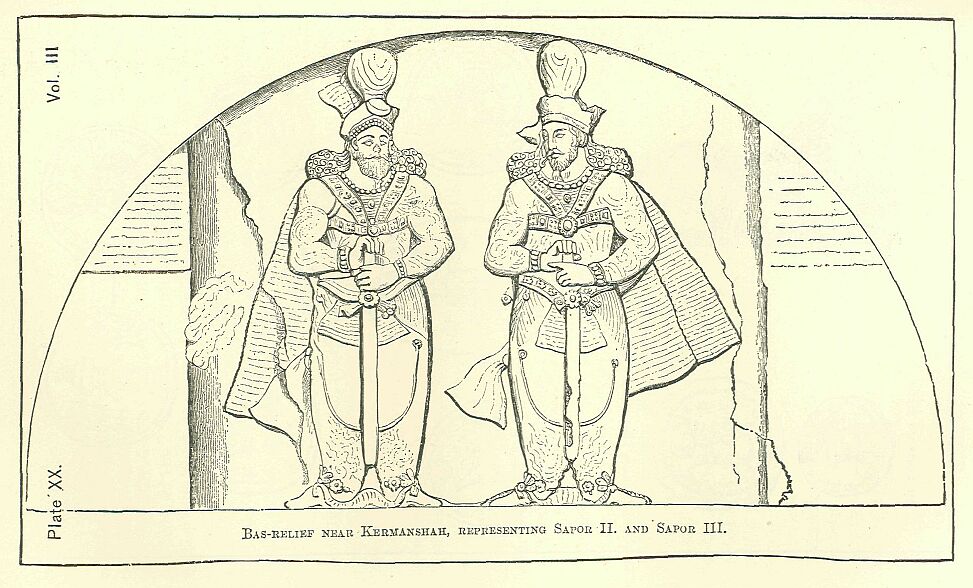
The taste of the monument is questionable. An elaborate finish of all the details of the costume compensates but ill for a clumsiness of contour and a want of contrast and variety, which indicate a low condition of art, and compare unfavorably with the earlier performances of the Neo-Persian sculptors. It may be doubted whether, among all the reliefs of the Sassanians, there is one which is so entirely devoid of artistic merit as this coarse and dull production.
The coins of Sapor III. and his predecessor, Artaxerxes II., have little about them that is remarkable. Those of Artaxerxes bear a head which is surmounted with the usual inflated ball, and has the diadem, but is without a crown—a deficiency in which some see an indication that the prince thus represented was regent rather than monarch of Persia. [PLATE XIX. Fig. 2.] The legends upon the coins are, however, in the usual style of royal epigraphs, running commonly—"Mazdisn bag Artah-shetri malkan malka Air an ve Aniran," or "the Ormazd-worshipping divine Artaxerxes, king of the kings of Iran and Turan." They are easily distinguishable from those of Artaxerxes I., both by the profile, which is far less marked, and by the fire-altar on the reverse, which has always two supporters, looking towards the altar. The coins of Sapor III. present some unusual types. [PLATE XIX. Fig. 6.] On some of them the king has his hair bound with a simple diadem, without crown or cap of any kind. On others he wears a cap of a very peculiar character, which has been compared to a biretta, but is really altogether sui generis. The cap is surmounted by the ordinary inflated ball, is ornamented with jewels, and is bound round at bottom with the usual diadem. The legend upon the obverse of Sapor's coins is of the customary character; but the reverse bears usually, besides the name of the king, the word atur, which has been supposed to stand for Aturia or Assyria; this explanation, however, is very doubtful.
The coins of both kings exhibit marks of decline, especially on the reverse, where the drawing of the figures that support the altar is very inferior to that which we observe on the coins of the kings from Sapor I. to Sapor II. The characters on both obverse and reverse are also carelessly rendered, and can only with much difficulty be deciphered.
Sapor III. died A.D. 388, after reigning a little more than five years. He was a man of simple tastes, and is said to have been fond of exchanging the magnificence and dreary etiquette of the court for the freedom and ease of a life under tents. On an occasion when he was thus enjoying himself, it happened that one of those violent hurricanes, to which Persia is subject, arose, and, falling in full force on the royal encampment, blew down the tent wherein he was sitting. It happened unfortunately that the main tent-pole struck him, as it fell, in a vital part, and Sapor died from the blow. Such at least was the account given by those who had accompanied him, and generally believed by his subjects. There were not, however, wanting persons to whisper that the story was untrue—that the real cause of the catastrophe which had overtaken the unhappy monarch was a conspiracy of his nobles, or his guards, who had overthrown his tent purposely, and murdered him ere he could escape from them.
The successor of Sapor III. was Varahran IV., whom some authorities call his brother and others his son. This prince is known to the oriental writers as "Varahran Kerm-an-sh-ah," or "Varahran, king of Carmania." Agathias tells us that during the lifetime of his father he was established as governor over Kerman or Carmania, and thus obtained the appellation which pertinaciously adhered to him. A curious relic of antiquity, fortunately preserved to modern times amid so much that has been lost, confirms this statement. It is the seal of Varahran before he ascended the Persian throne, and contains, besides his portrait, beautifully cut, an inscription, which is read as follows:—"Varahran Kerman malka, bari mazdisn bag Shahpuh-rimalkan malka Axran ve Aniran, minuchitri min yazclan," or "Varahran, king of Kerman, son of the Ormazd-worshipping divine Sapor, king of the kings of Iran and Turan, heaven-descended of the race of the gods." [PLATE XIX. Fig. 5.] Another seal, belonging to him probably after he had become monarch of Persia, contains his full-length portrait, and exhibits him as trampling under foot a prostrate figure, supposed to represent a Roman, by which it would appear that he claimed to have gained victories or advantages over Rome. [PLATE XIX. Figs. 3 and 4.] It is not altogether easy to understand how this could have been. Not only do the Roman writers mention no war between the Romans and Persians at this time, but they expressly declare that the East remained in profound repose during the entire reign of Varahran, and that Rome and Persia continued to be friends. The difficulty may, however, be perhaps explained by a consideration of the condition of affairs in Armenia at this time; for in Armenia Rome and Persia had still conflicting interests, and, without having recourse to arms, triumphs might be obtained in this quarter by the one over the other.
On the division of Armenia between Arsaces and Chosroes, a really good understanding had been established, which had lasted for about six years. Arsaces had died two years after he became a Roman feudatory; and, at his death, Rome had absorbed his territories into her empire, and placed the new province under the government of a count. No objection to the arrangement had been made by Persia, and the whole of Armenia had remained for four years tranquil and without disturbance. But, about A.D. 390, Chosroes became dissatisfied with his position, and entered into relations with Rome which greatly displeased the Armenian monarch. Chosroes obtained from Theodosius his own appointment to the Armenian countship, and thus succeeded in uniting both Roman and Persian Armenia under his government. Elated with this success, he proceeded further to venture on administrative acts which trenched, according to Persian views, on the rights of the lord paramount. Finally, when Varahran addressed to him a remonstrance, he replied in insulting terms, and, renouncing his authority, placed the whole Armenian kingdom under the suzerainty and protection of Rome. War between the two great powers must now have seemed imminent, and could indeed only have been avoided by great moderation and self-restraint on the one side or the other. Under these circumstances it was Rome that drew back. Theodosius declined to receive the submission which Chosroes tendered, and refused to lift a finger in his defence. The unfortunate prince was forced to give himself up to Varahan, who consigned him to the Castle of Oblivion, and placed his brother, Varabran-Sapor, upon the Armenian throne. These events seem to have fallen into the year A.D. 391, the third year of Varahran, who may well have felt proud of them, and have thought that they formed a triumph over Rome which deserved to be commemorated.
The character of Varahran IV. is represented variously by the native authorities. According to some of them, his temper was mild, and his conduct irreproachable. Others say that he was a hard man, and so neglected the duties of his station that he would not even read the petitions or complaints which were addressed to him. It would seem that there must have been some ground for these latter representations, since it is generally agreed that the cause of his death was a revolt of his troops, who surrounded him and shot at him with arrows. One shaft, better directed than the rest, struck him in a vital part, and he fell and instantly expired. Thus perished, in A.D. 399, the third son of the Great Sapor, after a reign of eleven years.
Accession of Isdigerd I. Peaceful Character of his Reign. His Alleged Guardianship of Theodosius II. His leaning towards Christianity, and consequent Unpopularity with his Subjects. His Change of view and Persecution of the Christians. His relations with Armenia. II. Coins. His Personal Character. His Death.
Varahran IV. was succeeded (A.D. 399) by his son, Izdikerti or Isdigerd I. whom the soldiers, though they had murdered his father, permitted to ascend the throne without difficulty. He is said, at his accession, to have borne a good character for prudence and moderation, a character which he sought to confirm by the utterance on various occasions of high-sounding moral sentiments. The general tenor of his reign was peaceful; and we may conclude therefore that he was of an unwarlike temper, since the circumstances of the time were such as would naturally have induced a prince of any military capacity to resume hostilities against the Romans. After the arrangement made with Rome by Sapor III. in A.D. 384, a terrible series of calamities had befallen the empire. Invasions of Ostrogoths and Franks signalized the years A.D. 386 and 388; in A.D. 387 the revolt of Maximus seriously endangered the western moiety of the Roman state; in the same year occurred an outburst of sedition at Antioch, which was followed shortly by the more dangerous sedition, and the terrible massacre of Thessalonica; Argobastes and Eugenius headed a rebellion in A.D. 393; Gildo the Moor detached Africa from the empire in A.D. 386, and maintained a separate dominion on the southern shores of the Mediterranean for twelve years, from A.D. 386 to 398; in A.D. 395 the Gothic warriors within and without the Roman frontier took arms, and under the redoubtable Alaric threatened at once the East and the West, ravaged Greece, captured Corinth, Argos, and Sparta, and from the coasts of the Adriatic already marked for their prey the smiling fields of Italy. The rulers of the East and West, Arcadius and Honorius, were alike weak and unenterprising; and further, they were not even on good terms, nor was either likely to trouble himself very greatly about attacks upon the territories of the other. Isdigerd might have crossed the Euphrates, and overrun or conquered the Asiatic provinces of the Eastern Empire, without causing Honorious a pang, or inducing him to stir from Milan. It is true that Western Rome possessed at this time the rare treasure of a capable general; but Stilicho was looked upon with fear and aversion by the emperor of the East, and was moreover fully occupied with the defence of his own master's territories. Had Isdigerd, on ascending the throne in A.D. 399, unsheathed the sword and resumed the bold designs of his grandfather, Sapor II., he could scarcely have met with any serious or prolonged resistance. He would have found the East governed practically by the eunuch Eutropius, a plunderer and oppressor, universally hated and feared; he would have had opposed to him nothing but distracted counsels and disorganized forces; Asia Minor was in possession of the Ostrogoths, who, under the leadership of Tribigild, were ravaging and destroying far and wide; the armies of the State were commanded by Gainas, the Goth, and Leo, the wool-comber, of whom the one was incompetent, and the other unfaithful; there was nothing, apparently, that could have prevented him from overrunning Roman Armenia, Mesopotamia, and Syria, or even from extending his ravages, or his dominion, to the shores of the AEgean. But the opportunity was either not seen, or was not regarded as having any attractions. Isdigerd remained tranquil and at rest within the walls of his capital. Assuming as his special title the characteristic epithet of "Ramashtras," "the most quiet," or "the most firm," he justified his assumption of it by a complete abstinence from all military expeditions.
When Isdigerd had reigned peaceably for the space of nine years, he is said to have received a compliment of an unusual character. Arcadius, the emperor of the East, finding his end approaching, and anxious to secure a protector for his son Theodosius, a boy of tender age, instead of committing him to the charge of his uncle Honorius, or selecting a guardian for him from among his own subjects, by a formal testamentary act, we are told, placed his child under the protection of the Persian monarch. He accompanied the appointment by a solemn appeal to the magnanimity of Isdigerd, whom he exhorted at some length to defend with all his force, and guide with his best wisdom, the young king and his kingdom. According to one writer, he further appended to this trust a valuable legacy—no less than a thousand pounds weight of pure gold, which he begged his Persian brother to accept as a token of his goodwill. When Arcadius died, and the testament was opened, information of its contents was sent to Isdigerd, who at once accepted the charge assigned to him, and addressed a letter to the Senate of Constantinople, in which he declared his determination to punish any attempt against his ward with the extremest severity. Unable to watch over his charge in person, he selected for his guide and instructor a learned eunuch of his court, by name Antiochus, and sent him to Constantinople, where for several years he was the young prince's constant companion. Even after his death or expulsion, which took place in consequence of the intrigues of Pulcheria, Theodosius's elder sister, the Persian monarch continued faithful to his engagements. During the whole of his reign he not only remained at peace with the Romans, but avoided every act that they could have regarded as in the least degree unfriendly.
Such is the narrative which has come down to us on the authority of historians, the earliest of whom wrote a century and a half after Arcadius's death. Modern criticism has, in general, rejected the entire story, on this account, regarding the silence of the earlier writers as outweighing the positive statements of the later ones. It should, however, be borne in mind, first that the earlier writers are few in number, and that their histories are very meagre and scanty; secondly, that the fact, if fact it were, was one not very palatable to Christians; and thirdly, that, as the results, so far as Rome was concerned, were negative, the event might not have seemed to be one of much importance, or that required notice. The character of Procopius, with whom the story originates, should also be taken into consideration, and the special credit allowed him by Agathias for careful and diligent research. It may be added, that one of the main points of the narrative—the position of Antiochus at Constantinople during the early years of Theodosius—is corroborated by the testimony of a contemporary, the bishop Synesius, who speaks of a man of this name, recently in the service of a Persian, as all-powerful with the Eastern emperor. It has been supposed by one writer that the whole story grew out of this fact; but the basis scarcely seems to be sufficient; and it is perhaps most probable that Arcadius did really by his will commend his son to the kind consideration of the Persian monarch, and that that monarch in consequence sent him an adviser, though the formal character of the testamentary act, and the power and position of Antiochus at the court of Constantinople, may have been overstated. Theodosius no doubt owed his quiet possession of the throne rather to the good disposition towards him of his own subjects than to the protection of a foreigner; and Isdigerd refrained from all attack on the territories of the young prince, rather by reason of his own pacific temper than in consequence of the will of Arcadius.
The friendly relations established, under whatever circumstances, between Isdigerd and the Roman empire of the East seemed to have inclined the Persian monarch, during a portion of his reign, to take the Christians into his favor, and even to have induced him to contemplate seeking admission into the Church by the door of baptism. Antiochus, his representative at the Court of Arcadius, openly wrote in favor of the persecuted sect; and the encouragement received from this high quarter rapidly increased the number of professing Christians in the Persian territories. The sectaries, though oppressed, had long been allowed to have their bishops; and Isdigerd is said to have listened with approval to the teaching of two of them, Marutha, bishop of Mesopotamia, and Abdaas, bishop of Ctesiphon. Convinced of the truth of Christianity, but unhappily an alien from its spirit, he commenced a persecution of the Magians and their most powerful adherents, which caused him to be held in detestation by his subjects, and has helped to attach to his name the epithets of "Al-Khasha," "the Harsh," and "Al-Athim," "the Wicked." But the' persecution did not continue long. The excessive zeal of Abdaas after a while provoked a reaction; and Isdigerd, deserting the cause which he had for a time espoused, threw himself (with all the zeal of one who, after nearly embracing truth, relapses into error) into the arms of the opposite party. Abdaas had ventured to burn down the great Fire-Temple of Ctesiphon, and had then refused to rebuild it. Isdigerd authorized the Magian hierarchy to retaliate by a general destruction of the Christian churches throughout the Persian dominions, and by the arrest and punishment of all those who acknowledged themselves to believe the Gospel. A fearful slaughter of the Christians in Pergia followed during five years; some, eager for the earthly glory and the heavenly rewards of martyrdom, were forward to proclaim themselves members of the obnoxious sect; others, less courageous or less inclined to self-assertion, sought rather to conceal their creed; but these latter were carefully sought out, both in the towns and in the country districts, and when convicted were relentlessly put to death. Nor was mere death regarded as enough. The victims were subjected, besides, to cruel sufferings of various kinds, and the greater number of them expired under torture. Thus Isdigerd alternately oppressed the two religious professions, to one or other of which belonged the great mass of his subjects; and, having in this way given both parties reason to hate him, earned and acquired a unanimity of execration which has but seldom been the lot of persecuting monarchs.
At the same time that Isdigerd allowed this violent persecution of the Christians in his own kingdom of Persia, he also sanctioned an attempt to extirpate Christianity in the dependent country of Armenia. Varahran-Sapor, the successor of Chosroes, had ruled the territory quietly and peaceably for twenty-one years. He died A.D. 413, leaving behind him a single son, Artases, who was at his father's death aged no more than ten years. Under these circumstances, Isaac, the Metropolitan of Armenia, proceeded to the court of Ctesiphon, and petitioned Isdigerd to replace on the Armenian throne the prince who had been deposed twenty-one years earlier, and who was still a prisoner on parole in the "Castle of Oblivion"—viz. Chosroes. Isdigerd acceded to the request; and Chosroes was released from confinement and restored to the throne from which he had been expelled by Varahran IV. in A.D. 391. He, however, survived his elevation only a year. Upon his decease, A.D. 413, Isdigerd selected for the viceroyship, not an Arsacid, not even an Armenian, but his own son, Sapor, whom he forced upon the reluctant provincials, compelling them to acknowledge him as monarch (A.D. 413-414). Sapor was instructed to ingratiate himself with the Armenian nobles, by inviting them to visit him, by feasting them, making them presents, holding friendly converse with them, hunting with them; and was bidden to use such influence as he might obtain to convert the chiefs from Christianity to Zoroastrianism. The young prince appears to have done his best; but the Armenians were obstinate, resisted his blandishments, and remained Christians in spite of all his efforts. He reigned from A.D. 414 to 418, at the end of which time, learning that his father had fallen into ill health, he quitted Armenia and returned to the Persian court, in order to press his claims to the succession. Isdigerd died soon afterwards (A.D. 419 or 420); and Sapor made an attempt to seize the throne; but there was another pretender whose partisans had more strength, and the viceroy of Armenia was treacherously assassinated in the palace of his father. Armenia remained for three years in a state of anarchy; and it was not till Varahran V. had been for some time established upon the Persian throne that Artases was made viceroy, under the name of Artasiris or Artaxerxes.
The coins of Isdigerd I. are not remarkable as works of art; but they possess some features of interest. They are numerous, and appear to have been issued from various mints, but all bear a head of the same type. [PLATE XXI., Fig. 1.] It is that of a middle-aged man, with a short beard and hair gathered behind the head in a cluster of curls. The distinguishing mark is the headdress, which has the usual inflated ball above a fragment of the old mural crown, and further bears a crescent in front. The reverse has the usual fire-altar with supporters, and is for the most part very rudely executed. The ordinary legend is, on the obverse, "Mazdisn bag ramashtras Izdikerti, malkan malka Airan," or "the Ormazd-worshipping divine most peaceful Isdigerd, king of the kings of Iran;" and on the reverse, Ramashtras Izdikerti, "the most peaceful Isdigerd." In some cases, there is a second name, associated with that of the monarch, on the reverse, a name which reads either "Ardashatri" (Artaxerxes) or, "Varahran." It has been conjectured that, where the name of "Artaxerxes" occurs, the reference is to the founder of the empire; while it is admitted that the "Varahran" intended is almost certainly Isdigerd's son and successor, Varahran V., the "Bahram-Grur" of the modern Persians. Perhaps a more reasonable account of the matter would be that Isdigerd had originally a son Artaxerxes, whom he intended to make his successor, but that this son died or offended him, and that then he gave his place to Varahran.
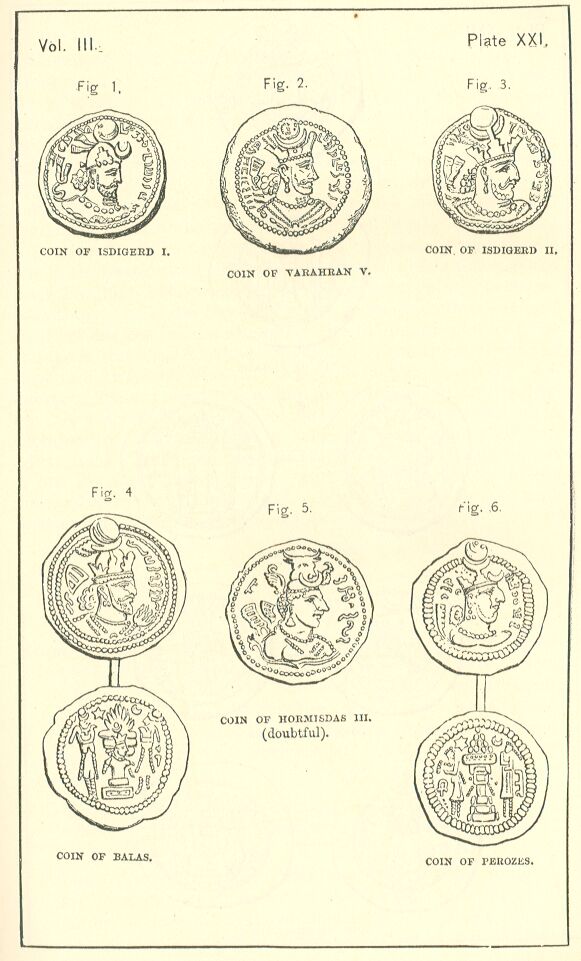
The character of Isdigerd is variously represented. According to the Oriental writers, he had by nature an excellent disposition, and at the time of his accession was generally regarded as eminently sage, prudent, and virtuous; but his conduct after he became king disappointed all the hopes that had been entertained of him. He was violent, cruel, and pleasure-seeking; he broke all laws human and divine; he plundered the rich, ill-used the poor, despised learning, left those who did him a service unrewarded, suspected everybody. He wandered continually about his vast empire, not to benefit his subjects, but to make them all suffer equally. In curious contrast with these accounts is the picture drawn of him by the Western authors, who celebrate his magnanimity and his virtue, his peaceful temper, his faithful guardianship of Theodosius, and even his exemplary piety. A modern writer has suggested that he was in fact a wise and tolerant prince, whose very mildness and indulgence offended the bigots of his own country, and caused them to represent his character in the most odious light, and do their utmost to blacken his memory. But this can scarcely be accepted as the true explanation of the discrepancy. It appears from the ecclesiastical historians that, whatever other good qualities Isdigerd may have possessed, tolerance at any rate was not among his virtues. Induced at one time by Christian bishops almost to embrace Christianity, he violently persecuted the professors of the old Persian religion. Alarmed at a later period by the excessive zeal of his Christian preceptors, and probably fearful of provoking rebellion among his Zoroastrian subjects, he turned around upon his late friends, and treated them with a cruelty even exceeding that previously exhibited towards their adversaries. It was probably this twofold persecution that, offending both professions, attached to Isdigerd in his own country the character of a harsh and bad monarch. Foreigners, who did not suffer from his caprices or his violence, might deem him magnanimous and a model of virtue. His own subjects with reason detested his rule, and branded his memory with the well-deserved epithet of Al-Athim, "the Wicked."
A curious tale is told as to the death of Isdigerd. He was still in the full vigor of manhood when one day a horse of rare beauty, without bridle or caparison, came of its own accord and stopped before the gate of his palace. The news was told to the king, who gave orders that the strange steed should be saddled and bridled, and prepared to mount it. But the animal reared and kicked, and would not allow any one to come near, till the king himself approached, when the creature totally changed its mood, appeared gentle and docile, stood perfectly still, and allowed both saddle and bridle to be put on. The crupper, however, needed some arrangement, and Isdigerd in full confidence proceeded to complete his task, when suddenly the horse lashed out with one of his hind legs, and dealt the unfortunate prince a blow which killed him on the spot. The animal then set off at speed, disembarrassed itself of its accoutrements, and galloping away was never seen any more. The modern historian of Persia compresses the tale into a single phrase, and tells us that "Isdigerd died from the kick of a horse:" but the Persians of the time regarded the occurrence as an answer to their prayers, and saw in the wild steed an angel sent by God.
Internal Troubles on the Death of Isdigerd I. Accession of Varahran V. His Persecution of the Christians. His War with Rome. His Relations with Armenia from A.D. 422 to A.D. 428. His Wars with the Scythic Tribes on his Eastern Frontier. His Strange Death. His Coins. His Character.
It would seem that at the death of Isdigerd there was some difficulty as to the succession. Varahran, whom he had designated as his heir, appears to have been absent from the capital at the time; while another son, Sapor, who had held the Armenian throne from A.D. 414 to 418, was present at the seat of government, and bent on pushing his claims. Varahran, if we may believe the Oriental writers, who are here unanimous, had been educated among the Arab tribes dependent on Persia, who now occupied the greater portion of Mesopotamia. His training had made him an Arab rather than a Persian; and he was believed to have inherited the violence, the pride, and the cruelty of his father. His countrymen were therefore resolved that they would not allow him to be king. Neither were they inclined to admit the claims of Sapor, whose government of Armenia had not been particularly successful, and whose recent desertion of his proper post for the advancement of his own private interests was a crime against his country which deserved punishment rather than reward. Armenia had actually revolted as soon as he quitted it, had driven out the Persian garrison, and was a prey to rapine and disorder. We cannot be surprised that, under these circumstances, Sapor's machinations and hopes were abruptly terminated, soon after his father's demise, by his own murder. The nobles and chief Magi took affairs into their own hands. Instead of sending for Varahran, or awaiting his arrival, they selected for king a descendant of Artaxerxes I. only remotely related to Isdigerd—a prince of the name of Chosroes—and formally placed him upon the throne. But Varahran was not willing to cede his rights. Having persuaded the Arabs to embrace his cause, he marched upon Ctesiphon at the head of a large force, and by some means or other, most probably by the terror of his arms, prevailed upon Chosroes, the nobles, and the Magi, to submit to him. The people readily acquiesced in the change of masters; Chosroes descended into a private station, and Varahran, son of Isdigerd, became king.
Varahran seems to have ascended the throne in A.D. 420. He at once threw himself into the hands of the priestly party, and, resuming the persecution of the Christians which his father had carried on during his later years, showed himself, to one moiety of his subjects at any rate, as bloody and cruel as the late monarch. Tortures of various descriptions were employed; and so grievous was the pressure put upon the followers of Christ that in a short time large numbers of the persecuted sect quitted the country, and placed themselves under the protection of the Romans. Varahran had to consider whether he would quietly allow the escape of these criminals, or would seek to enforce his will upon them at the risk of a rupture with Rome. He preferred the bolder line of conduct. His ambassadors were instructed to require the surrender of the refugees at the court of Constantinople; and when Theodosius, to his honor, indignantly rejected the demand, they had orders to protest against the emperor's decision, and to threaten him with their master's vengeance.
It happened that at the time there were some other outstanding disputes, which caused the relations of the two empires to be less amicable than was to be desired. The Persians had recently begun to work their gold mines, and had hired experienced persons from the Romans, whose services they found so valuable that when the period of the hiring was expired they would not suffer the miners to quit Persia and return to their homes. They are also said to have ill-used the Roman merchants who traded in the Persian territories, and to have actually robbed them of their merchandise.
These causes of complaint were not, however, it would seem, brought forward by the Romans, who contented themselves with simply refusing the demand for the extradition of the Christian fugitives, and refrained from making any counter-claims. But their moderation was not appreciated; and the Persian monarch, on learning that Rome would not restore the refugees, declared the peace to be at an end, and immediately made preparations for war. The Romans had, however, anticipated his decision, and took the field in force before the Persians were ready. The command was entrusted to a general bearing the strange name of Ardaburius, who marched his troops through Armenia into the fertile province of Arzanene, and there defeated Narses, the leader whom Varahran had sent against him. Proceeding to plunder Arzanene, Ardaburius suddenly heard that his adversary was about to enter the Roman province of Mesopotamia, which was denuded of troops, and seemed to invite attack. Hastily concluding his raid, he passed from Arzanene into the threatened district, and was in time to prevent the invasion intended by Narses, who, when he found his designs forestalled, threw himself into the fortress of Nisibis, and there stood on the defensive. Ardaburius did not feel himself strong enough to invest the town; and for some time the two adversaries remained inactive, each watching the other. It was during this interval that (if we may credit Socrates) the Persian general sent a challenge to the Roman, inviting him to fix time and place for a trial of strength between the two armies. Ardaburius prudently declined the overture, remarking that the Romans were not accustomed to fight battles when their enemies wished, but when it suited themselves. Soon afterwards he found himself able to illustrate his meaning by his actions. Having carefully abstained from attacking Nisibis while his strength seemed to him insufficient, he suddenly, upon receiving large reinforcements from Theodosius, changed his tactics, and, invading Persian Mesopotamia, marched upon the stronghold held by Narses, and formally commenced its siege.
Hitherto Varahran, confident in his troops or his good fortune, had left the entire conduct of the military operations to his general; but the danger of Nisibis—that dearly won and highly prized possession—seriously alarmed him, and made him resolve to take the field in person with all his forces. Enlisting on his side the services of his friends the Arabs, under their great sheikh, Al-Amundarus (Moundsir), and collecting together a strong body of elephants, he advanced to the relief of the beleaguered town. Ardaburius drew off on his approach, burned his siege artillery, and retired from before the place. Nisibis was preserved; but soon afterwards a disaster is said to have befallen the Arabs, who, believing themselves about to be attacked by the Roman force, were seized with a sudden panic, and, rushing in headlong flight to the Euphrates (!) threw themselves into its waters, encumbered with their clothes and arms, and there perished to the number of a hundred thousand.
The remaining circumstances of the war are not related by our authorities in chronological sequence. But as it is certain that the war lasted only two years, and as the events above narrated certainly belong to the earlier portion of it, and seem sufficient for one campaign, we may perhaps be justified in assigning to the second year, A.D. 421, the other details recorded—viz., the siege of Theodosiopolis, the combat between Areobindus and Ardazanes, the second victory of Ardaburius, and the destruction of the remnant of the Arabs by Vitianus.
Theodosiopolis was a city built by the reigning emperor, Theodosius II., in the Roman portion of Armenia, near the sources of the Euphrates. It was defended by strong walls, lofty towers, and a deep ditch. Hidden channels conducted an unfailing supply of water into the heart of the place, and the public granaries were large and generally well stocked with provisions. This town, recently built for the defence of the Roman Armenia, was (it would seem) attacked in A.D. 421 by Varahran in person. He besieged it for above thirty days, and employed against it all the means of capture which were known to the military art of the period. But the defence was ably conducted by the bishop of the city, a certain Eunomius, who was resolved that, if he could prevent it, an infidel and persecuting monarch should never lord it over his see. Eunomius not merely animated the defenders, but took part personally in the defence, and even on one occasion discharged a stone from a balista with his own hand, and killed a prince who had not confined himself to his military duties, but had insulted the faith of the besieged. The death of this officer is said to have induced Varahran to retire, and not further molest Theodosiopolis.
While the fortified towns on either side thus maintained themselves against the attacks made on them, Theodosius, we are told, gave an independent command to the patrician Procopius, and sent him at the head of a body of troops to oppose Varahran. The armies met, and were on the point of engaging when the Persian monarch made a proposition to decide the war, not by a general battle, but by a single combat. Procopius assented; and a warrior was selected on either side, the Persians choosing for their champion a certain Ardazanes, and the Romans "Areobindus the Goth," count of the "Foederati." In the conflict which followed the Persian charged his adversary with his spear, but the nimble Goth avoided the thrust by leaning to one side, after which he entangled Ardazanes in a net, and then despatched him with his sword. The result was accepted by Varahran as decisive of the war, and he desisted, from any further hostilities. Areobindus received the thanks of the emperor for his victory, and twelve years later was rewarded with the consulship.
But meanwhile, in other portions of the wide field over which the war was raging, Rome had obtained additional successes. Ardaburius, who probably still commanded in Mesopotamia, had drawn the Persian force opposed to him into an ambuscade, and had destroyed it, together with its seven generals. Vitianus, an officer of whom nothing more is known, had exterminated the remnant of the Arabs not drowned in the Euphrates. The war had gone everywhere against the Persians; and it is not improbable that Varahran, before the close of A.D. 421, proposed terms of peace.
Peace, however, was not exactly made till the next year. Early in A.D. 422, a Roman envoy, by name Maximus, appeared in the camp of Varahran, and, when taken into the presence of the great king, stated that he was empowered by the Roman generals to enter into negotiations, but had had no communication with the Roman emperor, who dwelt so far off that he had not heard of the war, and was so powerful that, if he knew of it, he would regard it as a matter of small account. It is not likely that Varahran was much impressed by these falsehoods; but he was tired of the war; he had found that Rome could hold her own, and that he was not likely to gain anything by prolonging it; and he was in difficulties as to provisions, whereof his supply had run short. He was therefore well inclined to entertain Maximus's proposals favorably. The corps of the "Immortals," however, which was in his camp, took a different view, and entreated to be allowed an opportunity of attacking the Romans unawares, while they believed negotiations to be going on, considering that under such circumstances they would be certain of victory. Varahran, according to the Roman writer who is here our sole authority, consented. The Immortals made their attack, and the Romans were at first in some danger; but the unexpected arrival of a reinforcement saved them, and the Immortals were defeated and cut off to a man. After this, Varahran made peace with Rome through the instrumentality of Maximus, consenting, it would seem, not merely that Rome should harbor the Persian Christians, if she pleased, but also that all persecution of Christians should henceforth cease throughout his own empire.
The formal conclusion of peace was accompanied, and perhaps helped forward, by the well-judging charity of an admirable prelate. Acacius, bishop of Amida, pitying the condition of the Persian prisoners whom the Romans had captured during their raid into Arzanene, and were dragging off into slavery, interposed to save them; and, employing for the purpose all the gold and silver plate that he could find in the churches of his diocese, ransomed as many as seven thousand captives, supplied their immediate wants with the utmost tenderness, and sent them to Varahran, who can scarcely have failed to be impressed by an act so unusual in ancient times. Our sceptical historian remarks, with more apparent sincerity than usual, that this act was calculated "to inform, the Persian king of the true spirit of the religion which he persecuted," and that the name of the doer might well "have dignified the saintly calendar." These remarks are just; and it is certainly to be regretted that, among the many unknown or doubtful names of canonized Christians to which the Church has given her sanction, there is no mention made of Acacius of Amida.
Varahran was perhaps the more disposed to conclude his war with Rome from the troubled condition of his own portion of Armenia, which imperatively required his attention. Since the withdrawal from that region of his brother Sapor in A.D. 418 or 419, the country had had no king. It had fallen into a state of complete anarchy and wretchedness; no taxes were collected; the roads were not safe; the strong robbed and oppressed the weak at their pleasure. Isaac, the Armenian patriarch, and the other bishops, had quitted their sees and taken refuge in Roman Armenia, where they were received favorably by the prefect of the East, Anatolius, who no doubt hoped by their aid to win over to his master the Persian division of the country. Varahran's attack on Theodosiopolis had been a counter movement, and had been designed to make the Romans tremble for their own possessions, and throw them back on the defensive. But the attack had failed; and on its failure the complete loss of Armenia probably seemed imminent. Varahran therefore hastened to make peace with Rome, and, having so done, proceeded to give his attention to Armenia, with the view of placing matters there on a satisfactory footing. Convinced that he could not retain Armenia unless with the good-will of the nobles, and believing them to be deeply attached to the royal stock of the Arsacids, he brought forward a prince of that noble house, named Artases, a son of Varahran-Sapor, and, investing him with the ensigns of royalty, made him take the illustrious name of Artaxerxes, and delivered into his hands the entire government of the country. These proceedings are assigned to the year A.D. 422, the year of the peace with Rome, and must have followed very shortly after the signature of the treaty.
It might have been expected that this arrangement would have satisfied the nobles of Armenia, and have given that unhappy country a prolonged period of repose. But the personal character of Artaxerxes was, unfortunately, bad; the Armenian nobles were, perhaps, capricious; and after a trial of six years it was resolved that the rule of the Arsacid monarch could not be endured, and that Varahran should be requested to make Armenia a province of his empire, and to place it under the government of a Persian satrap. The movement was resisted with all his force by Isaac, the patriarch, who admitted the profligacy of Artaxerxes and deplored it, but held that the role of a Christian, however lax he might be, was to be preferred to that of a heathen, however virtuous. The nobles, however, were determined; and the opposition of Isaac had no other result than to involve him in the fall of his sovereign. Appeal was made to the Persian king and Varahran, in solemn state, heard the charges made against Artaxerxes by his subjects, and listened to his reply to them. At the end he gave his decision. Artaxerxes was pronounced to have forfeited his crown, and was deposed; his property was confiscated, and his person committed to safe custody. The monarchy was declared to be at an end; and Persarmenia was delivered into the hands of a Persian governor. The patriarch Isaac was at the same time degraded from his office and detained in Persia as a prisoner. It was not till some years later that he was released, allowed to return into Armenia, and to resume, under certain restrictions, his episcopal functions.
The remaining circumstances of the reign of Varahran V. come to us wholly through the Oriental writers, amid whose exaggerations and fables it is very difficult to discern the truth. There can, however, be little doubt that it was during the reign of this prince that those terrible struggles commenced between the Persians and their neighbors upon the north-east which continued, from the early part of the fifth till the middle of the sixth century, to endanger the very existence of the empire. Various names are given to the people with whom Persia waged her wars during this period. They are called Turks, Huns, sometimes even Chinese, but these terms seem, to be used in a vague way, as "Scythian" was by the ancients; and the special ethnic designation of the people appears to be quite a different name from any of them. It is a name the Persian form of which is Haithal or Haiathleh, the Armenian Hephthagh, and the Greek "Ephthalites," or sometimes "Nephthalites." Different conjectures have been formed as to its origin: but none of them can be regarded as more than an ingenious theory. All that we know of the Ephthalites is, that they were established in force, during the fifth and sixth centuries of our era, in the regions east of the Caspian, especially in those beyond the Oxus river, and that they were generally regarded as belonging to the Scythic or Finno-Turkic population, which, at any rate from B.C. 200, had become powerful in that region. They were called "White Huns" by some of the Greeks; but it is admitted that they were quite distinct from the Huns who invaded Europe under Attila; and it may be doubted whether the term "Hun" is more appropriate to them than that of Turk or even of Chinese. The description of their physical character and habits left us by Procopius, who wrote when they were at the height of their power, is decidedly adverse to the view that they were really Huns. They were a light-complexioned race, whereas the Huns were decidedly swart; they were not ill-looking, whereas the Huns were hideous; they were an agricultural people, while the Huns were nomads; they had good laws, and were tolerably well civilized, but the Huns were savages. It is probable that they belonged to the Thibetic or Turkish stock, which has always been in advance of the Finnic, and has shown a greater aptitude for political organization and social progress.
We are told that the war of Varahran V. with this people commenced with an invasion of his kingdom by their Khacan, or Kahn, who crossed the Oxus with an army of 35,000 (or, according to others, of 250,000) men, and carried fire and sword into some of the most fertile provinces of Persia. The rich oasis, known as Meru or Merv, the ancient Margiana, is especially mentioned as overrun by his troops, which are said by some to have crossed the Elburz range into Khorassan and to have proceeded westward as far as Kei, or Rhages. When news of the invasion reached the Persian court, the alarm felt was great; Varahran was pressed to assemble his forces at once and encounter the unknown enemy; he, however, professed complete indifference, said that the Almighty would preserve the empire, and that, for his own part, he was going to hunt in Azerbijan, or Media Atropatene. During his absence the government could be conducted by Narses, his brother. All Persia was now thrown into consternation; Varahran was believed to have lost his senses; and it was thought that the only prudent course was to despatch an embassy to the Khacan, and make an arrangement with him by which Persia should acknowledge his suzerainty and consent to pay him a tribute. Ambassadors accordingly were sent; and the invaders, satisfied with the offer of submission, remained in the position which they had taken up, waiting for the tribute, and keeping slack guard, since they considered that they had nothing to fear. Varahran, however, was all the while preparing to fall upon them unawares. He had started for Azerbijan with a small body of picked warriors; he had drawn some further strength from Armenia; he proceeded along the mountain line through Taberistan, Hyrcania, and Nissa (Nishapur), marching only by night, and carefully masking his movements. In this way he reached the neighborhood of Merv unobserved. He then planned and executed a night attack on the invading army which was completely successful. Attacking his adversaries suddenly and in the dark—alarming them, moreover, with strange noises, and at the same time assaulting them with the utmost vigor—he put to flight the entire Tatar army. The Khan himself was killed; and the flying host was pursued to the banks of the Oxus. The whole of the camp equipage fell into the hands of the victors; and Khatoun, the wife of the great Khan, was taken. The plunder was of enormous value, and comprised the royal crown with its rich setting of pearls. After this success, Varahran, to complete his victory, sent one of his generals across the Oxus at the head of a large force, and falling upon the Tatars in their own country defeated them a second time with great slaughter. The enemy then prayed for peace, which was granted them by the victorious Varahran, who at the same time erected a column to mark the boundary of his empire in this quarter, and, appointing his brother Narses governor of Khorassan, ordered him to fix his residence at Balkh, and to prevent the Tatars from making incursions across the Oxus. It appears that these precautions were successful, for we hear nothing of any further hostilities in this quarter during the remainder of Varahran's reign.
The adventures of Varahran in India, and the enlargement of his dominions in that direction by the act of the Indian king, who is said so have voluntarily ceded to him Mekran and Scinde in return for his services against the Emperor of China, cannot be regarded as historical. Scarcely more so is the story that Persia had no musicians in his day, for which reason he applied to the Indian monarch, and obtained from him twelve thousand performers, who became the ancestors of the Lurs. After a reign which is variously estimated at nineteen, twenty, twenty-one, and twenty-three years, Varahran died by a death which would have been thought incredible, had not a repetition of the disaster, on the traditional site, been witnessed by an English traveller in comparatively recent times. The Persian writers state that Varahran was engaged in the hunt of the wild ass, when his horse came suddenly upon a deep pool, or spring of water, and either plunged into it or threw his rider into it, with the result that Varahran sank and never reappeared. The supposed scene of the incident is a valley between Ispahan and Shiraz. Here, in 1810, an English soldier lost his life through bathing in the spring traditionally declared to be that which proved fatal to Varahran. The coincidence has caused the general acceptance of a tale which would probably have been otherwise regarded as altogether romantic and mythical.
The coins of Varahran V. are chiefly remarkable for their rude and coarse workmanship and for the number of the mints from which they were issued. The mint-marks include Ctesiphon, Ecbatana, Isaphan, Arbela, Ledan, Nehavend, Assyria, Chuzistan, Media, and Kerman, or Carmania. The ordinary legend is, upon the obverse, Mazdisn bag Varahran malha, or Mazdisn bag Varahran rasti malha, and on the reverse, "Yavahran," together with a mint-mark. The head-dress has the mural crown in front and behind, but interposes between these two detached fragments a crescent and a circle, emblems, no doubt, of the sun and moon gods. The reverse shows the usual fire-altar, with guards, or attendants, watching it. The king's head appears in the flame upon the altar. [PLATE XXI. Fig. 2].
According to the Oriental writers, Varahran V. was one of the best of the Sassanian princes. He carefully administered justice among his numerous subjects, remitted arrears of taxation, gave pensions to men of science and letters, encouraged agriculture, and was extremely liberal in the relief of poverty and distress. His faults were, that he was over-generous and over-fond of amusements, especially of the chase. The nickname of "Bahram-Gur," by which he is known to the Orientals, marks this last-named predilection, transferring to him, as it does, the name of the animal which was the especial object of his pursuit. But he was almost equally fond of dancing and of games. Still it does not appear that his inclination for amusements rendered him neglectful of public affairs, or at all interfered with his administration of the State. Persia is said to have been in a most flourishing condition during his reign. He may not have gained all the successes that are ascribed to him; but he was undoubtedly an active prince, brave, energetic, and clear-sighted. He judiciously brought the Roman war to a close when a new and formidable enemy appeared on his north-eastern frontier; he wisely got rid of the Armenian difficulty, which had been a stumbling block in the way of his predecessors for two hundred years; he inflicted a check on the aggressive Tatars, which indisposed them to renew hostilities with Persia for a quarter of a century. It would seem that he did not much appreciate art but he encouraged learning, and did his best to advance science.