Annourbis.com > Julius Caesar > Chapter 19
The conquest of Gaul had been an exploit of extraordinary military difficulty. The intricacy of the problem had been enhanced by the venom of a domestic faction, to which the victories of a democratic general were more unwelcome than national disgrace. The discomfiture of Crassus had been more pleasant news to the Senate than the defeat of Ariovistus, and the passionate hope of the aristocracy had been for some opportunity which would enable them to check Caesar in his career of conquest and bring him home to dishonor and perhaps impeachment. They had failed. The efforts of the Gauls to maintain or recover their independence had been successively beaten down, and at the close of the summer of 53 Caesar had returned to the north of Italy, believing that the organization of the province which he had added to the Empire was all that remained to be accomplished. But Roman civilians had followed in the van of the armies. Roman traders had penetrated into the towns on the Seine and the Loire, and the curious Celts had learnt from them the distractions of their new rulers. Caesar's situation was as well understood among the Aedui and the Sequani as in the clubs and coteries of the capital of the Empire, and the turn of events was watched with equal anxiety. The victory over Sabinus, sharply avenged as it had been, kept alive the hope that their independence might yet be recovered. The disaffection of the preceding summer had been trampled out, but the ashes of it were still smouldering; and when it became known that Clodius, who was regarded as Caesar's tribune, had been killed, that the Senate was in power again, and that Italy was threatened with civil convulsions, their passionate patriotism kindled once more into flame. Sudden in their resolutions, they did not pause to watch how the balance would incline. Caesar was across the Alps. Either he would be deposed, or civil war would detain him in Italy. His legions were scattered between Trèves, Auxerre, and Sens, far from the Roman frontier. A simultaneous rising would cut them off from support, and they could be starved out or overwhelmed in detail, as Sabinus had been at Tongres and Cicero had almost been at Charleroy. Intelligence was swiftly exchanged. The chiefs of all the tribes established communications with each other. They had been deeply affected by the execution of Acco, the patriotic leader of the Carnutes. The death of Acco was an intimation that they were Roman subjects, and were to be punished as traitors if they disobeyed a Roman command. They buried their own dissensions. Except among the Aedui there was no longer a Roman faction and a patriot faction. The whole nation was inspired by a simultaneous impulse to snatch the opportunity, and unite in a single effort to assert their freedom. The understanding was complete. A day was fixed for a universal rising. The Carnutes began by a massacre which would cut off possibility of retreat, and, in revenge for Acco, slaughtered a party of Roman civilians who were engaged in business at Gien. 1 A system of signals had been quietly arranged. The massacre at Gien was known in a few hours in the south, and the Auvergne country, which had hitherto been entirely peaceful, rose in reply, under a young high-born chief named Vercingetorix.
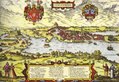
Gergovia, the principal town of the Arverni, was for the moment undecided. 2 The elder men there, who had known the Romans long, were against immediate action; but Vercingetorix carried the people away with him. His name had not appeared in the earlier campaigns, but his father had been a man of note beyond the boundaries of Auvergne; and he must himself have had a wide reputation among the Gauls, for everywhere, from the Seine to the Garonne, he was accepted as chief of the national confederacy. Vercingetorix had high ability and real organizing powers. He laid out a plan for the general campaign. He fixed a contingent of men and arms which each tribe was to supply, and failure brought instantaneous punishment. Mild offences were visited with the loss of eyes or ears; neglect of a more serious sort with death by fire in the wicker tower. Between enthusiasm and terror he had soon an army at his command, which he could increase indefinitely at his need. Part he left to watch the Roman province and prevent Caesar, if he should arrive, from passing through. With part he went himself to watch the Aedui, the great central race, where Roman authority had hitherto prevailed unshaken, but among whom, as he well knew, he had the mass of the people on his side. The Aedui were hesitating. They called their levies under arms, as if to oppose him, but they withdrew them again; and to waver at such a moment was to yield to the stream.
The Gauls had not calculated without reason on Caesar's embarrassments. The death of Clodius had been followed by the burning of the senate-house and by many weeks of anarchy. To leave Italy at such a moment might be to leave it a prey to faction or civil war. His anxiety was relieved at last by hearing that Pompey had acted, and that order was restored; and seeing no occasion for his own interference, and postponing the agitation for his second consulship, he hurried back to encounter the final and convulsive effort of the Celtic race to preserve their liberties. The legions were as yet in no danger. They were dispersed in the north of France, far from the scene of the present rising, and the northern tribes had suffered too desperately in the past years to be in a condition to stir without assistance. But how was Caesar to join them? The garrisons in the province could not be moved. If he sent for the army to come across to him, Vercingetorix would attack them on the march, and he could not feel confident of the result; while the line of the old frontier of the province was in the hands of the insurgents, or of tribes who could not be trusted to resist the temptation, if he passed through himself without more force than the province could supply. But Caesar had a resource which never failed him in the daring swiftness of his own movements. He sent for the troops which were left beyond the Alps. He had a few levies with him to fill the gaps in the old legions, and after a rapid survey of the stations on the provincial frontier he threw himself upon the passes of the Cevennes. It was still winter. The snow lay six feet thick on the mountains, and the roads at that season were considered impracticable even for single travellers. The Auvergne rebels dreamt of nothing so little as of Caesar's coming upon them at such a time and from such a quarter. He forced his way. He fell on them while they were lying in imagined security, Vercingetorix and his army being absent watching the Aedui, and, letting loose his cavalry, he laid their country waste. But Vercingetorix, he knew, would fly back at the news of his arrival; and he had already made his further plans. He formed a strong entrenched camp, where he left Decimus Brutus in charge, telling him that he would return as quickly as possible; and, unknown to any one, lest the troops should lose courage at parting with him, he flew across through an enemy's country with a handful of attendants to Vienne, on the Rhone, where some cavalry from the province had been sent to wait for him. Vercingetorix, supposing him still to be in the Auvergne, thought only of the camp of Brutus; and Caesar, riding day and night through the doubtful territories of the Aedui, reached the two legions which were quartered near Auxerre. Thence he sent for the rest to join him, and he was at the head of his army before Vercingetorix knew that only Brutus was in front of him. The Aedui, he trusted, would now remain faithful. But the problem before him was still most intricate. The grass had not begun to grow. Rapid movement was essential to prevent the rebel confederacy from consolidating itself; but rapid movements with a large force required supplies; and whence were the supplies to come? Some risks had to be run, but to delay was the most dangerous of all. On the defeat of the Helvetii, Caesar had planted a colony of them at Gorgobines, near Nevers, on the Loire. These colonists, called Boii, had refused to take part in the rising; and Vercingetorix, turning in contempt from Brutus, had gone off to punish them. Caesar ordered the Aedui to furnish his commissariat, sent word to the Boii that he was coming to their relief, swept through the Senones, that he might leave no enemy in his rear, and then advanced on Gien, where the Roman traders had been murdered, and which the Carnutes still occupied in force. There was a bridge there over the Loire, by which they tried to escape in the night. Caesar had beset the passage. He took the whole of them prisoners, plundered and burnt the town, gave the spoil to his troops, and then crossed the river and went up to help the Boii. He took Nevers. Vercingetorix, who was hastening to its relief, ventured his first battle with him; but the cavalry, on which the Gauls most depended, were scattered by Caesar's German horse. He was entirely beaten, and Caesar turned next to Avaricum (Bourges), a rich and strongly fortified town of the Bituriges. From past experience Caesar had gathered that the Gauls were easily excited and as easily discouraged. If he could reduce Bourges, he hoped that this part of the country would return to its allegiance. Perhaps he thought that Vercingetorix himself would give up the struggle. But he had to deal with a spirit and with a man different from any which he had hitherto encountered. Disappointed in his political expectations, baffled in strategy, and now defeated in open fight, the young chief of the Arverni had only learnt that he had taken a wrong mode of carrying on the war, and that he was wasting his real advantages. Battles in the field he saw that he would lose. But the Roman numbers were limited, and his were infinite. Tens of thousands of gallant young men, with their light, active horses, were eager for any work on which he might set them. They could scour the country far and wide. They could cut off Caesar's supplies. They could turn the fields into a blackened wilderness before him on whichever side he might turn. The hearts of the people were with him. They consented to a universal sacrifice. They burnt their farmsteads. They burnt their villages. Twenty towns (so called) of the Bituriges were consumed in a single day. The tribes adjoining caught the enthusiasm. The horizon at night was a ring of blazing fires. Vercingetorix was for burning Bourges also; but it was the sacred home of the Bituriges, the one spot which they implored to be allowed to save, the most beautiful city in all Gaul. Rivers defended it on three sides, and on the fourth there were swamps and marshes which could be passed only by a narrow ridge. Within the walls the people had placed the best of their property, and Vercingetorix, against his judgment, consented, in pity for their entreaties, that Avaricum should be defended. A strong garrison was left inside. Vercingetorix entrenched himself in the forests sixteen miles distant, keeping watch over Caesar's communications. The place could only be taken by regular approaches, during which the army had to be fed. The Aedui were growing negligent. The feeble Boii, grateful, it seemed, for Caesar's treatment of them, exerted themselves to the utmost, but their small resources were soon exhausted. For many days the legions were without bread. The cattle had been driven into the woods. It came at last to actual famine. 3 "But not one word was heard from them," says Caesar, "unworthy of the majesty of the Roman people or their own earlier victories." He told them that if the distress became unbearable he would raise the siege. With one voice they entreated him to persevere. They had served many years with him, they said, and had never abandoned any enterprise which they had undertaken. They were ready to endure any degree of hardship before they would leave unavenged their countrymen who had been murdered at Gien.
Vercingetorix, knowing that the Romans were in difficulties, ventured nearer. Caesar surveyed his position. It had been well chosen behind a deep morass. The legions clamored to be allowed to advance and attack him, but a victory, he saw, would be dearly purchased. No condemnation could be too severe for him, he said, if he did not hold the lives of his soldiers dearer than his own interest, 4 and he led them back without indulging their eagerness.
The siege work was unexpectedly difficult. The inhabitants of the Loire country were skilled artisans, trained in mines and iron works. The walls, built of alternate layers of stone and timber, were forty feet in thickness, and could neither be burnt nor driven in with the ram. The town could be taken only with the help of an agger--a bank of turf and fagots raised against the wall of sufficient height to overtop the fortifications. The weather was cold and wet, but the legions worked with such a will that in twenty-five days they had raised their bank at last, a hundred yards in width and eighty feet high. As the work drew near its end Caesar himself lay out all night among the men, encouraging them. One morning at daybreak he observed that the agger was smoking. The ingenious Gauls had undermined it and set it on fire. At the same moment they appeared along the walls with pitch-balls, torches, fagots, which they hurled in to feed the flames. There was an instant of confusion, but Caesar uniformly had two legions under arms while the rest were working. The Gauls fought with a courage which called out his warm admiration. He watched them at the points of greatest danger falling under the shots from the scorpions, and others stepping undaunted into their places to fall in the same way. Their valor was unavailing. They were driven in, and the flames were extinguished; the agger was level with the walls, and defence was no longer possible. The garrison intended to slip away at night through the ruins to join their friends outside. The wailing of the women was heard in the Roman camp, and escape was made impossible. The morning after, in a tempest of rain and wind, the place was stormed. The legionaries, excited by the remembrance of Gien and the long resistance, slew every human being that they found, men, women, and children all alike. Out of forty thousand who were within the walls, eight hundred only, that had fled at the first sound of the attack, made their way to the camp of Vercingetorix.
Undismayed by the calamity, Vercingetorix made use of it to sustain the determination of his followers. He pointed out to them that he had himself opposed the defence. The Romans had defeated them, not by superior courage, but by superior science. The heart of the whole nation was united to force the Romans out of Gaul, and they had only to persevere in a course of action where science would be useless, to be sure of success in the end. He fell back upon his own country, taking special care of the poor creatures who had escaped from the carnage; and the effect of the storming of Bourges was to make the national enthusiasm hotter and fiercer than before.
The Romans found in the town large magazines of corn and other provisions, which had been laid in for the siege, and Caesar remained there some days to refresh his troops. The winter was now over. The Aedui were giving him anxiety, and as soon as he could he moved to Decize, a frontier town belonging to them on the Loire, almost in the very centre of France. The anti-Roman faction were growing in influence. He called a council of the principal persons, and, to secure the fidelity of so important a tribe, he deposed the reigning chief and appointed another who had been nominated by the Druids. 5 He lectured the Aedui on their duty, bade them furnish him with ten thousand men, who were to take charge of the commissariat, and then divided his army. Labienus, with four legions, was sent to compose the country between Sens and Paris. He himself, with the remaining six legions, ascended the right bank of the Allier towards Gergovia in search of Vercingetorix. The bridges on the Allier were broken, but Caesar seized and repaired one of them and carried his army over.
The town of Gergovia stood on a high plateau, where the rivers rise which run into the Loire on one side and into the Dordogne on the other. The sides of the hill are steep, and only accessible at a very few places, and the surrounding neighborhood is broken with rocky valleys. Vercingetorix lay in force outside, but in a situation where he could not be attacked except at disadvantage, and with his communication with the fortress secured. He was departing again from his general plan for the campaign in allowing Gergovia to be defended; but it was the central home of his own tribe, and the result showed that he was right in believing it to be impregnable. Caesar saw that it was too strong to be stormed, and that it could only be taken after long operations. After a few skirmishes he seized a spur of the plateau which cut off the garrison from their readiest water-supply, and he formed an entrenched camp upon it. He was studying the rest of the problem when bad news came that the Aedui were unsteady again. The ten thousand men had been raised as he had ordered, but on their way to join him they had murdered the Roman officers in charge of them, and were preparing to go over to Vercingetorix. Leaving two legions to guard his works, he intercepted the Aeduan contingent, took them prisoners, and protected their lives. In his absence Vercingetorix had attacked the camp with determined fury. The fighting had been desperate, and Caesar only returned in time to save it. The reports from the Aedui were worse and worse. The patriotic faction had the upper hand, and with the same passionate determination to commit themselves irrevocably, which had been shown before at Gien, they had massacred every Roman in their territory. It was no time for delaying over a tedious siege: Caesar was on the point of raising it, when accident brought on a battle under the walls. An opportunity seemed to offer itself of capturing the place by escalade, which part of the army attempted contrary to orders. They fought with more than their usual gallantry. The whole scene was visible from the adjoining hills, the Celtic women, with long streaming hair, wildly gesticulating on the walls. The Romans were driven back with worse loss than they had yet met with in Gaul. Forty-six officers and seven hundred men had been killed.
Caesar was never more calm than under a reverse. He addressed the legions the next day. He complimented their courage, but he said it was for the general and not for them to judge when assaults should be tried. He saw the facts of the situation exactly as they were. His army was divided. Labienus was far away with a separate command. The whole of Gaul was in flames. To persevere at Gergovia would only be obstinacy, and he accepted the single military failure which he met with when present in person through the whole of his Gallic campaign.
Difficulties of all kinds were now thickening. Caesar had placed magazines in Nevers, and had trusted them to an Aeduan garrison. The Aeduans burnt the town and carried the stores over the Loire to their own strongest fortress, Bibracte (Mont Beauvray). The river had risen from the melting of the snows, and could not be crossed without danger; and to feed the army in its present position was no longer possible. To retreat upon the province would be a confession of defeat. The passes of the Cevennes would be swarming with enemies, and Labienus with his four legions in the west might be cut off. With swift decision he marched day and night to the Loire. He found a ford where the troops could cross with the water at their armpits. He sent his horse over and cleared the banks. The army passed safely. Food enough and in plenty was found in the Aeduans' country, and without waiting he pressed on toward Sens to reunite his forces. He understood the Gauls, and foresaw what must have happened.
Labienus, when sent on his separate command, had made Sens his head- quarters. All down the Seine the country was in insurrection. Leaving the new Italian levies at the station, he went with his experienced troops down the left bank of the river till he came to the Essonne. He found the Gauls entrenched on the other side, and, without attempting to force the passage, he marched back to Melun, where he repaired a bridge which the Gauls had broken, crossed over, and descended without interruption to Paris. The town had been burnt, and the enemy were watching him from the further bank. At this moment he heard of the retreat from Gergovia, and of the rebellion of the Aedui. Such news, he understood at once, would be followed by a rising in Belgium. Report had said that Caesar was falling back on the province. He did not believe it. Caesar, he knew, would not desert him. His own duty, therefore, was to make his way back to Sens. But to leave the army of Gauls to accompany his retreat across the Seine, with the tribes rising on all sides, was to expose himself to the certainty of being intercepted. "In these sudden difficulties," says Caesar, "he took counsel from the valor of his mind." 6 He had brought a fleet of barges with him from Melun. These he sent down unperceived to a point at the bend of the river four miles below Paris, and directed them to wait for him there. When night fell he detached a few cohorts with orders to go up the river with boats as if they were retreating, splashing their oars, and making as much noise as possible. He himself with three legions stole silently in the darkness to his barges, and passed over without being observed. The Gauls, supposing the whole army to be in flight for Sens, were breaking up their camp to follow in boisterous confusion. Labienus fell upon them, telling the Romans to fight as if Caesar was present in person; and the courage with which the Gauls fought in their surprise only made the overthrow more complete. The insurrection in the north-west was for the moment paralysed, and Labienus, secured by his ingenious and brilliant victory, returned to his quarters without further accident. There Caesar came to him as he expected, and the army was once more together.
Meanwhile the failure at Gergovia had kindled the enthusiasm of the central districts into white-heat. The Aedui, the most powerful of all the tribes, were now at one with their countrymen, and Bibracte became the focus of the national army. The young Vercingetorix was elected sole commander, and his plan, as before, was to starve the Romans out. Flying bodies harassed the borders of the province, so that no reinforcements could reach them from the south. Caesar, however, amidst his conquests had the art of making staunch friends. What the province could not supply he obtained from his allies across the Rhine, and he furnished himself with bodies of German cavalry, which when mounted on Roman horses proved invaluable. In the new form which the insurrection had assumed the Aedui were the first to be attended to. Caesar advanced leisurely upon them, through the high country at the rise of the Seine and the Marne, toward Alesia, or Alice St. Reine. Vercingetorix watched him at ten miles' distance. He supposed him to be making for the province, and his intention was that Caesar should never reach it. The Celts at all times have been fond of emphatic protestations. The young heroes swore a solemn oath that they would not see wife or children or parents more till they had ridden twice through the Roman army. In this mood they encountered Caesar in the valley of the Vingeanne, a river which falls into the Saône, and they met the fate which necessarily befell them when their ungovernable multitudes engaged the legions in the open field. They were defeated with enormous loss: not they riding through the Roman army, but themselves ridden over and hewn down by the German horsemen and sent flying for fifty miles over the hills into Alice St. Reine. Caesar followed close behind, driving Vercingetorix under the lines of the fortress; and the siege of Alesia, one of the most remarkable exploits in all military history, was at once undertaken.
Alesia, like Gergovia, is on a hill sloping off all round, with steep and, in places, precipitous sides. It lies between two small rivers, the Ose and the Oserain, both of which fall into the Brenne, and thence into the Seine. Into this peninsula, with the rivers on each side of him, Vercingetorix had thrown himself with eighty thousand men. Alesia as a position was impregnable except to famine. The water-supply was secure. The position was of extraordinary strength. The rivers formed natural trenches. Below the town to the east they ran parallel for three miles through an open alluvial plain before they reached Brenne. In every other direction rose rocky hills of equal height with the central plateau, originally perhaps one wide table-land, through which the water had ploughed out the valleys. To attack Vercingetorix where he had placed himself was out of the question; but to blockade him there, to capture the leader of the insurrection and his whole army, and so in one blow make an end with it, on a survey of the situation seemed not impossible. The Gauls had thought of nothing less than of being besieged. The provisions laid in could not be considerable, and so enormous a multitude could not hold out many days.
At once the legions were set to work cutting trenches or building walls as the form of the ground allowed. Camps were formed at different spots, and twenty-three strong block-houses at the points which were least defensible. The lines where the circuit was completed were eleven miles long. The part most exposed was the broad level meadow which spread out to the west toward the Brenne river. Vercingetorix had looked on for a time, not understanding what was happening to him. When he did understand it, he made desperate efforts on his side to break the net before it closed about him. But he could do nothing. The Gauls could not be brought to face the Roman entrenchments. Their cavalry were cut to pieces by the German horse. The only hope was in help from without, and before the lines were entirely finished horsemen were sent out with orders to ride for their lives into every district in Gaul and raise the entire nation. The crisis had come. If the countrymen of Vercingetorix were worthy of their fathers, if the enthusiasm with which they had risen for freedom was not a mere emotion, but the expression of a real purpose, their young leader called on them to come now, every man of them, and seize Caesar in the trap into which he had betrayed himself. If, on the other hand, they were careless, if they allowed him and his eighty thousand men to perish without an effort to save them, the independence which they had ceased to deserve would be lost forever. He had food, he bade the messengers say, for thirty days; by thrifty management it might be made to last a few days longer. In thirty days he should look for relief.
The horsemen sped away like the bearers of the fiery cross. Caesar learnt from deserters that they had gone out, and understood the message which they carried. Already he was besieging an army far outnumbering his own. If he persevered, he knew that he might count with certainty on being attacked by a second army immeasurably larger. But the time allowed for the collection of so many men might serve also to prepare for their reception. Vercingetorix said rightly that the Romans won their victories, not by superior courage, but by superior science. The same power of measuring the exact facts of the situation which determined Caesar to raise the siege of Gergovia decided him to hold on at Alesia. He knew exactly, to begin with, how long Vercingetorix could hold out. It was easy for him to collect provisions within his lines which would feed his own army a few days longer. Fortifications the same in kind as those which prevented the besieged from breaking out would serve equally to keep the assailants off. His plan was to make a second line of works--an exterior line as well as an interior line; and as the extent to be defended would thus be doubled, he made them of a peculiar construction, to enable one man to do the work of two. There is no occasion to describe the rows of ditches, dry and wet; the staked pitfalls; the cervi, pronged instruments like the branching horns of a stag; the stimuli, barbed spikes treacherously concealed to impale the unwary and hold him fast when caught, with which the ground was sown in irregular rows; the vallus and the lorica, and all the varied contrivances of Roman engineering genius. Military students will read the particulars for themselves in Caesar's own language. Enough that the work was done within the time, with the legions in perfect good humor, and giving jesting names to the new instruments of torture as Caesar invented them. Vercingetorix now and then burst out on the working parties, but produced no effect. They knew what they were to expect when the thirty days were out; but they knew their commander, and had absolute confidence in his judgment.
Meanwhile, on all sides, the Gauls were responding to the call. From every quarter, even from far-off parts of Belgium, horse and foot were streaming along the roads. Commius of Arras, Caesar's old friend, who had gone with him to Britain, was caught with the same frenzy, and was hastening among the rest to help to end him. At last two hundred and fifty thousand of the best fighting men that Gaul could produce had collected at the appointed rendezvous, and advanced with the easy conviction that the mere impulse of so mighty a force would sweep Caesar off the earth. They were late in arriving. The thirty days had passed, and there were no signs of the coming deliverers. Eager eyes were straining from the heights of the plateau; but nothing was seen save the tents of the legions or the busy units of men at work on the walls and trenches. Anxious debates were held among the beleaguered chiefs. The faint-hearted wished to surrender before they were starved. Others were in favor of a desperate effort to cut their way through or die. One speech Caesar preserves for its remarkable and frightful ferocity. A prince of Auvergne said that the Romans conquered to enslave and beat down the laws and liberties of free nations under the lictors' axes, and he proposed that sooner than yield they should kill and eat those who were useless for fighting.
Vercingetorix was of noble nature. To prevent the adoption of so horrible an expedient, he ordered the peaceful inhabitants, with their wives and children, to leave the town. Caesar forbade them to pass his lines. Cruel--but war is cruel; and where a garrison is to be reduced by famine the laws of it are inexorable.
But the day of expected deliverance dawned at last. Five miles beyond the Brenne the dust-clouds of the approaching host were seen, and then the glitter of their lances and their waving pennons. They swam the river. They filled the plain below the town. From the heights of Alesia the whole scene lay spread under the feet of the besieged. Vercingetorix came down on the slope to the edge of the first trench, prepared to cross when the turn of battle should give him a chance to strike. Caesar sent out his German horse, and stood himself watching from the spur of an adjoining hill. The Gauls had brought innumerable archers with them. The horse flinched slightly under the showers of arrows, and shouts of triumph rose from the lines of the town; but the Germans rallied again, sent the cavalry of the Gauls flying, and hewed down the unprotected archers. Vercingetorix fell back sadly to his camp on the hill, and then for a day there was a pause. The relieving army had little food with them, and, if they acted at all, must act quickly. They spread over the country collecting faggots to fill the trenches, and making ladders to storm the walls. At midnight they began their assault on the lines in the plain; and Vercingetorix, hearing by the cries that the work had begun, gave his own signal for a general sally. The Roman arrangements had been completed long before. Every man knew his post. The slings, the crossbows, the scorpions were all at hand and in order. Mark Antony and Caius Trebonius had each a flying division under them to carry help where the pressure was most severe. The Gauls were caught on the cervi, impaled on the stimuli, and fell in heaps under the bolts and balls which were poured from the walls. They could make no impression, and fell back at daybreak beaten and dispirited. Vercingetorix had been unable even to pass the moats and trenches, and did not come into action till his friends had abandoned the attack.
The Gauls had not yet taken advantage of their enormous numbers. Defeated on the level ground, they next tried the heights. The Romans were distributed in a ring now fourteen miles in extent. On the north side, beyond the Ose, the works were incomplete, owing to the nature of the ground, and their lines lay on the slope of the hills descending towards the river. Sixty thousand picked men left the Gauls' camp before dawn; they stole round by a distant route, and were allowed to rest concealed in a valley till the middle of the day. At noon they came over the ridge at the Romans' back; and they had the best of the position, being able to attack from above. Their appearance was the signal for a general assault on all sides, and for a determined sally by Vercingetorix from within. Thus before, behind, and everywhere, the legions were assailed at the same moment; and Caesar observes that the cries of battle in the rear are always more trying to men than the fiercest onset upon them in front; because what they cannot see they imagine more formidable than it is, and they depend for their own safety on the courage of others.
Caesar had taken his stand where he could command the whole action. There was no smoke in those engagements, and the scene was transparently visible. Both sides felt that the deciding trial had come. In the plain the Gauls made no more impression than on the preceding day. At the weak point on the north the Romans were forced back down the slope, and could not hold their positions. Caesar saw it, and sent Labienus with six cohorts to their help. Vercingetorix had seen it also, and attacked the interior lines at the same spot. Decimus Brutus was then despatched also, and then Caius Fabius. Finally, when the fighting grew desperate, he left his own station; he called up the reserves which had not yet been engaged, and he rode across the field, conspicuous in his scarlet dress and with his bare head, cheering on the men as he passed each point where they were engaged, and hastening to the scene where the chief danger lay. He sent round a few squadrons of horse to the back of the hills which the Gauls had crossed in the morning. He himself joined Labienus. Wherever he went he carried enthusiasm along with him. The legionaries flung away their darts and rushed upon the enemy sword in hand. The cavalry appeared above on the heights. The Gauls wavered, broke, and scattered. The German horse were among them, hewing down the brave but now helpless patriots who had come with such high hopes and had fought so gallantly. Out of the sixty thousand that had sallied forth in the morning, all but a draggled remnant lay dead on the hill-sides. Seventy-four standards were brought in to Caesar. The besieged retired into Alice again in despair. The vast hosts that were to have set them free melted away. In the morning they were streaming over the country, making back for their homes, with Caesar's cavalry behind them, cutting them down and capturing them in thousands.
The work was done. The most daring feat in the military annals of mankind had been successfully accomplished. A Roman army which could not at the utmost have amounted to fifty thousand men had held blockaded an army of eighty thousand--not weak Asiatics, but European soldiers, as strong and as brave individually as the Italians were; and they had defeated, beaten, and annihilated another army which had come expecting to overwhelm them, five times as large as their own.
Seeing that all was over, Vercingetorix called the chiefs about him. He had gone into the war, he said, for no object of his own, but for the liberty of his country. Fortune had gone against him; and he advised them to make their peace, either by killing him and sending his head to the conqueror or by delivering him up alive. A humble message of submission was despatched to Caesar. He demanded an unconditional surrender, and the Gauls, starving and hopeless, obeyed. The Roman general sat amidst the works in front of the camp while the chiefs one by one were produced before him. The brave Vercingetorix, as noble in his calamity as Caesar himself in his success, was reserved to be shown in triumph to the populace of Rome. The whole of his army were prisoners of war. The Aedui and Arverni among them were set aside, and were dismissed after a short detention for political reasons. The remainder were sold to the contractors, and the proceeds were distributed as prize-money among the legions. Caesar passed the winter at Bibracte, receiving the submission of the chiefs of the Aedui and of the Auvergne. Wounds received in war soon heal if gentle measures follow a victory. If tried by the manners of his age, Caesar was the most merciful of conquerors. His high aim was, not to enslave the Gauls, but to incorporate them in the Empire; to extend the privileges of Roman citizens among them and among all the undegenerate races of the European provinces. He punished no one. He was gracious and considerate to all, and he so impressed the central tribes by his judgment and his moderation that they served him faithfully in all his coming troubles, and never more, even in the severest temptation, made an effort to recover their independence.
[B.C. 51.] Much, however, remained to be done. The insurrection had shaken the whole of Gaul. The distant tribes had all joined in it, either actively or by sympathy; and the patriots who had seized the control, despairing of pardon, thought their only hope was in keeping rebellion alive. During winter they believed themselves secure. The Carnutes of the Eure and Loire, under a new chief named Gutruatus, 7 and the Bituriges, untaught by or savage at the fate of Bourges, were still defiant. When the winter was at its deepest, Caesar suddenly appeared across the Loire. He caught the country people unprepared, and captured them in their farms. The swiftness of his marches baffled alike flight and resistance; he crushed the whole district down, and he was again at his quarters in forty days. As a reward to the men who had followed him so cheerfully in the cold January campaign, he gave each private legionary 200 sesterces and each centurion 2,000. Eighteen days' rest was all that he allowed himself, and with fresh troops, and in storm and frost, he started for the Carnutes. The rebels were to have no rest till they submitted. The Bellovaci were now out also. The Remi alone of all the Gauls had continued faithful in the rising of Vercingetorix. The Bellovaci, led by Commius of Arras, were preparing to burn the territory of the Remi as a punishment. Commius was not as guilty, perhaps, as he seemed. Labienus had suspected him of intending mischief when he was on the Seine in the past summer, and had tried to entrap and kill him. Anyway Caesar's first object was to show the Gauls that no friends of Rome would be allowed to suffer. He invaded Normandy; he swept the country. He drove the Bellovaci and the Carnutes to collect in another great army to defend themselves; he set upon them with his usual skill; and destroyed them. Commius escaped over the Rhine to Germany. Gutruatus was taken. Caesar would have pardoned him; but the legions were growing savage at these repeated and useless commotions, and insisted on his execution. The poor wretch was flogged till he was insensible, and his head was cut off by the lictor's axe.
All Gaul was now submissive, its spirit broken, and, as the event proved, broken finally, except in the southwest. Eight years out of the ten of Caesar's government had expired. In one corner of the country only the dream still survived that, if the patriots could hold out till Caesar was gone, Celtic liberty might yet have a chance of recovering itself. A single tribe on the Dordogne, relying on the strength of a fortress in a situation resembling that of Gergovia, persisted in resistance to the Roman authority. The spirit of national independence is like a fire: so long as a spark remains a conflagration can again be kindled, and Caesar felt that he must trample out the last ember that was alive. Uxellodunum-- so the place was named--stood on an inaccessible rock, and was amply provisioned. It could be taken only as Edinburgh Castle was once taken, by cutting off its water; and the ingenious tunnel may still be seen by which the Roman engineers tapped the spring supplied the garrison. They, too, had then to yield, and the war in Gaul was over.
[B.C. 50.] The following winter Caesar spent at Arras. He wished to hand over his conquests to his successor not only subdued, but reconciled, to subjection. He invited the chiefs of all the tribes to come to him. He spoke to them of the future which lay open to them as members of a splendid Imperial State. He gave them magnificent presents. He laid no impositions either on the leaders or their people, and they went to their homes personally devoted to their conqueror, contented with their condition, and resolved to maintain the peace which was now established--a unique experience in political history. The Norman Conquest of England alone in the least resembles it. In the spring of 50 Caesar went to Italy. Strange things had happened meanwhile in Rome. So long as there was a hope that Caesar would be destroyed by the insurrection, the ill-minded Senate had waited to let the Gauls do the work for him. The chance was gone. He had risen above his perils more brilliant than ever, and nothing now was left to them but to defy and trample on him. Servius Galba, who was favorable to Caesar, had stood for the consulship for 49, and had received a majority of votes. The election was set aside. Two patricians, Lentulus and Caius Marcellus, were declared chosen, and their avowed purpose was to strip the conqueror of Gaul of his honors and rewards. 8 The people of his own Cisalpine Province desired to show that they at least had no sympathy with such envenomed animosities. In the colonies in Lombardy and Venetia Caesar was received with the most passionate demonstrations of affection. The towns were dressed out with flags and flowers. The inhabitants crowded into the streets with their wives and children to look at him as he passed. The altars smoked with offerings; the temples were thronged with worshippers praying the immortal gods to bless the greatest of the Romans. He had yet one more year to govern. After a brief stay he rejoined his army. He spent the summer in organizing the administration of the different districts and assigning his officers their various commands. That he did not at this time contemplate any violent interference with the Constitution may be proved by the distribution of his legions, which remained stationed far away in Belgium and on the Loire.
[1] Above Orleans, on the Loire.
[2] Four miles from Clermont, on the Allier, in the Puy-de-Dôme.
[3] "Extrema fames."--De Bell. Gall., vii. 17.
[4] "Summâ se iniquitatis condemnari debere nisi eorum vitam suâ salute habeat cariorem."
[5] De Bell. Gall., vii. 33.
[6] "Tantis subito difficultatibus objectis ab animi virtute consilium petebat."
[7] Gudrund? The word has a German sound.
[8] "Insolenter adversarii sui gloriabantur L. Lentulum et C. Marcellum consules creatos, qui omnem honorem et dignitatem Caesaris exspoliarent. Ereptum Servio Galbae consulatum cum is multo plus gratiâ, suffragiisque valuisset, quod sibi conjunctus et familiaritate et necessitudine legationis esset."--Auli Hirtii De Bell. Gall. viii. 50.