Anno Urbis - The Roman Empire Online

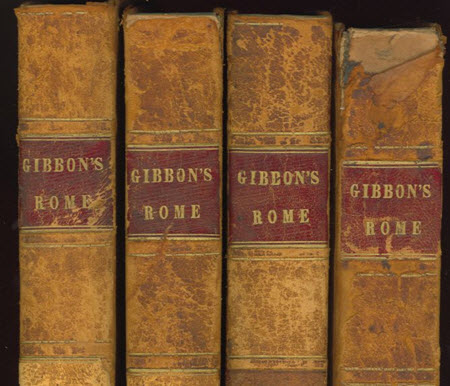
Gibbon's The Decline And Fall Of The Roman Empire

Home | Prev | Next | Contents

Volume 1 - Volume 2 - Volume 3 - Volume 4 - Volume 5 - Volume 6 -
Roman Empire


History Of The Decline And Fall Of The Roman Empire

Edward Gibbon, Esq.

With notes by the Rev. H. H. Milman

Vol. 1

1782 (Written), 1845 (Revised)

Introduction

Preface By The Editor.

The great work of Gibbon is indispensable to the student of history. The literature of Europe offers no substitute for "The Decline and Fall of the Roman Empire." It has obtained undisputed possession, as rightful occupant, of the vast period which it comprehends. However some subjects, which it embraces, may have undergone more complete investigation, on the general view of the whole period, this history is the sole undisputed authority to which all defer, and from which few appeal to the original writers, or to more modern compilers. The inherent interest of the subject, the inexhaustible labor employed upon it; the immense condensation of matter; the luminous arrangement; the general accuracy; the style, which, however monotonous from its uniform stateliness, and sometimes wearisome from its elaborate art., is throughout vigorous, animated, often picturesque always commands attention, always conveys its meaning with emphatic energy, describes with singular breadth and fidelity, and generalizes with unrivalled felicity of expression; all these high qualifications have secured, and seem likely to secure, its permanent place in historic literature.

This vast design of Gibbon, the magnificent whole into which he has cast the decay and ruin of the ancient civilization, the formation and birth of the new order of things, will of itself, independent of the laborious execution of his immense plan, render "The Decline and Fall of the Roman Empire" an unapproachable subject to the future historian:* in the eloquent language of his recent French editor, M. Guizot: --

"The gradual decline of the most extraordinary dominion which has ever invaded and oppressed the world; the fall of that immense empire, erected on the ruins of so many kingdoms, republics, and states both barbarous and civilized; and forming in its turn, by its dismemberment, a multitude of states, republics, and kingdoms; the annihilation of the religion of Greece and Rome; the birth and the progress of the two new religions which have shared the most beautiful regions of the earth; the decrepitude of the ancient world, the spectacle of its expiring glory and degenerate manners; the infancy of the modern world, the picture of its first progress, of the new direction given to the mind and character of man -- such a subject must necessarily fix the attention and excite the interest of men, who cannot behold with indifference those memorable epochs, during which, in the fine language of Corneille --

'Un grand destin commence, un grand destin s'achève.'"

This extent and harmony of design is unquestionably that which distinguishes the work of Gibbon from all other great historical compositions. He has first bridged the abyss between ancient and modern times, and connected together the two great worlds of history.

Table of Contents

Volume 1
Volume 2
Volume 3
Volume 4
Volume 5
Volume 6


Prev | Next | Contents


Political Violence in the Roman Republic
This table compiles names of prominent individuals who were victims of political violence in the Roman Republic. The term is used loosely and includes those killed in civil war, exiled and/or convicted on various politically inspired prosecutions, as well as those proscribed and otherwise murdered.This compilation highlights the period ...

Mediterranean Anarchy - Review
"Political science is not the same as political commentary. The former is the objective and often dry analysis of social events as they relate to theoretical paradigms. The latter is the biased, unscientific and all too often overly emotional discourse of opinions. The former takes training and a keen mind, ...

12 Byzantine Rulers: Part 10 - Heraclius
In the years following Justinian's death, the empire was rocked from within and without. Barbarians pushed in on every border and the empire's ancient enemy Persia ravaged the East unchecked. The empire met this challenge with a series of weak and foolish rulers who squandered what resources they had, and crumbled before the Persian onslaught. By the start of the 7th Century, the emperor was a virtual prisoner in his own palace, the Persians were beneath the walls of Constantinople, and the rest of the empire was in the hands of rebels. It looked as if the end had come at last, and yet, against all odds, an Armenian general was to defeat the Persians, sweep away the old Latin traditions and reform the empire on a Greek model. Join Lars Brownworth as he looks at Heraclius, whose reign saw this glittering triumph yet ended in such tragedy.

Review: The Roman Empire: from Severus to Constantine
"Lucid" is how I would describe Southern's work, employing the same adjective the publisher used in the back cover promotion. David Potter's Roman Empire at Bay was an informative study of the same time period, but so packed with academic postmodern jargon that is was distracting. Southern definitely writes for ...

12 Byzantine Rulers: Part 7 - Justinian - Part 1
As the 6th Century dawned on the tottering Byzantine State, the future seemed to hold only decline and decay, and yet unexpectedly, it was to see a renaissance unmatched in the long history of the empire. On every front, it seemed, were gathered the towering giants of the age- poised and ready to take the empire to ever greater and more dizzying heights. All that was needed was a ruler with enough vision to unite and drive this vast collection of the best and the brightest- a ruler who could dream on a truly imperial scale. He came, surprisingly enough, from the ranks of the great, unwashed masses- risen from poverty to fire the empire with the force of his will. Join Lars Brownworth as he looks at the stunning rise of Justinian- from shadow ruler to emperor in his own right.


Gibbon's The Decline and Fall of the Roman Empire is one of the greatest texts in the English language. In magisterial prose, Gibbon charts the gradual collapse of the Roman rule form Augustus (23 BC - AD 14) to the first of the barbarian kings, Odoacer (476- 490 AD). It is a remarkable account, with the extravagant corruption and depravity of emperors such as Commodus, Caracalla, and Elagabalus contrasted by the towering work of Constantine, Julian, and other remarkable men. It remains the standard work of scholarship on the subject two hundred years after it is written; yet equally important, in its sheer accessibility, it is an unforgettable story. Now you don't have to read this massive book - download it in audio book format now and listen to it in your spare time or while you commute!


Google
 
Web annourbis.com


Links: MovieAce.com -  Shakespeare-1.com -  AudioBookList.com -  Encyclopedia-1.com -  BookUpdate.com -  Book-Lover.com